AI Data Center Networking Market Size, Share, Scope Report 2026 to 2035
What is AI Data Center Networking Market size?
Global AI Data Center Networking Market is predicted to grow at a 19.5% CAGR during the forecast period for 2026 to 2035.
AI Data Center Networking Market Size, Share & Trends Analysis Distribution By Offering (AI Switching Systems, AI Network Adapters, Optical Interconnect & Cabling, AI Fabric Software), By Fabric Technology (Ethernet AI Fabrics, InfiniBand Fabrics, Other & Emerging Fabrics), By Network Role (Back-End Scale-Out Fabrics, Scale-Up Networks, Front-End & Storage Networks, Scale-Across & Inter-Facility AI Fabrics), By Port Speed (≤400G Ports & Systems, 800G Ports & Systems, 1.6T & Above Ports & Systems), By End User (Hyperscale Cloud Providers, Neocloud & GPU-Cloud Providers, Enterprises & Telcos, Government, Sovereign AI & Research/HPC Institutions) and Segment Forecasts, 2026 to 2035.
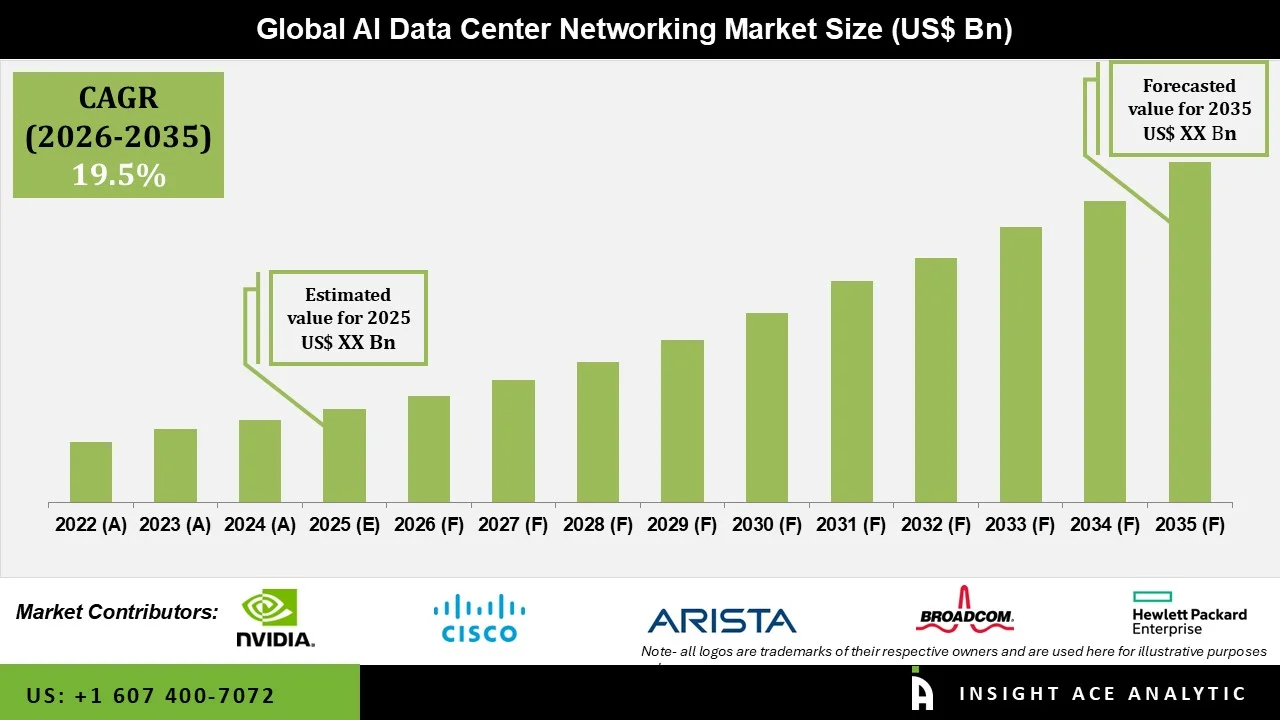
AI networking means the network infrastructure which links together processors, accelerators, servers, and storage systems in order to allow the exchange of data and coordinated computing when carrying out artificial intelligence (AI) workloads. It includes high-performance switching systems, network adapters, optical interconnects, cabling, and fabric software that enable communication both within and between AI computing clusters. These technologies are intended to handle large volumes of data, reduce communication latency, and ensure efficient connectivity in distributed computing environments.
The market for AI networking consists of the hardware and software solutions needed to set up, run, and optimize network infrastructure for AI training, inference, and other types of workloads that make heavy use of accelerators. It covers Ethernet and InfiniBand fabrics, high-speed network interfaces, optical interconnect technologies, and network management platforms that are used in hyperscale data centres, neocloud infrastructure, enterprise settings, and research computing facilities. With AI infrastructure moving in the direction of larger and more distributed computing clusters, AI networking has now become a separate element of data centre architecture and provides the means for communication across a variety of network layers, speeds, and deployment arrangements.
Competitive Landscape
Which are the Leading Players in the AI Data Center Networking Market?
- NVIDIA Corporation
- Cisco Systems, Inc.
- Arista Networks, Inc.
- Broadcom Inc.
- Hewlett Packard Enterprise (HPE)
- Huawei Technologies Co., Ltd.
- Celestica Inc.
- Marvell Technology, Inc.
- Advanced Micro Devices, Inc. (AMD Pensando)
- Dell Technologies Inc.
- Accton Technology Corporation (Edgecore Networks)
- Nokia Corporation
- Coherent Corp.
- Zhongji InnoLight Co., Ltd.
- Eoptolink Technology Inc., Ltd.
- Lumentum Holdings Inc.
- Credo Technology Group Holding Ltd.
- Amphenol Corporation
- Applied Optoelectronics, Inc.
- TE Connectivity plc
- Source Photonics, Inc.
- Accelink Technologies Co., Ltd.
- New H3C Technologies Co., Ltd.
- Cornelis Networks, Inc.
- Ruijie Networks Co., Ltd.
Market Dynamics
Driver
Growing Deployment of Generative AI and Large-Scale AI Infrastructure
The increasing adoption of generative AI, large language models (LLMs), and AI-powered applications is driving the deployment of large-scale AI data center infrastructure. Since training and running these models involve the use of thousands of GPUs and AI accelerators that have to transfer large amounts of data between connected computing systems, there is an increased requirement for high-bandwidth, low-latency networking solutions that allow efficient communication between processors, servers, and storage systems. As a result, large-scale cloud providers and those who specialise in AI infrastructure are putting money into advanced Ethernet and InfiniBand fabrics, fast switches, network interface cards, and optical interconnects in order to boost cluster performance and to accommodate distributed AI workloads. The greater scale and complexity of AI computing environments are therefore leading to a higher demand for specialised networking infrastructure capable of supporting next-generation AI data centres.
Restrain/Challenge
High Infrastructure Costs and Complexity of AI Networking Deployment
The great cost and technical difficulty involved in setting up advanced networking infrastructure are still major obstacles in the AI data center networking market. To operate large-scale AI clusters, substantial capital outlays are needed for high-performance switches, 800G and 1.6T optical transceivers, advanced network interface cards, and special cabling. Moreover, because it is necessary to combine networking hardware and software across Ethernet, InfiniBand, and new fabric architectures, specialized knowledge is required if interoperability is to be maintained, bandwidth utilization is to be optimized, and network congestion and latency are to be kept to a minimum. Since technological progress is happening so quickly, there is a greater risk that the infrastructure will become outdated, meaning that data centre operators have to carry out frequent upgrades in order to keep up with the changing needs of AI workloads.
AI Switching Systems Segment is Expected to Drive the AI Data Center Networking Market
AI switching systems are expected to be a major segment driving the AI data center networking market. The fast growth of the number of large AI clusters necessitates the use of high-performance switching devices that would be able to connect thousands of GPUs and AI accelerators with high bandwidth and low latency. AI switching systems are very important for management of the data traffic and minimization of the network congestion and other related issues. The move to 800G and even to future 1.6T Ethernet and InfiniBand networks makes the development of more advanced switching systems even more important.
Ethernet AI Fabrics Segment is Growing at the Highest Rate in the AI Data Center Networking Market
Ethernet AI fabrics are anticipated to form one of the fastest-growing areas of the AI data center networking market. The increasing use of high-performance Ethernet for large-scale AI training and inference is leading to a demand for networking infrastructure that is scalable, interoperable, and cost-effective. Progress in 800G and 1.6T Ethernet switching, along with technologies like RoCE and Ultra Ethernet, is enhancing Ethernet's capacity to handle distributed AI workloads which demand high bandwidth and low latency. Moreover, the flexibility of Ethernet ecosystems allows hyperscale cloud providers and neocloud operators to set up their networking infrastructure using a number of different vendors, thus promoting wider adoption. These developments are expected to help boost Ethernet's growth as AI data center operators expand their computing clusters and diversify their networking architectures.
Why North America Led the AI Data Center Networking Market?
North America is expected to take the lead in the AI data center networking market, a position being driven by the strong presence of hyperscale cloud providers, AI technology companies, and sophisticated data center infrastructure, especially in the United States. Since major cloud operators are making heavy investments in AI computing capacity, there has been a greater demand for high-performance Ethernet and InfiniBand fabrics, as well as for advanced switching systems, network adapters, and high-speed optical interconnects.
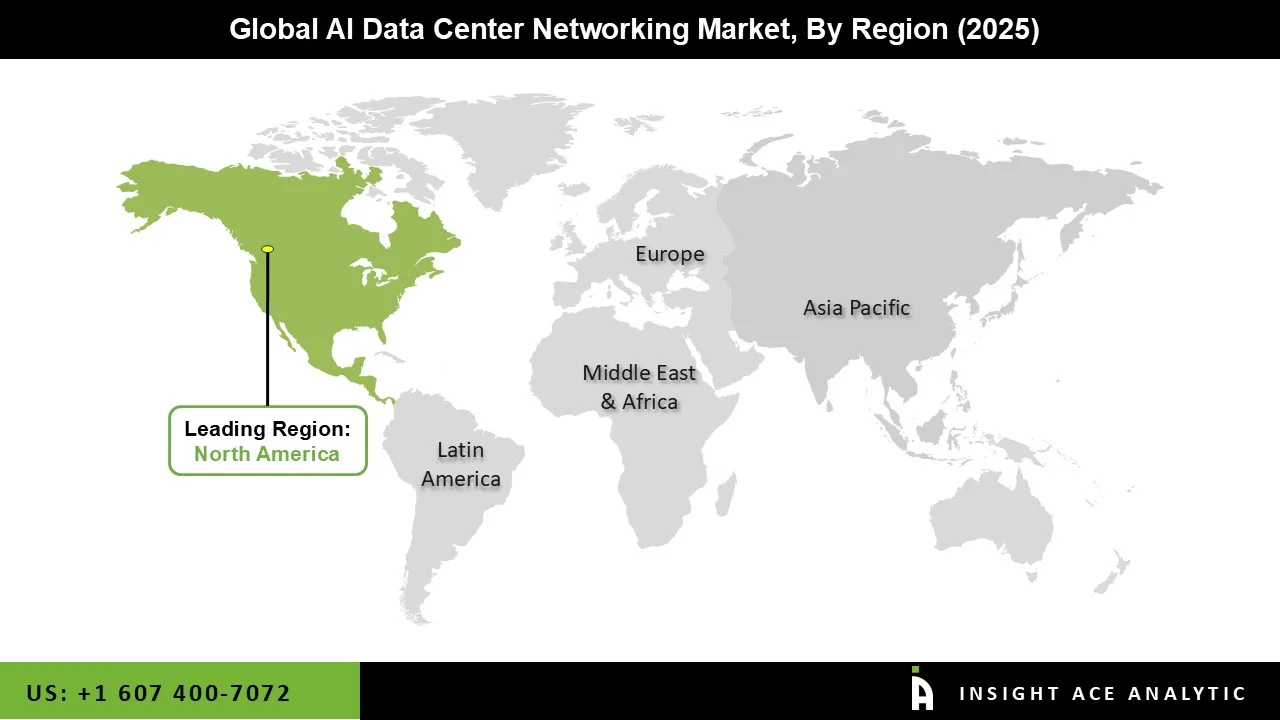
The region also enjoys the availability of leading networking and semiconductor companies, a well-developed cloud computing ecosystem, and significant investments in large-scale AI infrastructure. All of these factors are likely to promote ongoing acceptance of next-generation networking technologies and will help to reinforce North America's standing in the market.
Key Development-
August 2026: Cisco expanded its Secure AI Factory with NVIDIA through a partnership with Supermicro, combining high-density, liquid- and air-cooled computing systems with secure, full-stack AI infrastructure for enterprises, neoclouds, and sovereign clouds. The collaboration aims to accelerate AI infrastructure deployment while improving data security, operational efficiency, and performance.
AI Data Center Networking Market Report Scope :
| Report Attribute | Specifications |
| Growth Rate CAGR | CAGR of 19.5% from 2026 to 2035 |
| Quantitative Units | Representation of revenue in US$ Bn and CAGR from 2026 to 2035 |
| Historic Year | 2022 to 2025 |
| Forecast Year | 2026-2035 |
| Report Coverage | The forecast of revenue, the position of the company, the competitive market structure, growth prospects, and trends |
| Segments Covered | Offering, Fabric Technology, Network Role, Port Speed, End User and By Region |
| Regional Scope | North America; Europe; Asia Pacific; Latin America; Middle East & Africa |
| Country Scope | U.S.; Canada; U.K.; Germany; China; India; Japan; Brazil; Mexico; France; Italy; Spain; South Korea; Southeast Asia |
| Competitive Landscape | NVIDIA Corporation, Cisco Systems, Inc., Arista Networks, Inc., Broadcom Inc., Hewlett Packard Enterprise (HPE), Huawei Technologies Co., Ltd., Celestica Inc., Marvell Technology, Inc., Advanced Micro Devices, Inc. (AMD Pensando), Dell Technologies Inc., Accton Technology Corporation (Edgecore Networks), Nokia Corporation, Coherent Corp. |
| Customization Scope | Free customization report with the procurement of the report, Modifications to the regional and segment scope. Geographic competitive landscape. |
| Pricing and Available Payment Methods | Explore pricing alternatives that are customized to your particular study requirements. |
Segmentations AI Data Center Networking Market:
AI Data Center Networking Market by Offering -
- AI Switching Systems
- Fixed-Configuration Switch Systems
- Modular, Chassis & Distributed Fabric Systems
- AI Network Adapters
- AI NICs & SuperNICs
- DPUs & SmartNICs
- Optical Interconnect & Cabling
- Optical Transceivers — DSP-Retimed & Linear (LPO/TRO)
- Direct-Attach, Active Electrical & Active Copper Cabling
- Active Optical Cables
- AI Fabric Software
- Network Operating Systems (Unbundled)
- Fabric Management, Automation & Telemetry
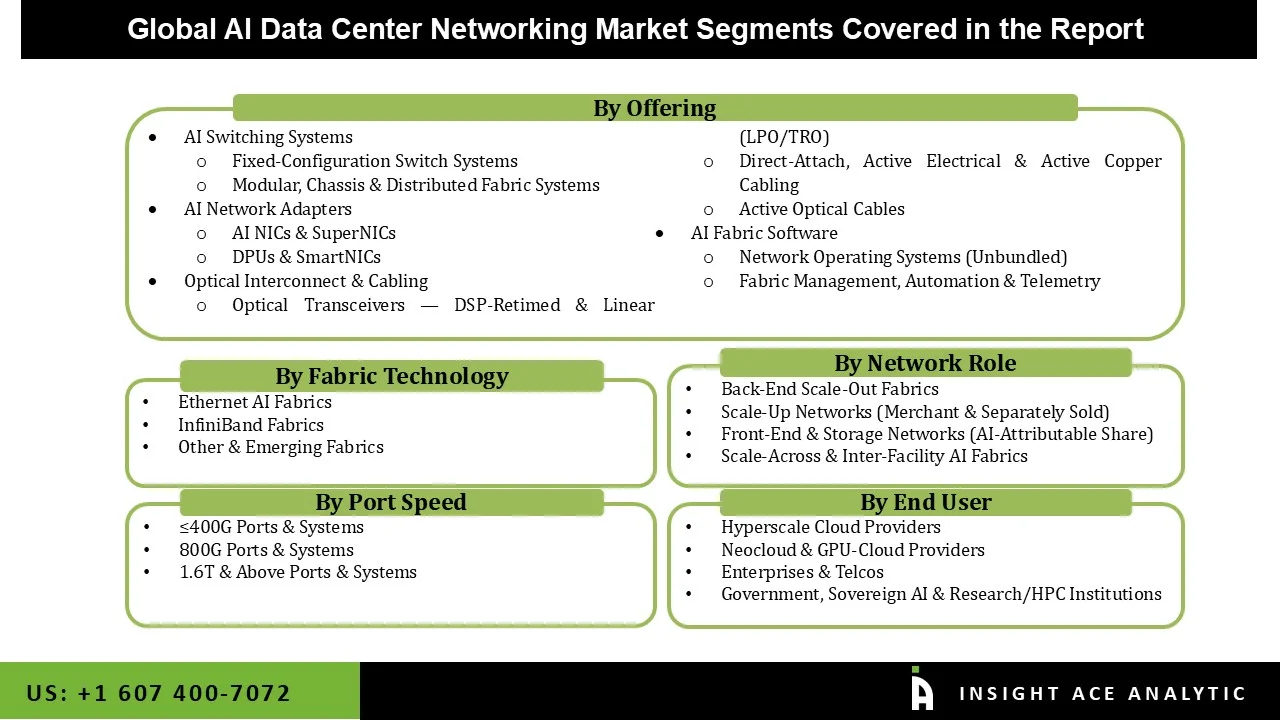
AI Data Center Networking Market by Fabric Technology -
- Ethernet AI Fabrics
- Standards-Based RoCE/UEC Fabrics
- Vendor-Scheduled & Full-Stack Ethernet Platforms
- InfiniBand Fabrics
- Other & Emerging Fabrics
AI Data Center Networking Market by Network Role -
- Back-End Scale-Out Fabrics
- Scale-Up Networks (Merchant & Separately Sold)
- Front-End & Storage Networks (AI-Attributable Share)
- Scale-Across & Inter-Facility AI Fabrics
AI Data Center Networking Market by Port Speed -
- ≤400G Ports & Systems
- 800G Ports & Systems
- 1.6T & Above Ports & Systems
AI Data Center Networking Market by End User -
- Hyperscale Cloud Providers
- Neocloud & GPU-Cloud Providers
- Enterprises & Telcos
- Government, Sovereign AI & Research/HPC Institutions
AI Data Center Networking Market by Region-
- North America-
- The US
- Canada
- Europe-
- Germany
- The UK
- France
- Italy
- Spain
- Rest of Europe
- Asia-Pacific-
- China
- Japan
- India
- South Korea
- South East Asia
- Rest of Asia Pacific
- Latin America-
- Brazil
- Argentina
- Mexico
- Rest of Latin America
- Middle East and Africa-
- GCC Countries
- South Africa
- Rest of Middle East and Africa
Research Design and Approach
This study employed a multi-step, mixed-method research approach that integrates:
- Secondary research
- Primary research
- Data triangulation
- Hybrid top-down and bottom-up modelling
- Forecasting and scenario analysis
This approach ensures a balanced and validated understanding of both macro- and micro-level market factors influencing the market.
Secondary Research
Secondary research for this study involved the collection, review, and analysis of publicly available and paid data sources to build the initial fact base, understand historical market behaviour, identify data gaps, and refine the hypotheses for primary research.
Sources Consulted
Secondary data for the market study was gathered from multiple credible sources, including:
- Government databases, regulatory bodies, and public institutions
- International organizations (WHO, OECD, IMF, World Bank, etc.)
- Commercial and paid databases
- Industry associations, trade publications, and technical journals
- Company annual reports, investor presentations, press releases, and SEC filings
- Academic research papers, patents, and scientific literature
- Previous market research publications and syndicated reports
These sources were used to compile historical data, market volumes/prices, industry trends, technological developments, and competitive insights.
Primary Research
Primary research was conducted to validate secondary data, understand real-time market dynamics, capture price points and adoption trends, and verify the assumptions used in the market modelling.
Stakeholders Interviewed
Primary interviews for this study involved:
- Manufacturers and suppliers in the market value chain
- Distributors, channel partners, and integrators
- End-users / customers (e.g., hospitals, labs, enterprises, consumers, etc., depending on the market)
- Industry experts, technology specialists, consultants, and regulatory professionals
- Senior executives (CEOs, CTOs, VPs, Directors) and product managers
Interview Process
Interviews were conducted via:
- Structured and semi-structured questionnaires
- Telephonic and video interactions
- Email correspondences
- Expert consultation sessions
Primary insights were incorporated into demand modelling, pricing analysis, technology evaluation, and market share estimation.
Data Processing, Normalization, and Validation
All collected data were processed and normalized to ensure consistency and comparability across regions and time frames.
The data validation process included:
- Standardization of units (currency conversions, volume units, inflation adjustments)
- Cross-verification of data points across multiple secondary sources
- Normalization of inconsistent datasets
- Identification and resolution of data gaps
- Outlier detection and removal through algorithmic and manual checks
- Plausibility and coherence checks across segments and geographies
This ensured that the dataset used for modelling was clean, robust, and reliable.
Market Size Estimation and Data Triangulation
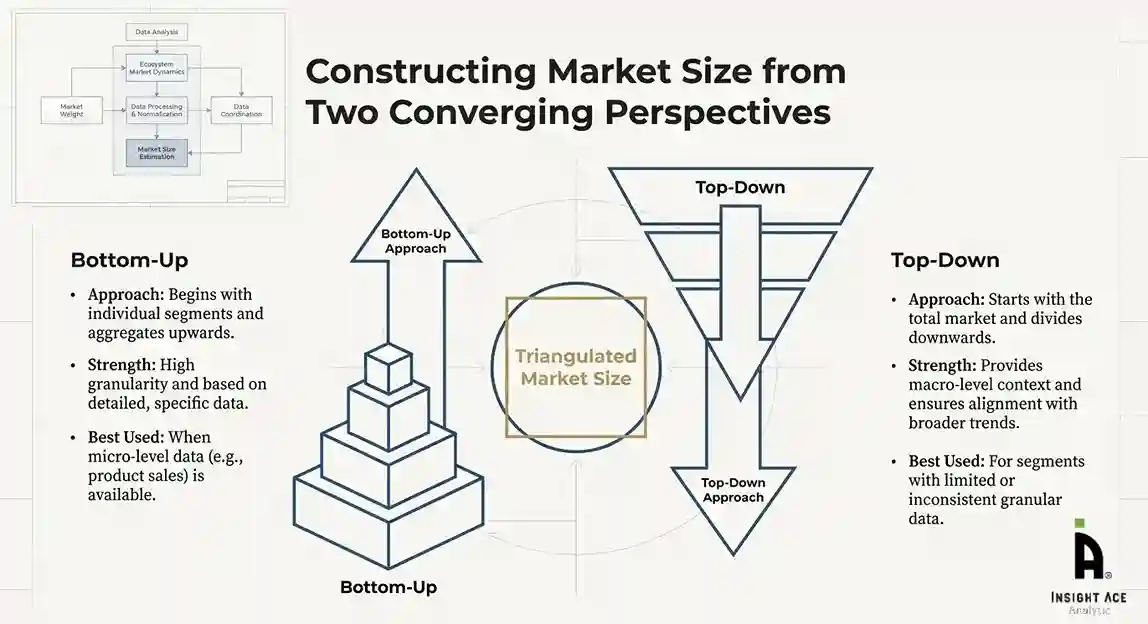
Bottom-Up Approach
The bottom-up approach involved aggregating segment-level data, such as:
- Company revenues
- Product-level sales
- Installed base/usage volumes
- Adoption and penetration rates
- Pricing analysis
This method was primarily used when detailed micro-level market data were available.
Top-Down Approach
The top-down approach used macro-level indicators:
- Parent market benchmarks
- Global/regional industry trends
- Economic indicators (GDP, demographics, spending patterns)
- Penetration and usage ratios
This approach was used for segments where granular data were limited or inconsistent.
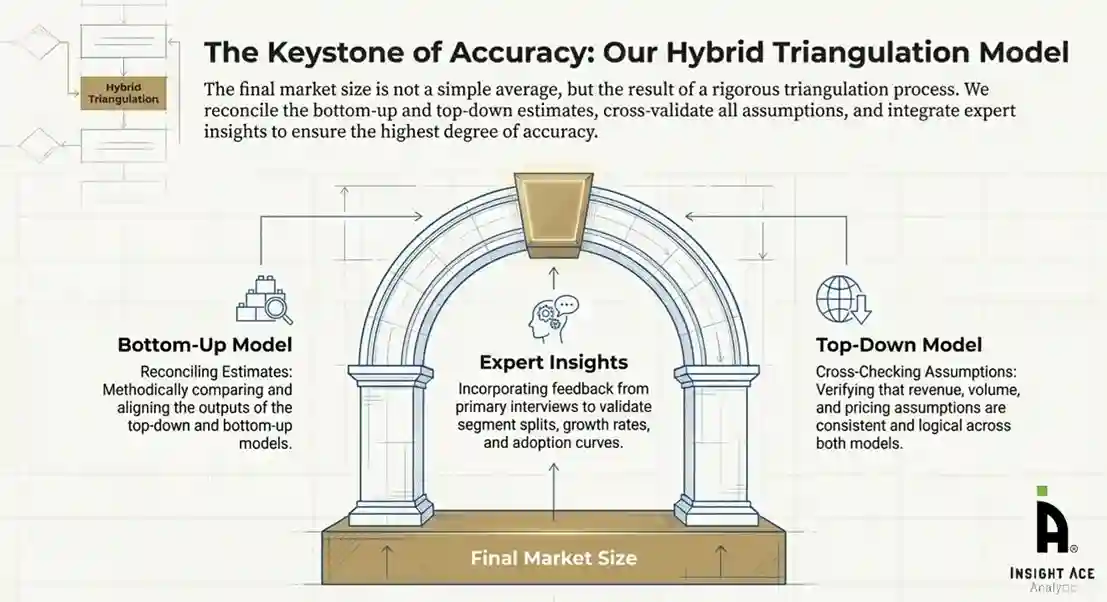
Hybrid Triangulation Approach
To ensure accuracy, a triangulated hybrid model was used. This included:
- Reconciling top-down and bottom-up estimates
- Cross-checking revenues, volumes, and pricing assumptions
- Incorporating expert insights to validate segment splits and adoption rates
This multi-angle validation yielded the final market size.
Forecasting Framework and Scenario Modelling
Market forecasts were developed using a combination of time-series modelling, adoption curve analysis, and driver-based forecasting tools.
Forecasting Methods
- Time-series modelling
- S-curve and diffusion models (for emerging technologies)
- Driver-based forecasting (GDP, disposable income, adoption rates, regulatory changes)
- Price elasticity models
- Market maturity and lifecycle-based projections
Scenario Analysis
Given inherent uncertainties, three scenarios were constructed:
- Base-Case Scenario: Expected trajectory under current conditions
- Optimistic Scenario: High adoption, favourable regulation, strong economic tailwinds
- Conservative Scenario: Slow adoption, regulatory delays, economic constraints
Sensitivity testing was conducted on key variables, including pricing, demand elasticity, and regional adoption.
Request Customization
Add countries, segments, company profiles, or extend forecast — free 10% customization with purchase.
Customize This Report →Enquire Before Buying
Speak with our analyst team about scope, methodology, pricing, or deliverable formats.
Enquire Now →Frequently Asked Questions
AI Data Center Networking Market is predicted to grow at a 19.5% CAGR during the forecast period for 2026 to 2035.
NVIDIA Corporation, Cisco Systems, Inc., Arista Networks, Inc., Broadcom Inc., Hewlett Packard Enterprise (HPE), Huawei Technologies Co., Ltd., Celestica Inc., Marvell Technology, Inc., Advanced Micro Devices, Inc. (AMD Pensando), Dell Technologies Inc., Accton Technology Corporation (Edgecore Networks), Nokia Corporation, Coherent Corp. and others.
AI Data Center Networking Market is segmented into Offering, Fabric Technology, Network Role, Port Speed, End User and Other.
North America region is leading the AI Data Center Networking Market.