Reverse Logistics Platforms for Reusable Takeaway Food Packaging Market Size and Scope 2026 to 2035
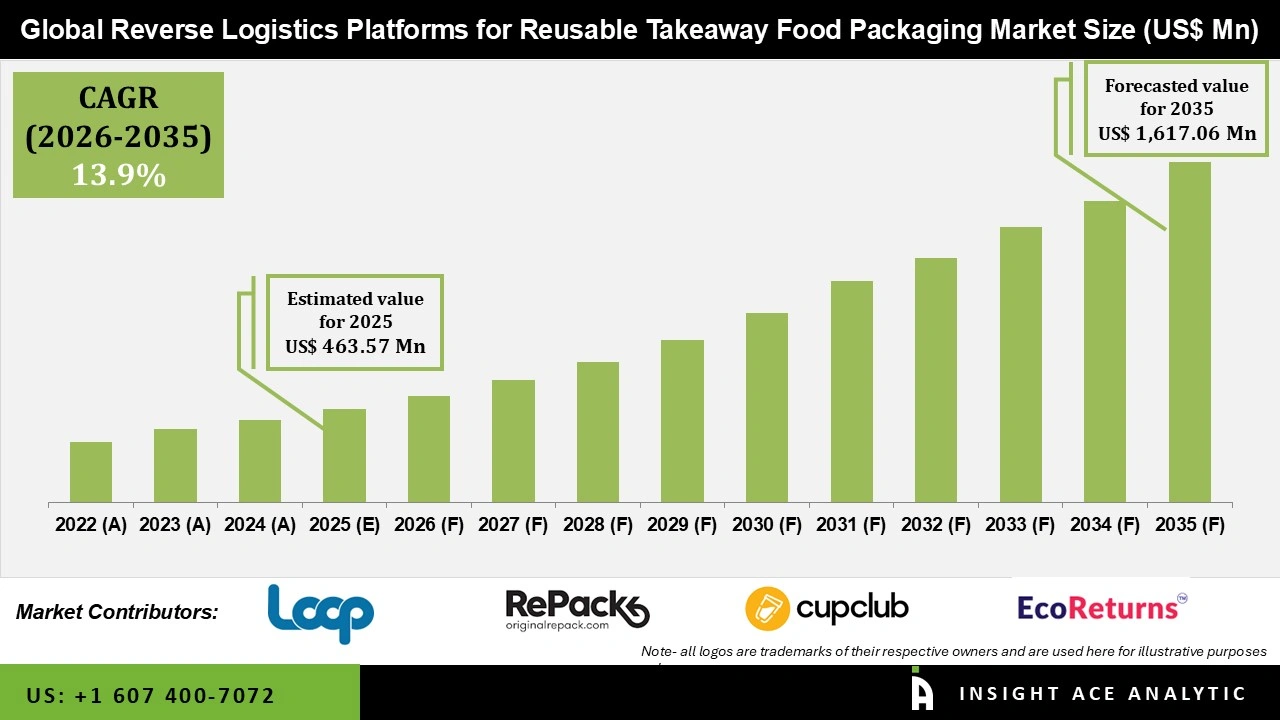
Global Reverse Logistics Platforms for Reusable Takeaway Food Packaging Market Size is valued at USD 463.57 Mn in 2025 and is predicted to reach USD 1617.06 Mn by the year 2035 at a 13.9% CAGR during the forecast period for 2026 to 2035.
Reverse Logistics Platforms for Reusable Takeaway Food Packaging Market Size, Share & Trends Analysis Distribution by Platform Type (Mobile App Enabled Return Platforms, Cloud Based Reverse Logistics Software, Integrated IoT Tracking & Collection Systems, and Support Services (Sorting, Cleaning, Redistribution)), End-user (Food Delivery & Aggregators, Restaurants & Quick Service Chains, Catering & Events Services, and Retail & Grocery Prepared Foods), and Segment Forecasts, 2026 to 2035
The reverse logistics platforms for reusable takeaway food packaging are operational and digital systems created to handle reusable food container returns, cleaning, redistribution, and tracking following consumer use. These solutions use physical logistical networks and integrated software to link restaurants, delivery partners, customers, and washing or refurbishment facilities. They monitor container circulation, guarantee prompt returns, and lower losses or contamination by using technology like QR codes, RFID tags, smartphone apps, and cloud-based tracking. The reverse logistics platforms for the reusable takeaway food packaging market are being driven by the fast expansion of takeaway and food delivery services worldwide, which has led to an increase in packaging waste and underscored the need for scalable return logistics.
As the global food service and takeaway ecosystem increasingly moves toward sustainable and circular approaches to packaging, reverse logistics platforms for reusable takeaway food packaging are gaining increased attention. The systems of reusable containers are being utilized by restaurants, delivery services, and packaging companies owing to rising consumer preferences relating to eco-friendly options, strict environmental regulations, and escalating concerns pertaining to plastic waste. Additionally, investments in digital platforms that facilitate container traceability, deposit management, and stakeholder coordination are gaining steam across the food service value chain due to an incessant surge in urban food delivery volumes. This would help the reverse logistics platforms for the reusable takeaway food packaging market expand during the forecast period.
Furthermore, the adoption of structured reverse logistics systems is being fueled by the increasing involvement of food delivery portal companies, sustainability-championing entrepreneurs, and government entities. For enhanced return percentages, optimizing delivery routes, and ensuring strict hygiene standards, advanced technologies such as RFID, QR codes, and data analysis are being introduced. In addition, as industry players seek scalable models for shifting away from the current use of disposable packaging towards reusable alternatives, government policies promoting methods of waste minimization, extending producer responsibility, and the adoption of a circular economy are further fuelling the growth of the reverse logistics systems for the reusable takeaway food packaging market.
Competitive Landscape
Which are the Leading Players in Reverse Logistics Platforms for Reusable Takeaway Food Packaging Market?
- RePack
- Loop (by Terracycle)
- Evre (Eco-Return Systems)
- CupClub
Market Dynamics
Driver
Growing Regulatory Demand to Cut Down on Single-use Plastic
The growing regulatory demand to cut down on single-use plastic and packaging waste is one of the key factors driving the reverse logistics platforms for the reusable takeaway food packaging market. The bans, surcharges, and enhanced producer responsibility standards are being implemented by governments and local authorities in numerous regions, making disposable packaging expensive and detrimental to food firms' reputations. Restaurants, cloud kitchens, and meal delivery services are therefore actively searching for workable and compliant substitutes. Reverse logistics platforms that support reusable packaging provide an organized approach that allows companies to comply with regulations while preserving operational effectiveness.
Restrain/Challenge
Difficulty of Setting up Reliable Return Procedures
The difficulty of setting up reliable return procedures that guarantee high user compliance and reduce the loss of reused containers is one of the key limitations in the reverse logistics platforms for the reusable takeaway food packaging market growth. To properly manage reverse flows, operators must make investments in technology, collecting locations, sanitary facilities, and employee training. Low return rates might lower economic viability due to inconsistent end-user engagement. In areas where supporting services are underdeveloped, infrastructure deficiencies restrict platform reach and impede the difficulty of setting up reliable return procedures for market growth.
Cloud Based Reverse Logistics Software Segment is Expected to Drive the Reverse Logistics Platforms for Reusable Takeaway Food Packaging Market
The Cloud Based Reverse Logistics Software category held the largest share in the Reverse Logistics Platforms for Reusable Takeaway Food Packaging market in 2025. Reusable takeout food packaging may be collected, sorted, cleaned, and distributed using this software's scalable, centralized platform. Businesses can track reusable containers throughout their lifecycle using cloud-based solutions, which offer effective management and real-time insight. These platforms assist businesses in cutting packaging waste and operating expenses by facilitating the seamless functioning of reverse logistics systems. Additionally, cloud-based solutions are becoming more and more popular because of their flexibility, simplicity of interface with current systems, and capacity to provide real-time data analytics, which makes them a desirable choice for companies trying to optimize their reverse logistics processes.
Restaurants & Quick Service Chains Segment is Growing at the Highest Rate in the Reverse Logistics Platforms for Reusable Takeaway Food Packaging Market
In 2025, the Restaurants & Quick Service Chains category dominated the Reverse Logistics Platforms for Reusable Takeaway Food Packaging market. In order to reduce waste and satisfy consumer demand for sustainable practices, these establishments are increasingly using reusable takeout food packaging. The large amount of takeout packaging poses a serious environmental problem in the foodservice industry, which is dominated by restaurants and quick-service franchises. These companies may lower packaging waste, increase operational effectiveness, and strengthen their sustainability credentials by putting in place reverse logistics platforms for reusable packaging. Reverse logistics solutions are becoming more and more popular in this market due to waste reduction requirements and the growing demand for eco-friendly foodservice options.
Why North America Led the Reverse Logistics Platforms for Reusable Takeaway Food Packaging Market?
The Reverse Logistics Platforms for Reusable Takeaway Food Packaging market was dominated by North America region in 2025 driven mostly by strict environmental laws and growing corporate and governmental commitments to sustainability. Restaurants, food chains, and delivery services are looking into reusable packaging options as a result of cities and states in the US and Canada actively limiting single-use plastics and promoting circular economy models.
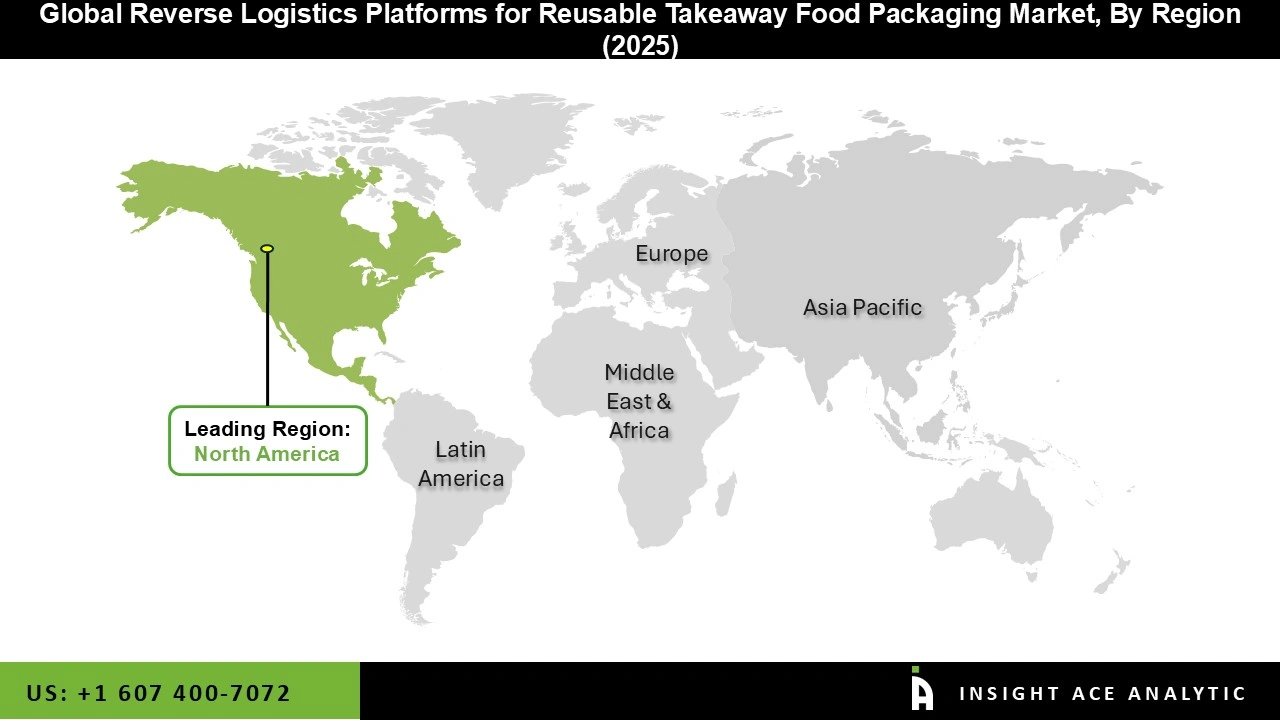
Furthermore, collaborations between meal delivery services, corporate cafeterias, and reusable packaging suppliers are speeding up market penetration, making North America one of the most promising and developed regions for the reverse logistics platforms for the reusable takeaway food packaging market expansion.
Reverse Logistics Platforms for Reusable Takeaway Food Packaging Market Report Scope:
| Report Attribute | Specifications |
| Market size value in 2025 | USD 463.57 Mn |
| Revenue forecast in 2035 | USD 1617.06 Mn |
| Growth Rate CAGR | CAGR of 13.9% from 2026 to 2035 |
| Quantitative Units | Representation of revenue in US$ Bn and CAGR from 2026 to 2035 |
| Historic Year | 2022 to 2024 |
| Forecast Year | 2026-2035 |
| Report Coverage | The forecast of revenue, the position of the company, the competitive market structure, growth prospects, and trends |
| Segments Covered | Platform Type, End-user, and By Region |
| Regional Scope | North America; Europe; Asia Pacific; Latin America; Middle East & Africa |
| Country Scope | U.S.; Canada; U.K.; Germany; China; India; Japan; Brazil; Mexico; The UK; France; Italy; Spain; China; Japan; India; South Korea; Southeast Asia; South Korea; Southeast Asia |
| Competitive Landscape | RePack, Loop (by Terracycle), Evre (Eco-Return Systems), and CupClub. |
| Customization Scope | Free customization report with the procurement of the report, Modifications to the regional and segment scope. Geographic competitive landscape. |
| Pricing and Available Payment Methods | Explore pricing alternatives that are customized to your particular study requirements. |
Segmentation of Reverse Logistics Platforms for Reusable Takeaway Food Packaging Marke:
Reverse Logistics Platforms for Reusable Takeaway Food Packaging Market by Platform Type-
- Mobile App Enabled Return Platforms
- Cloud Based Reverse Logistics Software
- Integrated IoT Tracking & Collection Systems
- Support Services (Sorting, Cleaning, Redistribution)
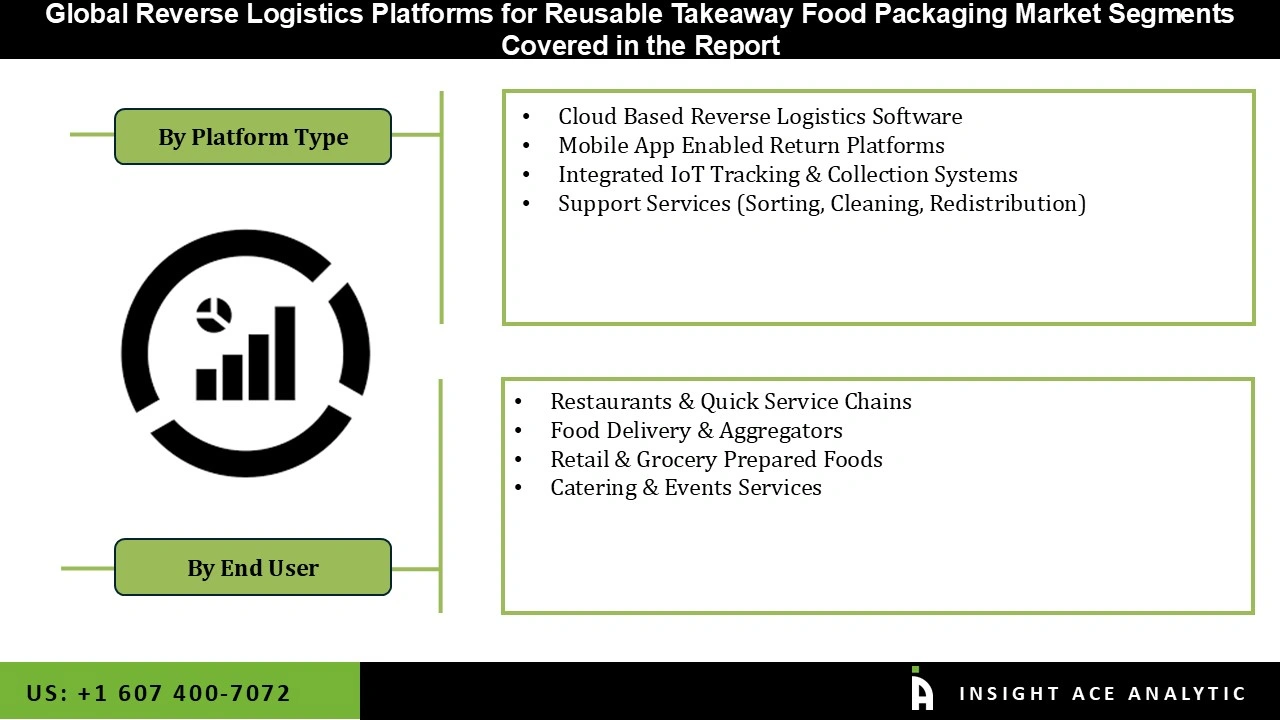
Reverse Logistics Platforms for Reusable Takeaway Food Packaging Market by End-user-
- Food Delivery & Aggregators
- Restaurants & Quick Service Chains
- Catering & Events Services
- Retail & Grocery Prepared Foods
Reverse Logistics Platforms for Reusable Takeaway Food Packaging Market by Region-
- North America-
- The US
- Canada
- Europe-
- Germany
- The UK
- France
- Italy
- Spain
- Rest of Europe
- Asia-Pacific-
- China
- Japan
- India
- South Korea
- South East Asia
- Rest of Asia Pacific
- Latin America-
- Brazil
- Argentina
- Mexico
- Rest of Latin America
- Middle East & Africa-
- GCC Countries
- South Africa
- Rest of Middle East and Africa
Research Design and Approach
This study employed a multi-step, mixed-method research approach that integrates:
- Secondary research
- Primary research
- Data triangulation
- Hybrid top-down and bottom-up modelling
- Forecasting and scenario analysis
This approach ensures a balanced and validated understanding of both macro- and micro-level market factors influencing the market.
Secondary Research
Secondary research for this study involved the collection, review, and analysis of publicly available and paid data sources to build the initial fact base, understand historical market behaviour, identify data gaps, and refine the hypotheses for primary research.
Sources Consulted
Secondary data for the market study was gathered from multiple credible sources, including:
- Government databases, regulatory bodies, and public institutions
- International organizations (WHO, OECD, IMF, World Bank, etc.)
- Commercial and paid databases
- Industry associations, trade publications, and technical journals
- Company annual reports, investor presentations, press releases, and SEC filings
- Academic research papers, patents, and scientific literature
- Previous market research publications and syndicated reports
These sources were used to compile historical data, market volumes/prices, industry trends, technological developments, and competitive insights.

Primary Research
Primary research was conducted to validate secondary data, understand real-time market dynamics, capture price points and adoption trends, and verify the assumptions used in the market modelling.
Stakeholders Interviewed
Primary interviews for this study involved:
- Manufacturers and suppliers in the market value chain
- Distributors, channel partners, and integrators
- End-users / customers (e.g., hospitals, labs, enterprises, consumers, etc., depending on the market)
- Industry experts, technology specialists, consultants, and regulatory professionals
- Senior executives (CEOs, CTOs, VPs, Directors) and product managers
Interview Process
Interviews were conducted via:
- Structured and semi-structured questionnaires
- Telephonic and video interactions
- Email correspondences
- Expert consultation sessions
Primary insights were incorporated into demand modelling, pricing analysis, technology evaluation, and market share estimation.
Data Processing, Normalization, and Validation
All collected data were processed and normalized to ensure consistency and comparability across regions and time frames.
The data validation process included:
- Standardization of units (currency conversions, volume units, inflation adjustments)
- Cross-verification of data points across multiple secondary sources
- Normalization of inconsistent datasets
- Identification and resolution of data gaps
- Outlier detection and removal through algorithmic and manual checks
- Plausibility and coherence checks across segments and geographies
This ensured that the dataset used for modelling was clean, robust, and reliable.
Market Size Estimation and Data Triangulation
Bottom-Up Approach
The bottom-up approach involved aggregating segment-level data, such as:
- Company revenues
- Product-level sales
- Installed base/usage volumes
- Adoption and penetration rates
- Pricing analysis
This method was primarily used when detailed micro-level market data were available.

Top-Down Approach
The top-down approach used macro-level indicators:
- Parent market benchmarks
- Global/regional industry trends
- Economic indicators (GDP, demographics, spending patterns)
- Penetration and usage ratios
This approach was used for segments where granular data were limited or inconsistent.
Hybrid Triangulation Approach
To ensure accuracy, a triangulated hybrid model was used. This included:
- Reconciling top-down and bottom-up estimates
- Cross-checking revenues, volumes, and pricing assumptions
- Incorporating expert insights to validate segment splits and adoption rates
This multi-angle validation yielded the final market size.
Forecasting Framework and Scenario Modelling
Market forecasts were developed using a combination of time-series modelling, adoption curve analysis, and driver-based forecasting tools.
Forecasting Methods
- Time-series modelling
- S-curve and diffusion models (for emerging technologies)
- Driver-based forecasting (GDP, disposable income, adoption rates, regulatory changes)
- Price elasticity models
- Market maturity and lifecycle-based projections
Scenario Analysis
Given inherent uncertainties, three scenarios were constructed:
- Base-Case Scenario: Expected trajectory under current conditions
- Optimistic Scenario: High adoption, favourable regulation, strong economic tailwinds
- Conservative Scenario: Slow adoption, regulatory delays, economic constraints
Sensitivity testing was conducted on key variables, including pricing, demand elasticity, and regional adoption.
Request Customization
Add countries, segments, company profiles, or extend forecast — free 10% customization with purchase.
Customize This Report →Enquire Before Buying
Speak with our analyst team about scope, methodology, pricing, or deliverable formats.
Enquire Now →Frequently Asked Questions
Reverse Logistics Platforms for Reusable Takeaway Food Packaging Market Size is valued at USD 463.57 Mn in 2025 and is predicted to reach USD 1617.06 Mn by the year 2035.
Reverse Logistics Platforms for Reusable Takeaway Food Packaging Market is expected to grow at a 13.9% CAGR during the forecast period for 2026 to 2035
RePack, Loop (by Terracycle), Evre (Eco-Return Systems), CupClub and Others.
Reverse Logistics Platforms for Reusable Takeaway Food Packaging Market is Segmented in Distribution by Platform Type (Mobile App Enabled Return Platforms, Cloud Based Reverse Logistics Software, Integrated IoT Tracking & Collection Systems, and Support Services (Sorting, Cleaning, Redistribution)), End-user (Food Delivery & Aggregators, Restaurants & Quick Service Chains, Catering & Events Services, and Retail & Grocery Prepared Foods) and Other
North America region is leading the Reverse Logistics Platforms for Reusable Takeaway Food Packaging Market.