Space In Orbit Refueling Market Forecast with Size and Share Analysis 2026 to 2035
What is Space In Orbit Refueling Market Size?
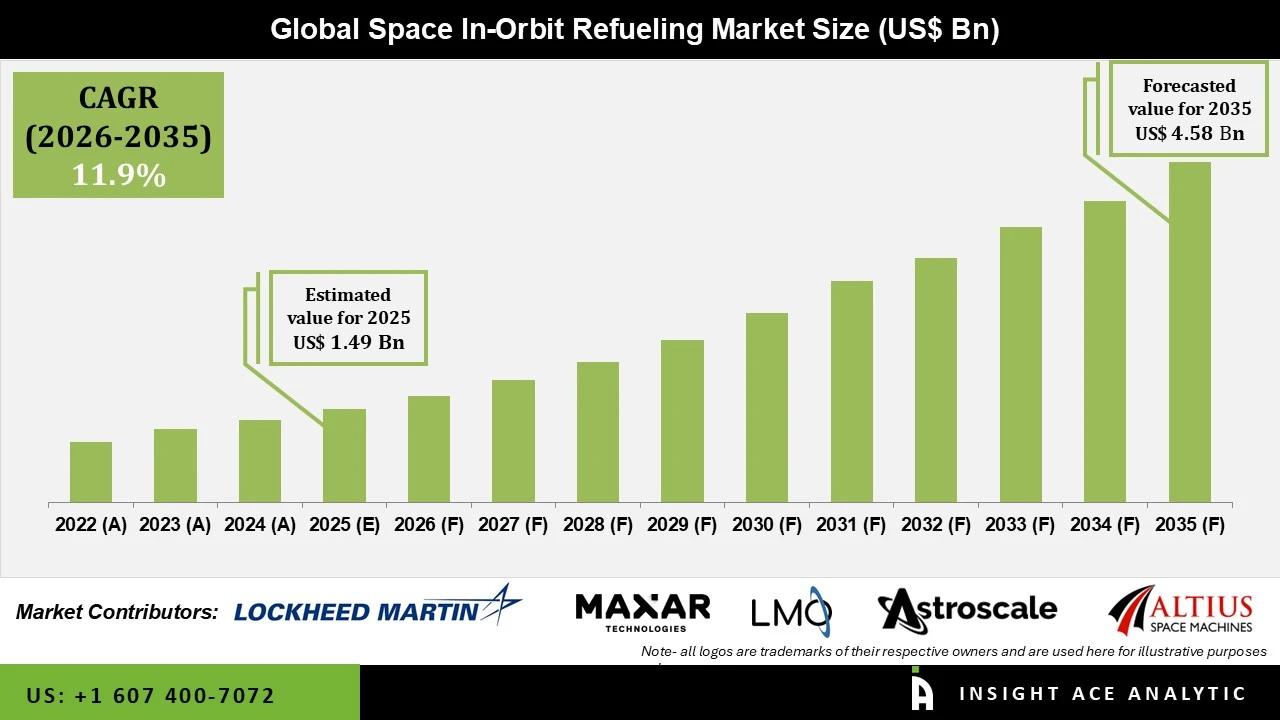
Space In Orbit Refueling Market Size is valued at USD 1.49 Bn in 2025 and is predicted to reach USD 4.58 Bn by the year 2035 at a 11.9% CAGR during the forecast period for 2026 to 2035.
Space In Orbit Refueling Market Size, Share & Trends Analysis Distribution by Application (Communication, Earth Observation, and Navigation), End-user (Commercial and Others), and Segment Forecasts, 2026 to 2035
Space In Orbit Refueling Market Key Takeaways:
|
The process of providing fuel, oxidizer, or other consumable fluids to a spacecraft while it is already in orbit as opposed to launching it with all the propellant it will ever require is known as space in-orbit refueling, or on-orbit propellant transfer. Frequently referred to as a tanker, depot, or servicing satellite, a service vehicle rendezvouses with a target satellite or spacecraft, docks or connects via specialized valves, and uses pressurized pumping systems to transfer fuel in microgravity, preventing vapor formation and leakage. This feature helps deep-space missions, allows orbital repositioning, prolongs the operating life of satellites, and lessens the need to replace costly spacecraft too soon. The increased satellite deployment, space exploration operations, and the influx of private companies into the space sector have all contributed to the space in-orbit refueling market growth.
The major factor behind the expansion of the space in-orbit refueling market is the growing need for longer satellite lifetimes and improved mission capabilities. The requirement to refuel in orbit grows more urgent as satellite constellations get more complex and essential for uses including navigation, space communication, and earth observation. As a result, satellite operators may maximize their return on investment by extending their operational life, modifying orbits, and maintaining maximum performance. Additionally, the space in-orbit refueling market is being driven by the advancement of sophisticated refueling technology and the growing commercialization of space. Furthermore, the space in-orbit refueling market is growing in the public and private sectors as a result of increased spending in space research, satellite constellations, and defense-related operations.
In addition, the space technological breakthroughs and strategic alliances between governments, space agencies, and private sector businesses are driving the space in-orbit refueling market's expansion. The need of in-orbit refueling for far space missions is particularly highlighted by NASA's Artemis program, which seeks to establish a sustainable human presence on the Moon by the late 2026s. Additionally, the development of reusable rocket technology by commercial space companies such as SpaceX and Blue Origin is increasing the demand for refueling options in order to keep spacecraft in orbit. However, the high expense of space in-orbit refueling is one of the key challenges in this market, despite the optimistic prognosis. A significant upfront capital expenditure is needed for the development and implementation of refueling infrastructure and vehicles.
Competitive Landscape
Which are the Leading Players in Space In-Orbit Refueling Market?
• Astroscale Holdings Inc.
• D-Orbit SpA
• Lockheed Martin Corporation
• Altius Space Machines, Inc.
• LMO Space
• Maxar Technologies Inc.
• Obruta Space Solutions
• Starfish Space Inc.
• Tethers Unlimited, Inc.
• Orbit Recycling
• SpaceX
• SpaceLogistics (a subsidiary of Northrop Grumman Corporation)
• Momentus Space
• Orbit Fab, Inc.
• Space Machines Company
Market Dynamics
Driver
Rising Need for Debris Mitigation, Space Sustainability, and Extended Mission Lifespan to Drive Market Growth
A key factor propelling the space in-orbit refueling market growth is the requirement for a longer mission lifespan, which is combined with programs for space sustainability and debris reduction. Satellites and spacecraft have historically had a limited operational life due to their restricted fuel capacity. When these resources are exhausted, they either stop working efficiently or add to the expanding space debris issue. Additionally, by prolonging the operating lifespan of spacecraft, this technology offers a revolutionary answer. This capacity offers significant cost savings and improves mission flexibility. Refueling enables satellites to continue carrying out vital functions including communications, Earth observation, and scientific research rather than prematurely decommissioning them due to fuel exhaustion. Furthermore, refueling is essential to space sustainability initiatives. The environmental impact of space operations is reduced when satellites are kept in operation rather than being abandoned or adding to space debris. The future generations of satellites and spacecraft will fly in safer and more sustainable orbits due to refueling, which also aids global efforts to reduce space trash.
Restrain/Challenge
Growing Reliability Problems and Technical Complexity Will Restrain Market Growth
One of the significant barrier that affects the space in-orbit refueling market growth is striking a balance between the advantages of prolonging satellite lifespans and the related expenses. Satellite mission extensions can lower launch frequency, increase operational efficiency, and improve data continuity. But it also brings up important technological and financial issues that can impede the expansion of the space in-orbit refueling market. Additionally, maximizing the return on investment through extended operating durations is the main advantage of prolonging satellite lifespans. Extending the operational period of satellites enables operators to spread out the initial investments over a longer period of time, as satellites are expensive to design, manufacture, and launch. Over the course of the satellite's longer mission, this can therefore result in lower annual operating expenses and higher income production. Furthermore, satellites have greater technical complexity as they get older, necessitating more frequent hardware replacements, software upgrades, and maintenance to guarantee continuous operation.
Earth Observation Segment is Expected to Drive the Space In-Orbit Refueling Market
The Earth Observation category held the largest share in the Space In-Orbit Refueling market in 2025, as governments and private companies rely more and more on satellites for border surveillance, agriculture analysis, disaster management, and climate monitoring. In order to maintain image coverage and precision, these satellites frequently need to make orbital changes, which uses a lot of fuel and reduces mission life. In-orbit refueling improves return on investment and data continuity by allowing operators to replenish fuel and carry on operations without launching replacement spacecraft. Additionally, the agencies and private businesses are being encouraged to implement life-extension technologies by the growing demand for real-time environmental monitoring, weather forecasts, and resource mapping.
Commercial Segment is Growing at the Highest Rate in the Space In-Orbit Refueling Market
In 2025, the commercial category dominated the Space In-Orbit Refueling market, as commercial satellite companies look for more economical ways to upgrade and maintain their assets in orbit. Refueling services are extremely useful since communications, broadband internet, and Earth-observation firms run big satellite constellations that need lengthy operational lives and occasional orbit corrections. Operators can refuel outdated spacecraft to regain mobility and continue making money rather than launching new satellites. Tanker spacecraft and orbital fuel depots are becoming more commercially viable due to the growth of private spaceflight firms and satellite servicing providers like SpaceX and Orbit Fab. The desire to decrease space trash, rising insurance cost pressures, and increasing investments in space-based broadband networks are all driving the commercial adoption of in-orbit refueling technologies.
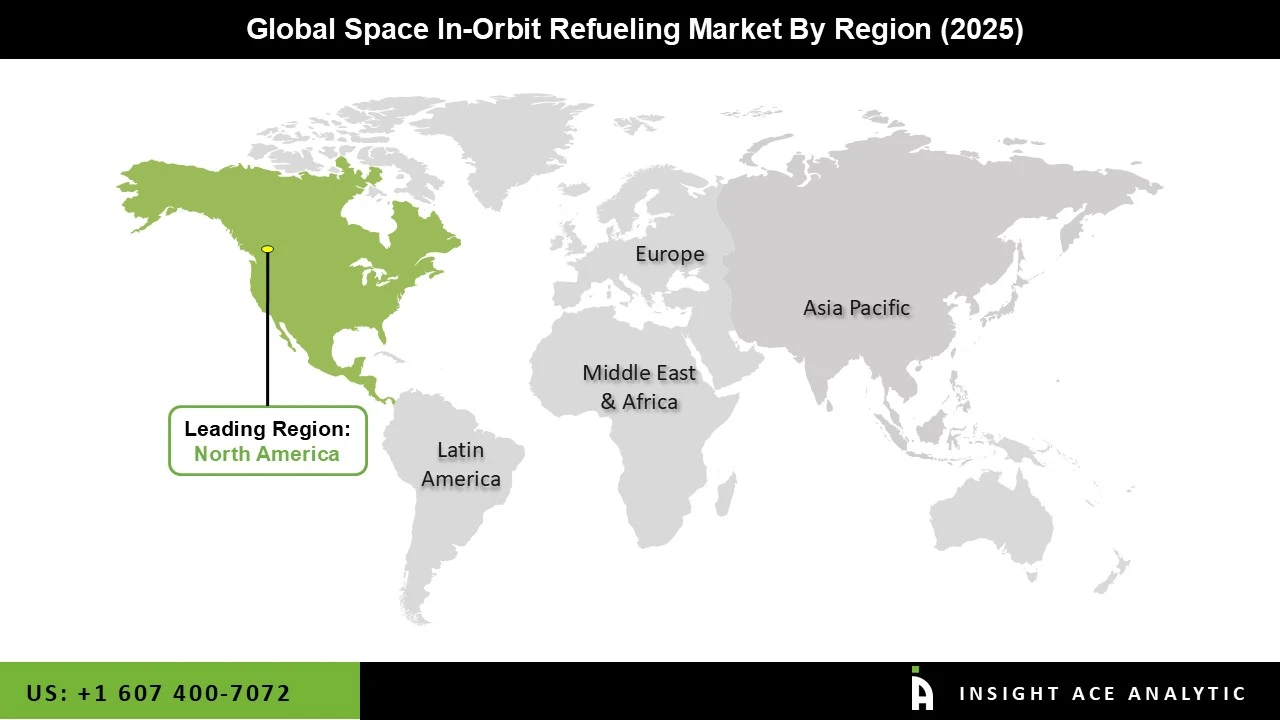
Why North America Led the Space In-Orbit Refueling Market?
The Space In-Orbit Refueling market was dominated by North America region in 2025 driven by rising expenditures on satellite maintenance technology and space infrastructure. With the help of defense programs from the U.S. Department of Defense and funding from organizations like the National Aeronautics and Space Administration, the United States is the region's leader. Significant commercial space firms like SpaceX and Northrop Grumman are present, which is speeding up technological developments in fuel transfer and on-orbit maintenance systems. The market is expanding as a result of rising demand for extending satellite lifespan, minimizing space debris, and assisting with national security operations. Furthermore, in order to improve operational effectiveness and lower long-term replacement costs across constellations, commercial satellite operators are progressively implementing refueling alternatives.
Space In-Orbit Refueling Market Report Scope:
| Report Attribute | Specifications |
| Market size value in 2025 | USD 1.49 Bn |
| Revenue forecast in 2035 | USD 4.58 Bn |
| Growth Rate CAGR | CAGR of 11.9% from 2026 to 2035 |
| Quantitative Units | Representation of revenue in US$ Bn and CAGR from 2026 to 2035 |
| Historic Year | 2022 to 2025 |
| Forecast Year | 2026-2035 |
| Report Coverage | The forecast of revenue, the position of the company, the competitive market structure, growth prospects, and trends |
| Segments Covered | Application, End-user, and By Region |
| Regional Scope | North America; Europe; Asia Pacific; Latin America; Middle East & Africa |
| Country Scope | U.S.; Canada; U.K.; Germany; China; India; Japan; Brazil; Mexico; The UK; France; Italy; Spain; China; Japan; India; South Korea; Southeast Asia; South Korea; Southeast Asia |
| Competitive Landscape | Astroscale Holdings Inc., D-Orbit SpA, Lockheed Martin Corporation, Altius Space Machines, Inc., LMO Space, Maxar Technologies Inc., Obruta Space Solutions, Starfish Space Inc., Tethers Unlimited, Inc., Orbit Recycling, SpaceX, SpaceLogistics (a subsidiary of Northrop Grumman Corporation), Momentus Space, Orbit Fab, Inc., and Space Machines Company |
| Customization Scope | Free customization report with the procurement of the report, Modifications to the regional and segment scope. Geographic competitive landscape. |
| Pricing and Available Payment Methods | Explore pricing alternatives that are customized to your particular study requirements. |
Market Segmentation:
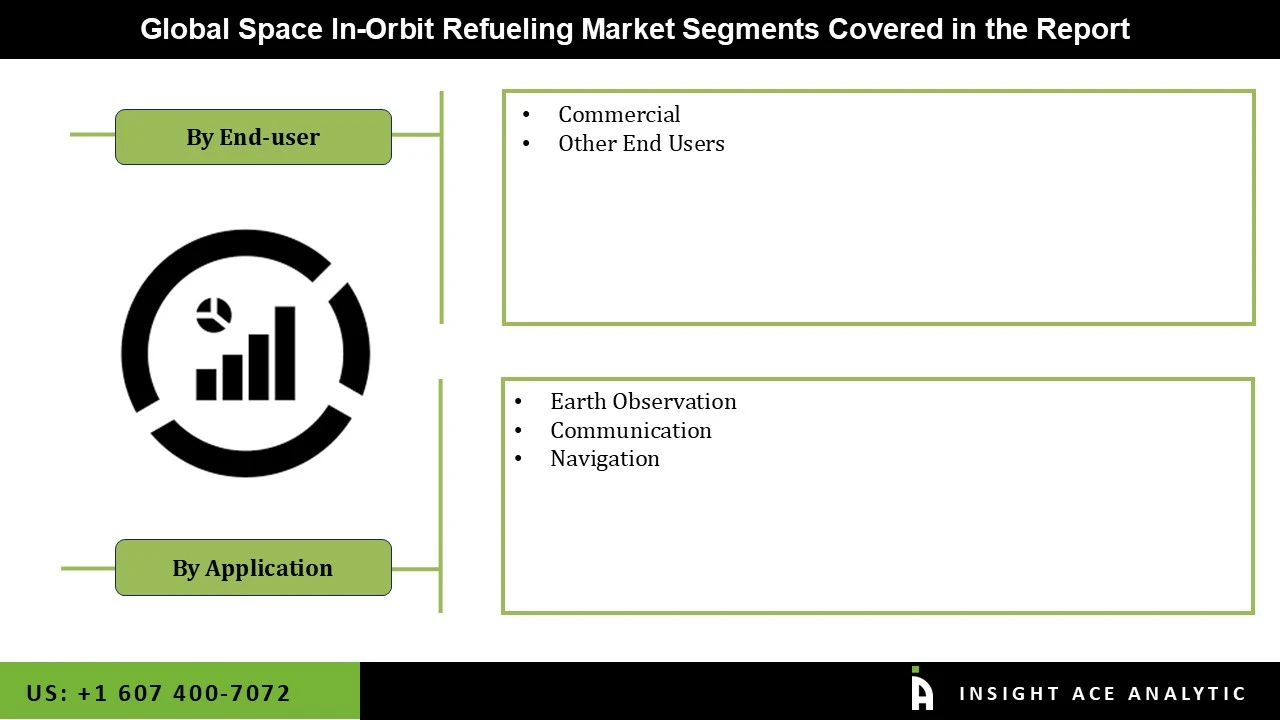
Space In-Orbit Refueling Market by Application-
• Communication
• Earth Observation
• Navigation
Space In-Orbit Refueling Market by End-user-
• Commercial
• Others
By Region-
North America-
• The US
• Canada
Europe-
• Germany
• The UK
• France
• Italy
• Spain
• Rest of Europe
Asia-Pacific-
• China
• Japan
• India
• South Korea
• South East Asia
• Rest of Asia Pacific
Latin America-
• Brazil
• Argentina
• Mexico
• Rest of Latin America
Middle East & Africa-
• GCC Countries
• South Africa
• Rest of Middle East and Africa
Research Design and Approach
This study employed a multi-step, mixed-method research approach that integrates:
- Secondary research
- Primary research
- Data triangulation
- Hybrid top-down and bottom-up modelling
- Forecasting and scenario analysis
This approach ensures a balanced and validated understanding of both macro- and micro-level market factors influencing the market.
Secondary Research
Secondary research for this study involved the collection, review, and analysis of publicly available and paid data sources to build the initial fact base, understand historical market behaviour, identify data gaps, and refine the hypotheses for primary research.
Sources Consulted
Secondary data for the market study was gathered from multiple credible sources, including:
- Government databases, regulatory bodies, and public institutions
- International organizations (WHO, OECD, IMF, World Bank, etc.)
- Commercial and paid databases
- Industry associations, trade publications, and technical journals
- Company annual reports, investor presentations, press releases, and SEC filings
- Academic research papers, patents, and scientific literature
- Previous market research publications and syndicated reports
These sources were used to compile historical data, market volumes/prices, industry trends, technological developments, and competitive insights.

Primary Research
Primary research was conducted to validate secondary data, understand real-time market dynamics, capture price points and adoption trends, and verify the assumptions used in the market modelling.
Stakeholders Interviewed
Primary interviews for this study involved:
- Manufacturers and suppliers in the market value chain
- Distributors, channel partners, and integrators
- End-users / customers (e.g., hospitals, labs, enterprises, consumers, etc., depending on the market)
- Industry experts, technology specialists, consultants, and regulatory professionals
- Senior executives (CEOs, CTOs, VPs, Directors) and product managers
Interview Process
Interviews were conducted via:
- Structured and semi-structured questionnaires
- Telephonic and video interactions
- Email correspondences
- Expert consultation sessions
Primary insights were incorporated into demand modelling, pricing analysis, technology evaluation, and market share estimation.
Data Processing, Normalization, and Validation
All collected data were processed and normalized to ensure consistency and comparability across regions and time frames.
The data validation process included:
- Standardization of units (currency conversions, volume units, inflation adjustments)
- Cross-verification of data points across multiple secondary sources
- Normalization of inconsistent datasets
- Identification and resolution of data gaps
- Outlier detection and removal through algorithmic and manual checks
- Plausibility and coherence checks across segments and geographies
This ensured that the dataset used for modelling was clean, robust, and reliable.
Market Size Estimation and Data Triangulation
Bottom-Up Approach
The bottom-up approach involved aggregating segment-level data, such as:
- Company revenues
- Product-level sales
- Installed base/usage volumes
- Adoption and penetration rates
- Pricing analysis
This method was primarily used when detailed micro-level market data were available.

Top-Down Approach
The top-down approach used macro-level indicators:
- Parent market benchmarks
- Global/regional industry trends
- Economic indicators (GDP, demographics, spending patterns)
- Penetration and usage ratios
This approach was used for segments where granular data were limited or inconsistent.
Hybrid Triangulation Approach
To ensure accuracy, a triangulated hybrid model was used. This included:
- Reconciling top-down and bottom-up estimates
- Cross-checking revenues, volumes, and pricing assumptions
- Incorporating expert insights to validate segment splits and adoption rates
This multi-angle validation yielded the final market size.
Forecasting Framework and Scenario Modelling
Market forecasts were developed using a combination of time-series modelling, adoption curve analysis, and driver-based forecasting tools.
Forecasting Methods
- Time-series modelling
- S-curve and diffusion models (for emerging technologies)
- Driver-based forecasting (GDP, disposable income, adoption rates, regulatory changes)
- Price elasticity models
- Market maturity and lifecycle-based projections
Scenario Analysis
Given inherent uncertainties, three scenarios were constructed:
- Base-Case Scenario: Expected trajectory under current conditions
- Optimistic Scenario: High adoption, favourable regulation, strong economic tailwinds
- Conservative Scenario: Slow adoption, regulatory delays, economic constraints
Sensitivity testing was conducted on key variables, including pricing, demand elasticity, and regional adoption.
Request Customization
Add countries, segments, company profiles, or extend forecast — free 10% customization with purchase.
Customize This Report →Enquire Before Buying
Speak with our analyst team about scope, methodology, pricing, or deliverable formats.
Enquire Now →Frequently Asked Questions
Space In Orbit Refueling Market Size is valued at USD 1.49 Bn in 2025 and is predicted to reach USD 4.58 Bn by the year 2035
Space In Orbit Refueling Market is expected to grow at a 11.9% CAGR during the forecast period for 2026 to 2035.
Astroscale Holdings Inc., D-Orbit SpA, Lockheed Martin Corporation, Altius Space Machines, Inc., LMO Space, Maxar Technologies Inc., Obruta Space Solutions, Starfish Space Inc., Tethers Unlimited, Inc., Orbit Recycling, SpaceX, SpaceLogistics (a subsidiary of Northrop Grumman Corporation), Momentus Space, Orbit Fab, Inc., and Space Machines Company
Space In Orbit Refueling Market is segmented into by Application, End-user, and By Region.
North America is leading the Space In Orbit Refueling Market.