Radiopharmaceuticals Third Party Logistics Market Size, Revenue, Forecast Report 2026 to 2035
What is Radiopharmaceuticals Third-Party Logistics Market Size?
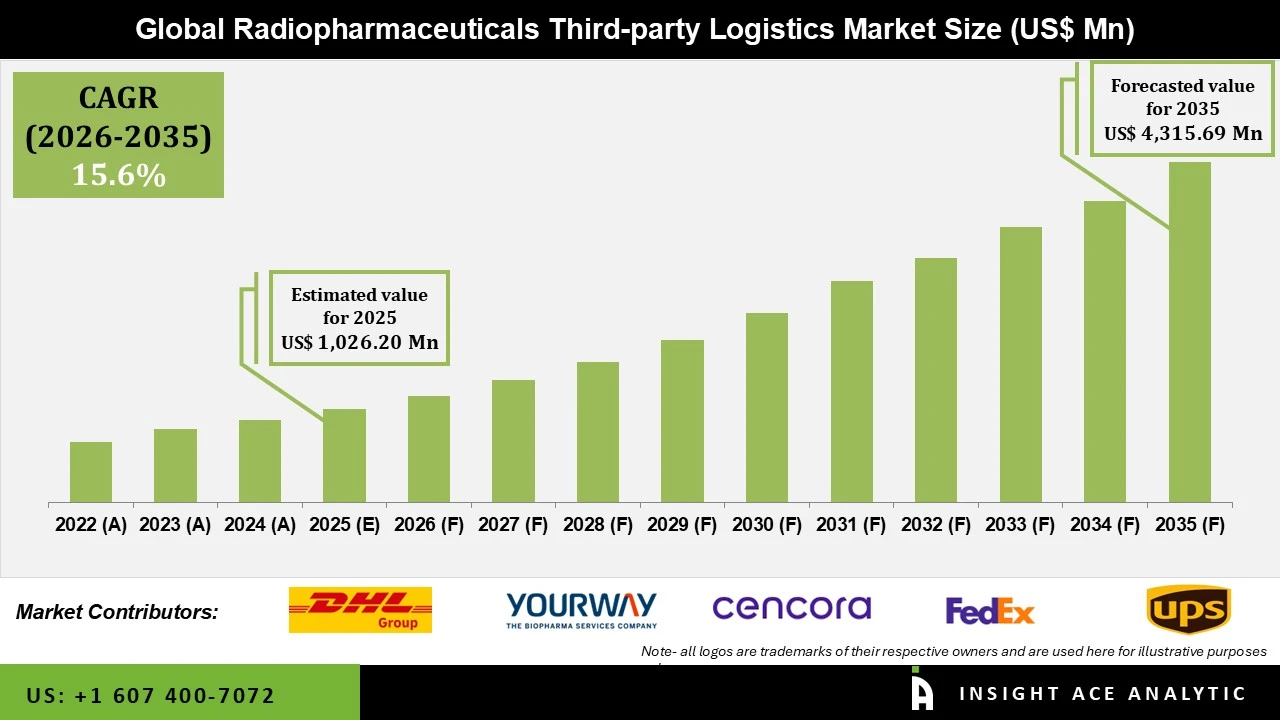
Radiopharmaceuticals Third-Party Logistics Market Size is valued at USD 1,026.20 Mn in 2025 and is predicted to reach USD 4,315.69 Mn by the year 2035 at a 15.6% CAGR during the forecast period for 2026 to 2035.
Radiopharmaceuticals Third Party Logistics Market Size, Share & Trends Analysis By Type (Diagnostic Radiopharmaceuticals, Therapeutic Radiopharmaceuticals, and Theranostics), Service (Transportation, Warehousing & Storage, Packaging Solutions, Monitoring & Visibility Solutions, Specialized Handling & Compliance Services, and Others), Radioisotope Half-Life (Ultra-Short Half-Life, Short Half-Life, and Medium/Long Half-Life), Temperature Range (Ambient, Controlled Room Temperature (CRT), Refrigerated, and Others), End-user (Pharma & Biopharma Companies, Research Institutes & CROs, CDMOs / CMOs, Clinical Facilities, and Others), and Segment Forecasts, 2026 to 2035
Radiopharmaceuticals third-party logistics (3PL) are the special logistic service operations that handle transport, storage, packaging, and distribution of the radiopharmaceutical products used in diagnostic imaging as well as in targeted treatments. These logistics services ensure the safe delivery of the radiopharmaceuticals in question in accordance with strict temperature controls, radiation safety standards, and other regulations. Since the majority of radiopharmaceuticals have very short half-lives, timely delivery is critical in order to retain the efficiency and safety of the products. That is why manufacturers and healthcare institutions increasingly prefer specialized third-party logistics companies with extensive experience in managing radioactive pharmaceuticals.
An increased number of nuclear medicine procedures and radiopharmaceuticals targeting therapy are one of the key drivers of the market growth. The rising prevalence of cancers, cardiovascular diseases, and neurological disorders results in growing popularity of PET and SPECT scanning and increases the need for logistics services. In addition, pharmaceuticals expand their manufacturing of the radiopharmaceuticals for therapeutic purposes and, therefore, require sophisticated and well-coordinated networks to deliver them. Increasing investments into the infrastructure of nuclear medicine in developed and emerging countries contribute to this market growth.
In addition, advances in the logistics industry through cold chain logistics, digitized logistics tracking and real-time monitoring are contributing to increased efficiency in radiopharmaceuticals transport. More logistics companies are incorporating internet-of-things based logistics tracking software, automatic inventory control systems and predictive logistics routing systems in order to minimize any logistical issues during delivery while minimizing wastage of goods. Regulatory bodies have put more stringent standards when it comes to transporting radioactive material, leading to a call by such bodies for healthcare institutions to work alongside experienced logistics professionals. The need for logistics services is bound to increase due to continued growth in precision medicine.
Competitive Landscape
Which are the Leading Players in Radiopharmaceuticals Third-Party Logistics Market?
Specialized Logistics and Courier Providers
• United Parcel Service, Inc. – UPS Healthcare, Marken and MNX
• Cencora, Inc. – World Courier
• DHL Group – DHL Health Logistics
• Kuehne+Nagel International AG – QuickSTAT
• FedEx Corporation – FedEx Custom Critical
• Movianto – Walden Group
• Yourway Transport, Inc.
Nuclear Pharmacy and Radiopharmaceutical Distribution Networks
• Cardinal Health, Inc.
• Telix Pharmaceuticals Limited – RLS Radiopharmacies
• Curium Pharma
• PharmaLogic Holdings Corp.
• Jubilant Radiopharma
• SOFIE Biosciences
• Eckert & Ziegler SE
• NTP Radioisotopes SOC Ltd
Market Dynamics
Driver
Growing Adoption of Nuclear Medicine and Targeted Radiopharmaceutical Therapies
The rising use of nuclear medicine in the diagnosis and targeted therapy of diseases is one of the leading drivers of the radiopharmaceuticals third-party logistics market. Nuclear medicine uses radiopharmaceuticals to carry out positron emission tomography (PET), single-photon emission computed tomography (SPECT), and targeted radionuclide therapies that help in diagnosing and treating conditions such as cancer, cardiovascular disease, neurological problems, and endocrine disorders. With more healthcare providers performing more nuclear medicine procedures on a yearly basis, there is a greater demand for the transportation of radioactive products within set time limits.
Radiopharmaceuticals are different from regular pharmaceuticals in that their radioactive elements have very short half-lives, hence the requirement for fast delivery of these products to healthcare institutions. Even slight delays in delivery can decrease the efficacy of these products while at the same time causing losses. The third-party logistics providers offer unique shipping and delivery solutions, which include temperature controlled transportation, special handling, secure packaging, and tracking of shipments. All these attributes make outsourcing logistics appealing.
Restrain/Challenge
Complex Regulatory Requirements and Short Product Shelf Life
One of the factors that influence the third-party logistics market for radiopharmaceuticals across the globe is the highly regulated environment with regard to transport and handling of the radiopharmaceuticals. The transport companies have to adhere to the regulations concerning radiation safety, packaging, documentation, and monitoring during transport which are set out by national nuclear regulators, aviation regulators, transport regulators, and international organizations. Compliance with the aforementioned regulations complicates the operation and increases the cost of logistics services.
Apart from that, a very short half-life of many radiopharmaceuticals makes their delivery rather problematic. For instance, radiopharmaceuticals like F-18 and C-11 should reach their destination point soon after being manufactured in order to remain effective. Any delay because of customs procedures, transport problems, bad weather, or inspections can make the product useless since the radiopharmaceuticals will expire. It not only causes additional expenses but can also disrupt the procedures planned for patients.
Diagnostic Radiopharmaceuticals Segment is Expected to Hold the Largest Share of the Radiopharmaceuticals Third-Party Logistics Market
Diagnostic radiopharmaceuticals was the segment that held the maximum market share in 2025 and is expected to retain this status during the entire forecast period. The usage of PET & SPECT imaging techniques is growing in terms of frequency all across the globe on account of increased occurrence of cancer, cardiovascular ailments, and nervous system disorders. These radiopharmaceuticals need to be shipped at very high speeds and also with reliability on account of their short shelf life, hence the involvement of dedicated third-party logistics companies in the supply chain process.
Air Transportation Segment is Expected to Register the Fastest Growth
It is forecasted that the air transport segment will witness the fastest growth over the forecast period because of the urgent transportation needs of radiopharmaceuticals. Air freight ensures quick and efficient transportation over long distances while reducing radioactivity. Logistics service providers have been investing in specialized air cargo for health care products in which packages are provided with temperature control facilities, proper radiation handling, and shipment tracking. The growing international trade of radiopharmaceuticals will fuel the growth of the air transportation segment.
Why North America Led the Radiopharmaceuticals Third-Party Logistics Market?
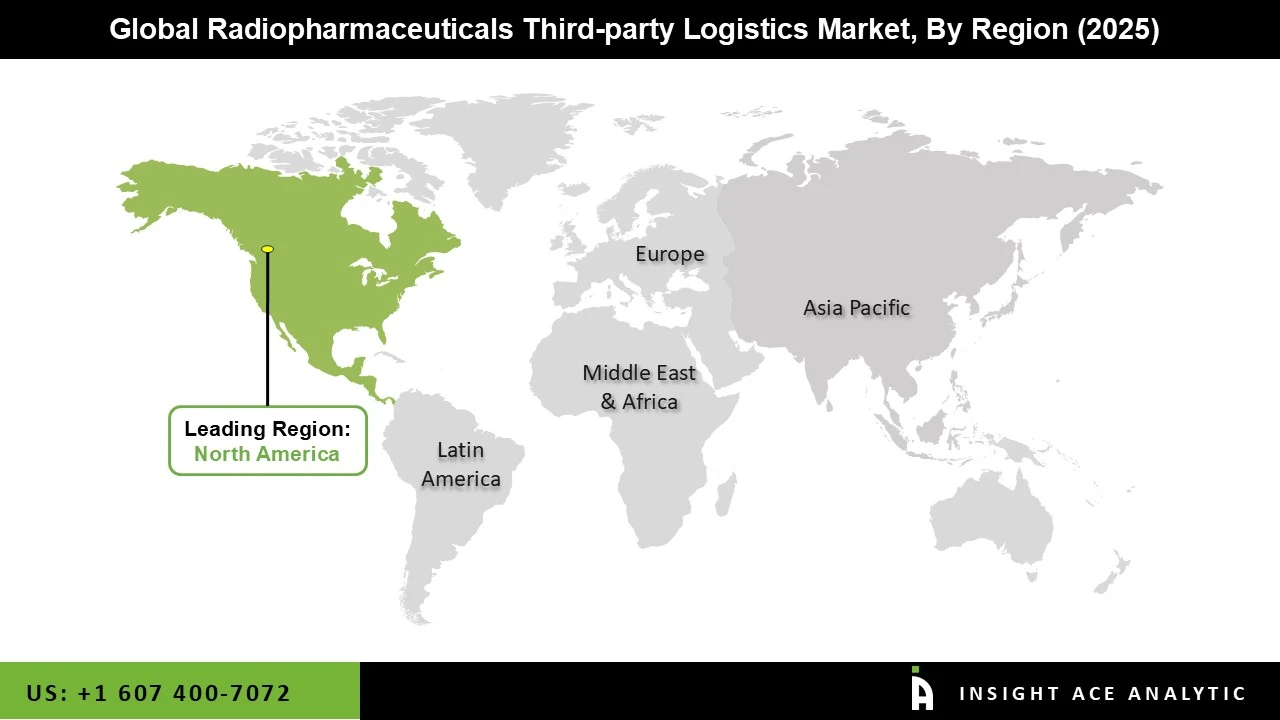
North America was expected to rule the radiopharmaceuticals third-party logistics market in 2025 due to the existing nuclear medicine network, the capacity for pharmaceutical manufacturing, and wide-spread usage of advanced imaging diagnostics. The USA conducts a large amount of PET and SPECT imaging procedures annually, generating constant demand for the transportation and distribution of the radiopharmaceuticals.
The region is also characterized by the existence of leading manufacturers of radiopharmaceuticals, dedicated logistics service providers, and third-party distributors. It also features advanced healthcare infrastructure and supportive reimbursement strategies that promote the implementation of nuclear medicine in order to identify diseases and target cancer. In addition, increased investments in radioligand therapies and precision medicines have contributed to the increased production of radiopharmaceuticals and, consequently, to the need for specialized logistics.
North America is known for its adoption of innovative cold-chain technology, GPS-based shipment tracking, automation of inventory management, and radiation-proof transportation options. These measures increase the efficiency of operations and reduce the number of delays and wasted products. The presence of regulatory bodies that set transportation standards has positively impacted the reliability of logistics services in the region.
Key Development
• In January 2025, Telix Pharmaceuticals completed its acquisition of RLS USA Inc. The transaction added a network of 31 licensed radiopharmacies and strengthened Telix’s U.S. manufacturing, radiometal-production, and last-mile radiopharmaceutical-distribution capabilities.
Radiopharmaceuticals Third-Party Logistics Market Report Scope:
| Report Attribute | Specifications |
| Market size value in 2025 | USD 1,026.20 Mn |
| Revenue forecast in 2035 | USD 4,315.69 Mn |
| Growth Rate CAGR | CAGR of 15.6% from 2026 to 2035 |
| Quantitative Units | Representation of revenue in US$ Mn and CAGR from 2026 to 2035 |
| Historic Year | 2022 to 2025 |
| Forecast Year | 2026-2035 |
| Report Coverage | The forecast of revenue, the position of the company, the competitive market structure, growth prospects, and trends |
| Segments Covered | Type, Service, Radioisotope Half-Life, Temperature Range, End-user, and By Region |
| Regional Scope | North America; Europe; Asia Pacific; Latin America; Middle East & Africa |
| Country Scope | U.S.; Canada; U.K.; Germany; China; India; Japan; Brazil; Mexico; The UK; France; Italy; Spain; China; Japan; India; South Korea; Southeast Asia; South Korea; Southeast Asia |
| Competitive Landscape | UPS Healthcare–Marken–MNX; Cencora–World Courier; DHL Health Logistics; Kuehne+Nagel–QuickSTAT; FedEx Custom Critical; Cardinal Health; Telix–RLS Radiopharmacies; Curium; PharmaLogic; Jubilant Radiopharma; SOFIE Biosciences; Eckert & Ziegler; Movianto; Yourway; NTP Radioisotopes |
| Customization Scope | Free customization report with the procurement of the report, Modifications to the regional and segment scope. Geographic competitive landscape. |
| Pricing and Available Payment Methods | Explore pricing alternatives that are customized to your particular study requirements. |
Market Segmentation:
Radiopharmaceuticals Third-Party Logistics Market by Type -
• Diagnostic Radiopharmaceuticals
o PET Radiopharmaceuticals
o SPECT Radiopharmaceuticals
• Therapeutic Radiopharmaceuticals
o Beta-Emitting Therapeutics
o Alpha-Emitting Therapeutics
o Other Therapeutic Radiopharmaceuticals
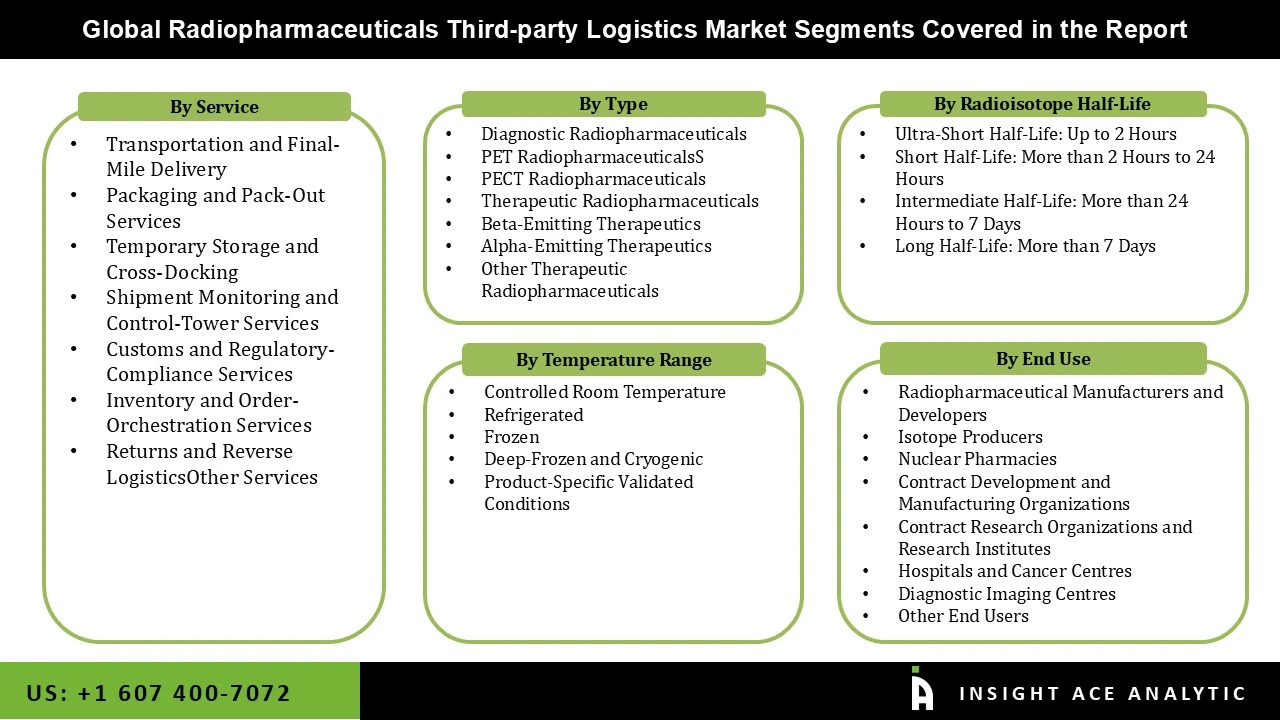
Radiopharmaceuticals Third-Party Logistics Market by Service -
• Transportation and Final-Mile Delivery
• Packaging and Pack-Out Services
• Temporary Storage and Cross-Docking
• Shipment Monitoring and Control-Tower Services
• Customs and Regulatory-Compliance Services
• Inventory and Order-Orchestration Services
• Returns and Reverse Logistics
• Other Services
Radiopharmaceuticals Third-Party Logistics Market by Radioisotope Half-Life -
• Ultra-Short Half-Life: Up to 2 Hours
• Short Half-Life: More than 2 Hours to 24 Hours
• Intermediate Half-Life: More than 24 Hours to 7 Days
• Long Half-Life: More than 7 Days
Radiopharmaceuticals Third-Party Logistics Market by Temperature Range -
• Controlled Room Temperature
• Refrigerated
• Frozen
• Deep-Frozen and Cryogenic
• Product-Specific Validated Conditions
Radiopharmaceuticals Third-Party Logistics Market by End-User -
• Radiopharmaceutical Manufacturers and Developers
• Isotope Producers
• Nuclear Pharmacies
• Contract Development and Manufacturing Organizations
• Contract Research Organizations and Research Institutes
• Hospitals and Cancer Centres
• Diagnostic Imaging Centres
• Other End Users
By Region-
North America-
• The US
• Canada
Europe-
• Germany
• The UK
• France
• Italy
• Spain
• Rest of Europe
Asia-Pacific-
• China
• Japan
• India
• South Korea
• South East Asia
• Rest of Asia Pacific
Latin America-
• Brazil
• Argentina
• Mexico
• Rest of Latin America
Middle East & Africa-
• GCC Countries
• South Africa
• Rest of Middle East and Africa
Research Design and Approach
This study employed a multi-step, mixed-method research approach that integrates:
- Secondary research
- Primary research
- Data triangulation
- Hybrid top-down and bottom-up modelling
- Forecasting and scenario analysis
This approach ensures a balanced and validated understanding of both macro- and micro-level market factors influencing the market.
Secondary Research
Secondary research for this study involved the collection, review, and analysis of publicly available and paid data sources to build the initial fact base, understand historical market behaviour, identify data gaps, and refine the hypotheses for primary research.
Sources Consulted
Secondary data for the market study was gathered from multiple credible sources, including:
- Government databases, regulatory bodies, and public institutions
- International organizations (WHO, OECD, IMF, World Bank, etc.)
- Commercial and paid databases
- Industry associations, trade publications, and technical journals
- Company annual reports, investor presentations, press releases, and SEC filings
- Academic research papers, patents, and scientific literature
- Previous market research publications and syndicated reports
These sources were used to compile historical data, market volumes/prices, industry trends, technological developments, and competitive insights.

Primary Research
Primary research was conducted to validate secondary data, understand real-time market dynamics, capture price points and adoption trends, and verify the assumptions used in the market modelling.
Stakeholders Interviewed
Primary interviews for this study involved:
- Manufacturers and suppliers in the market value chain
- Distributors, channel partners, and integrators
- End-users / customers (e.g., hospitals, labs, enterprises, consumers, etc., depending on the market)
- Industry experts, technology specialists, consultants, and regulatory professionals
- Senior executives (CEOs, CTOs, VPs, Directors) and product managers
Interview Process
Interviews were conducted via:
- Structured and semi-structured questionnaires
- Telephonic and video interactions
- Email correspondences
- Expert consultation sessions
Primary insights were incorporated into demand modelling, pricing analysis, technology evaluation, and market share estimation.
Data Processing, Normalization, and Validation
All collected data were processed and normalized to ensure consistency and comparability across regions and time frames.
The data validation process included:
- Standardization of units (currency conversions, volume units, inflation adjustments)
- Cross-verification of data points across multiple secondary sources
- Normalization of inconsistent datasets
- Identification and resolution of data gaps
- Outlier detection and removal through algorithmic and manual checks
- Plausibility and coherence checks across segments and geographies
This ensured that the dataset used for modelling was clean, robust, and reliable.
Market Size Estimation and Data Triangulation
Bottom-Up Approach
The bottom-up approach involved aggregating segment-level data, such as:
- Company revenues
- Product-level sales
- Installed base/usage volumes
- Adoption and penetration rates
- Pricing analysis
This method was primarily used when detailed micro-level market data were available.

Top-Down Approach
The top-down approach used macro-level indicators:
- Parent market benchmarks
- Global/regional industry trends
- Economic indicators (GDP, demographics, spending patterns)
- Penetration and usage ratios
This approach was used for segments where granular data were limited or inconsistent.
Hybrid Triangulation Approach
To ensure accuracy, a triangulated hybrid model was used. This included:
- Reconciling top-down and bottom-up estimates
- Cross-checking revenues, volumes, and pricing assumptions
- Incorporating expert insights to validate segment splits and adoption rates
This multi-angle validation yielded the final market size.
Forecasting Framework and Scenario Modelling
Market forecasts were developed using a combination of time-series modelling, adoption curve analysis, and driver-based forecasting tools.
Forecasting Methods
- Time-series modelling
- S-curve and diffusion models (for emerging technologies)
- Driver-based forecasting (GDP, disposable income, adoption rates, regulatory changes)
- Price elasticity models
- Market maturity and lifecycle-based projections
Scenario Analysis
Given inherent uncertainties, three scenarios were constructed:
- Base-Case Scenario: Expected trajectory under current conditions
- Optimistic Scenario: High adoption, favourable regulation, strong economic tailwinds
- Conservative Scenario: Slow adoption, regulatory delays, economic constraints
Sensitivity testing was conducted on key variables, including pricing, demand elasticity, and regional adoption.
Request Customization
Add countries, segments, company profiles, or extend forecast — free 10% customization with purchase.
Customize This Report →Enquire Before Buying
Speak with our analyst team about scope, methodology, pricing, or deliverable formats.
Enquire Now →Frequently Asked Questions
Radiopharmaceuticals Third-Party Logistics Market Size is valued at USD 1,026.20 Mn in 2025 and is predicted to reach USD 4,315.69 Mn by the year 2035
Radiopharmaceuticals Third-Party Logistics Market is expected to grow at a 15.6% CAGR during the forecast period for 2026 to 2035.
UPS Healthcare–Marken–MNX; Cencora–World Courier; DHL Health Logistics; Kuehne+Nagel–QuickSTAT; FedEx Custom Critical; Cardinal Health; Telix–RLS Radiopharmacies; Curium; PharmaLogic; Jubilant Radiopharma; SOFIE Biosciences; Eckert & Ziegler; Movianto; Yourway; NTP Radioisotopes
Radiopharmaceuticals Third-Party Logistics Market is segmented into Type, Service, Radioisotope Half-Life, Temperature Range, End-user, and By Region
North America region is leading the Radiopharmaceuticals Third-Party Logistics Market.