Cocoa Free and Alternative Chocolate Market Size, Trend, Forecast Report 2026 to 2035
What is Cocoa Free & Alternative Chocolate Market Size?
Cocoa Free & Alternative Chocolate Market is estimated to grow with 22.3% CAGR during the forecast period for 2026 to 2035.
Cocoa Free & Alternative Chocolate Market Size, Share & Trends Analysis Distribution by Product Type (Chocolate Mass & Couverture Alternatives, Compound Coatings & Glazes, Chips, Drops & Inclusions, Cocoa Powder Alternatives, Spreads & Fillings, Cocoa Butter Alternatives (Novel Fats), Finished Bars & Confectionery), By Technology Route (Fermented Plant-Based Cocoa Alternatives, Non-Fermented Plant-Based Cocoa Alternatives, Plant Cell-Cultured Cocoa, Precision & Biomass Fermentation-Derived Ingredients), By Application (Confectionery, Bakery, Biscuits & Pastry, Ice Cream & Frozen Desserts, Cereals & Snack Bars, Beverages, Others), By End User (Industrial Food & Confectionery Manufacturers, Artisanal Bakeries, Patisseries & Foodservice, Retail Consumers) and Segment Forecasts, 2026 to 2035
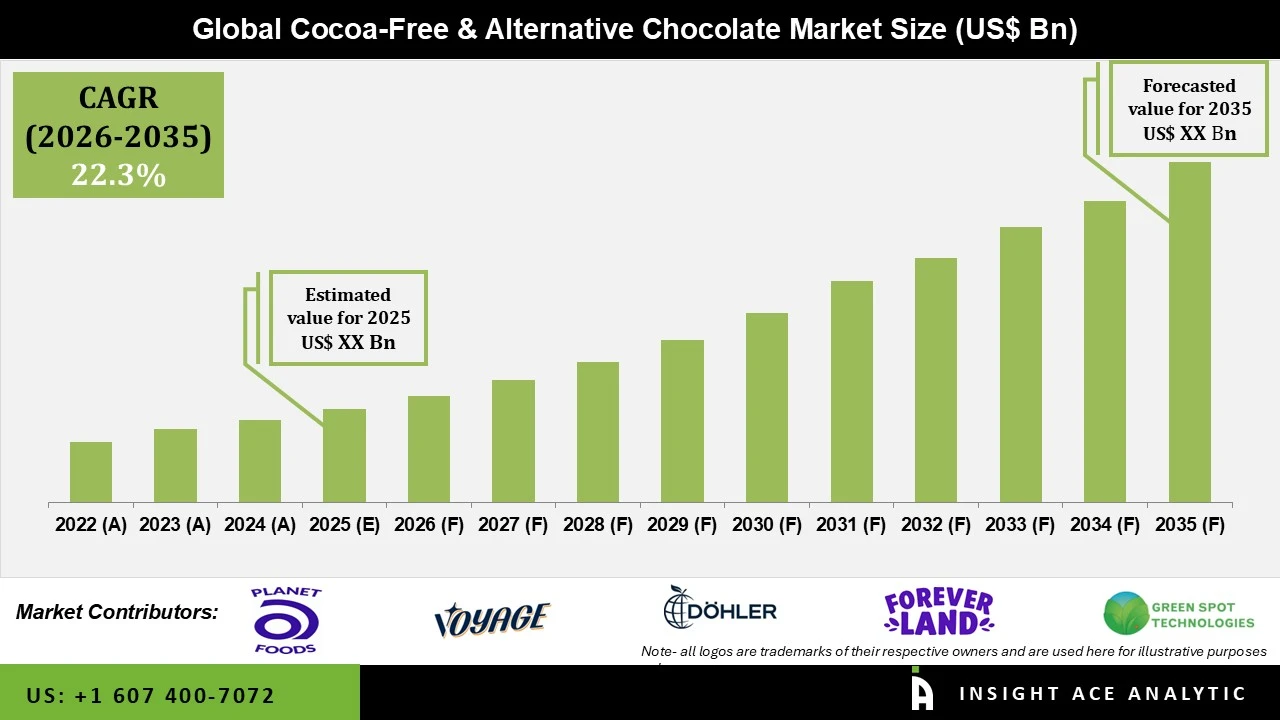
Chocolate that is free from cocoa and those which are alternative to chocolate are products and confectionery formulations designed to mimic the sensory, functional, and processing properties of ordinary chocolate without depending completely on traditional cocoa ingredients. Such alternatives can make use of plant-based raw materials including carob, grains, legumes, seeds, fruits, and other botanical sources, as well as fermentation, precision fermentation, biomass fermentation, and cell-culture technologies. The range of products includes cocoa-free chocolate masses and couverture alternatives, compound coatings and glazes, chips and inclusions, alternatives to cocoa powder, spreads and fillings, alternatives to cocoa butter, and finished bars and confectionery.
The market for cocoa-free and alternative chocolate includes the development, production, processing and marketing of these alternative chocolate products and ingredients in a variety of areas such as confectionery, bakery and pastry, ice cream and frozen desserts, cereals and snack bars, beverages, and other food uses. It involves technology developers, producer-brands, ingredient and formulation companies, companies that help with scaling up and distribution, and providers of processing technology, all of whom serve industrial manufacturers, foodservice operators, artisanal producers and retail consumers. The market's scope extends to include both alternative products that are already available on the market and new technology-based formulations that are moving towards commercial-scale production.
Competitive Landscape
Which are the Leading Players in the Cocoa-Free & Alternative Chocolate Market?
Technology Developers
• Planet A Foods GmbH
• Voyage Foods, Inc.
• Win-Win (formerly WNWN Food Labs Ltd.)
• Döhler GmbH (Nukoko)
• Foreverland Food
• Endless Food Co
• Green Spot Technologies
• Compound Foods, Inc.
• Kawa Project
• California Cultured, Inc.
• Celleste Bio Ltd.
• Food Brewer AG
• Kokomodo
• C16 Biosciences, Inc.
• Abydos Bioscience
• Smey
• Sun Bear Biofuture
• Fungu'it
Producer-Brands
• Fazer Group
• Mez Foods
Scale-Up & Distribution Partners
• Barry Callebaut AG
• Cargill, Incorporated
• Puratos Group
• Martin Braun-Gruppe
• Bunge Loders Croklaan (BLC)
Processing & Manufacturing-Technology Providers
• Bühler Group
• Royal Duyvis Wiener / NETZSCH
• Baker Perkins / Sollich
• GEA Group
Market Dynamics
Driver
Rising Cocoa Price Volatility and Supply Constraints
The higher level of volatility in cocoa prices, together with shortages of supply and changes in cocoa production, is causing chocolate manufacturers to look into cocoa-free and cocoa-reduced options. By using alternative ingredients and fermentation-based technologies, manufacturers can achieve more reliable sourcing of their raw materials and gain greater flexibility when formulating their products while still being able to maintain a chocolate-like taste, texture, and functionality. As a result, funding is being accelerated for cocoa alternatives in the confectionery, bakery, ice cream, and other food areas.
Restrain/Challenge
Difficulty in Replicating the Sensory and Functional Properties of Cocoa
A key difficulty lies in obtaining the taste, aroma, texture, mouthfeel, melting behaviour, colour, and processing properties of ordinary cocoa when using alternative ingredients. Cocoa has a rich mix of flavour compounds and functional properties which are hard to mimic with plant-based, fermented, or cell-based alternatives. Moreover, differences in the raw materials and the processing can have an impact on product consistency, which makes it difficult for manufacturers to deliver the same sensory experience and performance in different applications.
Chocolate Mass & Couverture Alternatives Segment is Expected to Drive the Cocoa-Free & Alternative Chocolate Market
The chocolate mass & couverture alternatives segment is expected to be the major growth-driving segment due to its broad applicability across confectionery, bakery, desserts, and foodservice applications. They can be used directly as a substitute for conventional cocoa-based chocolate in industrial recipes, which makes them appealing to food manufacturers who are looking for flexible alternative ingredients. At the same time, progress in fermentation-based and plant-based technologies is enhancing the taste, texture, melting characteristics, and processing performance of these products, and the increasing attention from technology developers to B2B chocolate masses and couverture formulations is helping to promote their use in a variety of finished products.
Precision & Biomass Fermentation-Derived Ingredients Segment is Growing at the Highest Rate in the Cocoa-Free & Alternative Chocolate Market
The precision & biomass fermentation-derived Ingredients segment is expected to grow at the highest rate, supported by advances in fermentation technologies that enable the production of cocoa-like flavors, fats, and functional ingredients with greater consistency and scalability. The technologies enable manufacturers to create alternative versions of specific cocoa components, thus supporting their use in chocolate masses, in cocoa butter alternatives, in coatings and in other confectionery products, as well as promoting the commercialisation and acceptance of fermentation-based solutions.
Why Europe Led the Cocoa-Free & Alternative Chocolate Market?
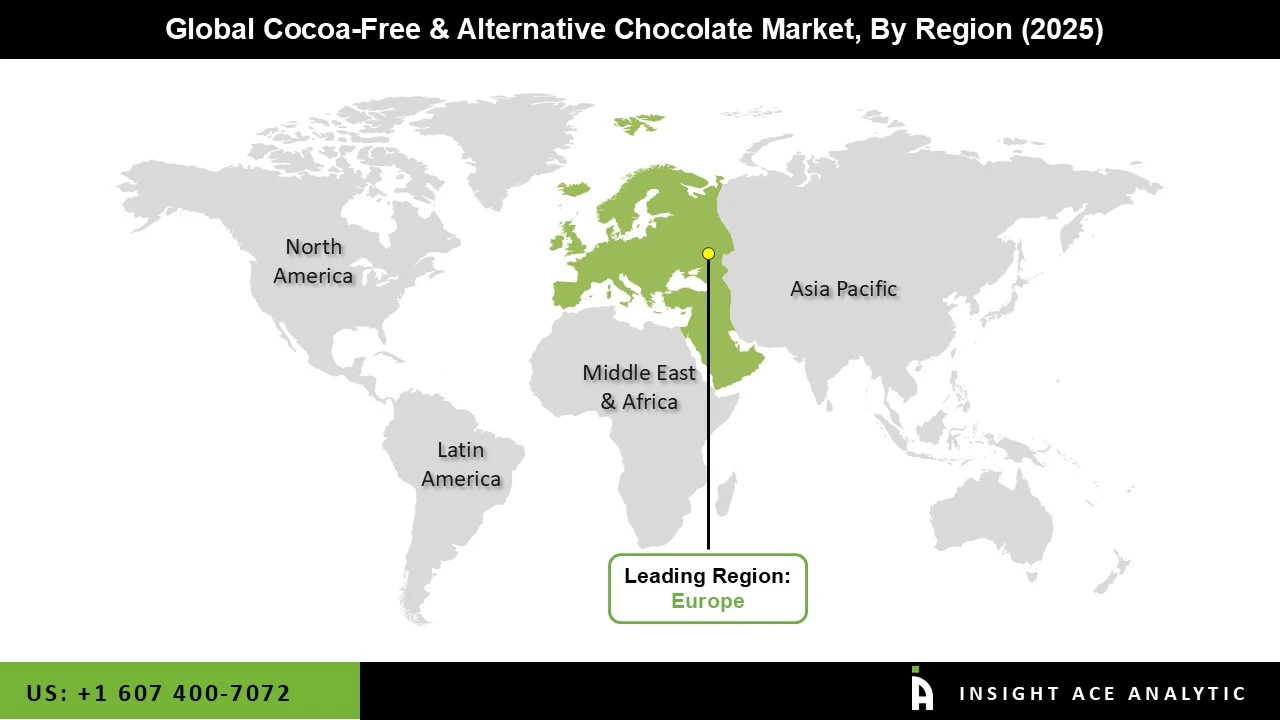
Europe is expected to take the lead in the cocoa-free & alternative chocolate market, a position underpinned by the strength of the region's chocolate and confectionery industry, the early adoption of alternative food technologies, and the availability of a number of leading cocoa-alternative developers and producer brands. There has also been an increasing commercialisation of cocoa-free products and fermentation-based alternatives, with companies including Planet A Foods, Win-Win, Foreverland, and Fazer developing or launching alternative chocolate solutions. Furthermore, existing confectionery manufacturers and ingredient suppliers offer a solid ecosystem that enables these products to be scaled for use in both industrial and retail settings.
Key Development
May 2026: Cargill partnered with Voyage Foods to bring NextCoa™, a cocoa-free confectionery alternative, to North America, starting with the U.S. The plant-based product uses ingredients such as grape seeds and Voyage Foods’ patented technology to deliver chocolate-like taste while offering improved pricing stability, broader availability, and a 67% lower carbon footprint than conventional chocolate.
Cocoa-Free & Alternative Chocolate Market Report Scope:
| Report Attribute | Specifications |
| Growth Rate CAGR | CAGR of 22.3% from 2026 to 2035 |
| Quantitative Units | Representation of revenue in US$ Bn and CAGR from 2026 to 2035 |
| Historic Year | 2022 to 2025 |
| Forecast Year | 2026-2035 |
| Report Coverage | The forecast of revenue, the position of the company, the competitive market structure, growth prospects, and trends |
| Segments Covered | Product Type, Technology Route, Application, End User and By Region |
| Regional Scope | North America; Europe; Asia Pacific; Latin America; Middle East & Africa |
| Country Scope | U.S.; Canada; U.K.; Germany; China; India; Japan; Brazil; Mexico; France; Italy; Spain; South Korea; Southeast Asia |
| Competitive Landscape | Planet A Foods GmbH, Voyage Foods, Inc., Win-Win (formerly WNWN Food Labs Ltd.), Döhler GmbH (Nukoko), Foreverland Food, Endless Food Co, Green Spot Technologies, Compound Foods, Inc., Kawa Project, California Cultured, Inc., Celleste Bio Ltd. |
| Customization Scope | Free customization report with the procurement of the report, Modifications to the regional and segment scope. Geographic competitive landscape. |
| Pricing and Available Payment Methods | Explore pricing alternatives that are customized to your particular study requirements. |
Market Segmentation:
Cocoa-Free & Alternative Chocolate Market by Product Type -
• Chocolate Mass & Couverture Alternatives
• Compound Coatings & Glazes
• Chips, Drops & Inclusions
• Cocoa Powder Alternatives
• Spreads & Fillings
• Cocoa Butter Alternatives (Novel Fats)
• Finished Bars & Confectionery
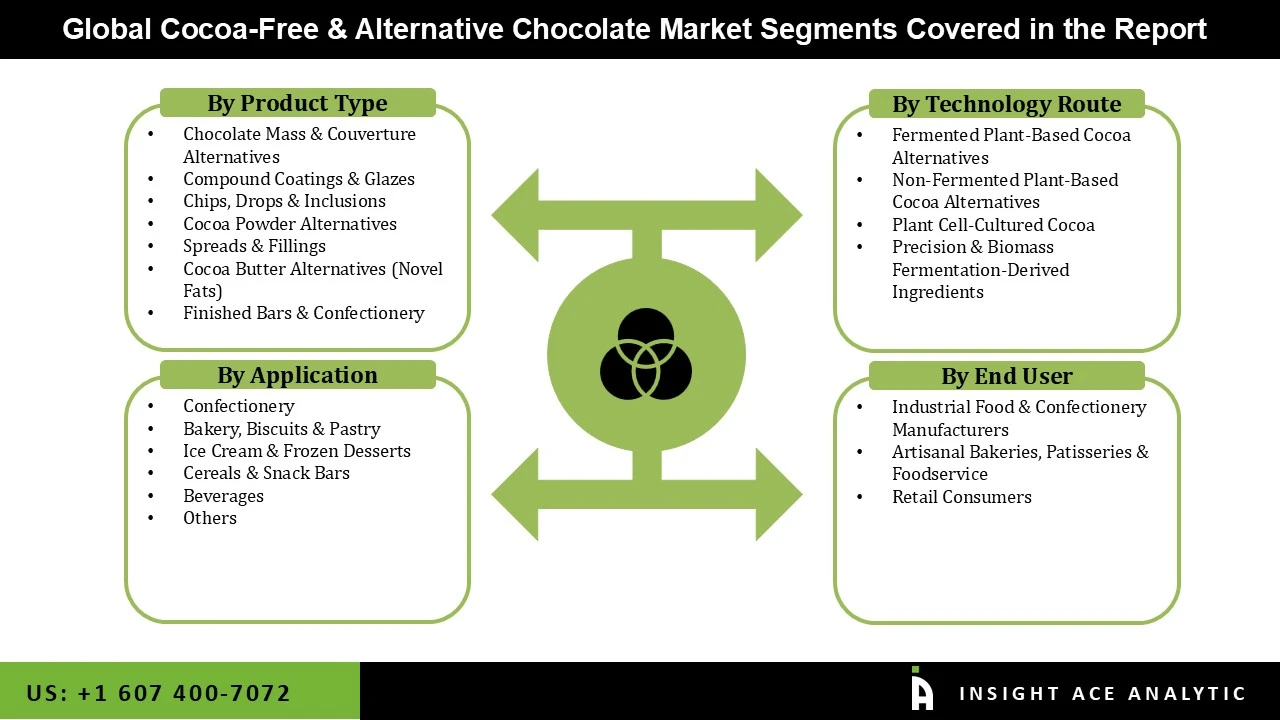
Cocoa-Free & Alternative Chocolate Market by Technology Route -
• Fermented Plant-Based Cocoa Alternatives
• Non-Fermented Plant-Based Cocoa Alternatives
• Plant Cell-Cultured Cocoa
• Precision & Biomass Fermentation-Derived Ingredients
Cocoa-Free & Alternative Chocolate Market by Application -
• Confectionery
• Bakery, Biscuits & Pastry
• Ice Cream & Frozen Desserts
• Cereals & Snack Bars
• Beverages
• Others
Cocoa-Free & Alternative Chocolate Market by End User -
• Industrial Food & Confectionery Manufacturers
• Artisanal Bakeries, Patisseries & Foodservice
• Retail Consumers
Cocoa-Free & Alternative Chocolate Market by Region-
North America-
• The US
• Canada
• Mexico
Europe-
• Germany
• The UK
• France
• Italy
• Spain
• Rest of Europe
Asia-Pacific-
• China
• Japan
• India
• South Korea
• South East Asia
• Rest of Asia Pacific
Latin America-
• Brazil
• Argentina
• Rest of Latin America
Middle East & Africa-
• GCC Countries
• South Africa
• Rest of Middle East and Africa
Research Design and Approach
This study employed a multi-step, mixed-method research approach that integrates:
- Secondary research
- Primary research
- Data triangulation
- Hybrid top-down and bottom-up modelling
- Forecasting and scenario analysis
This approach ensures a balanced and validated understanding of both macro- and micro-level market factors influencing the market.
Secondary Research
Secondary research for this study involved the collection, review, and analysis of publicly available and paid data sources to build the initial fact base, understand historical market behaviour, identify data gaps, and refine the hypotheses for primary research.
Sources Consulted
Secondary data for the market study was gathered from multiple credible sources, including:
- Government databases, regulatory bodies, and public institutions
- International organizations (WHO, OECD, IMF, World Bank, etc.)
- Commercial and paid databases
- Industry associations, trade publications, and technical journals
- Company annual reports, investor presentations, press releases, and SEC filings
- Academic research papers, patents, and scientific literature
- Previous market research publications and syndicated reports
These sources were used to compile historical data, market volumes/prices, industry trends, technological developments, and competitive insights.
Primary Research
Primary research was conducted to validate secondary data, understand real-time market dynamics, capture price points and adoption trends, and verify the assumptions used in the market modelling.
Stakeholders Interviewed
Primary interviews for this study involved:
- Manufacturers and suppliers in the market value chain
- Distributors, channel partners, and integrators
- End-users / customers (e.g., hospitals, labs, enterprises, consumers, etc., depending on the market)
- Industry experts, technology specialists, consultants, and regulatory professionals
- Senior executives (CEOs, CTOs, VPs, Directors) and product managers
Interview Process
Interviews were conducted via:
- Structured and semi-structured questionnaires
- Telephonic and video interactions
- Email correspondences
- Expert consultation sessions
Primary insights were incorporated into demand modelling, pricing analysis, technology evaluation, and market share estimation.
Data Processing, Normalization, and Validation
All collected data were processed and normalized to ensure consistency and comparability across regions and time frames.
The data validation process included:
- Standardization of units (currency conversions, volume units, inflation adjustments)
- Cross-verification of data points across multiple secondary sources
- Normalization of inconsistent datasets
- Identification and resolution of data gaps
- Outlier detection and removal through algorithmic and manual checks
- Plausibility and coherence checks across segments and geographies
This ensured that the dataset used for modelling was clean, robust, and reliable.
Market Size Estimation and Data Triangulation
Bottom-Up Approach
The bottom-up approach involved aggregating segment-level data, such as:
- Company revenues
- Product-level sales
- Installed base/usage volumes
- Adoption and penetration rates
- Pricing analysis
This method was primarily used when detailed micro-level market data were available.
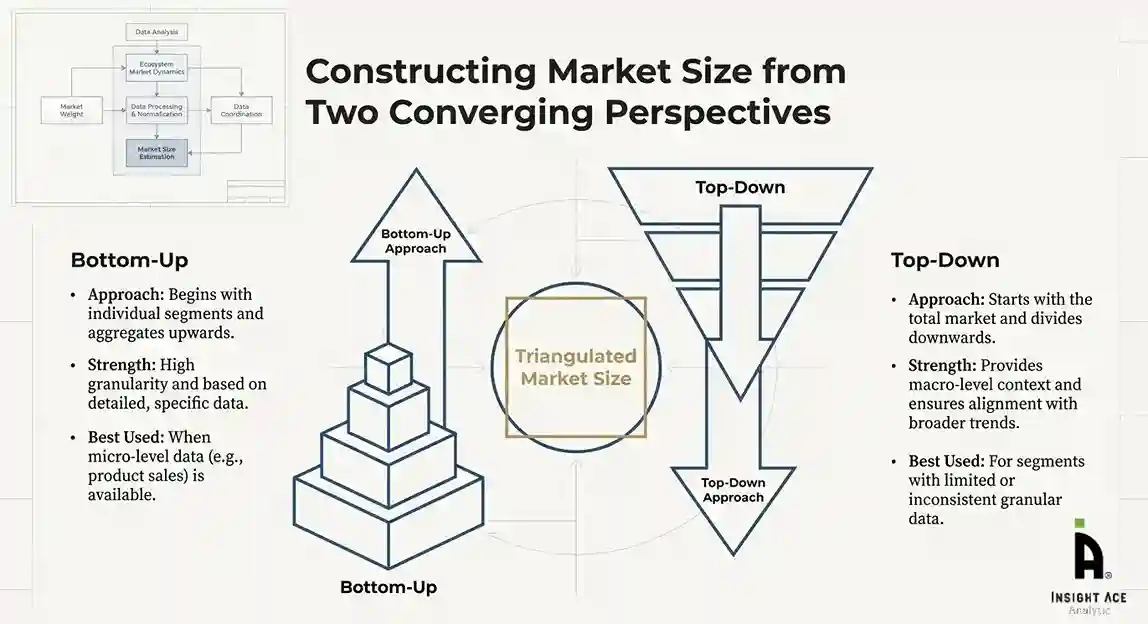
Top-Down Approach
The top-down approach used macro-level indicators:
- Parent market benchmarks
- Global/regional industry trends
- Economic indicators (GDP, demographics, spending patterns)
- Penetration and usage ratios
This approach was used for segments where granular data were limited or inconsistent.
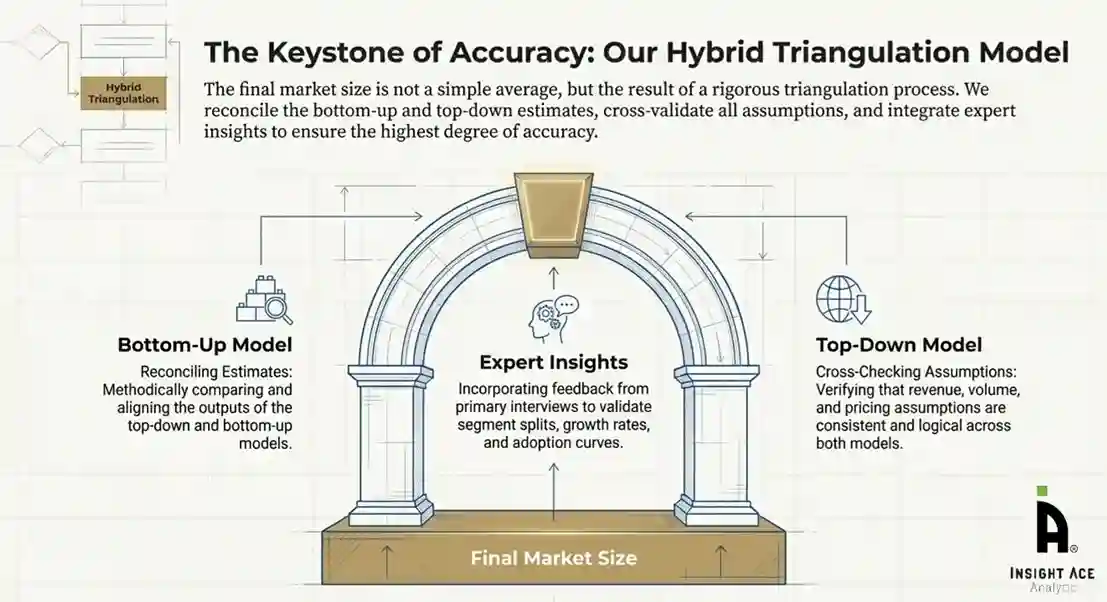
Hybrid Triangulation Approach
To ensure accuracy, a triangulated hybrid model was used. This included:
- Reconciling top-down and bottom-up estimates
- Cross-checking revenues, volumes, and pricing assumptions
- Incorporating expert insights to validate segment splits and adoption rates
This multi-angle validation yielded the final market size.
Forecasting Framework and Scenario Modelling
Market forecasts were developed using a combination of time-series modelling, adoption curve analysis, and driver-based forecasting tools.
Forecasting Methods
- Time-series modelling
- S-curve and diffusion models (for emerging technologies)
- Driver-based forecasting (GDP, disposable income, adoption rates, regulatory changes)
- Price elasticity models
- Market maturity and lifecycle-based projections
Scenario Analysis
Given inherent uncertainties, three scenarios were constructed:
- Base-Case Scenario: Expected trajectory under current conditions
- Optimistic Scenario: High adoption, favourable regulation, strong economic tailwinds
- Conservative Scenario: Slow adoption, regulatory delays, economic constraints
Sensitivity testing was conducted on key variables, including pricing, demand elasticity, and regional adoption.
Request Customization
Add countries, segments, company profiles, or extend forecast — free 10% customization with purchase.
Customize This Report →Enquire Before Buying
Speak with our analyst team about scope, methodology, pricing, or deliverable formats.
Enquire Now →Frequently Asked Questions
Cocoa Free & Alternative Chocolate Market is estimated to grow with 22.3% CAGR during the forecast period for 2026 to 2035.
Planet A Foods GmbH, Voyage Foods, Inc., Win-Win (formerly WNWN Food Labs Ltd.), Döhler GmbH (Nukoko), Foreverland Food, Endless Food Co, Green Spot Technologies, Compound Foods, Inc., Kawa Project, California Cultured, Inc., Celleste Bio Ltd.
Cocoa Free & Alternative Chocolate Market is expected to grow into Product Type, Technology Route, Application, End User and By Region
Europe region is leading the Cocoa Free & Alternative Chocolate Market.