Portable Colorimeter Market Size, Share, Scope Report 2026 to 2035
What is Portable Colorimeter Market?
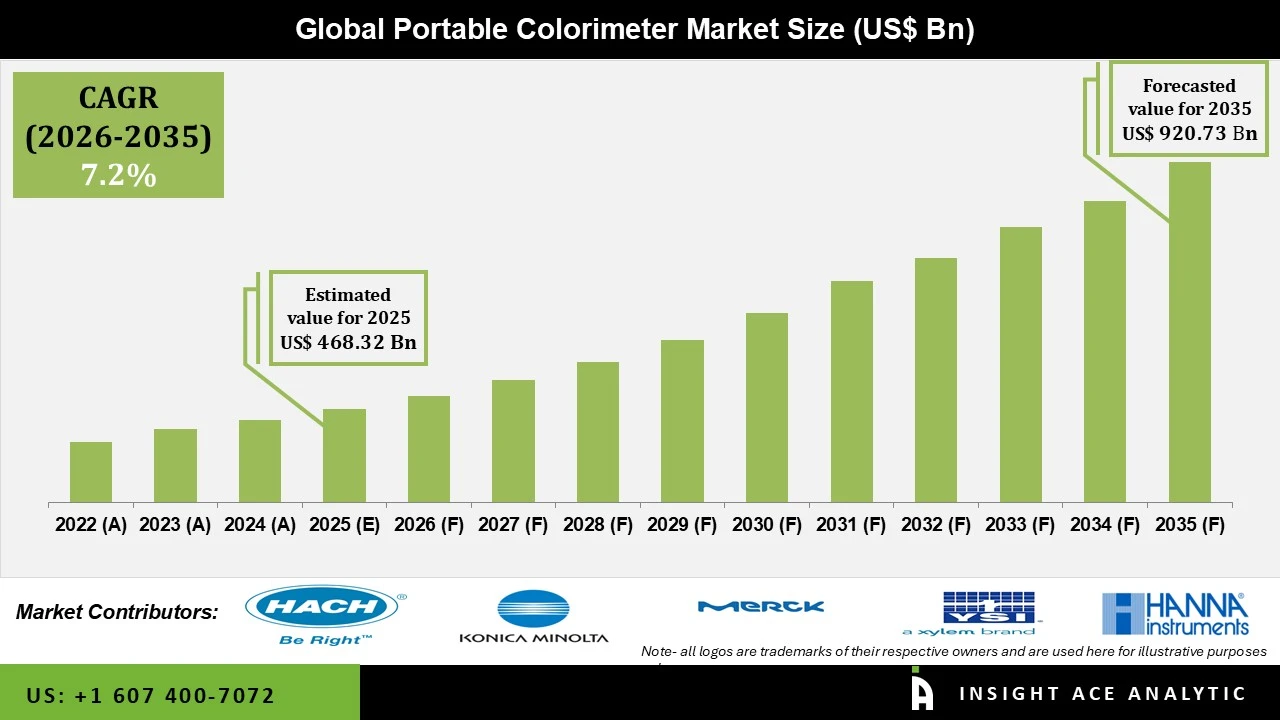
Portable Colorimeter Market Size is valued at USD 468.32 Bn in 2025 and is predicted to reach USD 920.73 Bn by the year 2035 at an 7.2 CAGR during the forecast period for 2026 to 2035.
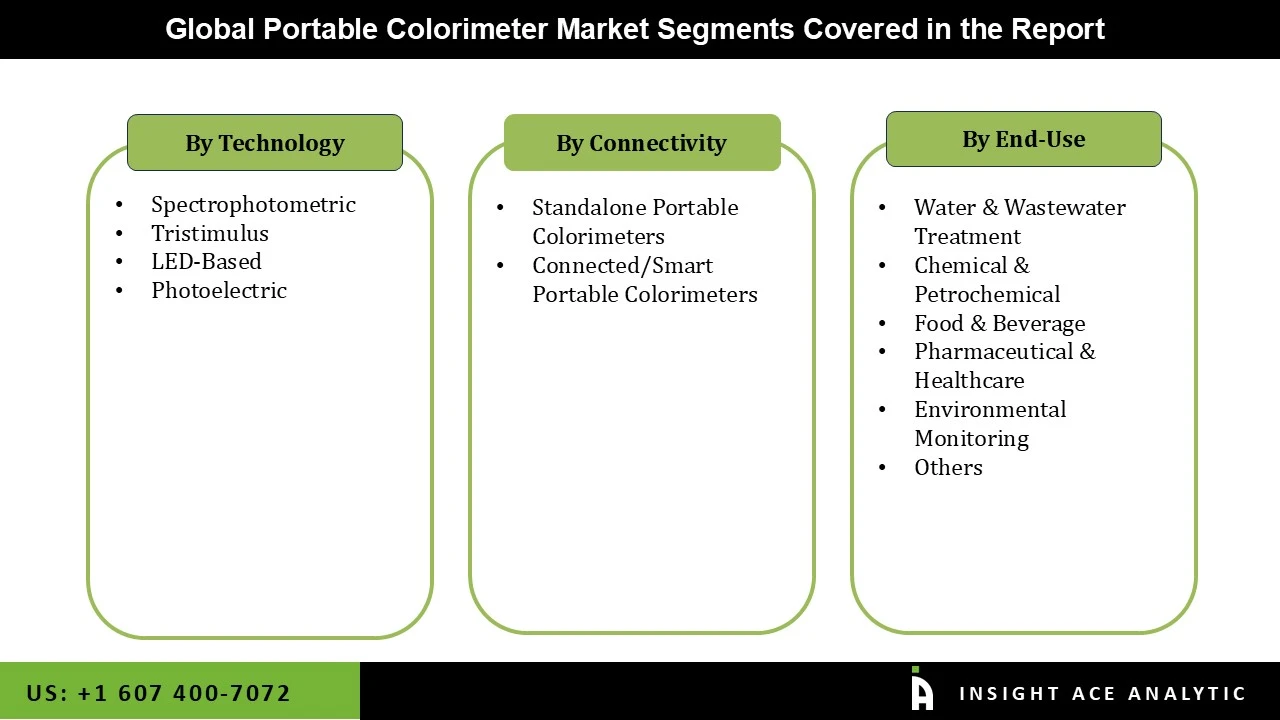
Portable Colorimeter Market Size, Share & Trends Analysis by Technology (Spectrophotometric, Tristimulus, LED-Based, Photoelectric), by Connectivity (Standalone Portable Colorimeters, Connected/Smart Portable Colorimeters), by End-User (Water & Wastewater Treatment, Chemical & Petrochemical, Food & Beverage, Pharmaceutical & Healthcare, Environmental Monitoring, Others) and Segment Forecasts, 2026 to 2035
Portable colorimeters are widely used to measure colour intensity and determine the concentration of specific substances in liquid samples. Their compact design, ease of use, and ability to provide quick measurements make them useful for field testing, laboratory work, and on-site quality control. As industries place greater emphasis on process monitoring, product quality, water quality, and regulatory compliance, demand for reliable, portable colour measurement solutions continues to grow. The market offers several types of colorimeter technologies, including spectrophotometric, tristimulus, LED-based, and photoelectric models.
Each type is suited to different needs, depending on the application, accuracy required, sample type, and environment. The portable colorimeter market is a key part of the analytical and measurement equipment industry, supporting applications in water and wastewater treatment, food and beverage, pharmaceuticals, chemicals, environmental monitoring, and other industrial sectors. However, there is growing interest in connected and smart colorimeters, as users want features like digital data storage, connectivity, automated measurements, and simpler reporting. Advances in sensors, optics, batteries, and digital interfaces are making these instruments smaller and easier to use.
The need for portable colorimeters is growing because many industries want fast and reliable testing. One of the main uses is in water and wastewater treatment, where colorimeters check things like chlorine levels, pH, and other chemicals. Facilities such as municipal water plants, industrial wastewater sites, labs, and environmental groups use these devices to test samples on-site. In the food and beverage industry, colorimeters help maintain quality and consistency by analyzing color and chemical properties.
The pharmaceutical and healthcare fields also need accurate measurements and quality checks, which creates more demand for portable testing tools. Chemical and petrochemical companies use colorimeters to monitor processes, test quality, and analyze chemicals. Environmental monitoring is also important, especially as governments and organizations focus more on water quality, pollution control, and meeting environmental standards. The need for testing in different locations is increasing demand for portable devices. Field workers can now do some tests on-site instead of always sending samples to central labs, which saves time and helps make quicker decisions.
New technology is shaping the portable colorimeter market. Manufacturers are working to make these devices more accurate, reliable, long-lasting, and easier to use. Features like LED-based optics, better sensors, microprocessors, and digital screens are making colorimeters more efficient. Connected and smart models are becoming more popular because they allow for data transfer, digital records, wireless connections, and integration with other systems.
Competitive Landscape
Which are the Leading Players in the Portable Colorimeter Market?
• Hach
• Konica Minolta Sensing Americas Inc.
• Merck KGaA
• YSI Inc.
• Hanna Equipment (India) Pvt. Ltd.
• LaMotte
• Biobase Group
• Shenzhen Threenh Technology Co., Ltd.
• Shenzhen Linshang Technology Co., Ltd.
• Aqualytic Laboratories Limited.
Driver
Growing Demand for Rapid, On-Site Testing Across Water Treatment, Food, Chemical, and Environmental Applications is Driving the Portable Colorimeter Market
As the need for quick, reliable, and easy testing grows, the portable colorimeter market is expanding. These devices are now used more often in water and wastewater treatment, food and beverage production, chemical and petrochemical industries, healthcare, and environmental monitoring. Because they are small, users can take measurements on-site instead of sending samples to a central lab. This saves time and helps people make faster decisions when they need regular monitoring. Water and wastewater treatment drives much of the demand for portable colorimeters because these facilities need to check water quality and chemical levels often. Municipal water plants, industrial wastewater sites, and environmental labs use these tools for regular field tests and process checks.
The food and beverage industry relies on colorimeters for quality control, while chemical and petrochemical companies use them for monitoring and analysis. In healthcare and pharmaceuticals, the need for accurate, repeatable results increases demand for reliable portable instruments. New technology is helping the market grow. Companies are making smaller devices with better sensors, clearer displays, longer battery life, and simpler controls. LED and spectrophotometric technologies are making measurements more accurate for different uses. Connected and smart colorimeters are also becoming popular because they let users store data, connect wirelessly, automate reports, and share results easily. As industries focus more on quality, regulations, and quick on-site testing, the demand for portable colorimeters should keep rising.
Restraint/Challenge
High Instrument Costs, Calibration Requirements, and Competition from Alternative Analytical Equipment Can Limit Portable Colorimeter Market Expansion
The cost of advanced portable colorimeters and the need for regular calibration and maintenance can create challenges for market expansion. Basic instruments may be relatively affordable, but models offering higher accuracy, advanced connectivity, data management, and specialized testing capabilities can require greater investment. This can be an important consideration for smaller laboratories, municipal facilities, and organizations operating with limited testing budgets. Regular calibration and proper maintenance are also important for ensuring reliable measurement results. Reagents, testing accessories, batteries, and other consumables can increase overall operating costs. In addition, sample conditions, testing procedures, temperature, and instrument handling can affect measurement accuracy. Users therefore require appropriate training and standardized testing practices to obtain consistent results.
The market also faces competition from laboratory-based spectrophotometers, benchtop colorimeters, test kits, sensors, and other analytical instruments. These alternatives may be preferred in applications requiring more detailed laboratory analysis or higher testing capacity. In some cases, organizations may continue to rely on centralized laboratories rather than investing in portable testing equipment. To address these challenges, manufacturers are focusing on developing easy-to-use instruments, improving battery life, simplifying calibration procedures, reducing maintenance requirements, and introducing cost-effective models. Improvements in connected technologies and digital data management can also increase the value of portable colorimeters by making testing and reporting more efficient.
Water & Wastewater Treatment Segment is Expected to Account for a Significant Share of the Portable Colorimeter Market
Water and wastewater treatment is expected to remain a significant application area for the Portable Colorimeter Market because of the growing need for regular water-quality testing and process monitoring. Municipal water treatment plants, wastewater treatment facilities, industrial plants, and environmental agencies require frequent measurements to monitor chemical parameters and maintain treatment performance. Portable colorimeters are particularly useful in field applications because they allow operators to perform measurements directly at sampling locations. This reduces reliance on laboratory testing for routine measurements and helps operators identify water-quality changes more quickly.
The growing focus on clean water, wastewater reuse, industrial discharge control, and environmental compliance is creating additional demand for convenient water-testing equipment. Portable colorimeters also support the need for decentralized testing. Industrial facilities may need to monitor water at different stages of their operations, while municipal and environmental teams may collect samples from multiple locations. Portable instruments provide flexibility for these applications and can support faster operational decisions. As governments, utilities, and industries continue investing in water and wastewater infrastructure, demand for reliable field-testing equipment is expected to increase. Improvements in sensor technology, testing methods, instrument durability, and digital connectivity are likely further to support the adoption of portable colorimeters in this segment.
Connected/Smart Portable Colorimeters are Expected to Gain Significant Demand in the Portable Colorimeter Market
Connected and smart portable colorimeters are gaining attention as organizations increasingly look for digital solutions that can simplify testing, data management, and reporting. Traditional standalone portable colorimeters remain widely used because of their simple operation and suitability for routine measurements. However, connected instruments can provide additional capabilities such as wireless data transfer, digital record-keeping, mobile-device connectivity, automated reporting, and easier sharing of test results. These capabilities are particularly useful for organizations that conduct large numbers of tests across multiple locations.
Water treatment operators, environmental monitoring teams, laboratories, food and beverage manufacturers, and industrial facilities can use connected instruments to organize measurement data and improve traceability. Digital records can also help support quality-control procedures and regulatory reporting. Technological improvements in Bluetooth, wireless connectivity, mobile applications, cloud-based data management, and embedded software are creating new opportunities for smart portable colorimeters. Manufacturers are also focusing on intuitive interfaces and automated functions to reduce testing complexity and make instruments easier for non-specialist users. However, standalone instruments are expected to remain important where users prioritize simplicity, lower costs, and basic field measurements. The balance between affordability and advanced connectivity will therefore influence product development and customer adoption across different end-user industries.
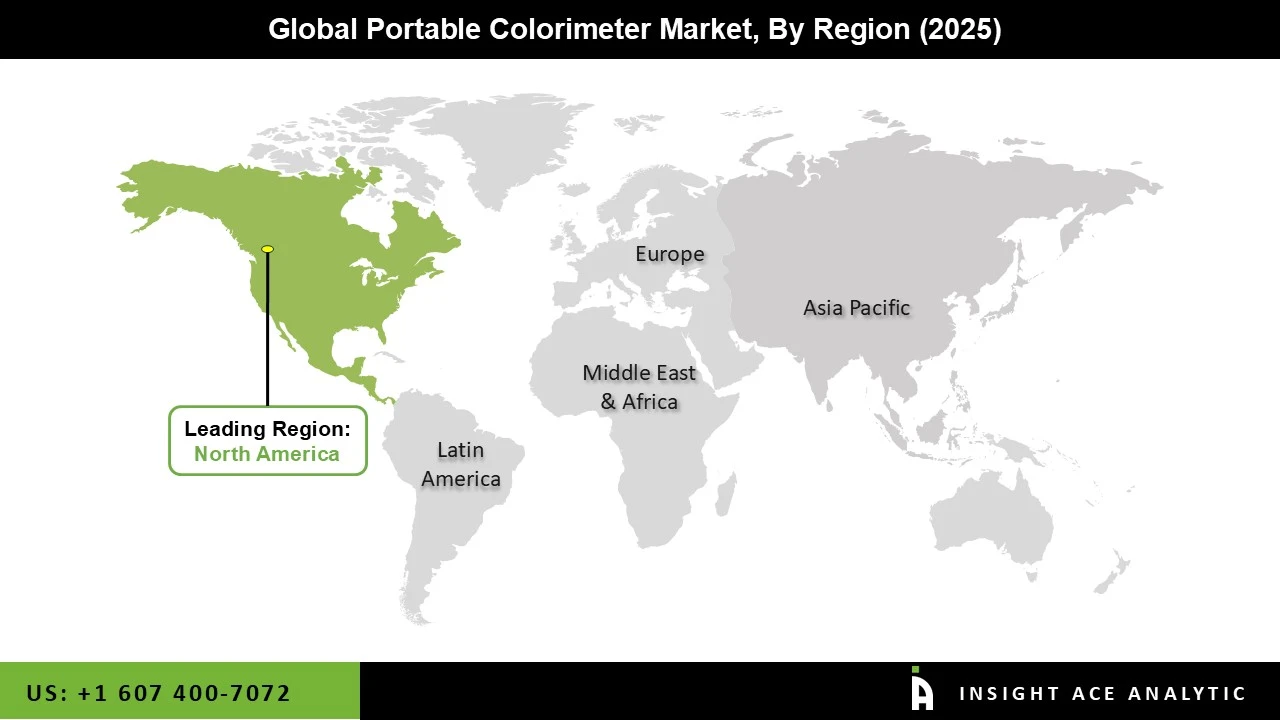
Why North America Led the Portable Colorimeter Market?
North America represents an important region in the portable colorimeter market, supported by established water and wastewater infrastructure, strong industrial activity, environmental monitoring requirements, and demand for advanced analytical equipment. The United States accounts for a significant share of regional demand, supported by extensive municipal and industrial water treatment facilities, pharmaceutical and healthcare activities, food and beverage manufacturing, and chemical processing. Water-quality monitoring is an important driver across the region. Municipalities, industrial facilities, laboratories, and environmental organizations use portable testing equipment for field measurements and routine monitoring.
Growing attention to water quality, wastewater management, industrial discharge, and environmental compliance supports demand for convenient analytical instruments. The region also has a well-established food and beverage, pharmaceutical, chemical, and petrochemical industry base. These industries require regular quality control and process monitoring, creating opportunities for portable colorimeter manufacturers. The increasing adoption of digital and connected laboratory equipment is also supporting demand for smart portable colorimeters that offer data storage, wireless connectivity, and improved reporting capabilities.
Canada also contributes to regional market demand through its water treatment, environmental monitoring, food processing, chemical, and industrial sectors. Both the U.S. and Canada continue to show interest in technologies that improve testing efficiency, portability, and data management. Overall, North America’s established industrial infrastructure, focus on water quality and environmental monitoring, and adoption of advanced analytical technologies continue to support the Portable Colorimeter Market. Manufacturers are increasingly focusing on improving measurement accuracy, connectivity, portability, battery performance, and ease of use, which is expected to shape the regional market's future development.
Key Developments
• In January 2026, Merck KGaA continued expanding its analytical and laboratory testing solutions, supporting applications across pharmaceutical, chemical, food, and environmental testing where reliable measurement and quality control are required.
• In July 2026, YSI Inc. continued developing water-quality monitoring solutions, with emphasis on portable instruments and field-testing technologies for environmental, municipal, and industrial water applications.
Portable Colorimeter Market Report Scope:
| Report Attribute | Specifications |
| Market size value in 2025 | USD 468.32 Bn |
| Revenue forecast in 2035 | USD 920.73 Bn |
| Growth Rate CAGR | CAGR of 7.2% from 2026 to 2035 |
| Quantitative Units | Representation of revenue in US$ Bn and CAGR from 2026 to 2035 |
| Historic Year | 2021 to 2025 |
| Forecast Year | 2026-2035 |
| Report Coverage | The forecast of revenue, the position of the company, the competitive market structure, growth prospects, and trends |
| Segments Covered | Technology, Connectivity, End User and By Region |
| Regional Scope | North America; Europe; Asia Pacific; Latin America; Middle East & Africa |
| Country Scope | U.S.; Canada; U.K.; Germany; China; India; Japan; Brazil; Mexico; France; Italy; Spain; South Korea; Southeast Asia |
| Competitive Landscape | Hach, Konica Minolta Sensing Americas Inc., Merck KGaA, YSI Inc., Hanna Equipment (India) Pvt. Ltd., LaMotte, Biobase Group, Shenzhen Threenh Technology Co., Ltd., Shenzhen Linshang Technology Co., Ltd., Aqualytic Laboratories Limited. |
| Customization Scope | Free customisation report with the procurement of the report, Modifications to the regional and segment scope. Geographic competitive landscape. |
| Pricing and Available Payment Methods | Explore pricing alternatives that are customised to your particular study requirements. |
Market Segmentation:
Portable Colorimeter Market by Technology -
• Filter-Based (LED-Based) Colorimeters
• Spectrophotometer-Based Colorimeters
• Digital Imaging/Camera-Based Colorimeters
• Others
Portable Colorimeter Market by Connectivity -
• Standalone Portable Colorimeters
• Connected/Smart Portable Colorimeters
Portable Colorimeter Market by End User -
• Water Utilities & Environmental Agencies
• Industrial Manufacturing
• Healthcare & Diagnostic Laboratories
• Food & Beverage
• Academic & Research Institutes
• Others
Portable Colorimeter Market by Region-
North America-
• United States
• Canada
Europe-
• Germany
• United Kingdom
• France
• Russia
• Italy
• Spain
• Rest of Europe
Asia Pacific-
• China
• India
• Japan
• South Korea
• Malaysia
• Thailand
• Indonesia
• Rest of APAC
South America-
• Brazil
• Mexico
• Argentina
• Rest of South America
Middle East & Africa (MEA)-
• GCC Countries
• South Africa
• Rest of MEA
Research Design and Approach
This study employed a multi-step, mixed-method research approach that integrates:
- Secondary research
- Primary research
- Data triangulation
- Hybrid top-down and bottom-up modelling
- Forecasting and scenario analysis
This approach ensures a balanced and validated understanding of both macro- and micro-level market factors influencing the market.
Secondary Research
Secondary research for this study involved the collection, review, and analysis of publicly available and paid data sources to build the initial fact base, understand historical market behaviour, identify data gaps, and refine the hypotheses for primary research.
Sources Consulted
Secondary data for the market study was gathered from multiple credible sources, including:
- Government databases, regulatory bodies, and public institutions
- International organizations (WHO, OECD, IMF, World Bank, etc.)
- Commercial and paid databases
- Industry associations, trade publications, and technical journals
- Company annual reports, investor presentations, press releases, and SEC filings
- Academic research papers, patents, and scientific literature
- Previous market research publications and syndicated reports
These sources were used to compile historical data, market volumes/prices, industry trends, technological developments, and competitive insights.

Primary Research
Primary research was conducted to validate secondary data, understand real-time market dynamics, capture price points and adoption trends, and verify the assumptions used in the market modelling.
Stakeholders Interviewed
Primary interviews for this study involved:
- Manufacturers and suppliers in the market value chain
- Distributors, channel partners, and integrators
- End-users / customers (e.g., hospitals, labs, enterprises, consumers, etc., depending on the market)
- Industry experts, technology specialists, consultants, and regulatory professionals
- Senior executives (CEOs, CTOs, VPs, Directors) and product managers
Interview Process
Interviews were conducted via:
- Structured and semi-structured questionnaires
- Telephonic and video interactions
- Email correspondences
- Expert consultation sessions
Primary insights were incorporated into demand modelling, pricing analysis, technology evaluation, and market share estimation.
Data Processing, Normalization, and Validation
All collected data were processed and normalized to ensure consistency and comparability across regions and time frames.
The data validation process included:
- Standardization of units (currency conversions, volume units, inflation adjustments)
- Cross-verification of data points across multiple secondary sources
- Normalization of inconsistent datasets
- Identification and resolution of data gaps
- Outlier detection and removal through algorithmic and manual checks
- Plausibility and coherence checks across segments and geographies
This ensured that the dataset used for modelling was clean, robust, and reliable.
Market Size Estimation and Data Triangulation
Bottom-Up Approach
The bottom-up approach involved aggregating segment-level data, such as:
- Company revenues
- Product-level sales
- Installed base/usage volumes
- Adoption and penetration rates
- Pricing analysis
This method was primarily used when detailed micro-level market data were available.

Top-Down Approach
The top-down approach used macro-level indicators:
- Parent market benchmarks
- Global/regional industry trends
- Economic indicators (GDP, demographics, spending patterns)
- Penetration and usage ratios
This approach was used for segments where granular data were limited or inconsistent.
Hybrid Triangulation Approach
To ensure accuracy, a triangulated hybrid model was used. This included:
- Reconciling top-down and bottom-up estimates
- Cross-checking revenues, volumes, and pricing assumptions
- Incorporating expert insights to validate segment splits and adoption rates
This multi-angle validation yielded the final market size.
Forecasting Framework and Scenario Modelling
Market forecasts were developed using a combination of time-series modelling, adoption curve analysis, and driver-based forecasting tools.
Forecasting Methods
- Time-series modelling
- S-curve and diffusion models (for emerging technologies)
- Driver-based forecasting (GDP, disposable income, adoption rates, regulatory changes)
- Price elasticity models
- Market maturity and lifecycle-based projections
Scenario Analysis
Given inherent uncertainties, three scenarios were constructed:
- Base-Case Scenario: Expected trajectory under current conditions
- Optimistic Scenario: High adoption, favourable regulation, strong economic tailwinds
- Conservative Scenario: Slow adoption, regulatory delays, economic constraints
Sensitivity testing was conducted on key variables, including pricing, demand elasticity, and regional adoption.
Request Customization
Add countries, segments, company profiles, or extend forecast — free 10% customization with purchase.
Customize This Report →Enquire Before Buying
Speak with our analyst team about scope, methodology, pricing, or deliverable formats.
Enquire Now →Frequently Asked Questions
Portable Colorimeter Market Size is valued at USD 468.32 Bn in 2025 and is predicted to reach USD 920.73 Bn by the year 2035
Portable Colorimeter Market is expected to grow at an 7.2 CAGR during the forecast period for 2026 to 2035.
Hach, Konica Minolta Sensing Americas Inc., Merck KGaA, YSI Inc., Hanna Equipment (India) Pvt. Ltd., LaMotte, Biobase Group, Shenzhen Threenh Technology Co., Ltd., Shenzhen Linshang Technology Co., Ltd., Aqualytic Laboratories Limited.
Portable Colorimeter Market is segmented into Technology, Connectivity, End User and By Region.
North America region is leading the Portable Colorimeter Market.