AI-Enabled Wearable Stroke Detection Devices Market Size, Scope, Revenue Report 2026 to 2035
What is AI-Enabled Wearable Stroke Detection Devices market?
Global AI-Enabled Wearable Stroke Detection Devices Market Size is valued at USD 32.03 Mn in 2025 and is predicted to reach USD 441.46 Mn by the year 2035 at a 30.1% CAGR during the forecast period for 2026 to 2035.
AI-Enabled Wearable Stroke Detection Devices Market Size, Share & Trends Analysis By Detection Technology (Neural Signal Sensing Wearables, Multimodal Biosignal Fusion Devices, Machine Learning Stroke Onset Algorithms), by Application (Immediate Stroke Alert Systems, At-Home Continuous Monitoring, Emergency Response Optimization), and Segment Forecasts, 2026 to 2035.
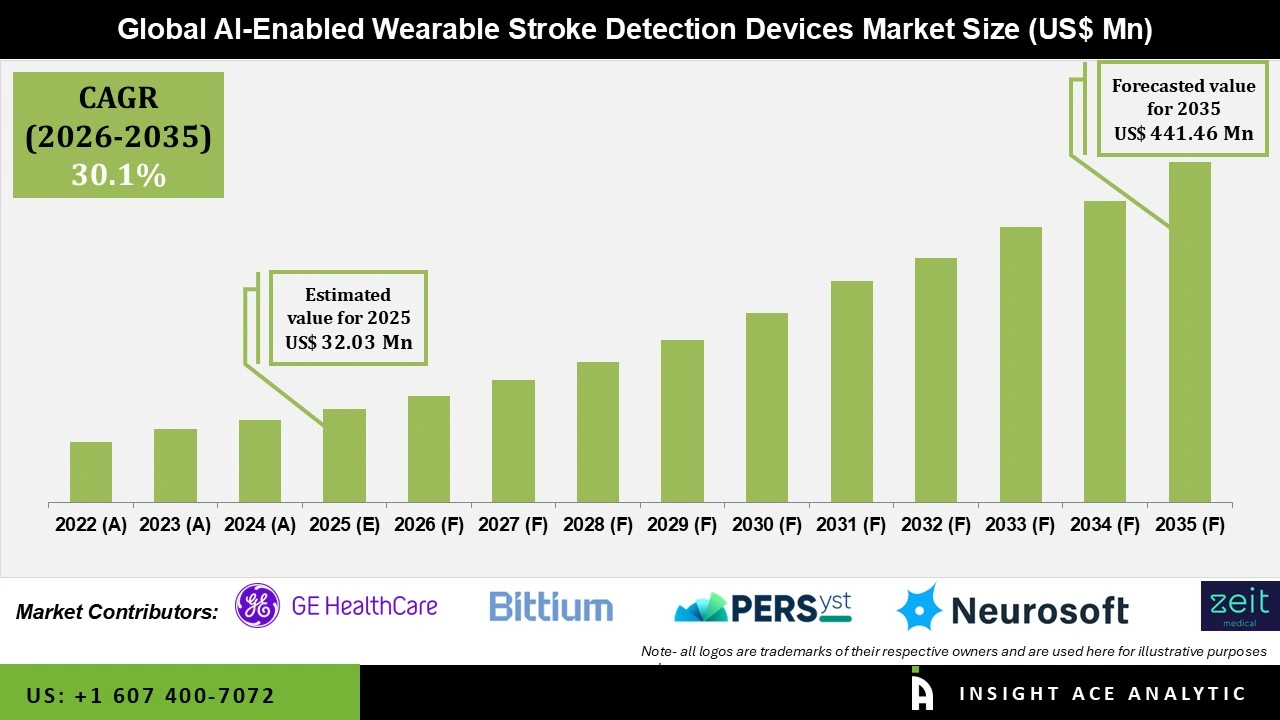
AI enabled wearable stroke detection devices are innovative wearable technology devices in the healthcare domain where AI sensors are incorporated into biosensors and used to monitor physiological parameters of patients continuously and detect early signs of strokes. Such devices continuously monitor health parameters like heart rhythm, oxygen level in the bloodstream, blood pressure, movements of the body and neurological symptoms and use machine learning algorithms to analyze them. AI enabled wearable devices can alert about the risks of stroke and prevent its occurrence and help avoid disability or death caused by it. These devices are widely implemented in hospitals, in-home healthcare, rehabilitation centers and among high-risk groups of population.
The rise in the number of strokes around the world, along with the increasing awareness about preventive healthcare is one of the main drivers of the AI enabled wearable stroke detection devices market. As stated by various international health organizations, strokes are the leading cause of mortality and disabilities in the world. In the current trend of the proactive approach to diseases and patient remote monitoring in healthcare sector, AI-powered wearable technologies became popular. They help detect cardiac arrhythmia, including atrial fibrillation, which is the main cause of the ischemic stroke.
Improvements in artificial intelligence, biosensor technology, cloud computing, and wireless technology have helped spur market growth even more. The capabilities of AI have improved significantly in their ability to detect small physiological changes that other monitoring systems might miss. The use of smartphones with wearables and the development of cloud computing and telemedicine solutions has increased patient compliance and allowed healthcare practitioners to monitor patients in real-time from remote locations. With the ongoing development of digital healthcare infrastructure across developed and emerging countries, AI-based wearable stroke detection systems will see widespread adoption going forward.
Competitive Landscape
Which are the Leading Players in AI-Enabled Wearable Stroke Detection Devices market?
- Medtronic plc
- Koninklijke Philips N.V.
- Abbott Laboratories
- GE HealthCare
- iRhythm Technologies
- BioIntelliSense
- VitalConnect
- Empatica Inc.
- AliveCor Inc.
- Preventice Solutions
- Biobeat Technologies
- Withings
- Omron Healthcare
- Boston Scientific Corporation
- Samsung Electronics
- Apple Inc.
- Garmin Ltd.
- Fitbit (Google)
- Dexcom Inc.
- Siemens Healthineers
- Masimo Corporation
- CardiacSense
- Neuroglee Health
- Aktiia
- Biofourmis
- SmartCardia
- Current Health
- Isansys Lifecare
- Bardy Diagnostics
- Vivalink
Market Dynamics
Driver
Rising Adoption of Remote Patient Monitoring and Digital Healthcare
The rising adoption of remote patient monitoring (RPM) technology is among the most important factors responsible for the growth of the AI-enabled wearable stroke detection devices market. With the use of wearable medical devices in monitoring patients in environments outside hospitals, especially seniors and those affected by cardiovascular conditions that can trigger a stroke, the need for such devices has increased. The fast growth in telehealth, along with supportive government policies for digital healthcare, has further contributed to the rise in demand for wearable stroke detection technologies. Furthermore, advancements in AI-based algorithms have improved the detection accuracy of arrhythmia, motion analysis, and predictive analytics. The growing emphasis of healthcare organizations on preventive medicine and reduction in hospital readmissions will continue to support the demand for intelligent wearables in the future.
Restrain/Challenge
Regulatory Complexity and Clinical Validation Requirements
While technological innovation is happening at a fast pace, the rigorous process of regulatory approval continues to pose a key challenge for the AI-powered wearable stroke detection device market. This is because such devices are critical to clinical decision-making, and hence, it is imperative that the company demonstrates high degrees of diagnostic accuracy and reliability through various clinical trials. The algorithms used by AI devices need constant validation from a wide range of patients’ data to reduce the number of false alerts and increase prediction accuracy. The different characteristics of individual patients – including demographics, lifestyle, and pre-existing illnesses – might impact the algorithm’s performance. Such product development is costly and lengthy.
Wearable ECG Monitors Segment is Expected to Dominate the AI-Enabled Wearable Stroke Detection Devices Market
The wearable ECG monitors segment captured the maximum share in 2025. The wearable ECG monitors continuously measure heart rhythm and can be used for the detection of atrial fibrillation, which happens to be one of the primary reasons for ischemic stroke. It is due to the clinical accuracy and ease of use that the wearable ECG monitors segment is more preferred for stroke risk assessment using Artificial Intelligence analytics.
Artificial Intelligence Technology Segment is Growing at the Highest Rate
The AI technology market segment is likely to register the highest CAGR during the forecast period. Artificial intelligence helps analyze huge amounts of physiological data generated through wearables constantly, thereby facilitating identification of the early symptoms of a stroke accurately and fast. The machine learning algorithms improve the predictive models by learning from health patterns specific to the patients, thereby providing customized monitoring and minimizing the number of false alarms. Innovation in AI software is likely to be an important growth driver for the segment.
Why North America Led the AI-Enabled Wearable Stroke Detection Devices market?
North America was the dominant region in the market for AI-enabled wearable stroke detection devices in 2025 due to the availability of advanced healthcare facilities, widespread use of wearable medical devices, and investments in the development of innovative healthcare solutions. The US is witnessing rapid growth in the adoption of AI-enabled remote patient monitoring platforms due to favorable reimbursement policies and rising healthcare spending. Moreover, the availability of key manufacturers and developers of AI software and medical devices is another factor supporting regional market dominance. Further, the rising awareness about stroke prevention, increasing incidence of cardiovascular diseases, and quick adoption of telemedicine services are fueling market growth in North America.
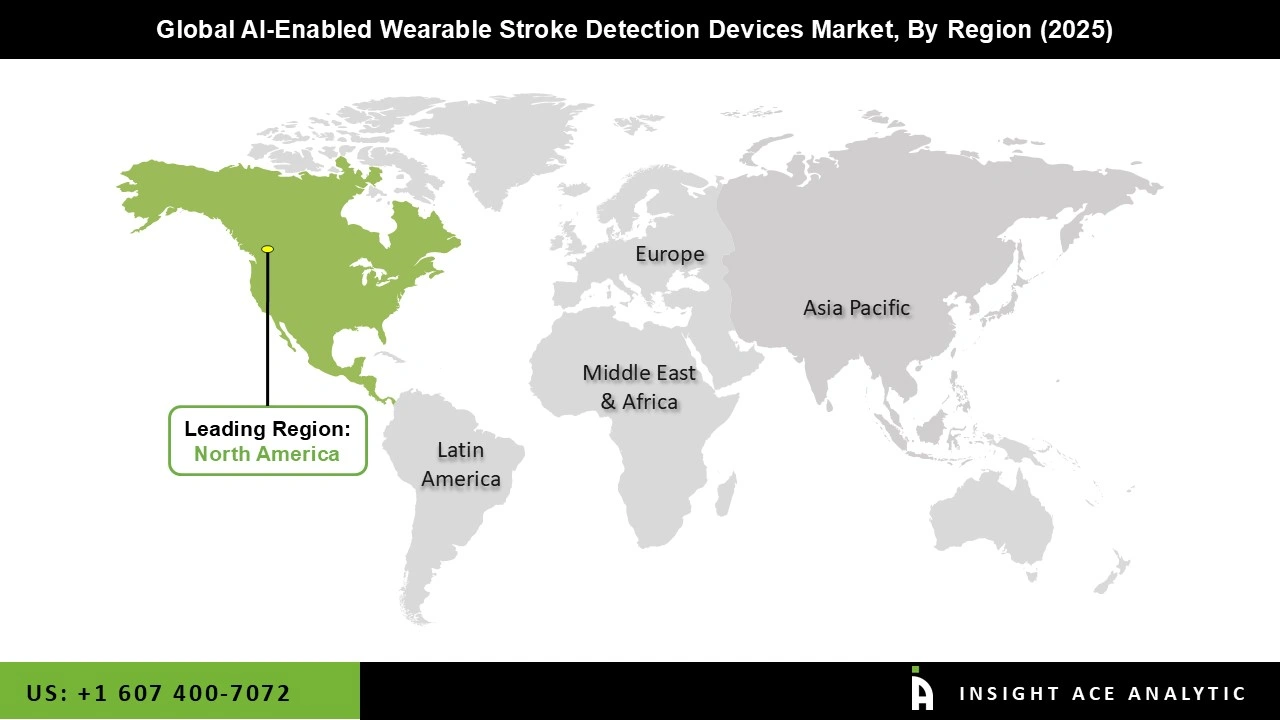
The Asia-Pacific region will see the highest CAGR during the forecast period. The increasing healthcare digitization, aging population, higher penetration rate of smartphones, and increased investment in artificial intelligence are contributing to the increasing usage of wearable health technology devices in countries like China, Japan, South Korea, and India. Other factors driving growth in the market include the efforts of governments towards digital healthcare and remote patient monitoring.
Key Development
• In February 2025, BioIntelliSense partnered with Hicuity Health to combine its BioButton continuous wearable-monitoring technology with remote clinical-monitoring services. The platform continuously collects vital-sign and biometric information and is intended to support earlier identification of patient deterioration in hospital and home settings.
AI-Enabled Wearable Stroke Detection Devices market Report Scope:
| Report Attribute | Specifications |
| Market size value in 2025 | USD 32.03 Mn |
| Revenue forecast in 2035 | USD 441.46 Mn |
| Growth Rate CAGR | CAGR of 30.1% from 2026 to 2035 |
| Quantitative Units | Representation of revenue in US$ Mn and CAGR from 2026 to 2035 |
| Historic Year | 2022 to 2025 |
| Forecast Year | 2026-2035 |
| Report Coverage | The forecast of revenue, the position of the company, the competitive market structure, growth prospects, and trends |
| Segments Covered | Detection Technology, Application, and By Region |
| Regional Scope | North America; Europe; Asia Pacific; Latin America; Middle East & Africa |
| Country Scope | U.S.; Canada; U.K.; Germany; China; India; Japan; Brazil; Mexico; The UK; France; Italy; Spain; China; Japan; India; South Korea; Southeast Asia; South Korea; Southeast Asia |
| Competitive Landscape | Medtronic plc, Philips, Abbott, GE HealthCare, iRhythm Technologies, BioIntelliSense, VitalConnect, Empatica, AliveCor, Preventice Solutions, Biobeat, Withings, Omron Healthcare, Boston Scientific, Samsung Electronics, Apple Inc., Garmin, Fitbit (Google), Dexcom, Siemens Healthineers, Masimo, CardiacSense, Neuroglee Health, Aktiia, Biofourmis, SmartCardia, Current Health, Isansys Lifecare, Bardy Diagnostics, and Vivalink. |
| Customization Scope | Free customization report with the procurement of the report, Modifications to the regional and segment scope. Geographic competitive landscape. |
| Pricing and Available Payment Methods | Explore pricing alternatives that are customized to your particular study requirements. |
Segmentations AI-Enabled Wearable Stroke Detection Devices market:
AI-Enabled Wearable Stroke Detection Devices market by Detection Technology -
- Neural Signal Sensing Wearables
- Multimodal Biosignal Fusion Devices
- Machine Learning Stroke Onset Algorithms
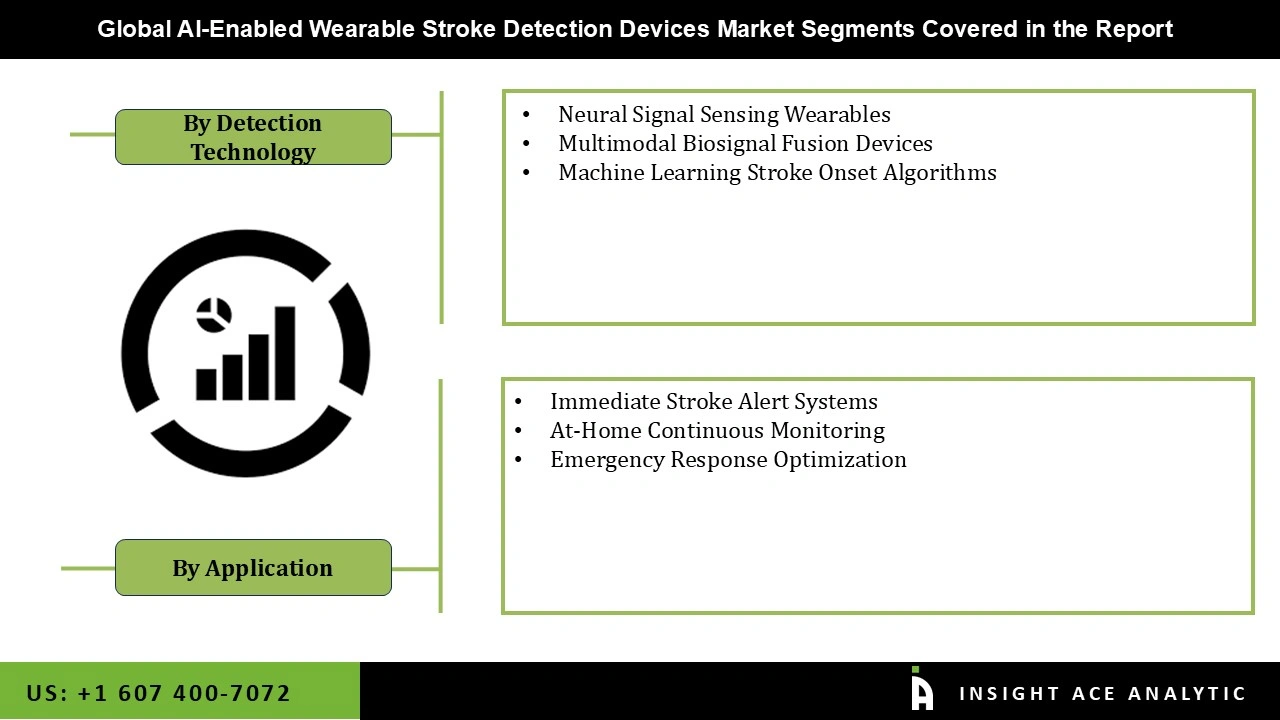
AI-Enabled Wearable Stroke Detection Devices market by Application-
- Immediate Stroke Alert Systems
- At-Home Continuous Monitoring
- Emergency Response Optimization
AI-Enabled Wearable Stroke Detection Devices market By Region-
- North America-
- The US
- Canada
- Europe-
- Germany
- The UK
- France
- Italy
- Spain
- Rest of Europe
- Asia-Pacific-
- China
- Japan
- India
- South Korea
- South East Asia
- Rest of Asia Pacific
- Latin America-
- Brazil
- Argentina
- Mexico
- Rest of Latin America
- Middle East and Africa-
- GCC Countries
- South Africa
- Rest of Middle East and Africa
Research Design and Approach
This study employed a multi-step, mixed-method research approach that integrates:
- Secondary research
- Primary research
- Data triangulation
- Hybrid top-down and bottom-up modelling
- Forecasting and scenario analysis
This approach ensures a balanced and validated understanding of both macro- and micro-level market factors influencing the market.
Secondary Research
Secondary research for this study involved the collection, review, and analysis of publicly available and paid data sources to build the initial fact base, understand historical market behaviour, identify data gaps, and refine the hypotheses for primary research.
Sources Consulted
Secondary data for the market study was gathered from multiple credible sources, including:
- Government databases, regulatory bodies, and public institutions
- International organizations (WHO, OECD, IMF, World Bank, etc.)
- Commercial and paid databases
- Industry associations, trade publications, and technical journals
- Company annual reports, investor presentations, press releases, and SEC filings
- Academic research papers, patents, and scientific literature
- Previous market research publications and syndicated reports
These sources were used to compile historical data, market volumes/prices, industry trends, technological developments, and competitive insights.

Primary Research
Primary research was conducted to validate secondary data, understand real-time market dynamics, capture price points and adoption trends, and verify the assumptions used in the market modelling.
Stakeholders Interviewed
Primary interviews for this study involved:
- Manufacturers and suppliers in the market value chain
- Distributors, channel partners, and integrators
- End-users / customers (e.g., hospitals, labs, enterprises, consumers, etc., depending on the market)
- Industry experts, technology specialists, consultants, and regulatory professionals
- Senior executives (CEOs, CTOs, VPs, Directors) and product managers
Interview Process
Interviews were conducted via:
- Structured and semi-structured questionnaires
- Telephonic and video interactions
- Email correspondences
- Expert consultation sessions
Primary insights were incorporated into demand modelling, pricing analysis, technology evaluation, and market share estimation.
Data Processing, Normalization, and Validation
All collected data were processed and normalized to ensure consistency and comparability across regions and time frames.
The data validation process included:
- Standardization of units (currency conversions, volume units, inflation adjustments)
- Cross-verification of data points across multiple secondary sources
- Normalization of inconsistent datasets
- Identification and resolution of data gaps
- Outlier detection and removal through algorithmic and manual checks
- Plausibility and coherence checks across segments and geographies
This ensured that the dataset used for modelling was clean, robust, and reliable.
Market Size Estimation and Data Triangulation
Bottom-Up Approach
The bottom-up approach involved aggregating segment-level data, such as:
- Company revenues
- Product-level sales
- Installed base/usage volumes
- Adoption and penetration rates
- Pricing analysis
This method was primarily used when detailed micro-level market data were available.

Top-Down Approach
The top-down approach used macro-level indicators:
- Parent market benchmarks
- Global/regional industry trends
- Economic indicators (GDP, demographics, spending patterns)
- Penetration and usage ratios
This approach was used for segments where granular data were limited or inconsistent.
Hybrid Triangulation Approach
To ensure accuracy, a triangulated hybrid model was used. This included:
- Reconciling top-down and bottom-up estimates
- Cross-checking revenues, volumes, and pricing assumptions
- Incorporating expert insights to validate segment splits and adoption rates
This multi-angle validation yielded the final market size.
Forecasting Framework and Scenario Modelling
Market forecasts were developed using a combination of time-series modelling, adoption curve analysis, and driver-based forecasting tools.
Forecasting Methods
- Time-series modelling
- S-curve and diffusion models (for emerging technologies)
- Driver-based forecasting (GDP, disposable income, adoption rates, regulatory changes)
- Price elasticity models
- Market maturity and lifecycle-based projections
Scenario Analysis
Given inherent uncertainties, three scenarios were constructed:
- Base-Case Scenario: Expected trajectory under current conditions
- Optimistic Scenario: High adoption, favourable regulation, strong economic tailwinds
- Conservative Scenario: Slow adoption, regulatory delays, economic constraints
Sensitivity testing was conducted on key variables, including pricing, demand elasticity, and regional adoption.
Request Customization
Add countries, segments, company profiles, or extend forecast — free 10% customization with purchase.
Customize This Report →Enquire Before Buying
Speak with our analyst team about scope, methodology, pricing, or deliverable formats.
Enquire Now →Frequently Asked Questions
AI-Enabled Wearable Stroke Detection Devices Market Size is valued at USD 32.03 Mn in 2025 and is predicted to reach USD 441.46 Mn by the year 2035
The AI-Enabled Wearable Stroke Detection Devices Market is expected to grow at a 30.1% CAGR during the forecast period for 2026 to 2035
Medtronic plc, Philips, Abbott, GE HealthCare, iRhythm Technologies, BioIntelliSense, VitalConnect, Empatica, AliveCor, Preventice Solutions, Biobeat, Withings, Omron Healthcare, Boston Scientific, Samsung Electronics, Apple Inc., Garmin, Fitbit (Google), Dexcom, Siemens Healthineers, Masimo, CardiacSense, Neuroglee Health, Aktiia, Biofourmis, SmartCardia, Current Health, Isansys Lifecare, Bardy Diagnostics, Vivalink and Other.
AI-Enabled Wearable Stroke Detection Devices Market is segmented into Detection Technology, Application, and Other.
North America region is leading the AI-Enabled Wearable Stroke Detection Devices Market.