Smart Hospital Bed Market Size, Trend, Forecast Report 2026 to 2035
What is Smart Hospital Bed Market Size?
Smart Hospital Bed Market likely to grow with the CAGR of 10.2% during the forecast period for 2026 to 2035.
Smart Hospital Bed Market Size, Share & Trends Analysis Distribution by Offering (Hardware, Software & Platforms, Services & Subscriptions), by Capability / Functional Layer (Sensing & Safety Automation, Connectivity & Communications, Clinical Workflow Integration, Monitoring & Clinical-Data Integration, Fleet / Asset & Service Digitalization, Predictive & Advanced Analytics), by Connectivity Architecture (Wired / Cabled, Wireless / Cable-less, Hybrid), by Installation Type (New-Build / Greenfield, First-Time Retrofit / Fleet Upgrade, Replacement & Expansion), by Acuity / Bed Platform, by Clinical Department / Care Area, by End User and Segment Forecasts, 2026 to 2035
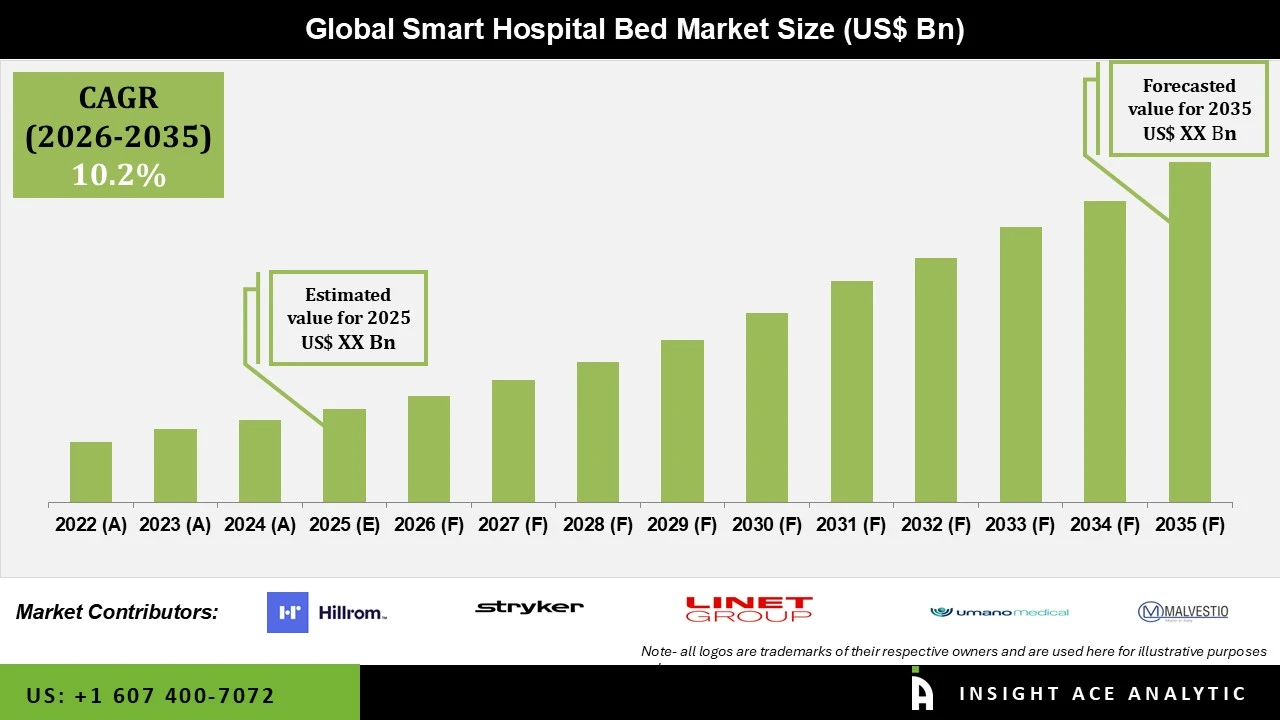
The Smart Hospital Bed Market is growing as hospitals and healthcare providers look for connected, automated, and patient-focused solutions to improve care quality, staff efficiency, and patient safety. Smart hospital beds use advanced hardware, sensors, connectivity, software, and monitoring features to help with patient positioning, fall prevention, weight monitoring, bed-exit alerts, vital-sign tracking, and workflow management. These beds are now used in general wards, intensive care units, emergency departments, surgical areas, maternity units, rehabilitation centers, and long-term care settings. As hospitals work to improve patient outcomes while dealing with staff shortages and rising costs, the demand for connected and intelligent bed systems is likely to rise.
Technological advancements are playing an important role in shaping the smart hospital bed market. Modern beds are increasingly equipped with sensors and connected systems that can collect and transmit patient and bed-related information to hospital networks and clinical platforms. Wireless connectivity is gaining popularity because it allows healthcare staff to monitor bed status and patient activity without relying heavily on fixed cabling. Integration with electronic health records (EHRs), nurse-call systems, hospital information systems, and clinical monitoring platforms can also help healthcare professionals access relevant information more efficiently. In addition, predictive analytics and artificial intelligence are creating opportunities for smarter patient monitoring, early risk identification, and more proactive care. Features such as automated bed adjustments, fall-risk alerts, patient repositioning support, and pressure-injury prevention can help improve both patient safety and caregiver efficiency.
The growing number of hospital admissions, ageing populations, and increasing prevalence of chronic and mobility-related conditions are supporting demand for advanced hospital beds. Intensive and critical-care units represent an important application area because patients often require continuous monitoring, frequent repositioning, and specialised support. General medical and surgical wards are also adopting smart beds to improve workflow and reduce the workload associated with routine patient monitoring. In addition, hospitals are increasingly interested in fleet and asset management solutions that let them track bed availability, utilisation, maintenance requirements, and movement across departments.
These capabilities can help healthcare organisations make better use of existing bed capacity and improve operational efficiency. Another important trend is the growing adoption of software platforms and data-driven hospital bed management. Connected beds can become part of a broader hospital digital ecosystem, allowing information from multiple beds and departments to be collected and analysed. This can support real-time visibility into bed availability, maintenance status, patient movement, and clinical alerts. Cloud-based platforms and wireless technologies are also making it easier for hospitals to manage larger fleets of connected beds. As healthcare providers continue their digital transformation, smart beds are increasingly viewed not only as medical equipment but also as connected assets that can support broader clinical and operational workflows.
Despite these opportunities, the market faces several challenges. Smart hospital beds generally cost more upfront than conventional beds because they include sensors, connectivity systems, software, and advanced automation features. Hospitals may also need to invest in network infrastructure, cybersecurity, staff training, software integration, and ongoing maintenance. Integrating smart beds with existing hospital information systems can be technically complex, particularly in facilities with older infrastructure. Data privacy and cybersecurity are also important considerations because connected beds may generate and transmit patient-related information. In addition, healthcare providers need reliable technical support and maintenance services to ensure that smart beds remain operational and safe.
Competitive Landscape
Which are the Leading Players in the Smart Hospital Bed Market?
• Baxter International (Hillrom)
• Stryker
• LINET Group SE
• Umano Medical
• Malvestio
• Paramount Bed
• Stiegelmeyer
• Arjo
• Agiliti
• Joerns Healthcare
• Famed Żywiec
• Pardo
• Getinge
• Invacare
• Medline
Market Dynamics
Driver
Growing Demand for Patient Safety, Connected Care, and Hospital Automation
The growing focus on patient safety and better clinical outcomes is a major factor supporting the Smart Hospital Bed Market. Hospitals are increasingly adopting smart beds with sensors, automated positioning, bed-exit alerts, patient monitoring capabilities, and connectivity features to support safer, more efficient care. These technologies can help healthcare professionals monitor patients more effectively, reduce fall risks, support pressure-injury prevention, and improve patient positioning. The demand is particularly strong in intensive care, emergency, surgical, geriatric, and long-term care settings, where patients often require continuous monitoring and frequent repositioning. Smart beds can also connect with hospital information systems, nurse-call platforms, electronic health records, and other clinical technologies, helping staff access relevant information more efficiently.
As hospitals continue investing in digital transformation, connected medical equipment and automated clinical workflows are becoming increasingly important. The growing use of wireless connectivity, sensors, artificial intelligence, predictive analytics, and cloud-based platforms is creating additional opportunities. Hospitals are also looking beyond individual beds and adopting fleet management solutions that can track bed availability, utilisation, maintenance, and movement across departments. These capabilities can help hospitals improve resource utilisation while reducing manual workload for healthcare staff.
Restraint / Challenge
High Initial Costs, Integration Complexity, and Cybersecurity Concerns
Even though the Smart Hospital Bed Market has strong growth potential, it faces challenges like high costs and complex systems. Smart beds usually cost more than regular hospital beds because they have sensors, electronic controls, connectivity, software, monitoring, and automation. Hospitals may also need to spend on network upgrades, software, maintenance, staff training, and technical support. Connecting smart beds to existing hospital systems can also be difficult. Hospitals often use different electronic health records, nurse-call systems, and clinical platforms, so making sure everything works together is important. Older hospitals might need to upgrade their infrastructure before they can use smart beds fully. Cybersecurity and protecting patient data are also concerns, since connected beds handle sensitive information. Hospitals need strong security for their devices and networks. Maintenance, software updates, technical support, and staff training can add to the total cost. These issues may slow adoption, especially for smaller hospitals with tight budgets.
Sensing & Safety Automation Segment is Expected to Drive the Smart Hospital Bed Market
The Sensing & Safety Automation segment is expected to remain a major growth area in the smart hospital bed market. Smart beds increasingly use sensors to monitor patient movement, bed occupancy, weight, position, and other safety-related parameters. Bed-exit alerts can help healthcare professionals respond quickly when patients at risk of falling attempt to leave the bed. Automated positioning and adjustment features can also improve patient comfort and support clinical care. In intensive care and long-term care environments, automated functions can assist with repositioning and help reduce the risk of pressure injuries. These capabilities can also reduce the need for some routine manual interventions by nursing staff. As hospitals focus more on patient safety and efficient care, the need for beds with built-in sensors and automation is expected to grow. Ongoing advances in sensors, artificial intelligence, and automated controls will likely make smart hospital beds even more capable.
Wireless / Cable-less Segment is Expected to Drive the Smart Hospital Bed Market
The Wireless / Cable-less segment is expected to grow strongly as hospitals increasingly adopt connected medical equipment and wireless healthcare infrastructure. Wireless smart beds can communicate with hospital networks and clinical systems without relying heavily on fixed cabling, providing greater flexibility when beds are moved between rooms, wards, or departments. Wireless connectivity can support features such as remote bed-status monitoring, patient alerts, asset tracking, and communication with clinical platforms. It can also make it easier for hospitals to manage large fleets of beds and monitor their utilisation across different care areas. The increasing adoption of wireless technologies, connected devices, and hospital-wide digital platforms is expected to support this segment. As healthcare providers seek flexible, scalable solutions that integrate into modern digital hospitals, wireless smart beds are likely to become increasingly attractive.
Why North America Leads the Smart Hospital Bed Market?
North America is expected to maintain a leading position in the smart hospital bed market due to its advanced healthcare infrastructure, high adoption of connected medical technologies, and strong investment in hospital digitalisation. The U.S. has a large network of hospitals, academic medical centres, speciality hospitals, and critical-care facilities that are increasingly adopting smart healthcare equipment. The region benefits from strong demand for technologies that improve patient safety, reduce clinical workload, and support hospital efficiency. Hospitals are increasingly investing in connected beds, wireless monitoring, electronic health records, nurse-call integration, asset tracking, and clinical-data platforms. Established medical technology companies and a strong ecosystem of healthcare technology providers also support innovation in the region. The growing use of sensors, wireless connectivity, predictive analytics, and automated patient-care technologies is expected to create additional opportunities.
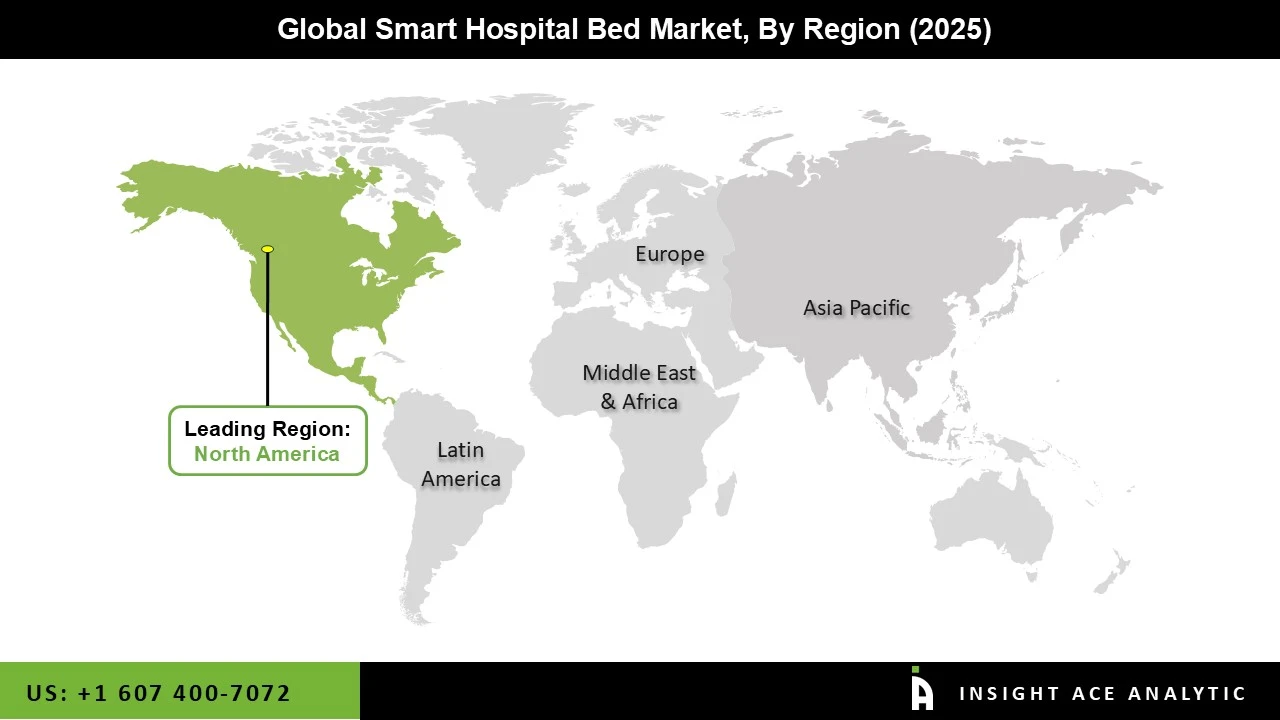
North American hospitals are also increasingly focused on reducing patient falls, improving pressure-injury prevention, optimising bed utilisation, and supporting nursing staff through automation. Asia Pacific is expected to witness strong growth during the forecast period. Increasing healthcare spending, hospital infrastructure development, expanding private healthcare facilities, and growing adoption of digital health technologies are supporting demand for smart hospital equipment across the region. Countries such as China, Japan, India, South Korea, and Australia are investing in modern hospitals and connected healthcare systems.
Key Developments:
• In January 2026, Baxter International introduced the Dynamo Series smart stretcher in the U.S., adding connected technologies, fall-prevention features, powered positioning, and optional wireless connectivity to its portfolio of smart beds, surfaces, and connected care solutions. The launch supports safer patient handling and aims to reduce unnecessary patient transfers in emergency, perioperative, and transport settings.
• In March 2026, Stryker launched its SmartHospital Platform, a digital ecosystem designed to connect medical devices, data, and care teams across hospitals. The platform includes workflow management, clinical communication, virtual care, and ambient intelligence capabilities, reflecting the industry's move toward more connected and digitally integrated hospital environments.
Smart Hospital Bed Market Report Scope:
| Report Attribute | Specifications |
| Growth Rate CAGR | CAGR of 10.2% from 2026 to 2035 |
| Quantitative Units | Representation of revenue in US$ Bn and CAGR from 2026 to 2035 |
| Historic Year | 2021 to 2025 |
| Forecast Year | 2026-2035 |
| Report Coverage | The forecast of revenue, the position of the company, the competitive market structure, growth prospects, and trends |
| Segments Covered | Offering, Capability / Functional Layer, Connectivity Architecture, Installation Type, Acuity / Bed Platform, Clinical Department / Care Area, End User and By Region |
| Regional Scope | North America; Europe; Asia Pacific; Latin America; Middle East & Africa |
| Country Scope | U.S.; Canada; U.K.; Germany; China; India; Japan; Brazil; Mexico; France; Italy; Spain; South Korea; Southeast Asia |
| Competitive Landscape | Baxter International (Hillrom), Stryker, LINET Group SE, Umano Medical, Malvestio, Paramount Bed, Stiegelmeyer, Arjo, Agiliti, Joerns Healthcare, Famed Żywiec, Pardo, Getinge, Invacare, Medline. |
| Customization Scope | Free customisation report with the procurement of the report, Modifications to the regional and segment scope. Geographic competitive landscape. |
| Pricing and Available Payment Methods | Explore pricing alternatives that are customised to your particular study requirements. |
Market Segmentation:
Smart Hospital Bed Market by Offering -
• Hardware
• Software & Platforms
• Services & Subscriptions
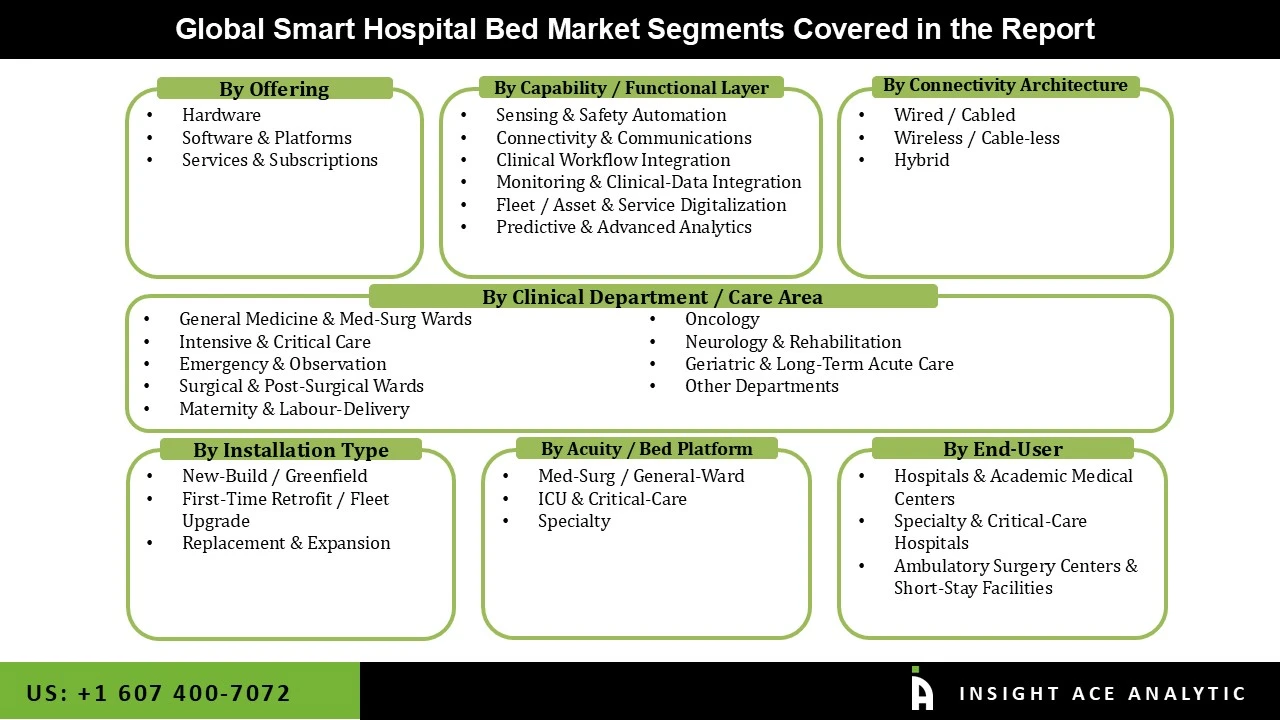
Smart Hospital Bed Market by Capability / Functional Layer-
• Sensing & Safety Automation
• Connectivity & Communications
• Clinical Workflow Integration
• Monitoring & Clinical-Data Integration
• Fleet / Asset & Service Digitalization
• Predictive & Advanced Analytics
Smart Hospital Bed Market by Connectivity Architecture-
• Wired / Cabled
• Wireless / Cable-less
• Hybrid
Smart Hospital Bed Market by Installation Type-
• New-Build / Greenfield
• First-Time Retrofit / Fleet Upgrade
• Replacement & Expansion
Smart Hospital Bed Market by Acuity / Bed Platform–
• Med-Surg / General-Ward
• ICU & Critical-Care
• Specialty
Smart Hospital Bed Market by Clinical Department / Care Area–
• General Medicine & Med-Surg Wards
• Intensive & Critical Care
• Emergency & Observation
• Surgical & Post-Surgical Wards
• Maternity & Labour-Delivery
• Oncology
• Neurology & Rehabilitation
• Geriatric & Long-Term Acute Care
• Other Departments
Smart Hospital Bed Market by End User–
• Hospitals & Academic Medical Centers
• Specialty & Critical-Care Hospitals
• Ambulatory Surgery Centers & Short-Stay Facilities
Smart Hospital Bed Market by Region-
North America-
• The US
• Canada
• Mexico
• Rest of North America
Europe-
• Germany
• United Kingdom
• France
• Italy
• Nordics
• Rest of Europe
Asia-Pacific-
• Japan
• China
• South Korea
• India
• Australia
• Rest of Asia-Pacific
Middle East and Africa-
• GCC & Saudi Arabia
• South Africa
• Rest of Middle East & Africa
Latin America-
• Brazil
• Rest of Latin America
Research Design and Approach
This study employed a multi-step, mixed-method research approach that integrates:
- Secondary research
- Primary research
- Data triangulation
- Hybrid top-down and bottom-up modelling
- Forecasting and scenario analysis
This approach ensures a balanced and validated understanding of both macro- and micro-level market factors influencing the market.
Secondary Research
Secondary research for this study involved the collection, review, and analysis of publicly available and paid data sources to build the initial fact base, understand historical market behaviour, identify data gaps, and refine the hypotheses for primary research.
Sources Consulted
Secondary data for the market study was gathered from multiple credible sources, including:
- Government databases, regulatory bodies, and public institutions
- International organizations (WHO, OECD, IMF, World Bank, etc.)
- Commercial and paid databases
- Industry associations, trade publications, and technical journals
- Company annual reports, investor presentations, press releases, and SEC filings
- Academic research papers, patents, and scientific literature
- Previous market research publications and syndicated reports
These sources were used to compile historical data, market volumes/prices, industry trends, technological developments, and competitive insights.

Primary Research
Primary research was conducted to validate secondary data, understand real-time market dynamics, capture price points and adoption trends, and verify the assumptions used in the market modelling.
Stakeholders Interviewed
Primary interviews for this study involved:
- Manufacturers and suppliers in the market value chain
- Distributors, channel partners, and integrators
- End-users / customers (e.g., hospitals, labs, enterprises, consumers, etc., depending on the market)
- Industry experts, technology specialists, consultants, and regulatory professionals
- Senior executives (CEOs, CTOs, VPs, Directors) and product managers
Interview Process
Interviews were conducted via:
- Structured and semi-structured questionnaires
- Telephonic and video interactions
- Email correspondences
- Expert consultation sessions
Primary insights were incorporated into demand modelling, pricing analysis, technology evaluation, and market share estimation.
Data Processing, Normalization, and Validation
All collected data were processed and normalized to ensure consistency and comparability across regions and time frames.
The data validation process included:
- Standardization of units (currency conversions, volume units, inflation adjustments)
- Cross-verification of data points across multiple secondary sources
- Normalization of inconsistent datasets
- Identification and resolution of data gaps
- Outlier detection and removal through algorithmic and manual checks
- Plausibility and coherence checks across segments and geographies
This ensured that the dataset used for modelling was clean, robust, and reliable.
Market Size Estimation and Data Triangulation
Bottom-Up Approach
The bottom-up approach involved aggregating segment-level data, such as:
- Company revenues
- Product-level sales
- Installed base/usage volumes
- Adoption and penetration rates
- Pricing analysis
This method was primarily used when detailed micro-level market data were available.

Top-Down Approach
The top-down approach used macro-level indicators:
- Parent market benchmarks
- Global/regional industry trends
- Economic indicators (GDP, demographics, spending patterns)
- Penetration and usage ratios
This approach was used for segments where granular data were limited or inconsistent.
Hybrid Triangulation Approach
To ensure accuracy, a triangulated hybrid model was used. This included:
- Reconciling top-down and bottom-up estimates
- Cross-checking revenues, volumes, and pricing assumptions
- Incorporating expert insights to validate segment splits and adoption rates
This multi-angle validation yielded the final market size.
Forecasting Framework and Scenario Modelling
Market forecasts were developed using a combination of time-series modelling, adoption curve analysis, and driver-based forecasting tools.
Forecasting Methods
- Time-series modelling
- S-curve and diffusion models (for emerging technologies)
- Driver-based forecasting (GDP, disposable income, adoption rates, regulatory changes)
- Price elasticity models
- Market maturity and lifecycle-based projections
Scenario Analysis
Given inherent uncertainties, three scenarios were constructed:
- Base-Case Scenario: Expected trajectory under current conditions
- Optimistic Scenario: High adoption, favourable regulation, strong economic tailwinds
- Conservative Scenario: Slow adoption, regulatory delays, economic constraints
Sensitivity testing was conducted on key variables, including pricing, demand elasticity, and regional adoption.
Request Customization
Add countries, segments, company profiles, or extend forecast — free 10% customization with purchase.
Customize This Report →Enquire Before Buying
Speak with our analyst team about scope, methodology, pricing, or deliverable formats.
Enquire Now →Frequently Asked Questions
Smart Hospital Bed Market likely to grow with the CAGR of 10.2% during the forecast period for 2026 to 2035.
Baxter International (Hillrom), Stryker, LINET Group SE, Umano Medical, Malvestio, Paramount Bed, Stiegelmeyer, Arjo, Agiliti, Joerns Healthcare, Famed Żywiec, Pardo, Getinge, Invacare, Medline.
Smart Hospital Bed Market is segmented into Offering, Capability / Functional Layer, Connectivity Architecture, Installation Type, Acuity / Bed Platform, Clinical Department / Care Area, End User and By Region
North America region is leading the Smart Hospital Bed Market.