Polyurea Coatings Market Size, Share, Trend, Forecast Report 2026 to 2035
What is Polyurea Coatings Market Size?
Polyurea Coatings Market Size is valued at USD 1.81 Bn in 2025 and is predicted to reach USD 4.29 Bn by the year 2035 at a 9.2% CAGR during the forecast period for 2026 to 2035.
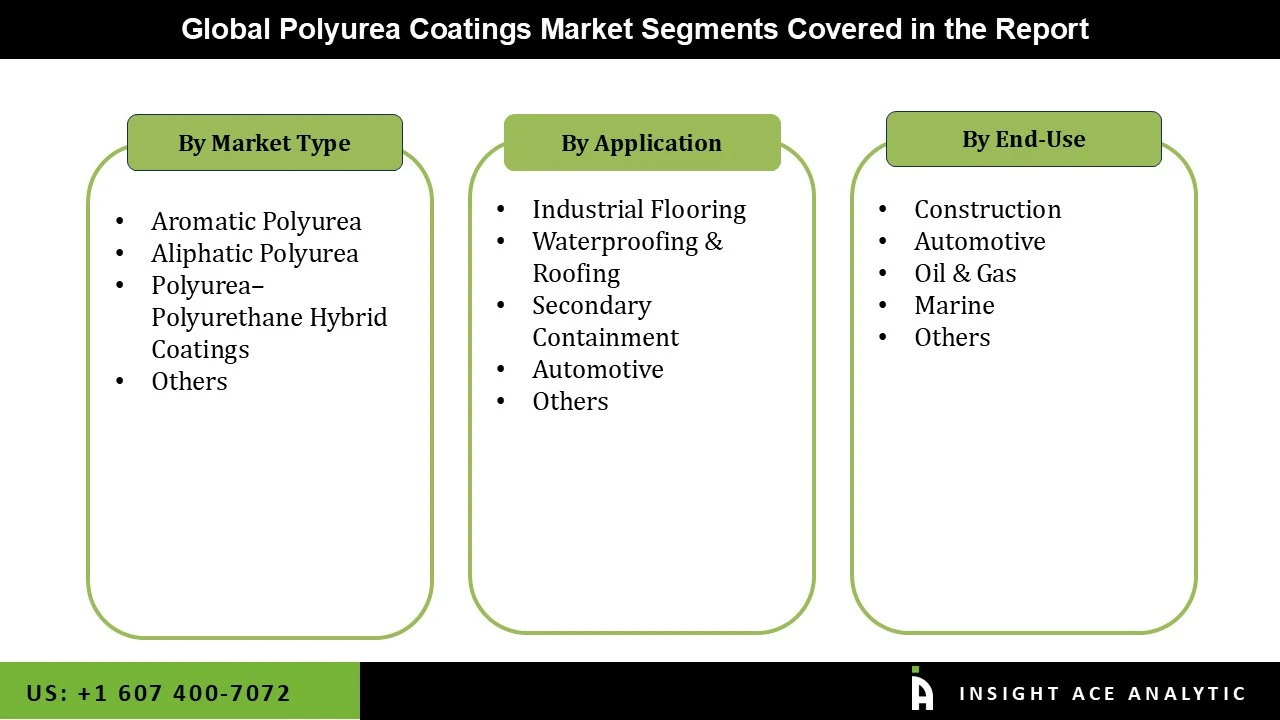
Polyurea Coatings Market Size, Share & Trends Analysis Distribution by Market Type (Aromatic Polyurea, Aliphatic Polyurea, Polyurea–Polyurethane Hybrid Coatings, Others), by Application (Industrial Flooring, Waterproofing & Roofing, Secondary Containment, Automotive, Others), by End-User Industry (Construction, Automotive, Oil & Gas, Marine, Others) and Segment Forecasts, 2026 to 2035
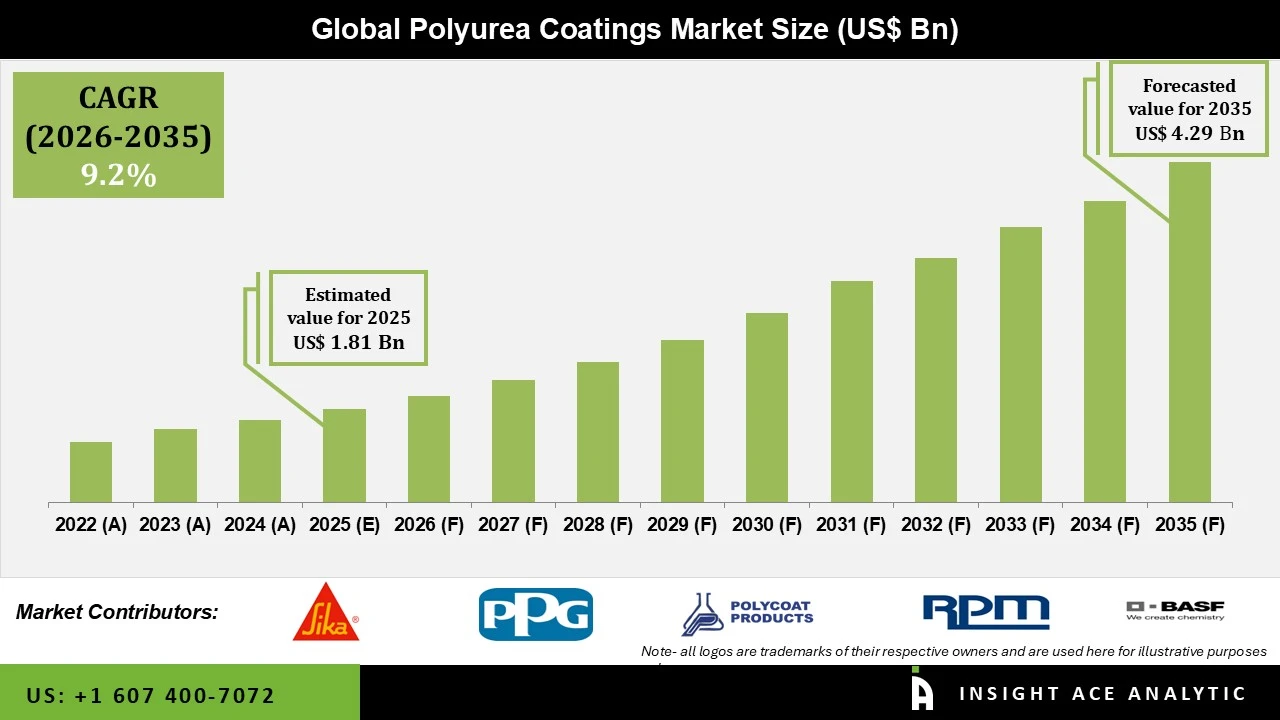
The polyurea coatings market covers protective coatings known for their durability, corrosion resistance, waterproofing, and chemical protection in many industries. These coatings are often used on concrete, steel, and other surfaces to extend service life and protect important infrastructure from tough conditions. Because they cure quickly, are flexible, and resist abrasion, moisture, and extreme temperatures, polyurea coatings are popular for industrial floors, waterproofing, secondary containment, automotive parts, and marine uses. As industries focus more on protecting assets and reducing maintenance costs, polyurea coatings have become a key solution for modern infrastructure and industrial projects.
The market is growing steadily as investments in construction, transportation, energy, and industrial infrastructure rise around the world. Rapid urbanisation, more commercial and residential buildings, and increased spending on repairing old infrastructure are driving demand for advanced protective coatings. Industries like oil and gas, marine, manufacturing, and automotive are using polyurea coatings more often because they can be applied quickly, reduce downtime, and perform better than many traditional coatings. The focus on preventing corrosion, waterproofing, and making industrial assets last longer is also helping polyurea coatings gain popularity in both developed and emerging markets.
The technology improvements are making the market stronger. Manufacturers are creating new types of polyurea coatings that have better UV stability, chemical resistance, flexibility, and longer lifespans. There is also more interest in eco-friendly coatings with lower VOC emissions and better sustainability. New spray equipment, application methods, and hybrid systems are making installation easier and more reliable. At the same time, partnerships between manufacturers, suppliers, and contractors are helping to develop solutions that fit the changing needs of industrial, commercial, and infrastructure projects. Even though the outlook is good, the market has some challenges.
Polyurea coatings usually need special spray equipment, skilled workers, and controlled conditions, which can raise initial project costs. Changes in raw material prices, especially for isocyanates and speciality resins, can impact manufacturing costs and profits. Also, other protective coatings like epoxy and polyurethane compete for use in projects where cost matters. Meeting environmental rules and industry standards means companies must keep investing in product development and quality control.
Despite these challenges, the long-term outlook for the polyurea coatings market is very positive. More infrastructure projects, higher demand for durable and low-maintenance coatings, and growing industrial activity are expected to keep the market growing. Continued innovation, wider use in emerging economies, and ongoing investment in modernising industry will also boost demand. As industries focus on protecting assets, working efficiently, and using sustainable maintenance, polyurea coatings are likely to become even more important in the global protective coatings industry.
Competitive Landscape
Which are the Leading Players in the Polyurea Coatings Market?
• PPG Industries, Inc.
• RPM International Inc.
• Sika AG
• The Sherwin-Williams Company
• BASF SE
• Huntsman Corporation
• Nukote Coating Systems International
• Rhino Linings Corporation
• Tecnopol Sistemas, S.L.
• Specialty Products, Inc.
• Polycoat Products, Inc.
• ArmorThane USA Inc.
• VIP Coatings Europe GmbH
• Krypton Chemical, S.L.
Market Dynamics
Driver
Growing Demand for Durable Protective Coatings Across Infrastructure and Industrial Sectors
The polyurea coatings market is growing steadily as more industries look for durable protective solutions to extend asset life and lower maintenance costs. As infrastructure grows and cities expand, there is a greater need for coatings that can handle tough environments, chemicals, moisture, and abrasion. Polyurea coatings are now often chosen for uses like industrial flooring, waterproofing, bridges, tunnels, parking garages, storage tanks, pipelines, and marine structures because they cure quickly and offer strong, lasting protection. Governments and private companies are investing more in updating and repairing infrastructure, which opens up new opportunities for advanced coatings. As more people realise the long-term cost savings and the need to protect assets from corrosion and water damage, polyurea coatings are being used more widely in construction, oil and gas, transportation, and manufacturing.
Restrain/Challenge
High Installation Costs and Specialised Application Requirements
Even though demand is high, the market faces some challenges that could slow wider use. Applying polyurea coatings needs special spray equipment, skilled workers, and controlled conditions to work well. These factors raise upfront costs, which can make polyurea less appealing for smaller projects or those with tight budgets. Manufacturers also deal with changing prices for raw materials like isocyanates and speciality resins, which can impact production costs and profits. Meeting environmental rules and new industry standards means they must keep investing in product development and quality control. Polyurea coatings also face competition from traditional options like epoxy and polyurethane, especially when cost matters more than long-term performance.
Aromatic Polyurea Segment is Expected to Drive the Polyurea Coatings Market
The Aromatic Polyurea segment is expected to make up a large part of the global market in the coming years. These coatings are popular in industrial and infrastructure projects because they are strong, resist abrasion, keep water out, and are cost-effective. They are often used on industrial floors, wastewater plants, storage tanks, secondary containment, and concrete structures where UV light is not a big issue. As industries continue to invest in corrosion protection and infrastructure maintenance, demand for aromatic polyurea coatings should stay high because they work well and are affordable.
Industrial Flooring Segment is Expected to Drive the Polyurea Coatings Market
The Industrial Flooring segment is expected to take a big share of the market as more factories, warehouses, logistics centres, food plants, and commercial buildings need tough flooring. Polyurea coatings stand out because they resist chemicals, heavy loads, abrasion, moisture, and impacts, and they cure very quickly, which helps reduce downtime. As more industrial facilities are built, more warehouses go up, and investments in manufacturing grow, demand for polyurea flooring systems should keep rising in both developed and emerging markets.
Why North America Leads the Polyurea Coatings Market?
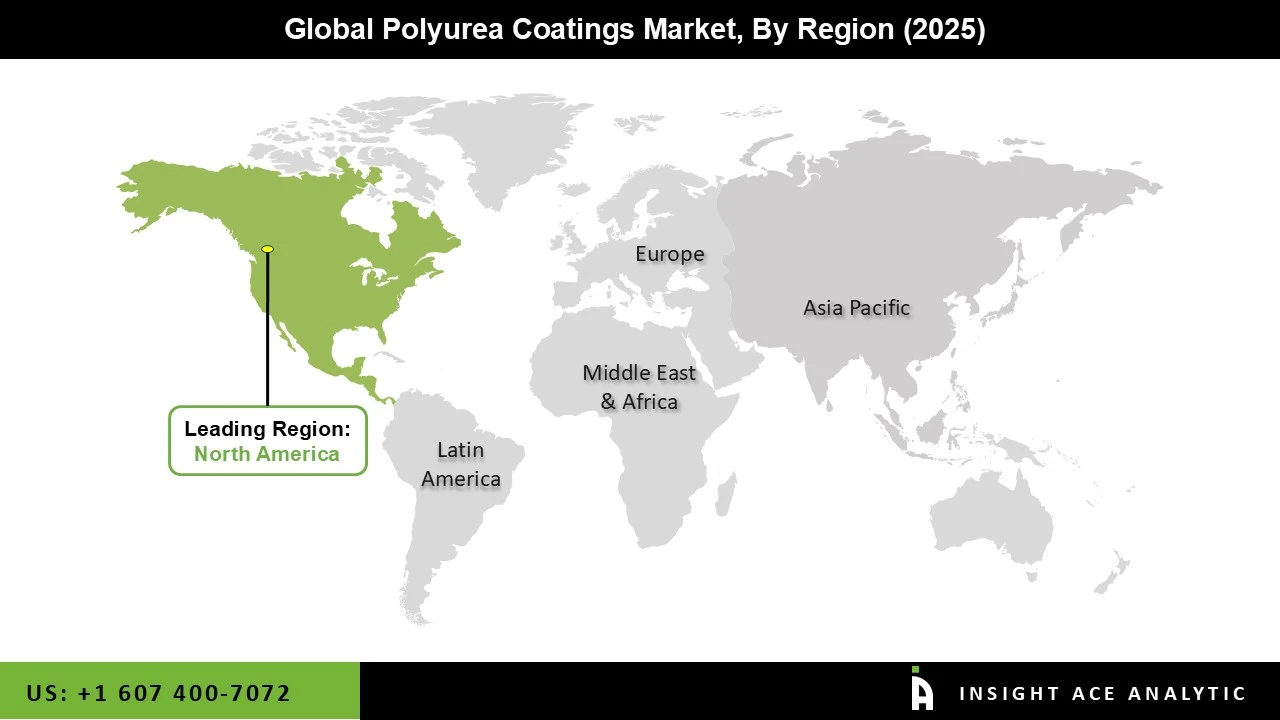
North America holds a leading position in the polyurea coatings market due to its well-established industrial base, significant investments in infrastructure maintenance, and widespread adoption of advanced protective coating technologies. The region has a strong presence of major coating manufacturers, engineering companies, and industrial asset owners that prioritise corrosion protection, waterproofing, and long-term infrastructure performance. Increasing investments in commercial construction, transportation infrastructure, oil & gas facilities, and industrial maintenance continue to drive demand for high-performance polyurea coatings. Meanwhile, Asia Pacific is expected to register the fastest market growth during the forecast period. Rapid urbanisation, expanding construction activities, increasing industrialisation, and rising investments in infrastructure development across countries such as China, India, Japan, and South Korea are creating strong demand for protective coating solutions. Growing awareness of asset protection, coupled with expanding manufacturing and energy sectors, is expected to accelerate market growth throughout the region further.
Key Developments-
• In December 2025, Sika expanded its liquid-applied roofing and waterproofing portfolio with Sikalastic 835 I, a two-component, hot-spray-applied pure polyurea resin intended for professional waterproofing applications.
Polyurea Coatings Market Report Scope:
| Report Attribute | Specifications |
| Market size value in 2025 | USD 1.81 Bn |
| Revenue forecast in 2035 | USD 4.29 Bn |
| Growth Rate CAGR | CAGR of 9.2% from 2026 to 2035 |
| Quantitative Units | Representation of revenue in US$ Bn and CAGR from 2026 to 2035 |
| Historic Year | 2021 to 2025 |
| Forecast Year | 2026-2035 |
| Report Coverage | The forecast of revenue, the position of the company, the competitive market structure, growth prospects, and trends |
| Segments Covered | By Application, Market Type, End Use Industry and By Region |
| Regional Scope | North America; Europe; Asia Pacific; Latin America; Middle East & Africa |
| Country Scope | U.S.; Canada; U.K.; Germany; China; India; Japan; Brazil; Mexico; France; Italy; Spain; South Korea; Southeast Asia |
| Competitive Landscape | Carboline Company, PPG Industries, Inc., Hempel A/S, RPM International Inc., BASF SE, Jotun A/S, Wacker Chemie AG, Huntsman Corporation. |
| Customization Scope | Free customisation report with the procurement of the report, Modifications to the regional and segment scope. Geographic competitive landscape. |
| Pricing and Available Payment Methods | Explore pricing alternatives that are customized to your particular study requirements. |
Market Segmentation:
Polyurea Coatings Market by Market Type-
• Aromatic Polyurea
• Aliphatic Polyurea
• Polyurea–Polyurethane Hybrid Coatings
• Others
Polyurea Coatings Market by Application-
• Industrial Flooring
• Waterproofing & Roofing
• Secondary Containment
• Automotive
• Others
Polyurea Coatings Market by End-Use Industry-
• Construction
• Automotive
• Oil & Gas
• Marine
• Others
Polyurea Coatings Market by Region-
North America-
• The US
• Canada
Europe-
• Germany
• UK
• France
• Nordics
• Netherlands
• Switzerland
• Spain
• Italy
• Benelux
• Rest of Europe
Asia-Pacific-
• China
• Japan
• South Korea
• Australia
• India
• Rest of APAC
Latin America-
• Brazil
• Mexico
• Chile
• Rest of LatAm
Middle East & Africa-
• GCC
• South Africa
• Rest of MEA
Research Design and Approach
This study employed a multi-step, mixed-method research approach that integrates:
- Secondary research
- Primary research
- Data triangulation
- Hybrid top-down and bottom-up modelling
- Forecasting and scenario analysis
This approach ensures a balanced and validated understanding of both macro- and micro-level market factors influencing the market.
Secondary Research
Secondary research for this study involved the collection, review, and analysis of publicly available and paid data sources to build the initial fact base, understand historical market behaviour, identify data gaps, and refine the hypotheses for primary research.
Sources Consulted
Secondary data for the market study was gathered from multiple credible sources, including:
- Government databases, regulatory bodies, and public institutions
- International organizations (WHO, OECD, IMF, World Bank, etc.)
- Commercial and paid databases
- Industry associations, trade publications, and technical journals
- Company annual reports, investor presentations, press releases, and SEC filings
- Academic research papers, patents, and scientific literature
- Previous market research publications and syndicated reports
These sources were used to compile historical data, market volumes/prices, industry trends, technological developments, and competitive insights.

Primary Research
Primary research was conducted to validate secondary data, understand real-time market dynamics, capture price points and adoption trends, and verify the assumptions used in the market modelling.
Stakeholders Interviewed
Primary interviews for this study involved:
- Manufacturers and suppliers in the market value chain
- Distributors, channel partners, and integrators
- End-users / customers (e.g., hospitals, labs, enterprises, consumers, etc., depending on the market)
- Industry experts, technology specialists, consultants, and regulatory professionals
- Senior executives (CEOs, CTOs, VPs, Directors) and product managers
Interview Process
Interviews were conducted via:
- Structured and semi-structured questionnaires
- Telephonic and video interactions
- Email correspondences
- Expert consultation sessions
Primary insights were incorporated into demand modelling, pricing analysis, technology evaluation, and market share estimation.
Data Processing, Normalization, and Validation
All collected data were processed and normalized to ensure consistency and comparability across regions and time frames.
The data validation process included:
- Standardization of units (currency conversions, volume units, inflation adjustments)
- Cross-verification of data points across multiple secondary sources
- Normalization of inconsistent datasets
- Identification and resolution of data gaps
- Outlier detection and removal through algorithmic and manual checks
- Plausibility and coherence checks across segments and geographies
This ensured that the dataset used for modelling was clean, robust, and reliable.
Market Size Estimation and Data Triangulation
Bottom-Up Approach
The bottom-up approach involved aggregating segment-level data, such as:
- Company revenues
- Product-level sales
- Installed base/usage volumes
- Adoption and penetration rates
- Pricing analysis
This method was primarily used when detailed micro-level market data were available.

Top-Down Approach
The top-down approach used macro-level indicators:
- Parent market benchmarks
- Global/regional industry trends
- Economic indicators (GDP, demographics, spending patterns)
- Penetration and usage ratios
This approach was used for segments where granular data were limited or inconsistent.
Hybrid Triangulation Approach
To ensure accuracy, a triangulated hybrid model was used. This included:
- Reconciling top-down and bottom-up estimates
- Cross-checking revenues, volumes, and pricing assumptions
- Incorporating expert insights to validate segment splits and adoption rates
This multi-angle validation yielded the final market size.
Forecasting Framework and Scenario Modelling
Market forecasts were developed using a combination of time-series modelling, adoption curve analysis, and driver-based forecasting tools.
Forecasting Methods
- Time-series modelling
- S-curve and diffusion models (for emerging technologies)
- Driver-based forecasting (GDP, disposable income, adoption rates, regulatory changes)
- Price elasticity models
- Market maturity and lifecycle-based projections
Scenario Analysis
Given inherent uncertainties, three scenarios were constructed:
- Base-Case Scenario: Expected trajectory under current conditions
- Optimistic Scenario: High adoption, favourable regulation, strong economic tailwinds
- Conservative Scenario: Slow adoption, regulatory delays, economic constraints
Sensitivity testing was conducted on key variables, including pricing, demand elasticity, and regional adoption.
Request Customization
Add countries, segments, company profiles, or extend forecast — free 10% customization with purchase.
Customize This Report →Enquire Before Buying
Speak with our analyst team about scope, methodology, pricing, or deliverable formats.
Enquire Now →Frequently Asked Questions
Polyurea Coatings Market Size is valued at USD 1.81 Bn in 2025 and is predicted to reach USD 4.29 Bn by the year 2035
Polyurea Coatings Market is expected to grow at a 9.2% CAGR during the forecast period for 2026 to 2035.
Carboline Company, PPG Industries, Inc., Hempel A/S, RPM International Inc., BASF SE, Jotun A/S, Wacker Chemie AG, Huntsman Corporation.
Polyurea Coatings Market is segmented into By Application, Market Type, End Use Industry and By Region
North America region is leading the Polyurea Coatings Market.