Pharmacodynamic Biomarker Assays, Platforms and Services Market Size, Trend, Revenue Report 2026 to 2035
What is Pharmacodynamic Biomarker Assays, Platforms and Services Market Size?
Global Pharmacodynamic Biomarker Assays, Platforms and Services Market Size is predicted to grow at a 9.5% CAGR during the forecast period for 2026 to 2035.
Pharmacodynamic Biomarker Assays, Platforms and Services Market Size, Share & Trends Analysis Distribution by Offering (Instruments and Systems, Reagent Kits and Assay Panels, CRO / Central Laboratory Biomarker Services, Software and Informatics), by Technology / Analytical Platform (Immunoassays, Flow Cytometry / Phospho-Flow / Mass Cytometry, Mass Spectrometry, Genomics / Transcriptomics, Imaging & Spatial Omics, Functional and Cell-Based Assays), by Application (Clinical Trials and Dose Selection, Drug Discovery and Preclinical Development, PD Biomarker Assay Validation & Companion Diagnostic Co-Development, Biosimilar PD Equivalence Testing, Treatment Response Monitoring & Patient Stratification, Post-Approval Treatment Response Monitoring & Real-World Biomarker Evidence), by PD Biomarker Type (Target Engagement Biomarkers, Pathway / Mechanism Biomarkers, Functional / Physiological Response Biomarkers, Immunopharmacodynamic Biomarkers) and Segment Forecasts, 2026 to 2035
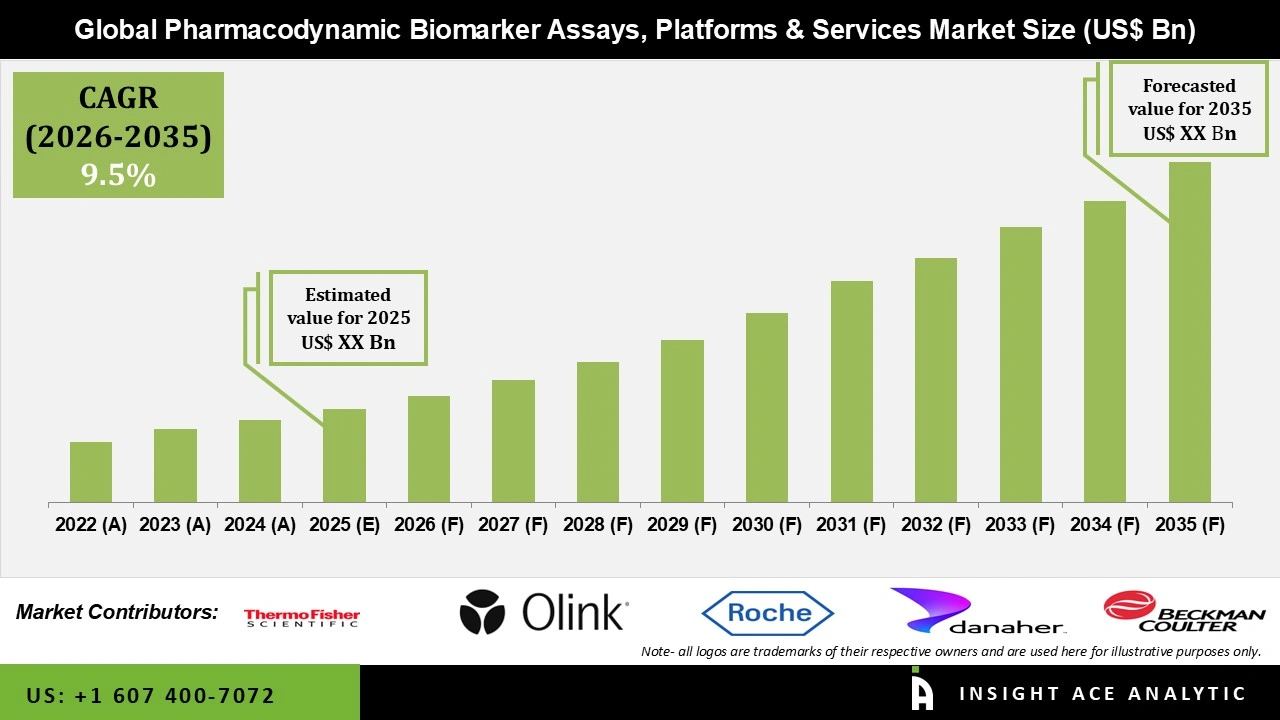
Pharmacodynamic (PD) biomarker assays, platforms, and services are playing a bigger role in drug development as pharmaceutical and biotech companies work on more targeted and personalised treatments. These tools help researchers see how drugs interact with the body, check if they reach the right target, and track how biological pathways respond. As precision medicine grows in fields like oncology, immunology, neurology, and rare diseases, the need for dependable PD biomarker testing and analysis is rising quickly. One key reason for market growth is that more companies are using biomarker-guided drug development. Drug developers use pharmacodynamic biomarkers to help choose doses, show how drugs work, monitor responses, and boost clinical trial success. Regulators are also encouraging the use of biomarkers to improve clinical evidence and speed up new therapies. Because of this, pharmaceutical companies are putting more resources into advanced biomarker strategies in both preclinical and clinical development.
New technologies are also helping the market grow. Advances in multiplex immunoassays, flow cytometry, mass cytometry, next-generation sequencing, spatial biology, transcriptomics, and sensitive biomarker detection are giving researchers better insights into drug responses and disease biology. These platforms let researchers study several biomarkers at once, improve data accuracy, and get more useful clinical information. More companies are also using bioinformatics, artificial intelligence, and cloud-based data tools to manage complex biomarker data more efficiently. Another trend in the market is the increased use of outsourcing. Pharmaceutical and biotech companies are working more with contract research organisations (CROs), central labs, and specialised biomarker service providers to get technical expertise, advanced technology, and global testing. Outsourcing helps drug developers simplify operations, manage costs, and speed up development, while still meeting high scientific and regulatory standards.
Even with strong growth, the market still faces challenges. Pharmacodynamic biomarker testing needs advanced equipment, specialised labs, and skilled scientists. Creating and validating these assays can be complicated, take a lot of time, and cost a lot, especially for new therapies and emerging biomarkers. Changing regulatory rules, data standardisation, and the need for solid analytical validation also create hurdles for service providers and drug developers. Handling large amounts of biological data while keeping it accurate, reliable, and compliant with regulations is still a major focus for the industry. Still, the long-term outlook for the pharmacodynamic biomarker assays, platforms and services market is very positive. More investment in precision medicine, more clinical trials, wider use of biomarkers, and ongoing technology advances are expected to keep the market growing. As drug development becomes more data-driven and personalised, pharmacodynamic biomarkers will be key for better decision-making, faster clinical development, and successful launches of new therapies around the world.
Competitive Landscape
Which are the Leading Players in the Pharmacodynamic Biomarker Assays, Platforms and Services Market?
- BioAgilytix
- Thermo Fisher Scientific
- Olink Proteomics
- PPD CRO
- Roche
- Foundation Medicine
- Ventana
- Danaher Corporation
- Beckman Coulter
- Leica Biosystems
- Molecular Devices
- Agilent Technologies
- Bio-Rad Laboratories
- QIAGEN N.V.
- Abbott Laboratories
- Siemens Healthineers
- Meso Scale Diagnostics (MSD)
- Bio-Techne
- RandD Systems
- Revvity
- BioLegend
- DiaSorin
- Luminex
- Standard BioTools
- Fluidigm
- SomaLogic
- Quanterix Corporation
- Bruker Spatial Biology
- NanoString
- 10x Genomics
- Q² Solutions
- IQVIA
- LabCorp Drug Development
- Covance
- BioAgilytix
- Eurofins Scientific
- ICON Bioanalytical Labs
- Pacific Bioanalytical Inc.
- Natera Inc.
- Biodesix Inc.
- Myriad Genetics
- Merck KGaA
- MilliporeSigma
Market Dynamics
Driver
Growing Adoption of Precision Medicine and Biomarker-Guided Drug Development
Precision medicine is becoming more widely used, and this is a key factor driving growth in the pharmacodynamic biomarker assays, platforms and services market. Pharmaceutical and biotech companies now rely on pharmacodynamic (PD) biomarkers to see how therapies interact with biological targets and to track treatment responses during drug development. PD biomarkers help confirm that drugs are hitting their targets, assess drug activity, choose the right dose, and improve clinical trial results. With more targeted therapies, immunotherapies, cell therapies, and gene therapies being developed, there is a fast-growing need for reliable biomarker assays and analysis tools. Drug developers are using PD biomarkers in both early and late-stage studies to build stronger scientific evidence and help with regulatory approval. More investment in areas like cancer, autoimmune diseases, neurological conditions, and rare diseases is also speeding up the use of advanced biomarker technologies and supporting long-term market growth around the world.
Restrain/Challenge
Complexity of Biomarker Assay Development and Regulatory Validation
A major challenge for the pharmacodynamic biomarker assays, platforms and services market is how complex it is to develop, validate, and standardize biomarker assays. Many PD biomarkers need advanced technology, specialized labs, and skilled scientists to get accurate and reliable results. Discovering and validating biomarkers often takes a lot of time, money, and technical effort, especially for new treatment targets and methods. Regulatory agencies now expect strong analytical validation, reliable data, and clear clinical relevance before biomarker data can be used for drug development or approval. Service providers need to keep investing in new technologies, quality systems, and compliance programs to keep up with changing industry standards. Handling large biological datasets and making sure results are consistent across global studies are also big challenges for companies in this market.
Immunoassays Segment is Expected to Drive the Pharmacodynamic Biomarker Assays, Platforms and Services Market
Immunoassays are expected to drive much of the growth in the Pharmacodynamic Biomarker Assays, Platforms and Services Market because they are widely used to measure protein biomarkers, cytokines, chemokines, and other signs of drug activity. These technologies are sensitive, scalable, and accepted by regulators, so they are often chosen for both early and late-stage biomarker studies. Pharmaceutical companies often use immunoassays to check if drugs are hitting their targets, track how patients respond to treatment, and help choose the right dose during drug development. More companies are now using multiplex immunoassay platforms, which can measure several biomarkers at once, making research faster and more efficient. As more drug development relies on biomarkers, the need for advanced immunoassay solutions is likely to stay high.
Clinical Trials and Dose Selection Segment is Expected to Drive the Pharmacodynamic Biomarker Assays, Platforms and Services Market
The Clinical Trials and Dose Selection segment is expected to have a large share of the market because pharmacodynamic biomarkers are now key tools for checking drug activity and finding the best dosing strategies. Biomarker data show researchers if a treatment is having the intended effect and give important information during both early and late stages of clinical development. Pharmaceutical and biotech companies are increasingly using PD biomarkers to make clinical trials more efficient and reduce development risks, especially for dose optimisation and proof-of-mechanism studies. Regulators also support the use of biomarker evidence to improve clinical decisions. This growing focus on biomarker-driven development is expected to keep this segment growing strongly in the coming years.
Why North America Leads the Pharmacodynamic Biomarker Assays, Platforms and Services Market?
North America is the leader in the pharmacodynamic biomarker assays, platforms and services market because it has a strong pharmaceutical and biotech industry, advanced research facilities, and major investments in precision medicine and biomarker-based drug development. The region includes many leading pharmaceutical companies, biotech innovators, research institutions, contract research organisations (CROs), and specialised biomarker service providers. The United States accounts for a large share of global clinical trial activity and continues to invest in research for cancer, immune diseases, neuroscience, and rare diseases, all of which increasingly use pharmacodynamic biomarkers.
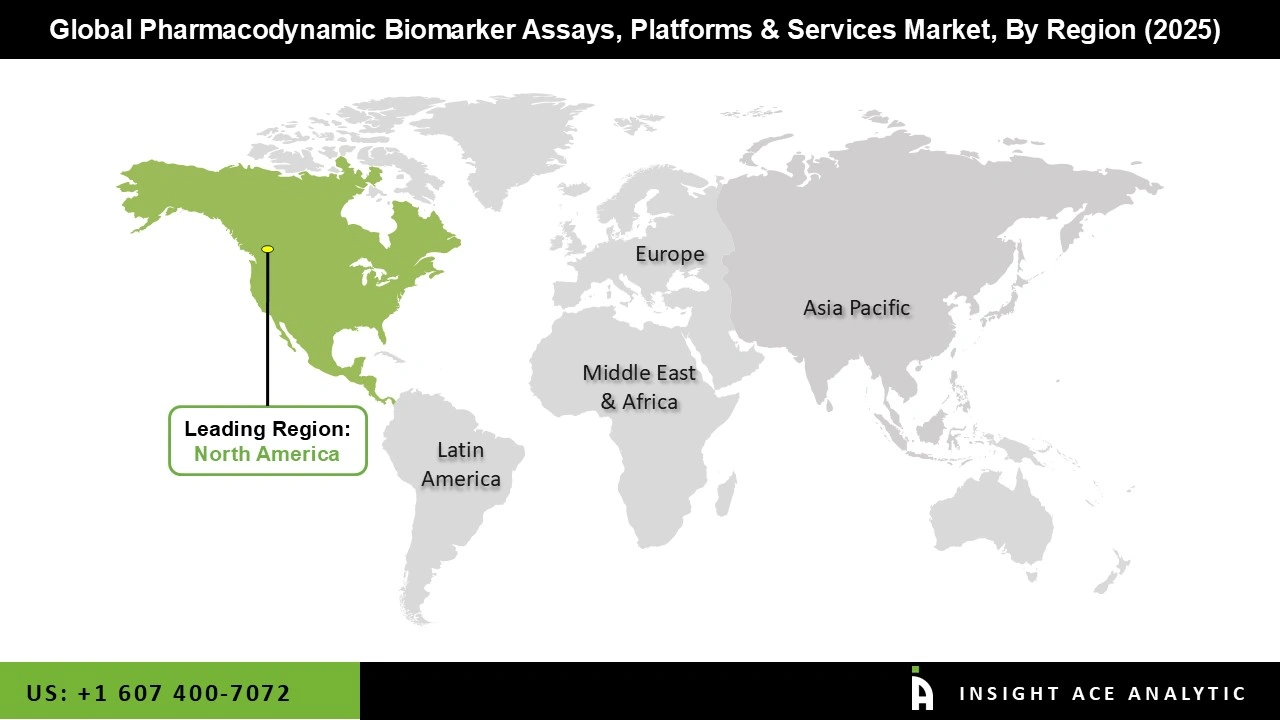
Strong regulatory support, use of advanced analytical tools, and a skilled scientific workforce make the region’s market position even stronger. Developers, research institutions, and CROs are accelerating biomarker innovation and commercialisation. With continued advancements in precision medicine, companion diagnostics, and multi-omics technologies, North America is expected to maintain its leadership position in the pharmacodynamic biomarker assays, platforms and services market over the coming years.
Key Developments-
• In February 2025, Roche and Foundation Medicine advanced their companion diagnostic and biomarker development programs, supporting the growing use of pharmacodynamic biomarkers for patient stratification and treatment response monitoring in oncology clinical trials.
• In January 2025, Standard BioTools expanded the adoption of its mass cytometry and single-cell analysis platforms, helping researchers generate deeper pharmacodynamic insights for immunology and oncology drug development programs.
Pharmacodynamic Biomarker Assays, Platforms and Services Market Report Scope:
| Report Attribute | Specifications |
| Growth Rate CAGR | CAGR of 9.5% from 2026 to 2035 |
| Quantitative Units | Representation of revenue in US$ Bn and CAGR from 2026 to 2035 |
| Historic Year | 2022 to 2025 |
| Forecast Year | 2026-2035 |
| Report Coverage | The forecast of revenue, the position of the company, the competitive market structure, growth prospects, and trends |
| Segments Covered | By Offering, Technology / Analytical Platform, Application, PD Biomarker Type and By Region |
| Regional Scope | North America; Europe; Asia Pacific; Latin America; Middle East and Africa |
| Country Scope | U.S.; Canada; U.K.; Germany; China; India; Japan; Brazil; Mexico; The UK; France; Italy; Spain; China; Japan; India; South Korea; Southeast Asia; South Korea; Southeast Asia |
| Competitive Landscape | Thermo Fisher Scientific, Olink Proteomics, PPD CRO, Roche, Foundation Medicine, Ventana, Danaher Corporation, Beckman Coulter, Leica Biosystems, Molecular Devices, Agilent Technologies, Bio-Rad Laboratories, QIAGEN N.V., Abbott Laboratories, Siemens Healthineers, Meso Scale Diagnostics (MSD), Bio-Techne, RandD Systems, Revvity, BioLegend, DiaSorin, Luminex, Standard BioTools, Fluidigm, SomaLogic, Quanterix Corporation, Bruker Spatial Biology, NanoString, 10x Genomics, Q² Solutions, IQVIA, LabCorp Drug Development, Covance, BioAgilytix, Eurofins Scientific, ICON Bioanalytical Labs, Pacific Bioanalytical Inc., Natera Inc., Biodesix Inc., Myriad Genetics, Merck KGaA, MilliporeSigma |
| Customization Scope | Free customization report with the procurement of the report, Modifications to the regional and segment scope. Geographic competitive landscape. |
| Pricing and Available Payment Methods | Explore pricing alternatives that are customized to your particular study requirements. |
Segmentations of Pharmacodynamic Biomarker Assays, Platforms and Services Market :
Pharmacodynamic Biomarker Assays, Platforms and Services Market by Offering Type -
- Instruments and Systems
- Reagent Kits and Assay Panels
- CRO / Central Laboratory Biomarker Services
- Software and Informatics
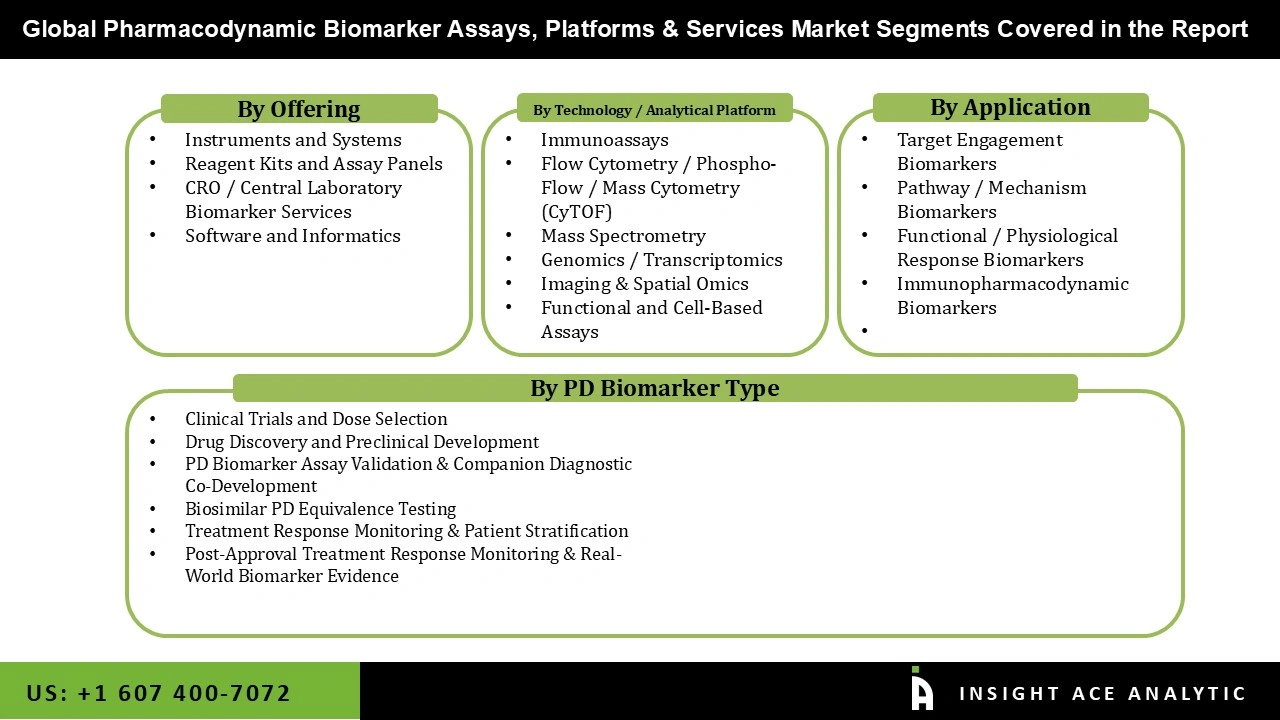
Pharmacodynamic Biomarker Assays, Platforms and Services Market by Technology / Analytical Platform-
- Immunoassays
- Flow Cytometry / Phospho-Flow / Mass Cytometry
- Mass Spectrometry
- Genomics / Transcriptomics
- Imaging and Spatial Omics
- Functional and Cell-Based Assays
Pharmacodynamic Biomarker Assays, Platforms and Services Market by Application -
- Clinical Trials and Dose Selection
- Drug Discovery and Preclinical Development
- PD Biomarker Assay Validation and Companion Diagnostic Co-Development
- Biosimilar PD Equivalence Testing
- Treatment Response Monitoring and Patient Stratification
- Post-Approval Treatment Response Monitoring and Real-World Biomarker Evidence
Pharmacodynamic Biomarker Assays, Platforms and Services Market by PD Biomarker Type -
- Target Engagement Biomarkers
- Pathway / Mechanism Biomarkers
- Functional / Physiological Response Biomarkers
- Immunopharmacodynamic Biomarkers
Pharmacodynamic Biomarker Assays, Platforms and Services Market by Region-
- North America-
- The US
- Canada
- Europe-
- Germany
- The UK
- France
- Italy
- Spain
- Rest of Europe
- Asia-Pacific-
- China
- Japan
- India
- South Korea
- South East Asia
- Rest of Asia Pacific
- Latin America-
- Brazil
- Argentina
- Mexico
- Rest of Latin America
- Middle East and Africa-
- GCC Countries
- South Africa
- Rest of Middle East and Africa
Research Design and Approach
This study employed a multi-step, mixed-method research approach that integrates:
- Secondary research
- Primary research
- Data triangulation
- Hybrid top-down and bottom-up modelling
- Forecasting and scenario analysis
This approach ensures a balanced and validated understanding of both macro- and micro-level market factors influencing the market.
Secondary Research
Secondary research for this study involved the collection, review, and analysis of publicly available and paid data sources to build the initial fact base, understand historical market behaviour, identify data gaps, and refine the hypotheses for primary research.
Sources Consulted
Secondary data for the market study was gathered from multiple credible sources, including:
- Government databases, regulatory bodies, and public institutions
- International organizations (WHO, OECD, IMF, World Bank, etc.)
- Commercial and paid databases
- Industry associations, trade publications, and technical journals
- Company annual reports, investor presentations, press releases, and SEC filings
- Academic research papers, patents, and scientific literature
- Previous market research publications and syndicated reports
These sources were used to compile historical data, market volumes/prices, industry trends, technological developments, and competitive insights.

Primary Research
Primary research was conducted to validate secondary data, understand real-time market dynamics, capture price points and adoption trends, and verify the assumptions used in the market modelling.
Stakeholders Interviewed
Primary interviews for this study involved:
- Manufacturers and suppliers in the market value chain
- Distributors, channel partners, and integrators
- End-users / customers (e.g., hospitals, labs, enterprises, consumers, etc., depending on the market)
- Industry experts, technology specialists, consultants, and regulatory professionals
- Senior executives (CEOs, CTOs, VPs, Directors) and product managers
Interview Process
Interviews were conducted via:
- Structured and semi-structured questionnaires
- Telephonic and video interactions
- Email correspondences
- Expert consultation sessions
Primary insights were incorporated into demand modelling, pricing analysis, technology evaluation, and market share estimation.
Data Processing, Normalization, and Validation
All collected data were processed and normalized to ensure consistency and comparability across regions and time frames.
The data validation process included:
- Standardization of units (currency conversions, volume units, inflation adjustments)
- Cross-verification of data points across multiple secondary sources
- Normalization of inconsistent datasets
- Identification and resolution of data gaps
- Outlier detection and removal through algorithmic and manual checks
- Plausibility and coherence checks across segments and geographies
This ensured that the dataset used for modelling was clean, robust, and reliable.
Market Size Estimation and Data Triangulation
Bottom-Up Approach
The bottom-up approach involved aggregating segment-level data, such as:
- Company revenues
- Product-level sales
- Installed base/usage volumes
- Adoption and penetration rates
- Pricing analysis
This method was primarily used when detailed micro-level market data were available.

Top-Down Approach
The top-down approach used macro-level indicators:
- Parent market benchmarks
- Global/regional industry trends
- Economic indicators (GDP, demographics, spending patterns)
- Penetration and usage ratios
This approach was used for segments where granular data were limited or inconsistent.
Hybrid Triangulation Approach
To ensure accuracy, a triangulated hybrid model was used. This included:
- Reconciling top-down and bottom-up estimates
- Cross-checking revenues, volumes, and pricing assumptions
- Incorporating expert insights to validate segment splits and adoption rates
This multi-angle validation yielded the final market size.
Forecasting Framework and Scenario Modelling
Market forecasts were developed using a combination of time-series modelling, adoption curve analysis, and driver-based forecasting tools.
Forecasting Methods
- Time-series modelling
- S-curve and diffusion models (for emerging technologies)
- Driver-based forecasting (GDP, disposable income, adoption rates, regulatory changes)
- Price elasticity models
- Market maturity and lifecycle-based projections
Scenario Analysis
Given inherent uncertainties, three scenarios were constructed:
- Base-Case Scenario: Expected trajectory under current conditions
- Optimistic Scenario: High adoption, favourable regulation, strong economic tailwinds
- Conservative Scenario: Slow adoption, regulatory delays, economic constraints
Sensitivity testing was conducted on key variables, including pricing, demand elasticity, and regional adoption.
Request Customization
Add countries, segments, company profiles, or extend forecast — free 10% customization with purchase.
Customize This Report →Enquire Before Buying
Speak with our analyst team about scope, methodology, pricing, or deliverable formats.
Enquire Now →Frequently Asked Questions
Pharmacodynamic Biomarker Assays, Platforms and Services Market Size is predicted to grow at a 9.5% CAGR during the forecast period for 2026 to 2035.
Thermo Fisher Scientific, Olink Proteomics, PPD CRO, Roche, Foundation Medicine, Ventana, Danaher Corporation, Beckman Coulter, Leica Biosystems, Molecular Devices, Agilent Technologies, Bio-Rad Laboratories, QIAGEN N.V., Abbott Laboratories, Siemens Healthineers, Meso Scale Diagnostics (MSD), Bio-Techne, RandD Systems, Revvity, BioLegend, DiaSorin, Luminex, Standard BioTools, Fluidigm, SomaLogic, Quanterix Corporation, Bruker Spatial Biology, NanoString, 10x Genomics, Q² Solutions, IQVIA, LabCorp Drug Development, Covance, BioAgilytix, Eurofins Scientific, ICON Bioanalytical Labs, Pacific Bioanalytical Inc., Natera Inc., Biodesix Inc., Myriad Genetics, Merck KGaA, MilliporeSigma and Other.
Pharmacodynamic Biomarker Assays, Platforms and Services Market is segmented into Offering, Technology / Analytical Platform, Application, PD Biomarker Type and other.
North America region is leading the Pharmacodynamic Biomarker Assays, Platforms and Services Market.