UAV Electric Motors Market Size, Scope, Revenue Report 2026 to 2035
What is UAV Electric Motors Market Size?
UAV Electric Motors Market Size is valued at USD 1,318.60 Bn in 2025 and is predicted to reach USD 5,869.20 Bn by the year 2035 at a 16.0% CAGR during the forecast period for 2026 to 2035.
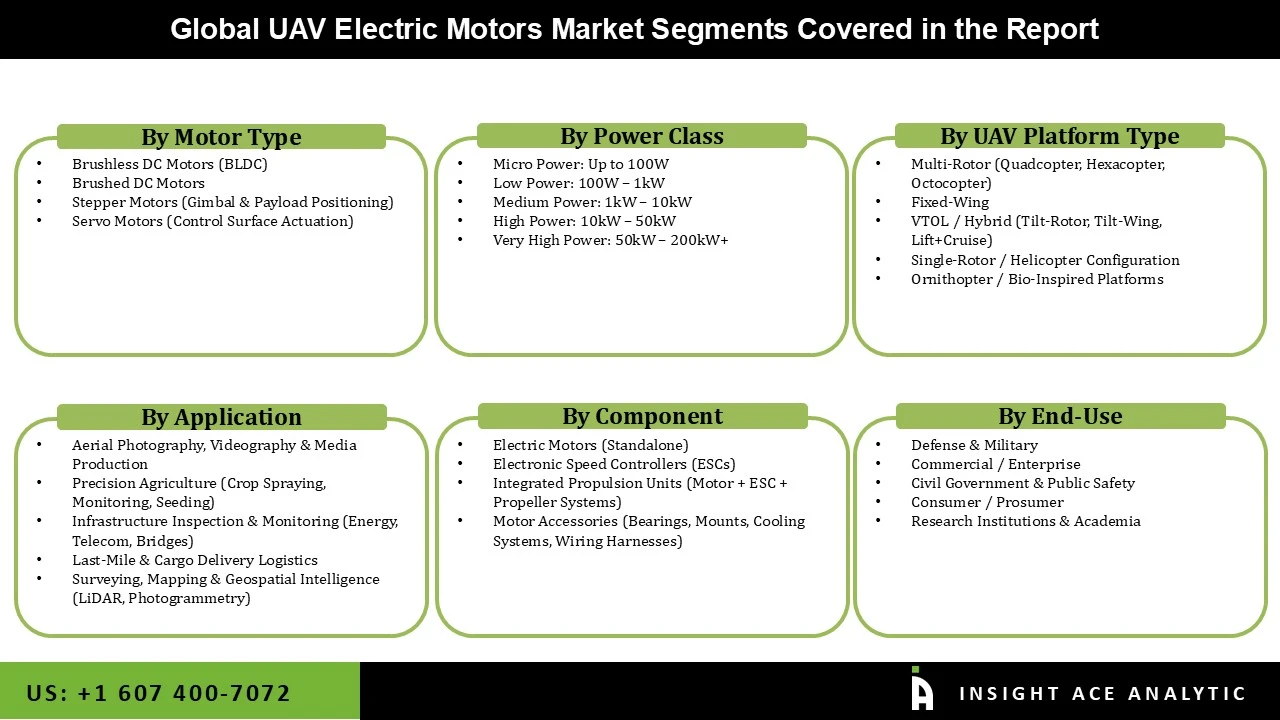
UAV Electric Motors Market Size, Share & Trends Analysis Distribution By Motor Type (Brushless DC Motors (BLDC), Outrunner BLDC Motors, Inrunner BLDC Motors, Axial Flux Motors, Pancake / Flat Profile Motors, Ironless / Slotless (Coreless) Motors, Brushed DC Motors, Stepper Motors (Gimbal & Payload Positioning), Servo Motors (Control Surface Actuation)), By Power Class (Micro Power: Up to 100W, Low Power: 100W – 1kW, Medium Power: 1kW – 10kW, High Power: 10kW – 50kW, Very High Power: 50kW – 200kW+),by UAV Platform Type (Multi-Rotor (Quadcopter, Hexacopter, Octocopter), Fixed-Wing, VTOL / Hybrid (Tilt-Rotor, Tilt-Wing, Lift+Cruise), Single-Rotor / Helicopter Configuration, Ornithopter / Bio-Inspired Platforms), by Application, by Component Type, by End User and Segment Forecasts, 2026 to 2035
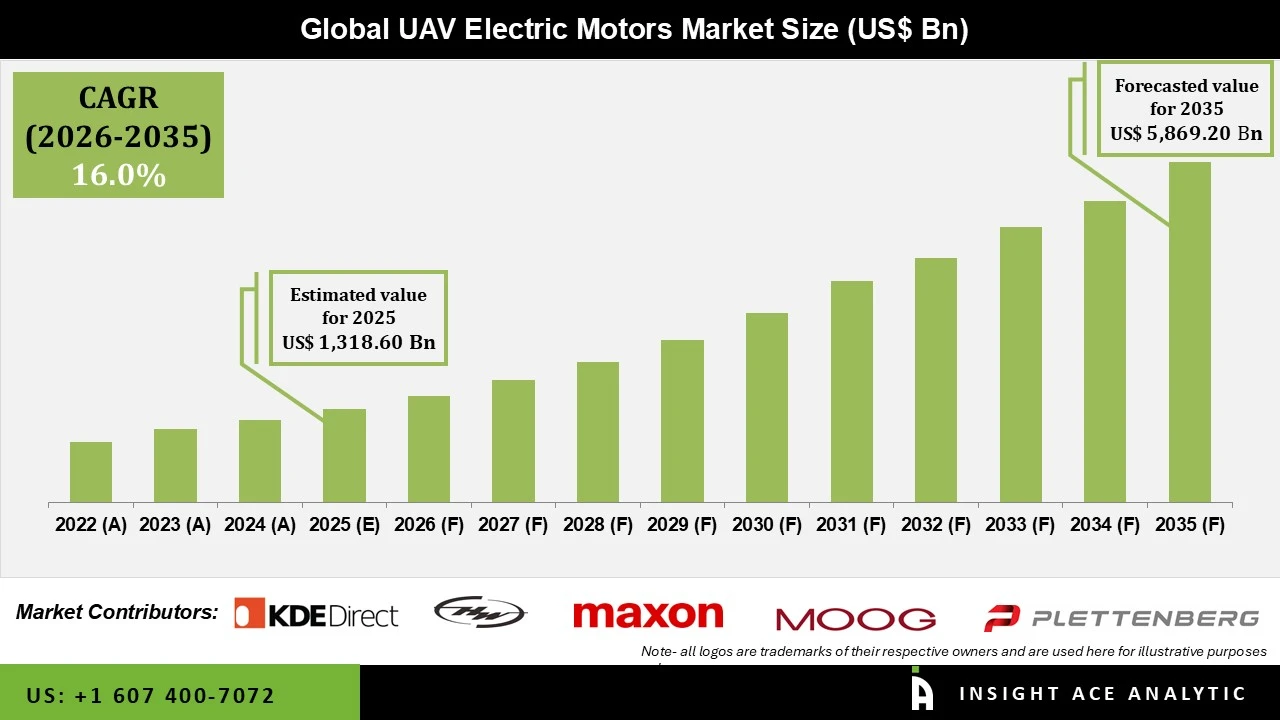
The UAV electric motors market encompasses the technologies and components that power and control drones across commercial, defense, and industrial applications. Drone manufacturers, defense organizations, and commercial operators increasingly prefer electric motors due to their efficiency, reliability, and precise flight control capabilities. These motors provide stable flight, agile maneuvering, and energy conservation, making them especially valuable for aerial surveillance, precision agriculture, infrastructure inspection, and logistics, where consistent performance matters. Compared to fuel-based systems, electric motors offer cleaner operation, reduced noise, lower maintenance needs, and better integration with electronic flight controls, aligning with today's UAV requirements. As demand for advanced drones grows and commercial uses expand, electric motors are becoming a central part of the UAV industry.
Advancements in motor technologies including brushless motors, axial-flux designs, and lightweight materials drive the UAV electric motors market by improving power output and efficiency. Integrated propulsion systems that combine motors, electronic speed controllers, and optimized propellers further enhance performance and simplify UAV design. High demand for high-power-density motors allows drones to fly longer and carry more payload, while emerging platforms such as VTOL aircraft and urban air mobility systems open new opportunities for motor manufacturers. Ongoing research and development improves cooling systems, extends motor lifespan, and enables more precise electronic control. However, high-performance motors capable of sustained power output remain expensive, limiting adoption for cost-sensitive operators. Variability in operating conditions such as temperature extremes, altitude changes, and payload requirements affects motor efficiency and reliability. Designers face challenges in balancing power output, weight, and energy efficiency, especially for long-endurance UAVs. Integration complexities with other UAV systems and the need for continuous technological upgrades add to development costs and extend time-to-market.
Advanced materials, smart motor technologies, and AI-driven control systems present a significant opportunity for the market. Motors with real-time performance monitoring, predictive maintenance capabilities, and adaptive power management can address many existing reliability and efficiency concerns. As urban air mobility and cargo drone applications move toward commercialization, specialized electric propulsion systems for higher payloads, longer ranges, and certification for manned and unmanned operations will see growing demand. Manufacturers that deliver cost-effective, high-reliability solutions for these emerging segments can capture substantial market share. Ongoing improvements in cooling technologies, magnetic materials, and motor design continue to address current limitations, ensuring that the UAV electric motors market evolves as a vital, high-growth segment of the global drone industry.
Competitive Landscape
Which are the Leading Players in the UAV Electric Motors Market ?
• T-Motor
• KDE Direct
• Hobbywing Technology Co., Ltd.
• SunnySky
• BrotherHobby
• Vertiq
• Maxon Group
• Moog Inc.
• Plettenberg Elektromotoren
• FAULHABER / MicroMo
• Allied Motion Technologies / Allient
• Portescap
• Emrax
• H3X Technologies
• LaunchPoint EPS
• ThinGap
• Safran Electrical & Power
• Evolito
• MGM Compro
• Nidec Corporation
• Johnson Electric Holdings
• AMETEK
• Turnigy / HobbyKing
• Valeo
• Bosch
• Continental AG
• Dana Incorporated / TM4
Market Dynamics
Driver
Rising Demand for High-Performance and Efficient UAV Systems
The primary driver of the UAV Electric Motors Market is the increasing demand for high-performance, energy-efficient, and reliable drone systems across defense, commercial, and industrial applications. As UAVs are deployed for more complex missions, including surveillance, precision agriculture, infrastructure inspection, mapping, and logistics, the need for advanced electric motors that offer longer flight endurance, improved power-to-weight ratios, and enhanced operational efficiency continues to grow. Electric motors play a critical role in ensuring flight stability, payload capacity, maneuverability, and overall UAV performance. Additionally, the growing adoption of drones for autonomous and data-driven operations is accelerating demand for propulsion systems that deliver greater reliability, energy efficiency, and precision, making advanced electric motors a fundamental component of next-generation UAV platforms.
Restrain/Challenge
Performance Limitations and Thermal Management Challenges
The UAV electric motors market faces challenges with performance limits and managing heat, which can affect efficiency and reliability. UAV motors have to work in different environments and under heavy use, which can cause them to overheat and wear out faster if not managed well. Things like nonstop use, carrying heavy loads, and tough weather can lower motor performance and efficiency. It is also hard for manufacturers to balance power, weight, and durability. These issues can shorten flight time and make it harder to keep drones running smoothly in all situations. Because of this, improving how motors handle heat and making them more durable are top priorities for companies in the market.
Multi-Rotor Segment is Expected to Drive the UAV Electric Motors Market
The multi-rotor segment is expected to play a leading role in driving the UAV electric motors market, primarily due to its widespread adoption across various commercial and consumer applications. Platforms such as quadcopters, hexacopters, and octocopters are widely used because of their stability, ease of control, and versatility. These UAVs require multiple electric motors, thereby increasing demand for efficient and reliable motor systems. Multi-rotor drones are commonly used for applications such as aerial photography, agriculture, inspection, and surveillance, which contribute to consistent market demand. Additionally, their suitability for short-range and precision-based tasks makes them highly popular among both professional and recreational users. Overall, the growing adoption of multi-rotor UAVs continues to support strong demand for electric motors in this segment.
Brushless DC Motors (BLDC) Segment is Expected to Drive the UAV Electric Motors Market
Brushless DC (BLDC) motors represent a key growth segment within the UAV Electric Motors Market due to their superior efficiency, reliability, and performance characteristics compared to conventional motor technologies. Widely used across commercial, industrial, and defense UAVs, BLDC motors offer lower power consumption, reduced maintenance requirements, longer operational life, and precise speed control. Their high power-to-weight ratio and low heat generation contribute to extended flight times, improved maneuverability, and enhanced overall UAV performance. These advantages make BLDC motors particularly well-suited for applications such as aerial imaging, surveillance, mapping, and inspection, where stability and precision are critical. As UAV technology continues to advance, ongoing innovations in BLDC motor design are further improving propulsion efficiency and reliability, strengthening their position as a major contributor to market growth.
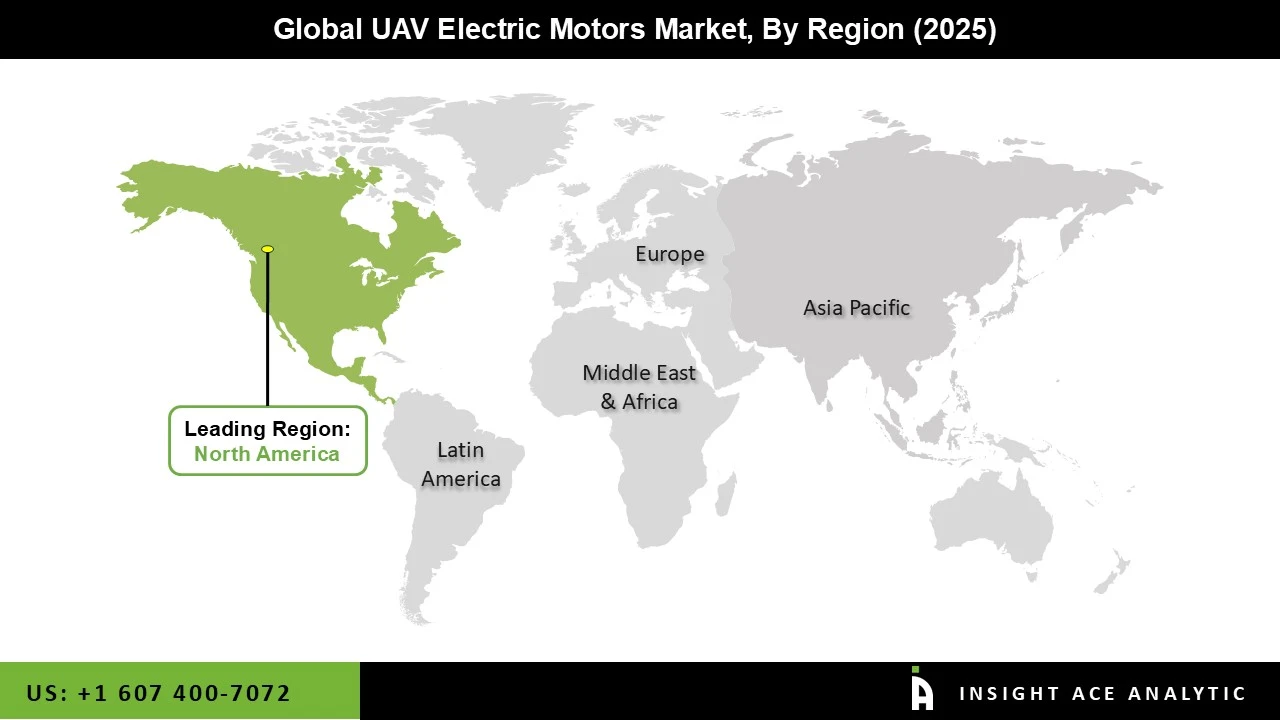
Why North America Led the UAV Electric Motors Market?
North America dominated the UAV Electric Motors Market due to its robust defense sector, advanced aerospace industry, and early adoption of unmanned aerial technologies. The region, led by the United States, has made substantial investments in military UAV programs for surveillance, reconnaissance, intelligence gathering, and tactical operations, creating strong demand for high-performance electric propulsion systems. In addition, the rapid expansion of commercial drone applications across agriculture, logistics, infrastructure inspection, construction, and media sectors is further driving the need for efficient and reliable electric motors.
The presence of leading UAV manufacturers, aerospace companies, and propulsion technology providers has fostered continuous innovation in motor design, energy efficiency, and lightweight materials. Growing investments in research and development, along with supportive regulatory initiatives and increasing adoption of drone-based services, have accelerated market growth across the region. As a result, North America continues to maintain its leadership position in the UAV Electric Motors Market through a combination of strong defense spending, expanding commercial drone usage, and a highly developed technological ecosystem.
Key Developments-
• In May 2026, T-Motor released the HEP-L Series Multi-Rotor Propellers, ultra-light propulsion components engineered for professional UAV platforms. Developed on an aerodynamic optimization platform, the HEP-L propellers deliver a 3% improvement in total flight time under identical operating conditions compared to previous designs, supporting longer mission durations in industrial drone operations.
UAV Electric Motors Market Report Scope:
| Report Attribute | Specifications |
| Market size value in 2025 | USD 1,318.60 Bn |
| Revenue forecast in 2035 | USD 5,869.20 Bn |
| Growth Rate CAGR | CAGR of 16.0 % from 2026 to 2035 |
| Quantitative Units | Representation of revenue in US$ Bn and CAGR from 2026 to 2035 |
| Historic Year | 2022 to 2025 |
| Forecast Year | 2026-2035 |
| Report Coverage | The forecast of revenue, the position of the company, the competitive market structure, growth prospects, and trends |
| Segments Covered | Motor Type, Power Class, UAV Platform Type, Application/Use Case, Component, End User and By Region |
| Regional Scope | North America; Europe; Asia Pacific; Latin America; Middle East & Africa |
| Country Scope | U.S.; Canada; U.K.; Germany; China; India; Japan; Brazil; Mexico; The UK; France; Italy; Spain; China; Japan; India; South Korea; Southeast Asia; South Korea; Southeast Asia |
| Competitive Landscape | T-Motor (China), KDE Direct (USA), Hobbywing Technology Co., Ltd. (China), SunnySky (China), BrotherHobby (China), Vertiq (USA), Maxon Group (Switzerland), Moog Inc. (USA), Plettenberg Elektromotoren (Germany), FAULHABER / MicroMo (Germany/USA), Allied Motion Technologies / Allient (USA), Portescap (USA), Emrax (Slovenia), H3X Technologies (USA), LaunchPoint EPS (USA), ThinGap (USA), Safran Electrical & Power (France), Evolito (UK), MGM Compro (Czech Republic), Nidec Corporation (Japan), Johnson Electric Holdings (Hong Kong), AMETEK (USA), Turnigy / HobbyKing (Hong Kong/Global), Valeo (France), Bosch (Germany), Continental AG (Germany), Dana Incorporated / TM4 (USA) |
| Customization Scope | Free customization report with the procurement of the report, Modifications to the regional and segment scope. Geographic competitive landscape. |
| Pricing and Available Payment Methods | Explore pricing alternatives that are customized to your particular study requirements. |
Market Segmentation:
UAV Electric Motors Market by Motor Type -
• Brushless DC Motors (BLDC)
o Outrunner BLDC Motors
o Inrunner BLDC Motors
o Axial Flux Motors
o Pancake / Flat Profile Motors
o Ironless / Slotless (Coreless) Motors
• Brushed DC Motors
• Stepper Motors (Gimbal & Payload Positioning)
• Servo Motors (Control Surface Actuation)
UAV Electric Motors Market by Power Class-
• Micro Power: Up to 100W
• Low Power: 100W – 1kW
• Medium Power: 1kW – 10kW
• High Power: 10kW – 50kW
• Very High Power: 50kW – 200kW+
UAV Electric Motors Market by UAV Platform Type -
• Multi-Rotor (Quadcopter, Hexacopter, Octocopter)
• Fixed-Wing
• VTOL / Hybrid (Tilt-Rotor, Tilt-Wing, Lift+Cruise)
• Single-Rotor / Helicopter Configuration
• Ornithopter / Bio-Inspired Platforms
UAV Electric Motors Market by Application/ Use Case -
• Aerial Photography, Videography & Media Production
• Precision Agriculture (Crop Spraying, Monitoring, Seeding)
• Infrastructure Inspection & Monitoring (Energy, Telecom, Bridges)
• Last-Mile & Cargo Delivery Logistics
• Surveying, Mapping & Geospatial Intelligence (LiDAR, Photogrammetry)
• Military ISR (Intelligence, Surveillance, Reconnaissance)
• Combat & Tactical Strike Operations (Loitering Munitions, FPV)
• Search & Rescue / Emergency Response
• Environmental Monitoring & Conservation
• Urban Air Mobility (UAM) / Air Taxi — Adjacent Segment
UAV Electric Motors Market by Component –
• Electric Motors (Standalone)
• Electronic Speed Controllers (ESCs)
• Integrated Propulsion Units (Motor + ESC + Propeller Systems)
• Motor Accessories (Bearings, Mounts, Cooling Systems, Wiring Harnesses)
UAV Electric Motors Market by End Users–
• Defense & Military
o Armed Forces / Military Agencies
o Defense Contractors & System Integrators
• Commercial / Enterprise
o Drone-as-a-Service (DaaS) Operators
o Agriculture & Forestry Enterprises
o Logistics, E-Commerce & Delivery Platforms
o Energy, Utilities & Mining Companies
• Civil Government & Public Safety
• Consumer / Prosumer
• Research Institutions & Academia
UAV Electric Motors Market by Region-
North America-
• The US
• Canada
Europe-
• Germany
• UK
• France
• Nordics
• Netherlands
• Switzerland
• Spain
• Italy
• Rest of Europe
Asia-Pacific-
• China
• Japan
• South Korea
• Australia
• India
• Rest of APAC
Latin America-
• Brazil
• Mexico
• Chile
• Rest of LatAm
Middle East & Africa-
• GCC
• South Africa
• Rest of MEA
Research Design and Approach
This study employed a multi-step, mixed-method research approach that integrates:
- Secondary research
- Primary research
- Data triangulation
- Hybrid top-down and bottom-up modelling
- Forecasting and scenario analysis
This approach ensures a balanced and validated understanding of both macro- and micro-level market factors influencing the market.
Secondary Research
Secondary research for this study involved the collection, review, and analysis of publicly available and paid data sources to build the initial fact base, understand historical market behaviour, identify data gaps, and refine the hypotheses for primary research.
Sources Consulted
Secondary data for the market study was gathered from multiple credible sources, including:
- Government databases, regulatory bodies, and public institutions
- International organizations (WHO, OECD, IMF, World Bank, etc.)
- Commercial and paid databases
- Industry associations, trade publications, and technical journals
- Company annual reports, investor presentations, press releases, and SEC filings
- Academic research papers, patents, and scientific literature
- Previous market research publications and syndicated reports
These sources were used to compile historical data, market volumes/prices, industry trends, technological developments, and competitive insights.

Primary Research
Primary research was conducted to validate secondary data, understand real-time market dynamics, capture price points and adoption trends, and verify the assumptions used in the market modelling.
Stakeholders Interviewed
Primary interviews for this study involved:
- Manufacturers and suppliers in the market value chain
- Distributors, channel partners, and integrators
- End-users / customers (e.g., hospitals, labs, enterprises, consumers, etc., depending on the market)
- Industry experts, technology specialists, consultants, and regulatory professionals
- Senior executives (CEOs, CTOs, VPs, Directors) and product managers
Interview Process
Interviews were conducted via:
- Structured and semi-structured questionnaires
- Telephonic and video interactions
- Email correspondences
- Expert consultation sessions
Primary insights were incorporated into demand modelling, pricing analysis, technology evaluation, and market share estimation.
Data Processing, Normalization, and Validation
All collected data were processed and normalized to ensure consistency and comparability across regions and time frames.
The data validation process included:
- Standardization of units (currency conversions, volume units, inflation adjustments)
- Cross-verification of data points across multiple secondary sources
- Normalization of inconsistent datasets
- Identification and resolution of data gaps
- Outlier detection and removal through algorithmic and manual checks
- Plausibility and coherence checks across segments and geographies
This ensured that the dataset used for modelling was clean, robust, and reliable.
Market Size Estimation and Data Triangulation
Bottom-Up Approach
The bottom-up approach involved aggregating segment-level data, such as:
- Company revenues
- Product-level sales
- Installed base/usage volumes
- Adoption and penetration rates
- Pricing analysis
This method was primarily used when detailed micro-level market data were available.

Top-Down Approach
The top-down approach used macro-level indicators:
- Parent market benchmarks
- Global/regional industry trends
- Economic indicators (GDP, demographics, spending patterns)
- Penetration and usage ratios
This approach was used for segments where granular data were limited or inconsistent.
Hybrid Triangulation Approach
To ensure accuracy, a triangulated hybrid model was used. This included:
- Reconciling top-down and bottom-up estimates
- Cross-checking revenues, volumes, and pricing assumptions
- Incorporating expert insights to validate segment splits and adoption rates
This multi-angle validation yielded the final market size.
Forecasting Framework and Scenario Modelling
Market forecasts were developed using a combination of time-series modelling, adoption curve analysis, and driver-based forecasting tools.
Forecasting Methods
- Time-series modelling
- S-curve and diffusion models (for emerging technologies)
- Driver-based forecasting (GDP, disposable income, adoption rates, regulatory changes)
- Price elasticity models
- Market maturity and lifecycle-based projections
Scenario Analysis
Given inherent uncertainties, three scenarios were constructed:
- Base-Case Scenario: Expected trajectory under current conditions
- Optimistic Scenario: High adoption, favourable regulation, strong economic tailwinds
- Conservative Scenario: Slow adoption, regulatory delays, economic constraints
Sensitivity testing was conducted on key variables, including pricing, demand elasticity, and regional adoption.
Request Customization
Add countries, segments, company profiles, or extend forecast — free 10% customization with purchase.
Customize This Report →Enquire Before Buying
Speak with our analyst team about scope, methodology, pricing, or deliverable formats.
Enquire Now →Frequently Asked Questions
UAV Electric Motors Market Size is valued at USD 1,318.60 Bn in 2025 and is predicted to reach USD 5,869.20 Bn by the year 2035
UAV Electric Motors Market Size is predicted to grow at a 16.0% CAGR during the forecast period for 2026 to 2035.
T-Motor (China), KDE Direct (USA), Hobbywing Technology Co., Ltd. (China), SunnySky (China), BrotherHobby (China), Vertiq (USA), Maxon Group (Switzerland), Moog Inc. (USA), Plettenberg Elektromotoren (Germany), FAULHABER / MicroMo (Germany/USA), Allied Motion Technologies / Allient (USA), Portescap (USA), Emrax (Slovenia), H3X Technologies (USA), LaunchPoint EPS (USA), ThinGap (USA), Safran Electrical & Power (France), Evolito (UK), MGM Compro (Czech Republic), Nidec Corporation (Japan), Johnson Electric Holdings (Hong Kong), AMETEK (USA), Turnigy / HobbyKing (Hong Kong/Global), Valeo (France), Bosch (Germany), Continental AG (Germany), Dana Incorporated / TM4 (USA)
UAV Electric Motors Market is segmented into Motor Type, Power Class, UAV Platform Type, Application/Use Case, Component, End User and By Region
North America region is leading the UAV Electric Motors Market.