OTOF Gene Therapy for Hearing Loss Market Size, Share, Trend Report 2026 to 2035
What is OTOF Gene Therapy for Hearing Loss Market Size?
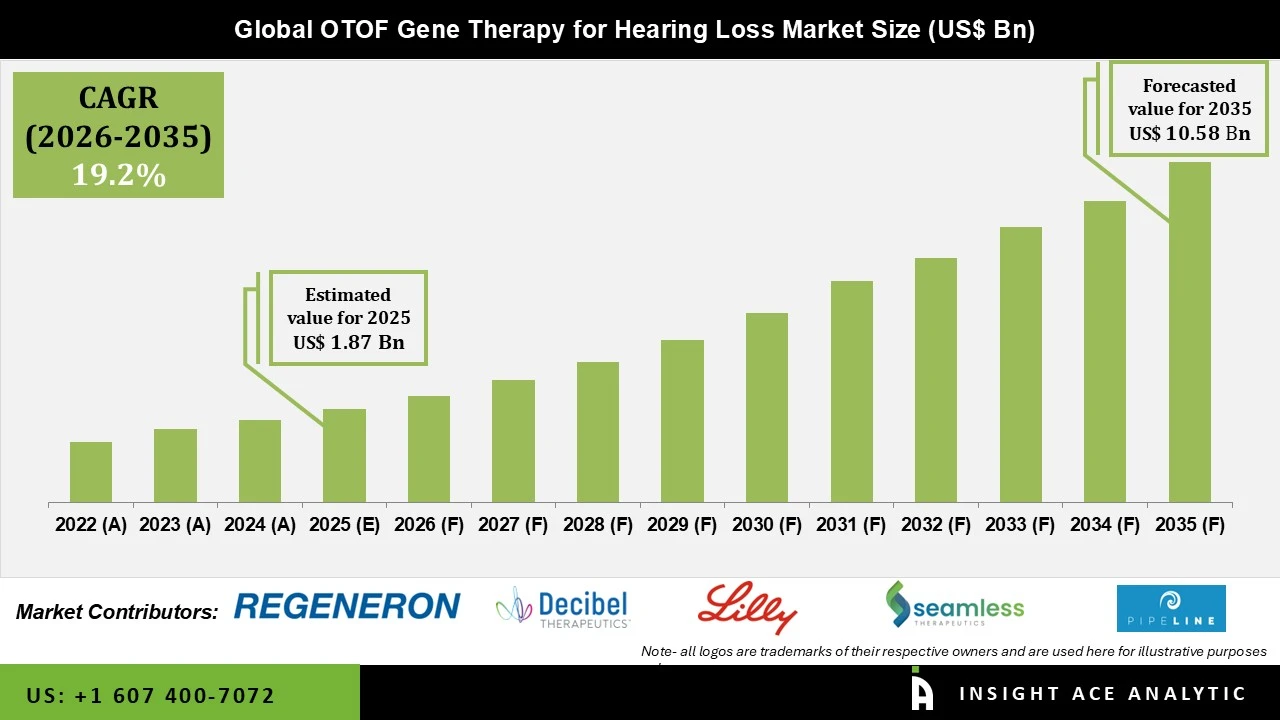
OTOF Gene Therapy for Hearing Loss Market Size is valued at USD 1.87 Bn in 2025 and is predicted to reach USD 10.58 Bn by the year 2035 at a 19.2% CAGR during the forecast period for 2026 to 2035.
OTOF Gene Therapy for Hearing Loss Market Size, Share & Trends Analysis by Type (Dual AAV Vector-Based, Single AAV Vector-Based, LNP-Based mRNA), by Patient Population (Pediatric (Congenital), Adult (Early Onset), Late-Stage Hearing Loss), by Distribution Channel (Hospital Specialty Clinics, ENT Centers, Rare Disease Treatment Centers), and Segment Forecasts, 2026 to 2035
OTOF gene therapy for hearing loss is an advanced genetic medicine approach designed to restore auditory function in patients with hearing loss caused by pathogenic variants in the OTOF gene. The OTOF gene encodes otoferlin, a protein required for synaptic transmission between cochlear inner hair cells and the auditory nerve. When otoferlin is absent or dysfunctional, sound detection may occur at the cochlear level, but auditory signals are not effectively transmitted to the brain. This condition is commonly associated with congenital or pre-lingual severe-to-profound hearing loss and auditory neuropathy.
Unlike conventional hearing aids and cochlear implants, which help manage hearing loss through amplification or electrical stimulation, OTOF gene therapy targets the underlying genetic cause. The therapy works by delivering a functional copy of the OTOF gene directly into the cochlea, enabling inner hair cells to produce otoferlin and restore more natural auditory signaling. This disease-modifying mechanism has positioned OTOF gene therapy as one of the most important breakthroughs in genetic hearing restoration.
The market is expected to gain strong traction due to increasing diagnosis of inherited hearing disorders, expansion of newborn and pediatric genetic testing, rising investment in gene therapy platforms, and the growing demand for one-time or durable treatments for rare genetic diseases. Recent clinical progress and regulatory milestones have strengthened confidence in the field, particularly for dual AAV vector-based approaches. Supportive rare disease frameworks, improving surgical delivery techniques, and growing specialist infrastructure across otology and cochlear implant centers are also expected to support market expansion. However, adoption will depend on early diagnosis, patient eligibility, long-term safety evidence, reimbursement access, and the availability of trained surgical teams.
Competitive Landscape
Which are the Leading Players in OTOF Gene Therapy for Hearing Loss Market?
• Akouos, Inc. (Eli Lilly and Company)
• Regeneron Pharmaceuticals, Inc.
• Decibel Therapeutics (Regeneron)
• Sensorion SA
• Genethon
• Pfizer Inc.
• Novartis AG
• Roche Holding AG
• MeiraGTx Holdings plc
• Sarepta Therapeutics
• REGENXBIO Inc.
• Neurogene Inc.
• Astellas Pharma Inc.
• Hough Ear Institute
• Boehringer Ingelheim
• Bluebird Bio
• Audina Hearing Instruments
• Otovia Therapeutics
• Other Emerging Players
Market Dynamics
Driver
Rising Demand for Curative Treatments for Genetic Hearing Loss
The OTOF gene therapy for hearing loss market is being driven by the growing need for treatments that address the root genetic cause of inherited deafness rather than only managing symptoms. Hearing aids and cochlear implants can significantly improve functional hearing, but they do not correct otoferlin deficiency or restore natural synaptic signaling between inner hair cells and the auditory nerve. OTOF gene therapy offers a disease-modifying approach by delivering a functional OTOF gene into cochlear cells, creating the potential for durable hearing improvement after a single intervention. Growth is also supported by wider use of genetic testing in newborns and children with severe-to-profound hearing loss, increasing awareness of auditory neuropathy, advancements in AAV vector engineering, and stronger investment in rare disease gene therapies. Regulatory momentum around genetic medicines and the first approval of an OTOF-targeted therapy further strengthens the commercial outlook.
Restrain/Challenge
High Development Costs and Complex Gene Delivery Systems
One of the major challenges in the OTOF gene therapy for hearing loss market is the technical complexity of delivering the large OTOF gene into cochlear inner hair cells. Because the OTOF gene is too large for a standard single AAV payload, many developers rely on dual-vector strategies, which increase manufacturing complexity, quality-control requirements, and development costs. Treatment administration also requires specialized otologic surgery and precise intracochlear delivery, limiting use to advanced centers with trained surgical teams. In addition, long-term safety monitoring, durability assessment, pediatric trial design, and strict regulatory requirements add to development timelines. Patient identification is another barrier, as therapy is most valuable when delivered early enough to support hearing and speech development. Reimbursement, access, and affordability may also remain important challenges, especially in markets with limited genetic testing or rare disease infrastructure.
OTOF-Mediated Congenital Deafness Segment is Expected to Drive the OTOF Gene Therapy for Hearing Loss Market
In 2025, the segment that covered OTOF-induced congenital deafness was the largest in the global market. This is mainly because of an increase in the number of diagnosed genetic hearing loss disorders in conjunction with advanced genetic testing techniques. Gene therapy is one of the most revolutionary treatment methods for those people born with OTOF-related hearing problems as they can regain their hearing abilities.
AAV-based Gene Therapy Segment is Growing at the Highest Rate in the OTOF Gene Therapy for Hearing Loss Market
The AAV-based gene therapy product segment accounted for the largest share of the market in 2025 due to its efficacy in delivering genes to the hair cells of the inner ear. The AAV vector platform has been found to offer good safety, sustained gene expression, and good therapeutic results through both pre-clinical and clinical trials. Moreover, advancements in the development of vector delivery systems have led to improved efficiency of treatment and possible applications.
Why North America Led the OTOF Gene Therapy for Hearing Loss Market?
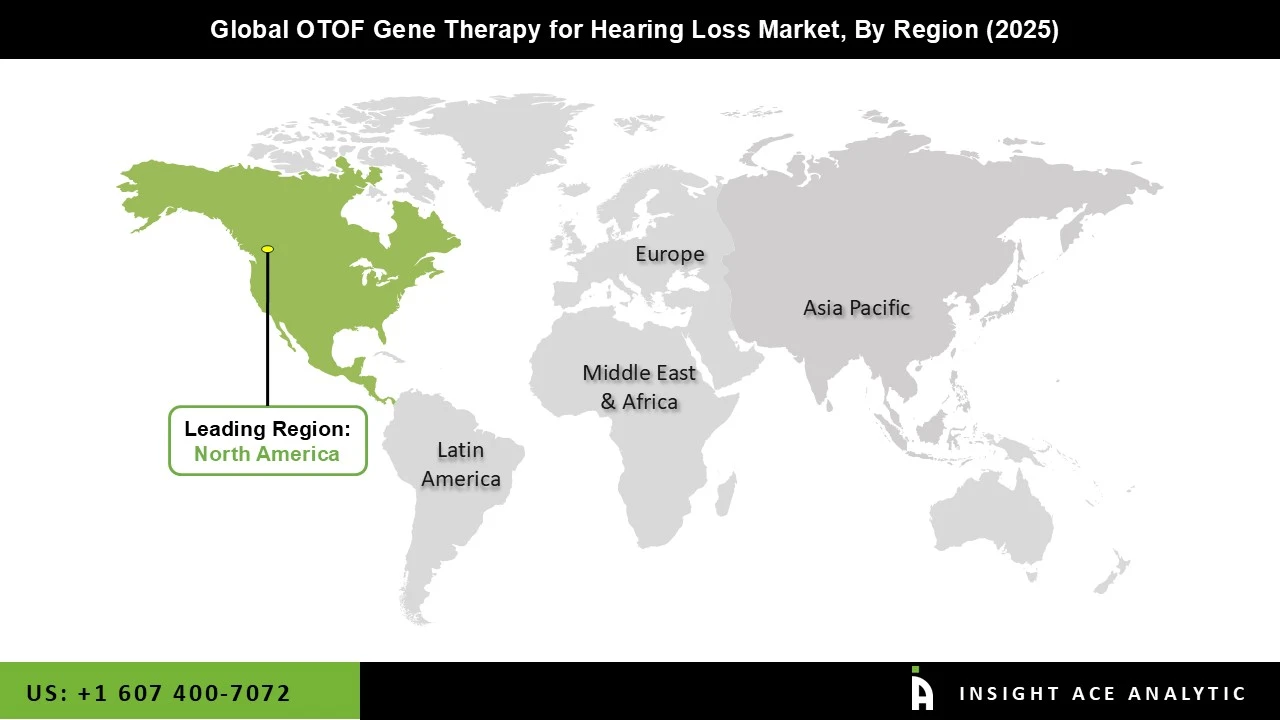
North America was projected to lead the market in terms of OTOF gene therapy for hearing loss in 2025 on account of the presence of top-notch biotech firms, better healthcare facilities, and research funding into gene therapy. It has a positive outlook for regulation for rare diseases and also enjoys considerable activities in terms of clinical trials. In addition, rising application of precision medicine techniques and increasing incidences of genetically-based hearing disorders are driving the growth of the market within the United States and Canada. The Asia Pacific region is likely to grow at the highest rate during the forecast period. Rising expenditure in healthcare, development of genetic tests, rising awareness about inherited hearing disorders, and increasing research funding in biotechnology are helping drive the growth of the market in this region.
Key Development
In April 2026, Regeneron Pharmaceuticals received U.S. FDA approval for Otarmeni, formerly known as DB-OTO, for OTOF-related severe-to-profound and profound sensorineural hearing loss. This approval marked a major milestone for the field and created a commercial benchmark for OTOF gene therapy.
In January 2024, Akouos, a wholly owned subsidiary of Eli Lilly and Company, announced positive Phase 1/2 clinical data from its AK-OTOF program, showing hearing restoration after a single administration in an initial participant with OTOF-mediated hearing loss. This strengthened confidence in AAV-based genetic hearing restoration.
OTOF Gene Therapy for Hearing Loss Market Report Scope:
| Report Attribute | Specifications |
| Market size value in 2025 | USD 1.87 Bn |
| Revenue forecast in 2035 | USD 10.58 Bn |
| Growth Rate CAGR | CAGR of 19.2% from 2026 to 2035 |
| Quantitative Units | Representation of revenue in US$ Bn and CAGR from 2026 to 2035 |
| Historic Year | 2022 to 2025 |
| Forecast Year | 2026-2035 |
| Report Coverage | The forecast of revenue, the position of the company, the competitive market structure, growth prospects, and trends |
| Segments Covered | Type, Patient Population, Distribution Channel, and By Region |
| Regional Scope | North America; Europe; Asia Pacific; Latin America; Middle East & Africa |
| Country Scope | U.S.; Canada; U.K.; Germany; China; India; Japan; Brazil; Mexico; The UK; France; Italy; Spain; China; Japan; India; South Korea; Southeast Asia; South Korea; Southeast Asia |
| Competitive Landscape | Akouos (Eli Lilly), Regeneron Pharmaceuticals, Decibel Therapeutics, Sensorion, Genethon, Pfizer, Roche, Novartis, MeiraGTx, REGENXBIO, Neurogene, Astellas Pharma, and Other Emerging Players. |
| Customization Scope | Free customization report with the procurement of the report, Modifications to the regional and segment scope. Geographic competitive landscape. |
| Pricing and Available Payment Methods | Explore pricing alternatives that are customized to your particular study requirements. |
Market Segmentation:
OTOF Gene Therapy for Hearing Loss Market by Type -
• Dual AAV Vector-Based
• Single AAV Vector-Based
• LNP-Based mRNA
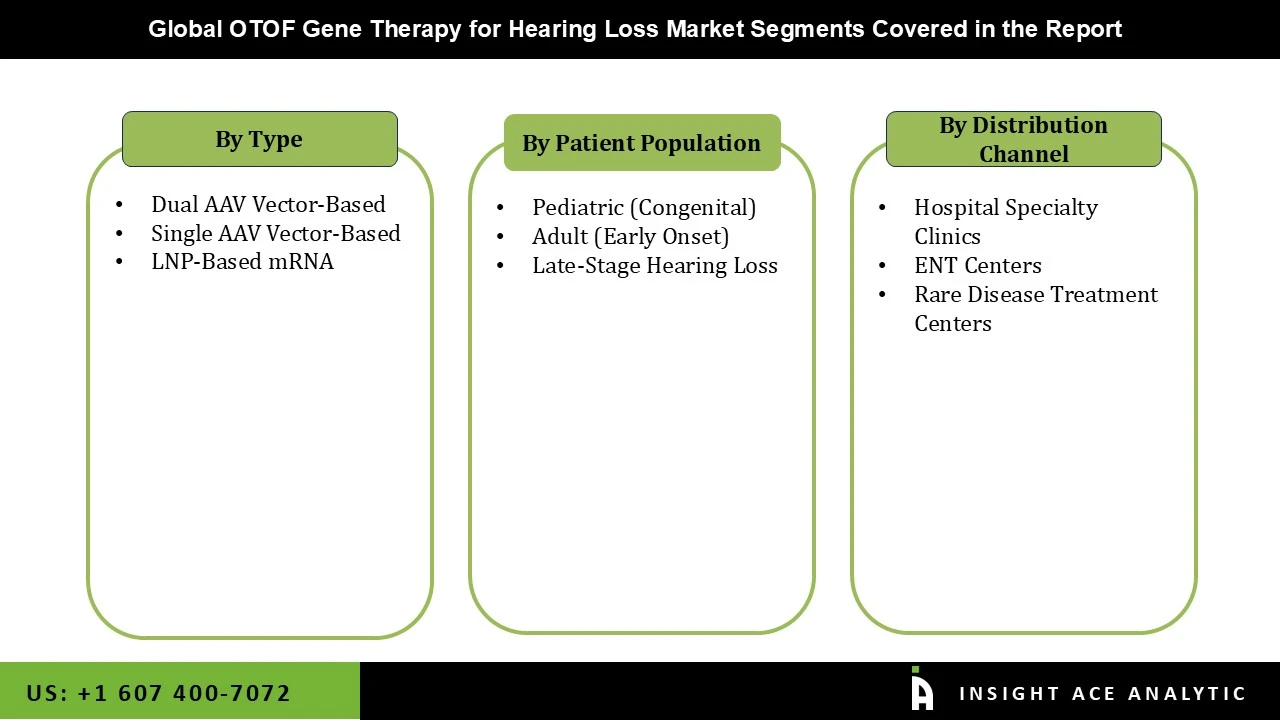
OTOF Gene Therapy for Hearing Loss Market by Patient Population -
• Pediatric (Congenital)
• Adult (Early Onset)
• Late-Stage Hearing Loss
OTOF Gene Therapy for Hearing Loss Market by Distribution Channel -
• Hospital Specialty Clinics
• ENT Centers
• Rare Disease Treatment Centers
OTOF Gene Therapy for Hearing Loss Market By Region-
North America-
• The US
• Canada
Europe-
• Germany
• The UK
• France
• Italy
• Spain
• Rest of Europe
Asia-Pacific-
• China
• Japan
• India
• South Korea
• South East Asia
• Rest of Asia Pacific
Latin America-
• Brazil
• Argentina
• Mexico
• Rest of Latin America
Middle East & Africa-
• GCC Countries
• South Africa
• Rest of Middle East and Africa
Research Design and Approach
This study employed a multi-step, mixed-method research approach that integrates:
- Secondary research
- Primary research
- Data triangulation
- Hybrid top-down and bottom-up modelling
- Forecasting and scenario analysis
This approach ensures a balanced and validated understanding of both macro- and micro-level market factors influencing the market.
Secondary Research
Secondary research for this study involved the collection, review, and analysis of publicly available and paid data sources to build the initial fact base, understand historical market behaviour, identify data gaps, and refine the hypotheses for primary research.
Sources Consulted
Secondary data for the market study was gathered from multiple credible sources, including:
- Government databases, regulatory bodies, and public institutions
- International organizations (WHO, OECD, IMF, World Bank, etc.)
- Commercial and paid databases
- Industry associations, trade publications, and technical journals
- Company annual reports, investor presentations, press releases, and SEC filings
- Academic research papers, patents, and scientific literature
- Previous market research publications and syndicated reports
These sources were used to compile historical data, market volumes/prices, industry trends, technological developments, and competitive insights.

Primary Research
Primary research was conducted to validate secondary data, understand real-time market dynamics, capture price points and adoption trends, and verify the assumptions used in the market modelling.
Stakeholders Interviewed
Primary interviews for this study involved:
- Manufacturers and suppliers in the market value chain
- Distributors, channel partners, and integrators
- End-users / customers (e.g., hospitals, labs, enterprises, consumers, etc., depending on the market)
- Industry experts, technology specialists, consultants, and regulatory professionals
- Senior executives (CEOs, CTOs, VPs, Directors) and product managers
Interview Process
Interviews were conducted via:
- Structured and semi-structured questionnaires
- Telephonic and video interactions
- Email correspondences
- Expert consultation sessions
Primary insights were incorporated into demand modelling, pricing analysis, technology evaluation, and market share estimation.
Data Processing, Normalization, and Validation
All collected data were processed and normalized to ensure consistency and comparability across regions and time frames.
The data validation process included:
- Standardization of units (currency conversions, volume units, inflation adjustments)
- Cross-verification of data points across multiple secondary sources
- Normalization of inconsistent datasets
- Identification and resolution of data gaps
- Outlier detection and removal through algorithmic and manual checks
- Plausibility and coherence checks across segments and geographies
This ensured that the dataset used for modelling was clean, robust, and reliable.
Market Size Estimation and Data Triangulation
Bottom-Up Approach
The bottom-up approach involved aggregating segment-level data, such as:
- Company revenues
- Product-level sales
- Installed base/usage volumes
- Adoption and penetration rates
- Pricing analysis
This method was primarily used when detailed micro-level market data were available.

Top-Down Approach
The top-down approach used macro-level indicators:
- Parent market benchmarks
- Global/regional industry trends
- Economic indicators (GDP, demographics, spending patterns)
- Penetration and usage ratios
This approach was used for segments where granular data were limited or inconsistent.
Hybrid Triangulation Approach
To ensure accuracy, a triangulated hybrid model was used. This included:
- Reconciling top-down and bottom-up estimates
- Cross-checking revenues, volumes, and pricing assumptions
- Incorporating expert insights to validate segment splits and adoption rates
This multi-angle validation yielded the final market size.
Forecasting Framework and Scenario Modelling
Market forecasts were developed using a combination of time-series modelling, adoption curve analysis, and driver-based forecasting tools.
Forecasting Methods
- Time-series modelling
- S-curve and diffusion models (for emerging technologies)
- Driver-based forecasting (GDP, disposable income, adoption rates, regulatory changes)
- Price elasticity models
- Market maturity and lifecycle-based projections
Scenario Analysis
Given inherent uncertainties, three scenarios were constructed:
- Base-Case Scenario: Expected trajectory under current conditions
- Optimistic Scenario: High adoption, favourable regulation, strong economic tailwinds
- Conservative Scenario: Slow adoption, regulatory delays, economic constraints
Sensitivity testing was conducted on key variables, including pricing, demand elasticity, and regional adoption.
Request Customization
Add countries, segments, company profiles, or extend forecast — free 10% customization with purchase.
Customize This Report →Enquire Before Buying
Speak with our analyst team about scope, methodology, pricing, or deliverable formats.
Enquire Now →Frequently Asked Questions
OTOF Gene Therapy for Hearing Loss Market Size is valued at USD 1.87 Bn in 2025 and is predicted to reach USD 10.58 Bn by the year 2035
OTOF Gene Therapy for Hearing Loss Market Size is predicted to grow at a 19.2% CAGR during the forecast period for 2026 to 2035.
Akouos (Eli Lilly), Regeneron Pharmaceuticals, Decibel Therapeutics, Sensorion, Genethon, Pfizer, Roche, Novartis, MeiraGTx, REGENXBIO, Neurogene, Astellas Pharma, and Other Emerging Players.
OTOF Gene Therapy for Hearing Loss Market is segmented into Type, Patient Population, Distribution Channel, and By Region
North America region is leading the OTOF Gene Therapy for Hearing Loss Market.