OEM mRNA for Diagnostics and Life Science Kits Market Size, Trend, Forecast Report 2026 to 2035
What is OEM mRNA for Diagnostics and Life Science Kits Market Size?
OEM mRNA for Diagnostics and Life Science Kits Market is predicted to grow at a 10.5% CAGR during the forecast period for 2026 to 2035.
OEM mRNA for Diagnostics and Life Science Kits Market Size, Share & Trends Analysis Distribution by Product / Component Type (OEM mRNA Molecules, Protected / Armored RNA Controls, IVT & mRNA-Enabling Reagents, mRNA Isolation & Purification Components, QC & Analytical Reagents), by Quality / Regulatory Grade (Research-Use-Only (RUO) / Research-Grade, Further-Manufacturing / TheraPure-Class, ISO 13485 / IVD-Intended, cGMP), by Application / End-Market Domain (Molecular Diagnostic (IVD) Kits, Life-Science & Research Kits, Bioprocess & Analytical QC), by Buyer / Customer Type (Global IVD Majors, Specialist / Emerging IVD Kit Brands, Life-Science Kit Brands, Academic / Core-Lab Kit Assemblers & CROs, Biopharma Process-Development / Analytical Groups) and Segment Forecasts, 2026 to 2035
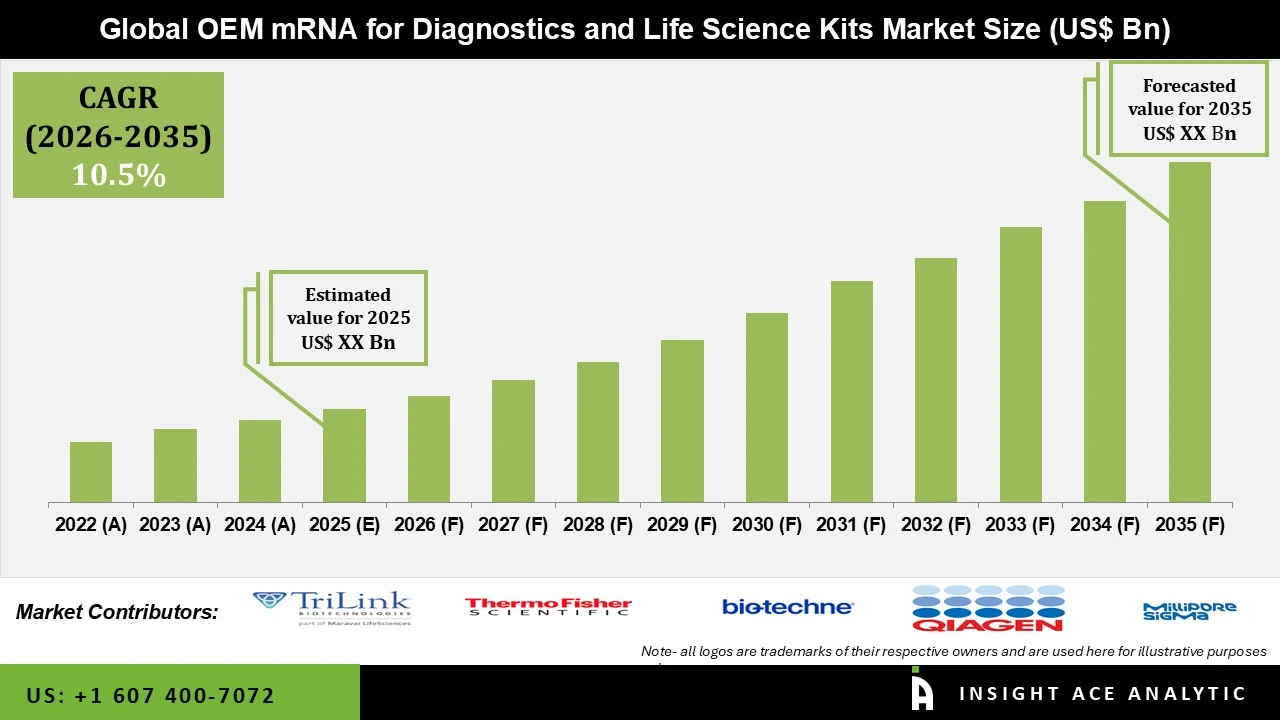
OEM mRNA for diagnostics and life science kits means making and supplying mRNA molecules, RNA controls, and related reagents that go into diagnostic and research kits. These products help with assay development, validation, quality control, and finding specific RNA targets in molecular diagnostics and research. The range includes OEM mRNA molecules, protected and armored RNA controls, in-vitro transcription (IVT) and mRNA reagents, mRNA isolation and purification tools, and quality control reagents. These are available in different quality and regulatory grades, such as research-use-only (RUO), further-manufacturing grade, ISO 13485-compliant, IVD-intended, and cGMP-grade materials.
The OEM mRNA Market for Diagnostics and Life Science Kits encompasses the manufacturing, customization, formulation, quality control, and commercial supply of mRNA components and related reagents intended for integration into diagnostic kits, research products, and quality-control systems.
The market includes RNA manufacturers, biotechnology companies, reagent suppliers, contract development and manufacturing organizations (CDMOs), and specialized ingredient providers that supply standard or customized RNA materials to in vitro diagnostics (IVD) companies, diagnostic kit developers, kit manufacturers, academic and research laboratories, contract research organizations (CROs), and biopharmaceutical process-development groups.
OEM supply models range from standardized, ready-to-use RNA controls and reagents to highly customized mRNA materials developed for specific assays, targets, concentrations, or analytical requirements. Customization may involve sequence design, modification, purification, formulation, packaging, and quality specifications tailored to the intended diagnostic or research workflow.
These capabilities allow diagnostic and life science companies to incorporate consistent RNA components into their products without establishing dedicated in-house manufacturing infrastructure. The increasing use of molecular diagnostics, nucleic-acid-based assays, RNA detection technologies, and advanced life science research is expanding the need for reliable, reproducible, and application-specific RNA controls and reagents.
Competitive Landscape
Which are the leading players in the OEM mRNA for Diagnostics and Life Science Kits Market?
• TriLink BioTechnologies / Maravai LifeSciences
• Thermo Fisher Scientific / Invitrogen
• Bio-Techne / Asuragen
• QIAGEN
• Merck KGaA / MilliporeSigma
• New England Biolabs
• Aldevron / Danaher
• GenScript / ProBio
• Roche CustomBiotech
• Promega
• CELLSCRIPT
• Kaneka Eurogentec
• LGC — SeraCare / Biosearch / Clinical
• Vazyme
• Takara Bio
• Jena Bioscience
• Molecular Biology Resources (MBR)
• VectorBuilder
• RiboPro
• Twist Bioscience
• Arnav Biotech
• Hyasen Biotech
• Hzymes Biotechnology
• BIORI Biotechnology / Zhuhai Biori
• APExBIO
• Promega / UBC RNA & Formulation Core
Market Dynamics
Driver
Increasing Demand for Reliable RNA Controls in Molecular Diagnostics and Life Science Research
As more molecular diagnostic techniques like RT-PCR and qPCR are used, the need for high-quality mRNA molecules and RNA controls is rising. Diagnostic kit makers need reliable RNA materials for developing assays, validating results, and ensuring quality. By using OEM-supplied mRNA components, manufacturers can standardize their products and avoid setting up their own RNA production. The push for better accuracy and quality is also leading IVD companies and life science kit makers to get specialized mRNA molecules, protected RNA controls, and related reagents from dedicated suppliers.
Restrain/Challenge
Complexity of mRNA Manufacturing, Stability, and Quality Consistency
One of the main challenges in the OEM mRNA market for diagnostics and life science kits is keeping mRNA products stable, pure, and consistent during manufacturing, storage, shipping, and use in diagnostic tests. mRNA can break down easily due to RNases, changes in temperature, or poor handling, which can hurt performance and shelf life.
Making RNA materials with the same sequence, quality, and concentration every time needs special manufacturing steps and strict quality checks. Suppliers who want to serve IVD and cGMP markets also have to provide more documentation, traceability, and quality management, which makes manufacturing more complex and costly. These issues can be tough for smaller suppliers who want to grow and work in regulated markets.
OEM mRNA Molecules Segment is Expected to Drive the OEM mRNA for Diagnostics and Life Science Kits Market
The OEM mRNA molecules segment is expected to make up a large part of the market because these molecules are used directly in diagnostic kits, assay development, and research products. Diagnostic manufacturers use custom mRNA as targets, controls, and reference materials to check how well RNA-based tests work. Having access to specific sequences, different transcript lengths, and custom formulas helps kit makers create products for many diagnostic and research uses. Outsourcing mRNA production to specialized suppliers also lets companies use proven manufacturing, keep products consistent, and avoid spending on their own RNA synthesis setups.
Molecular Diagnostic (IVD) Kits Segment is Expected to Drive the OEM mRNA for Diagnostics and Life Science Kits Market
The molecular diagnostic (IVD) kits segment is expected to take a large share of the market because more PCR-based and other nucleic acid tests are being used for disease detection. These kits need reliable RNA controls and reference materials for validating assays, checking performance, and routine quality control. OEM mRNA components, especially protected and armoured RNA controls, help manufacturers test RNA extraction, reverse transcription, and amplification. As more molecular diagnostic tests are developed and more companies outsource reagent production, the demand for custom OEM mRNA components is growing.
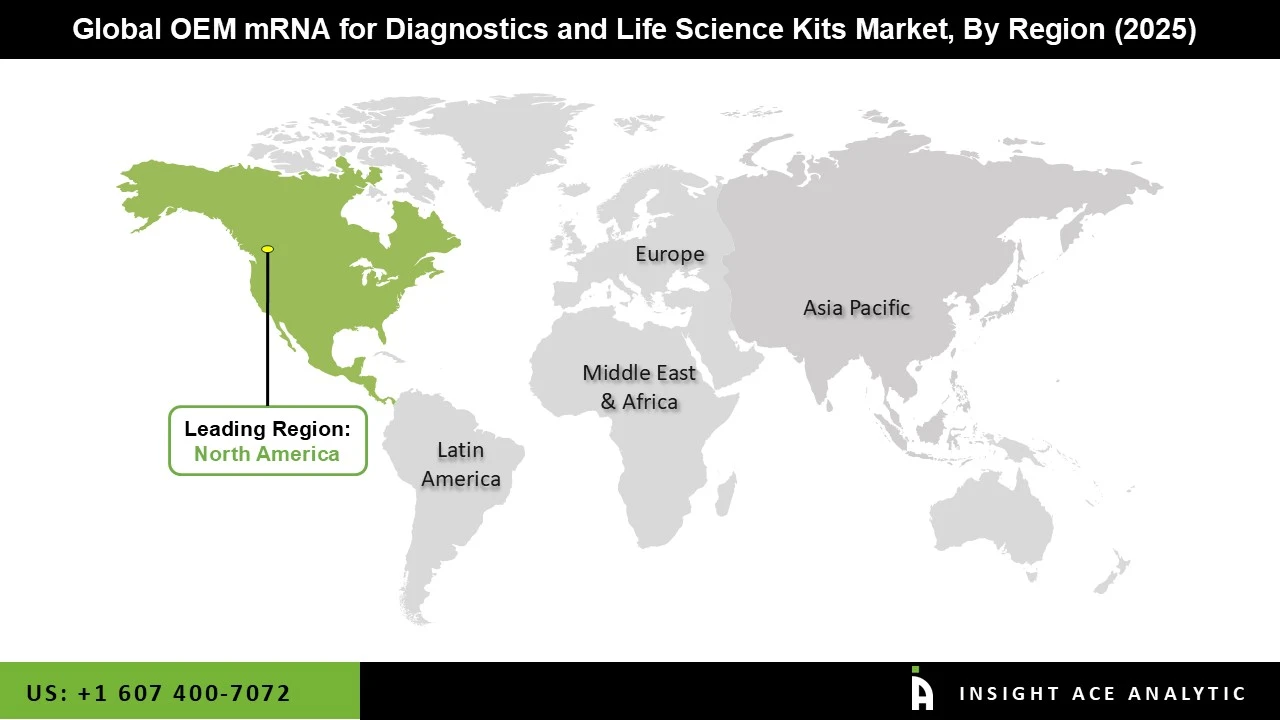
Why North America Led the OEM mRNA for Diagnostics and Life Science Kits Market?
North America is expected to lead the OEM mRNA for diagnostics and life science kits market, supported by its well-established molecular diagnostics industry, strong biotechnology ecosystem, and presence of majoNorth America is expected to lead the OEM mRNA market for diagnostics and life science kits because it has a strong molecular diagnostics industry, a solid biotech sector, and many major IVD and life science companies.
The United States is home to many diagnostic kit makers, biotech firms, research groups, and reagent suppliers that need high-quality RNA to develop and manufacture products. Companies like Thermo Fisher Scientific, Bio-Techne, TriLink BioTechnologies, New England Biolabs, and Aldevron help provide specialized RNA products and manufacturing. More investment in molecular diagnostics, new RNA-based testing technologies, and higher demand for outsourced OEM reagents are also driving market growth in the region.
Key Development
• In June 2026, TriLink BioTechnologies (Maravai LifeSciences) opened a new GMP enzyme manufacturing facility to strengthen its in-vitro transcription (IVT) supply capabilities. The facility is designed to support the production of critical enzymes used in mRNA manufacturing, enabling a more integrated supply chain from research and development to commercial-scale production.
• In August 2026, New England Biolabs (NEB) launched the Monarch® Mag Cell-free RNA (cfRNA) Extraction Kit for isolating low-abundance circulating cell-free RNA from biological samples, including plasma, serum, urine, and cerebrospinal fluid. The kit uses magnetic bead-based extraction and integrated DNase treatment to improve RNA recovery and reduce DNA contamination.
OEM mRNA for Diagnostics and Life Science Kits Market Report Scope:
| Report Attribute | Specifications |
| Market size value in 2025 | USD XX Bn |
| Revenue forecast in 2035 | USD XX Bn |
| Growth Rate CAGR | CAGR of 10.5% from 2026 to 2035 |
| Quantitative Units | Representation of revenue in US$ Bn and CAGR from 2026 to 2035 |
| Historic Year | 2022 to 2025 |
| Forecast Year | 2026-2035 |
| Report Coverage | The forecast of revenue, the position of the company, the competitive market structure, growth prospects, and trends |
| Segments Covered | Product / Component Type, Quality / Regulatory Grade, Application / End-Market Domain, Buyer / Customer Type and By Region |
| Regional Scope | North America; Europe; Asia Pacific; Latin America; Middle East & Africa |
| Country Scope | U.S.; Canada; U.K.; Germany; China; India; Japan; Brazil; Mexico; France; Italy; Spain; South Korea; Southeast Asia |
| Competitive Landscape | TriLink BioTechnologies / Maravai LifeSciences, Thermo Fisher Scientific / Invitrogen, Bio-Techne / Asuragen, QIAGEN, Merck KGaA / MilliporeSigma, New England Biolabs, Aldevron / Danaher, GenScript / ProBio, Roche CustomBiotech, Promega, CELLSCRIPT, Kaneka Eurogentec, LGC — SeraCare / Biosearch / Clinical, Vazyme, Takara Bio, Jena Bioscience, Molecular Biology Resources (MBR), VectorBuilder, RiboPro, Twist Bioscience, Arnav Biotech, Hyasen Biotech, Hzymes Biotechnology, BIORI Biotechnology / Zhuhai Biori, APExBIO, Promega / UBC RNA & Formulation Core |
| Customization Scope | Free customization report with the procurement of the report, Modifications to the regional and segment scope. Geographic competitive landscape. |
| Pricing and Available Payment Methods | Explore pricing alternatives that are customized to your particular study requirements. |
Market Segmentation:
OEM mRNA for Diagnostics and Life Science Kits Market by Product / Component Type -
• OEM mRNA Molecules
• Protected / Armored RNA Controls
• IVT & mRNA-Enabling Reagents
• mRNA Isolation & Purification Components
• QC & Analytical Reagents
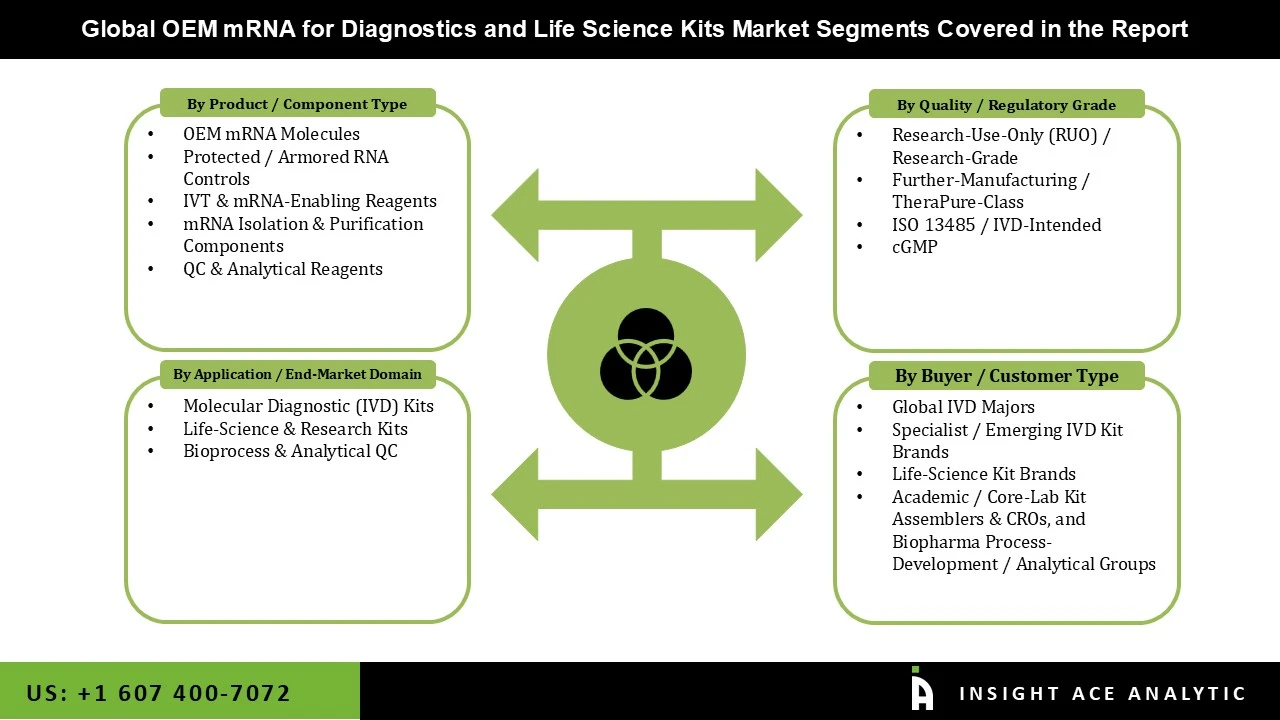
OEM mRNA for Diagnostics and Life Science Kits Market by Quality / Regulatory Grade-
• Research-Use-Only (RUO) / Research-Grade
• Further-Manufacturing / TheraPure-Class
• ISO 13485 / IVD-Intended
• cGMP
OEM mRNA for Diagnostics and Life Science Kits Market by Application / End-Market Domain -
• Molecular Diagnostic (IVD) Kits
• Life-Science & Research Kits
• Bioprocess & Analytical QC
OEM mRNA for Diagnostics and Life Science Kits Market by Buyer / Customer Type -
• Global IVD Majors
• Specialist / Emerging IVD Kit Brands
• Life-Science Kit Brands
• Academic / Core-Lab Kit Assemblers & CROs, and Biopharma Process-Development / Analytical Groups
OEM mRNA for Diagnostics and Life Science Kits Market by Region-
North America-
• The US
• Canada
• Mexico
Europe-
• Germany
• The UK
• France
• Italy
• Spain
• Rest of Europe
Asia-Pacific-
• China
• Japan
• India
• South Korea
• South East Asia
• Rest of Asia Pacific
Latin America-
• Brazil
• Argentina
• Rest of Latin America
Middle East & Africa-
• GCC Countries
• South Africa
• Rest of Middle East and Africa
Research Design and Approach
This study employed a multi-step, mixed-method research approach that integrates:
- Secondary research
- Primary research
- Data triangulation
- Hybrid top-down and bottom-up modelling
- Forecasting and scenario analysis
This approach ensures a balanced and validated understanding of both macro- and micro-level market factors influencing the market.
Secondary Research
Secondary research for this study involved the collection, review, and analysis of publicly available and paid data sources to build the initial fact base, understand historical market behaviour, identify data gaps, and refine the hypotheses for primary research.
Sources Consulted
Secondary data for the market study was gathered from multiple credible sources, including:
- Government databases, regulatory bodies, and public institutions
- International organizations (WHO, OECD, IMF, World Bank, etc.)
- Commercial and paid databases
- Industry associations, trade publications, and technical journals
- Company annual reports, investor presentations, press releases, and SEC filings
- Academic research papers, patents, and scientific literature
- Previous market research publications and syndicated reports
These sources were used to compile historical data, market volumes/prices, industry trends, technological developments, and competitive insights.
Primary Research
Primary research was conducted to validate secondary data, understand real-time market dynamics, capture price points and adoption trends, and verify the assumptions used in the market modelling.
Stakeholders Interviewed
Primary interviews for this study involved:
- Manufacturers and suppliers in the market value chain
- Distributors, channel partners, and integrators
- End-users / customers (e.g., hospitals, labs, enterprises, consumers, etc., depending on the market)
- Industry experts, technology specialists, consultants, and regulatory professionals
- Senior executives (CEOs, CTOs, VPs, Directors) and product managers
Interview Process
Interviews were conducted via:
- Structured and semi-structured questionnaires
- Telephonic and video interactions
- Email correspondences
- Expert consultation sessions
Primary insights were incorporated into demand modelling, pricing analysis, technology evaluation, and market share estimation.
Data Processing, Normalization, and Validation
All collected data were processed and normalized to ensure consistency and comparability across regions and time frames.
The data validation process included:
- Standardization of units (currency conversions, volume units, inflation adjustments)
- Cross-verification of data points across multiple secondary sources
- Normalization of inconsistent datasets
- Identification and resolution of data gaps
- Outlier detection and removal through algorithmic and manual checks
- Plausibility and coherence checks across segments and geographies
This ensured that the dataset used for modelling was clean, robust, and reliable.
Market Size Estimation and Data Triangulation
Bottom-Up Approach
The bottom-up approach involved aggregating segment-level data, such as:
- Company revenues
- Product-level sales
- Installed base/usage volumes
- Adoption and penetration rates
- Pricing analysis
This method was primarily used when detailed micro-level market data were available.
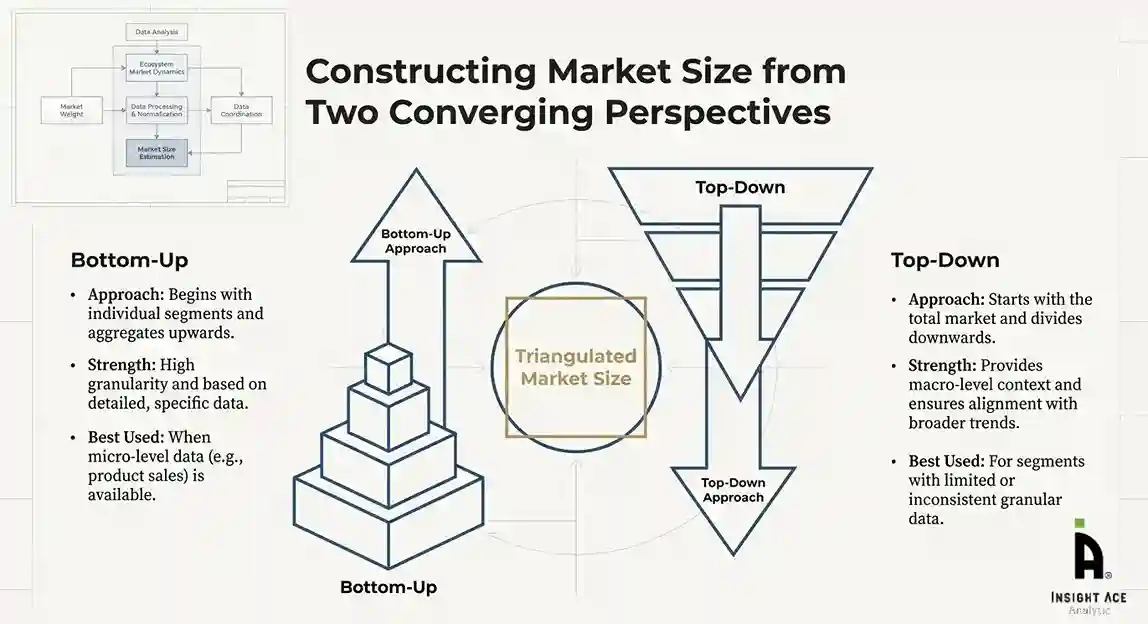
Top-Down Approach
The top-down approach used macro-level indicators:
- Parent market benchmarks
- Global/regional industry trends
- Economic indicators (GDP, demographics, spending patterns)
- Penetration and usage ratios
This approach was used for segments where granular data were limited or inconsistent.
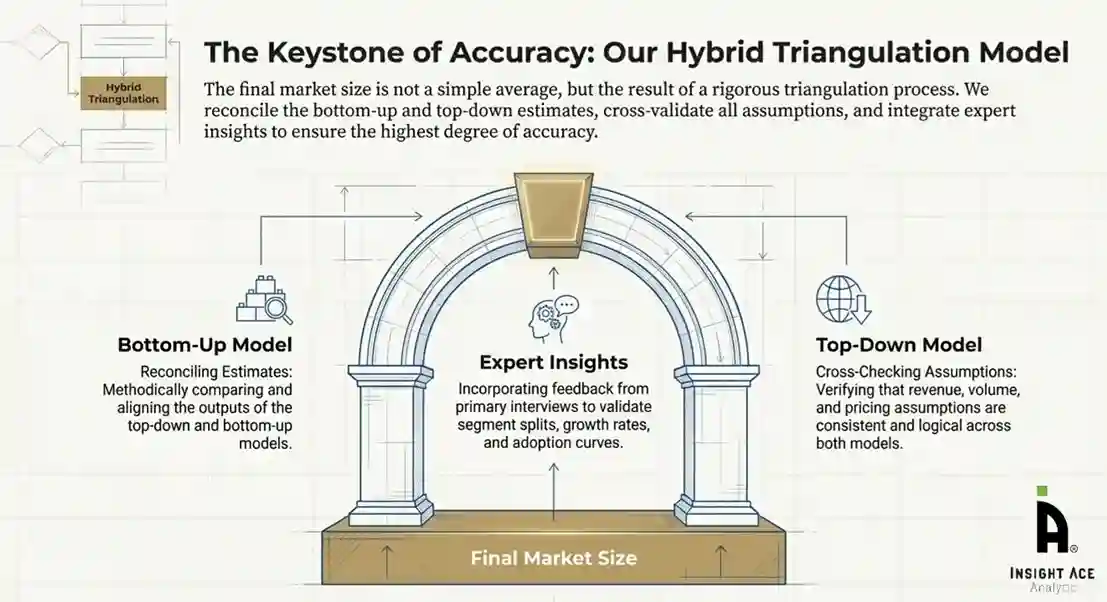
Hybrid Triangulation Approach
To ensure accuracy, a triangulated hybrid model was used. This included:
- Reconciling top-down and bottom-up estimates
- Cross-checking revenues, volumes, and pricing assumptions
- Incorporating expert insights to validate segment splits and adoption rates
This multi-angle validation yielded the final market size.
Forecasting Framework and Scenario Modelling
Market forecasts were developed using a combination of time-series modelling, adoption curve analysis, and driver-based forecasting tools.
Forecasting Methods
- Time-series modelling
- S-curve and diffusion models (for emerging technologies)
- Driver-based forecasting (GDP, disposable income, adoption rates, regulatory changes)
- Price elasticity models
- Market maturity and lifecycle-based projections
Scenario Analysis
Given inherent uncertainties, three scenarios were constructed:
- Base-Case Scenario: Expected trajectory under current conditions
- Optimistic Scenario: High adoption, favourable regulation, strong economic tailwinds
- Conservative Scenario: Slow adoption, regulatory delays, economic constraints
Sensitivity testing was conducted on key variables, including pricing, demand elasticity, and regional adoption.
Request Customization
Add countries, segments, company profiles, or extend forecast — free 10% customization with purchase.
Customize This Report →Enquire Before Buying
Speak with our analyst team about scope, methodology, pricing, or deliverable formats.
Enquire Now →Frequently Asked Questions
OEM mRNA for Diagnostics and Life Science Kits Market is predicted to grow at a 10.5% CAGR during the forecast period for 2026 to 2035.
TriLink BioTechnologies / Maravai LifeSciences, Thermo Fisher Scientific / Invitrogen, Bio-Techne / Asuragen, QIAGEN, Merck KGaA / MilliporeSigma, New England Biolabs, Aldevron / Danaher, GenScript / ProBio, Roche CustomBiotech, Promega, CELLSCRIPT, Kaneka Eurogentec, LGC — SeraCare / Biosearch / Clinical, Vazyme, Takara Bio, Jena Bioscience, Molecular Biology Resources (MBR), VectorBuilder, RiboPro, Twist Bioscience, Arnav Biotech, Hyasen Biotech, Hzymes Biotechnology, BIORI Biotechnology / Zhuhai Biori, APExBIO, Promega / UBC RNA & Formulation Core
OEM mRNA for Diagnostics and Life Science Kits Market is segmented into Product / Component Type, Quality / Regulatory Grade, Application / End-Market Domain, Buyer / Customer Type and By Region
North America region is leading the OEM mRNA for Diagnostics and Life Science Kits Market.