In Building Wireless Market Size, Revenue, Trend Report 2026 to 2035
What is In Building Wireless Market Size?
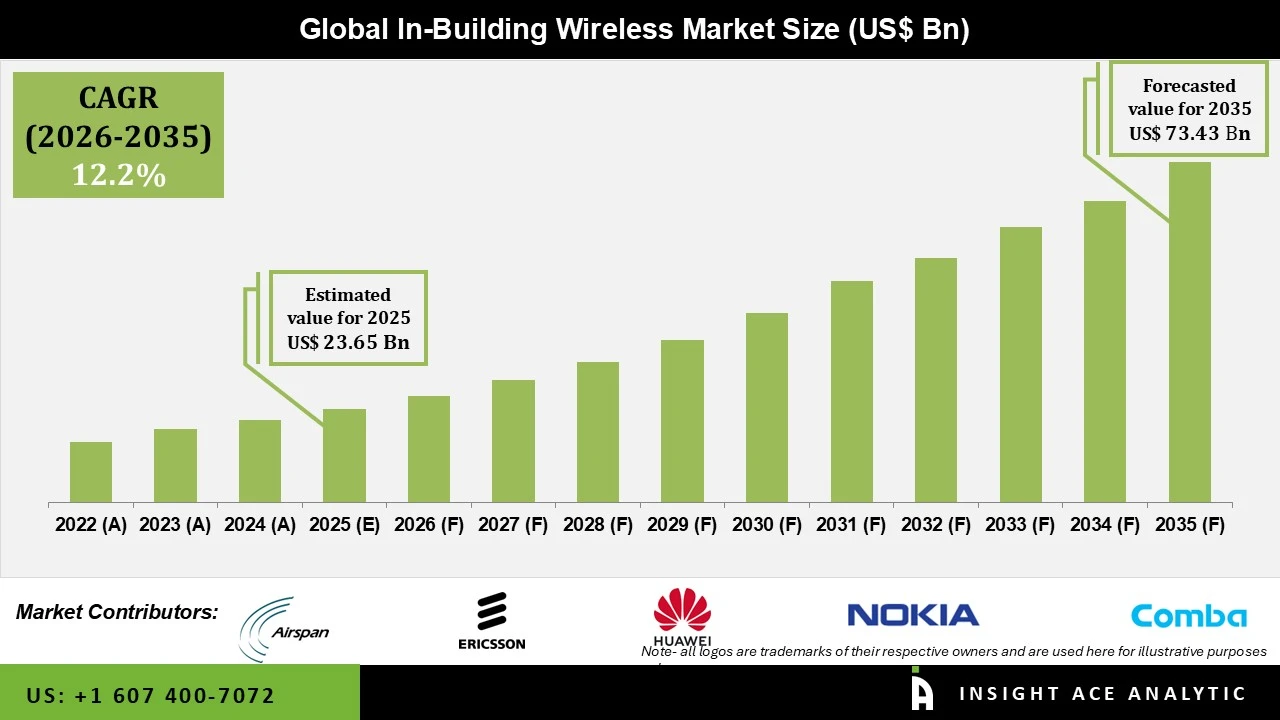
In Building Wireless Market Size is valued at USD 23.65 Bn in 2025 and is predicted to reach USD 73.43 Bn by the year 2035 at a 12.2% CAGR during the forecast period for 2026 to 2035.
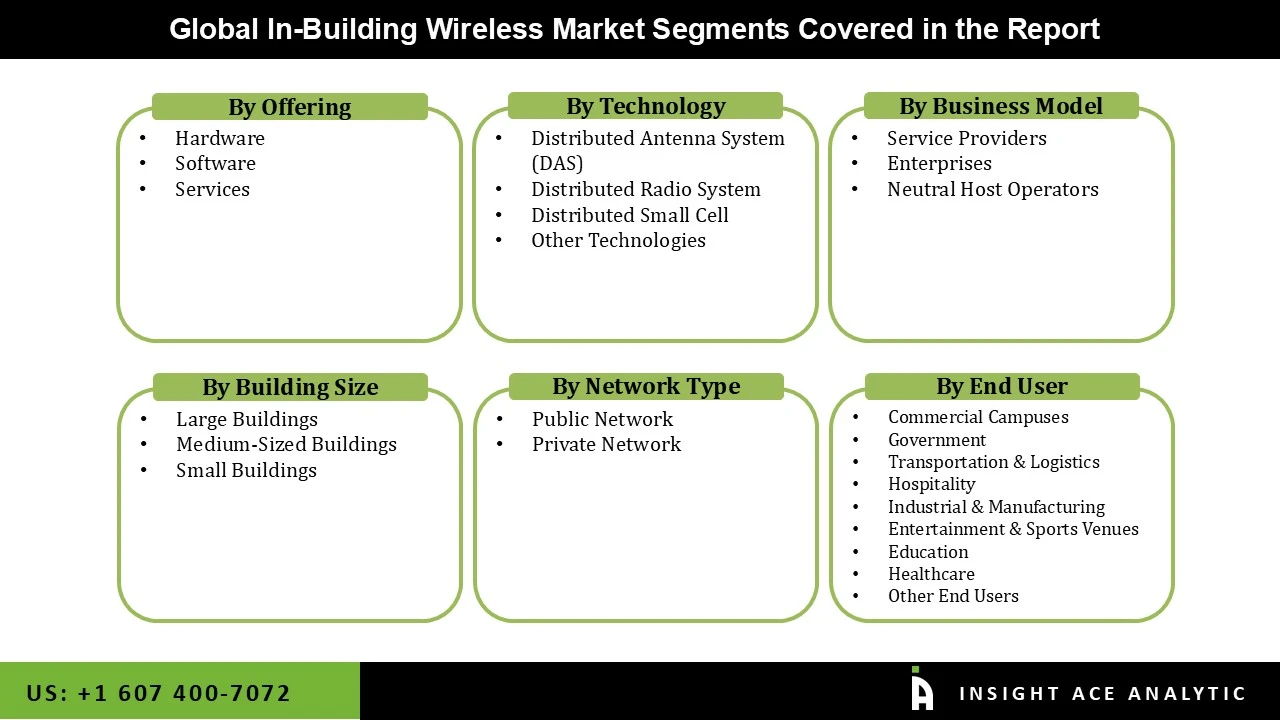
In Building Wireless Market Size, Share & Trends Analysis Distribution by Offering (Hardware, Software, Services), By Technology (Distributed Antenna System (DAS), Distributed Radio System, Distributed Small Cell, Other Technologies), By Business Model (Service Providers, Enterprises, Neutral Host Operators), By Building Size (Large Buildings, Medium-Sized Buildings, Small Buildings), By Network Type (Public Network, Private Network), By End User (Commercial Campuses, Government, Transportation & Logistics, Hospitality, Industrial & Manufacturing, Entertainment & Sports Venues, Education, Healthcare, Other End Users) and Segment Forecasts, 2026 to 2035
Wireless systems that are installed indoors are communication systems designed to offer cellular and wireless connectivity in indoor settings, for example in commercial buildings, offices, healthcare facilities, educational institutions, industrial facilities, transportation hubs, hospitality establishments, and entertainment sites. Such systems improve the wireless coverage and capacity inside buildings by spreading out the wireless signals using technologies including distributed antenna systems (DAS), distributed radio systems, and distributed small cells. The various in-building wireless solutions include the hardware, software, and related services needed for the planning, installation, management, and maintenance of the network.
The in-building wireless market consists of the products and services employed in the design, implementation, operation, and maintenance of indoor wireless communication networks. It covers hardware components including head-end units, remote units, repeaters, antennas, and femtocells; software solutions relating to network planning, design, and management; and professional and managed services as well. These solutions are used in buildings of different sizes, with various network types, business models, and end-user settings to provide both public and private wireless connectivity.
Competitive Landscape
Which are the Leading Players in the In-Building Wireless Market?
• Airspan Networks
• Ericsson
• Huawei
• Nokia
• Comba Telecom
• Samsung
• ZTE
• SOLiD
• NEC Corporation
• Fujitsu
• Sercomm Corporation
• Amphenol Corporation
• HUBER+SUHNER
• JMA Wireless
• Wilson Connectivity
• ADRF
• Contela
• Baicells Technologies
• Quectel
• Baylin Technologies
• PBE Axell
• Microlab
• Nextivity
• Resolution Wireless
• In-Building Wireless Solutions
• Maven Wireless
• Celona
• BTI Wireless
Market Dynamics
Driver
Growing Demand for Reliable High-Speed Indoor Connectivity
The growing demand for reliable and high-capacity wireless connectivity within buildings is a key factor in the expansion of the In-Building Wireless Market. Since modern commercial, industrial, healthcare, hospitality, transportation, and entertainment facilities have a large number of connected devices and users, there is a great need for steady indoor cellular and wireless coverage. Because building materials and complicated structures can attenuate outdoor network signals, coverage gaps and capacity constraints occur inside buildings. Solutions for in-building wireless connectivity such as DAS, distributed radio systems, and distributed small cells are able to eliminate these limitations by enhancing signal coverage and network capacity in all indoor areas. As organisations place increasing reliance on continuous wireless connectivity for communication, for their connected operations and for their digital services, the installation of in-building wireless infrastructure is growing in a wide variety of buildings.
Restrain/Challenge
High Deployment and Installation Costs
The high cost of setting up in-building wireless infrastructure presents a major problem for the market. To get sufficient coverage and capacity in complicated indoor environments, in-building wireless networks usually need detailed site surveys, network planning, specialized equipment, cabling, installation, integration and testing. Large buildings and sites that have many floors, a dense layout or special infrastructure may need a great deal of customization, which in turn raises the total deployment costs. Because of these large initial investments, it becomes difficult for organizations that are concerned about costs to decide on or speed up their adoption of in-building wireless solutions.
Services Segment is Expected to Drive the In-Building Wireless Market
Services is likely to be the main segment contributing to the growth of the In-Building Wireless Market, due to the growing demand for network design, integration and deployment, as well as for training, support, maintenance, and the provision of managed services connected with in-building wireless infrastructure. Since wireless network deployments are becoming more complicated in commercial, industrial, healthcare, transportation, and other types of facilities, organisations need specialised expertise in order to design, carry out, optimise, and manage wireless networks, thus enhancing the importance of services within the entire in-building wireless ecosystem.
Distributed Small Cell Segment is Growing at the Highest Rate in the In-Building Wireless Market
Distributed small cell is expected to grow at the highest rate among the technology segments in the In-building wireless market, supported by its ability to deliver high-capacity and low-latency connectivity in areas with concentrated user and device demand. Different from traditional coverage-oriented solutions, distributed small cells can be installed nearer to the end users and network endpoints, allowing for increased capacity to be focused on in offices, commercial campuses, healthcare facilities, transportation hubs, educational institutions, and industrial settings. The technology is also appropriate for use in private and enterprise wireless networks, in cases where companies need dedicated and reliable indoor connectivity for their connected devices, for automation, for real-time applications, and for data-intensive operations. Since indoor environments are becoming more and more reliant on wireless connectivity, the flexibility and scalability of distributed small-cell deployments are expected to promote quick adoption and thus make this segment a major factor in driving market growth.
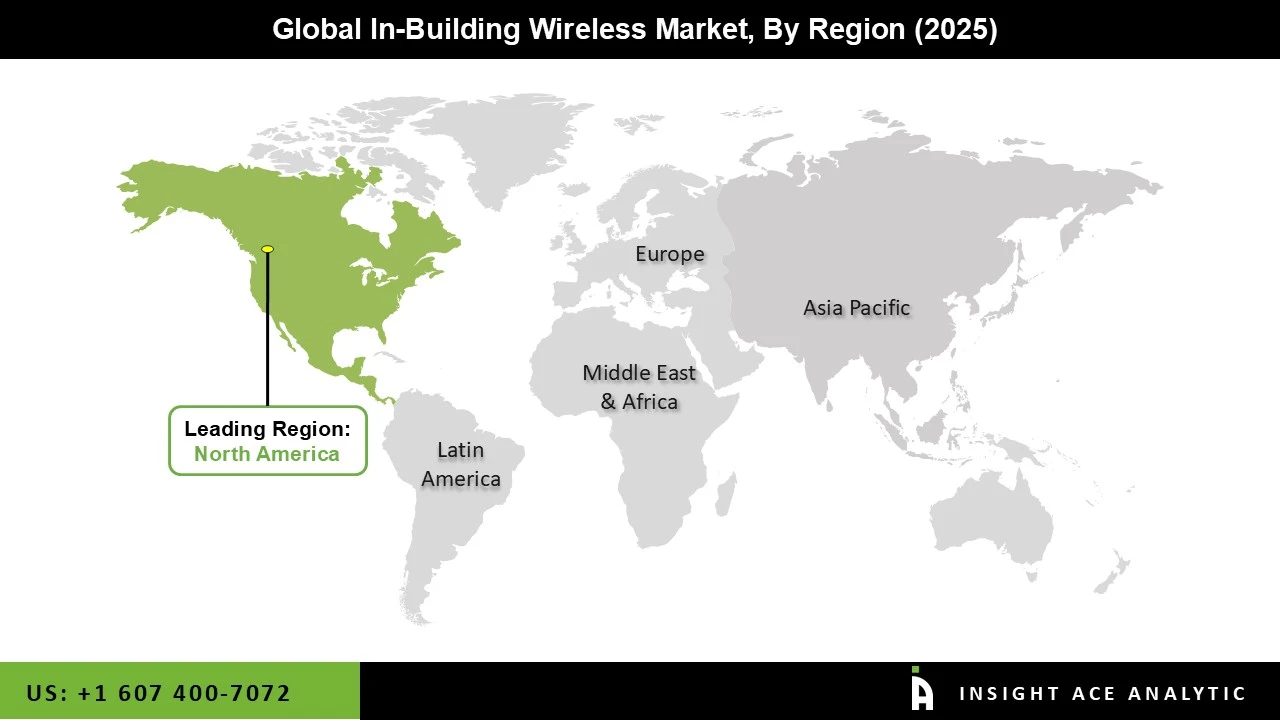
Why North America Led the In-Building Wireless Market?
North America leads the In-building wireless market because of its well-established IT infrastructure, high use of hybrid and multi-cloud setups, and a large number of companies managing complex multi-vendor technology systems. Organizations in sectors like BFSI, healthcare, telecommunications, manufacturing, and government depend on various hardware, software, networking, and data center assets from multiple OEMs. This creates a strong demand for centralized support services. The region is also home to major IT service providers and technology vendors, making advanced multi-vendor support solutions widely available. Additionally, significant investments in digital transformation, data center upgrades, managed IT services, and AI-driven infrastructure management, along with the growing need to improve IT asset performance and maintain business continuity, solidify North America's top position in the market.
Key Development
• June 2026: MTN Zambia and Huawei completed the world’s first commercial deployment of the five-band LampSite solution at Mulungushi International Conference Center, combining five frequency bands in a single unit and enabling peak speeds of up to 1 Gbps to enhance 5G indoor connectivity in Zambia.
In-Building Wireless Market Report Scope:
| Report Attribute | Specifications |
| Market size value in 2025 | USD 23.65 Bn |
| Revenue forecast in 2035 | USD 73.43 Bn |
| Growth Rate CAGR | CAGR of 12.2% from 2026 to 2035 |
| Quantitative Units | Representation of revenue in US$ Bn and CAGR from 2026 to 2035 |
| Historic Year | 2022 to 2025 |
| Forecast Year | 2026-2035 |
| Report Coverage | The forecast of revenue, the position of the company, the competitive market structure, growth prospects, and trends |
| Segments Covered | Offering, Technology, Business Model, Building Size, Network Type, and By Region |
| Regional Scope | North America; Europe; Asia Pacific; Latin America; Middle East & Africa |
| Country Scope | U.S.; Canada; U.K.; Germany; China; India; Japan; Brazil; Mexico; France; Italy; Spain; South Korea; Southeast Asia |
| Competitive Landscape | Airspan Networks, Ericsson, Huawei, Nokia, Comba Telecom, Samsung, ZTE, SOLiD, NEC Corporation, Fujitsu, Sercomm Corporation |
| Customization Scope | Free customization report with the procurement of the report, Modifications to the regional and segment scope. Geographic competitive landscape. |
| Pricing and Available Payment Methods | Explore pricing alternatives that are customized to your particular study requirements. |
Market Segmentation:
In-Building Wireless Market by Offering -
• Hardware
o Head End Units
o Remote Units
o Repeaters
o Antennas
o Femtocells
o Other Hardware
• Software
o Network Planning & Design
o Network Management
o Other Software
• Services
o Professional Services
Network Design
Integration & Deployment
Training, Support, & Maintenance
o Managed Services
In-Building Wireless Market by Technology -
• Distributed Antenna System (DAS)
o Active DAS
o Passive DAS
o Hybrid DAS
• Distributed Radio System
• Distributed Small Cell
• Other Technologies
In-Building Wireless Market by Business Model -
• Service Providers
• Enterprises
• Neutral Host Operators
In-Building Wireless Market by Building Size -
• Large Buildings
• Medium-Sized Buildings
• Small Buildings
In-Building Wireless Market by Network Type -
• Public Network
• Private Network
In-Building Wireless Market by End User -
• Commercial Campuses
• Government
• Transportation & Logistics
• Hospitality
• Industrial & Manufacturing
• Entertainment & Sports Venues
• Education
• Healthcare
• Other End Users
In-Building Wireless Market by Region-
North America-
• The US
• Canada
• Mexico
Europe-
• Germany
• The UK
• France
• Italy
• Spain
• Rest of Europe
Asia-Pacific-
• China
• Japan
• India
• South Korea
• South East Asia
• Rest of Asia Pacific
Latin America-
• Brazil
• Argentina
• Rest of Latin America
Middle East & Africa-
• GCC Countries
• South Africa
• Rest of Middle East and Africa
Research Design and Approach
This study employed a multi-step, mixed-method research approach that integrates:
- Secondary research
- Primary research
- Data triangulation
- Hybrid top-down and bottom-up modelling
- Forecasting and scenario analysis
This approach ensures a balanced and validated understanding of both macro- and micro-level market factors influencing the market.
Secondary Research
Secondary research for this study involved the collection, review, and analysis of publicly available and paid data sources to build the initial fact base, understand historical market behaviour, identify data gaps, and refine the hypotheses for primary research.
Sources Consulted
Secondary data for the market study was gathered from multiple credible sources, including:
- Government databases, regulatory bodies, and public institutions
- International organizations (WHO, OECD, IMF, World Bank, etc.)
- Commercial and paid databases
- Industry associations, trade publications, and technical journals
- Company annual reports, investor presentations, press releases, and SEC filings
- Academic research papers, patents, and scientific literature
- Previous market research publications and syndicated reports
These sources were used to compile historical data, market volumes/prices, industry trends, technological developments, and competitive insights.

Primary Research
Primary research was conducted to validate secondary data, understand real-time market dynamics, capture price points and adoption trends, and verify the assumptions used in the market modelling.
Stakeholders Interviewed
Primary interviews for this study involved:
- Manufacturers and suppliers in the market value chain
- Distributors, channel partners, and integrators
- End-users / customers (e.g., hospitals, labs, enterprises, consumers, etc., depending on the market)
- Industry experts, technology specialists, consultants, and regulatory professionals
- Senior executives (CEOs, CTOs, VPs, Directors) and product managers
Interview Process
Interviews were conducted via:
- Structured and semi-structured questionnaires
- Telephonic and video interactions
- Email correspondences
- Expert consultation sessions
Primary insights were incorporated into demand modelling, pricing analysis, technology evaluation, and market share estimation.
Data Processing, Normalization, and Validation
All collected data were processed and normalized to ensure consistency and comparability across regions and time frames.
The data validation process included:
- Standardization of units (currency conversions, volume units, inflation adjustments)
- Cross-verification of data points across multiple secondary sources
- Normalization of inconsistent datasets
- Identification and resolution of data gaps
- Outlier detection and removal through algorithmic and manual checks
- Plausibility and coherence checks across segments and geographies
This ensured that the dataset used for modelling was clean, robust, and reliable.
Market Size Estimation and Data Triangulation
Bottom-Up Approach
The bottom-up approach involved aggregating segment-level data, such as:
- Company revenues
- Product-level sales
- Installed base/usage volumes
- Adoption and penetration rates
- Pricing analysis
This method was primarily used when detailed micro-level market data were available.

Top-Down Approach
The top-down approach used macro-level indicators:
- Parent market benchmarks
- Global/regional industry trends
- Economic indicators (GDP, demographics, spending patterns)
- Penetration and usage ratios
This approach was used for segments where granular data were limited or inconsistent.
Hybrid Triangulation Approach
To ensure accuracy, a triangulated hybrid model was used. This included:
- Reconciling top-down and bottom-up estimates
- Cross-checking revenues, volumes, and pricing assumptions
- Incorporating expert insights to validate segment splits and adoption rates
This multi-angle validation yielded the final market size.
Forecasting Framework and Scenario Modelling
Market forecasts were developed using a combination of time-series modelling, adoption curve analysis, and driver-based forecasting tools.
Forecasting Methods
- Time-series modelling
- S-curve and diffusion models (for emerging technologies)
- Driver-based forecasting (GDP, disposable income, adoption rates, regulatory changes)
- Price elasticity models
- Market maturity and lifecycle-based projections
Scenario Analysis
Given inherent uncertainties, three scenarios were constructed:
- Base-Case Scenario: Expected trajectory under current conditions
- Optimistic Scenario: High adoption, favourable regulation, strong economic tailwinds
- Conservative Scenario: Slow adoption, regulatory delays, economic constraints
Sensitivity testing was conducted on key variables, including pricing, demand elasticity, and regional adoption.
Request Customization
Add countries, segments, company profiles, or extend forecast — free 10% customization with purchase.
Customize This Report →Enquire Before Buying
Speak with our analyst team about scope, methodology, pricing, or deliverable formats.
Enquire Now →Frequently Asked Questions
In Building Wireless Market Size is valued at USD 23.65 Bn in 2025 and is predicted to reach USD 73.43 Bn by the year 2035
In Building Wireless Market is expected to grow at a 12.2% CAGR during the forecast period for 2026 to 2035.
Airspan Networks, Ericsson, Huawei, Nokia, Comba Telecom, Samsung, ZTE, SOLiD, NEC Corporation, Fujitsu, Sercomm Corporation
In Building Wireless Market is segmented into Offering, Technology, Business Model, Building Size, Network Type, and By Region
North America region is leading the In Building Wireless Market.