Water 4.0 Market Size, Revenue, Trend Report 2026 to 2035
What is Water 4.0 Market Size?
Global Water 4.0 Market Size is valued at USD 19.53 Bn in 2025 and is predicted to reach USD 93.84 Bn by the year 2035 at a 17.2% CAGR during the forecast period for 2026 to 2035.
Water 4.0 Market Size, Share & Trends Analysis By Solution Type (Hardware, Software, Services) By Technology (Smart Monitoring, Digital Platforms, Advanced Intelligence, Automation, Cybersecurity) By Water Cycle Stage (Water Source Management, Water Treatment, Water Distribution, Wastewater Collection, Wastewater Treatment, Water Reuse & Recycling, Stormwater Management) By Application (Smart Water Distribution, Water Quality Monitoring, Asset Performance Management, Predictive Maintenance, Treatment Optimization, Energy Optimization, Smart Irrigation, Others) By End User (Municipal & Utility, Industrial, Commercial & Institutional, Agriculture), and Segment Forecasts, 2026 to 2035.
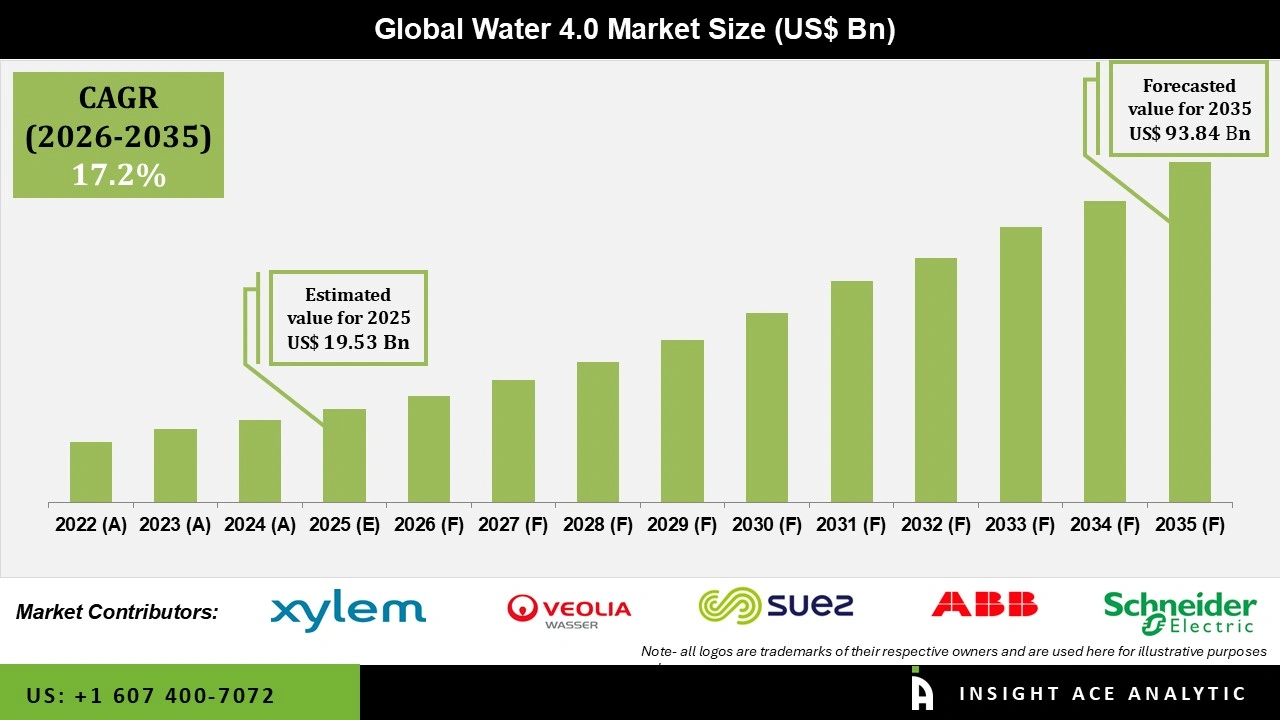
Water 4.0 refers to the adoption of interconnected digital systems to drive the transformation of the water sector by adopting advanced sensors, artificial intelligence, automation, cloud computing, big data analytics and digital twins. In this sense, Water 4.0 integrates the physical water infrastructure of the utility and digital systems in order to facilitate monitoring and analytics of all water resource uses. The technology applies to the whole water cycle from water collection, treatment and transportation to consumption and wastewater management and water treatment. Water 4.0 is a response to the growing pressures facing water utilities and industrial water users, such as water scarcity, aged infrastructure, climate change, high energy prices, and increasing water demand. In traditional water management, water utilities relied on manual inspection and monitoring of water resources and systems.
Water 4.0 requires the use of IoT-based sensors and smart water meters which would allow water utilities and operators to continuously monitor water flow, pressure, quality, use, temperature, equipment operations and networks condition. This data can be further processed using cloud computing and AI systems to detect abnormal conditions and potential operational issues. AI is becoming increasingly important in water management as AI-based technologies help in managing leak detection, water demand forecasts, predictive maintenance, pumping optimization, water quality management, waste water treatment, and flood predictions. Digital twins represent another aspect of Water 4.0 as they provide virtual representation of physical infrastructure which allows simulating operating conditions prior to implementing changes into the system.
In addition to individual solutions like sensors and smart meters, water management industry is moving towards the adoption of water management platforms integrating all aspects of water management in a single platform – from metering, water treatment and asset management to network monitoring. Such solution would create business opportunities for technology companies, water engineering firms, water utilities and automated management providers. Nevertheless, not all water management companies are ready to adopt Water 4.0 due to a number of barriers such as high cost of implementation, presence of aged infrastructure, cybersecurity risks, poor data quality, lack of expertise in using digital technologies, and fragmentation of water management systems. Small companies especially have trouble financing large-scale water management initiatives.
Competitive Landscape
Which are the Leading Players in Water 4.0 Market?
- Xylem Inc.
- Veolia Environnement S.A.
- SUEZ
- Siemens AG
- Schneider Electric
- Badger Meter, Inc.
- Itron, Inc.
- Bentley Systems, Incorporated
- Grundfos Holding A/S
- ABB Ltd.
- Honeywell International Inc.
- Emerson Electric Co.
- Trimble Inc.
- Danaher Corporation
- Veralto Corporation
- Kamstrup A/S
- Mueller Water Products, Inc.
- IBM Corporation
- Autodesk, Inc.
- Kando Environmental Services
Market Dynamics
Driver
Increasing Need to Reduce Water Losses and Improve Infrastructure Efficiency
Water loss continues to pose significant challenges to the water networks managed by municipalities. Pipeline deterioration, connection damage, changes in pressure, illegal usage, and failure to detect leaks on time can lead to considerable amounts of processed water being wasted before it is delivered to end-users. With Water 4.0 technologies, utility companies are continuously informed of the status of the network through such solutions as smart meters, pressure sensors, acoustic sensors, IoT gadgets, and AI-driven analytics. Rather than checking up the whole network at once, the utilities can rely on digital solutions to spot problematic areas of interest requiring attention. This principle may also be employed when dealing with other elements such as pumps, treatment facilities, control valves, water tanks, and other types of infrastructure.
Restrain/Challenge
High Initial Investment and Complexity of Legacy Water Infrastructure
The process of transformation into Water 4.0 involves significant investments in terms of sensors, communication technologies, smart meters, software platform, cloud technologies, cybersecurity, data management, and staff development. While large-scale utilities have an opportunity to plan these investments over several years, this aspect poses additional problems for smaller municipalities because of their financial limitations. Outdated infrastructure remains the other potential problem. Water supply systems were created many years ago; therefore, they do not correspond to the requirements for installing modern IoT sensors, software programs, and databases.
Another important issue concerns the growing relevance of cybersecurity because more devices are connected to the water supply system. Consequently, the number of opportunities for a potential attack increases; thus, the consideration of these aspects should be included in the initial process of design of the new infrastructure of Water 4.0. Quality of data affects the work of AI algorithms. Inadequate or absent information, unreliable sensors, different data format, and low network connectivity cause errors.
Internet of Things (IoT) Segment is Expected to Drive the Global Water 4.0 Market
This particular technology segment is expected to stay relevant since these connected devices collect the necessary data for the purposes of digital water management. Smart sensors are capable of measuring such parameters like water pressure, flow, temperature, quality, condition of the equipment as well as all kinds of operational metrics. All of this data could be delivered via centralized systems that will analyze the collected metrics and derive actionable intelligence out of it. Smart meters are gaining importance as well. Thanks to smart meters, utilities are able to analyze consumption trends, identify any outliers in consumption, increase accuracy of billings and detect the signs of leaks at the household level. Low power technologies allow easier implementation of these connected devices in the water network. With further reduction in the prices for sensors and communication equipment, utilities are expected to monitor all network assets digitally.
Artificial Intelligence & Machine Learning Segment is Growing at a Significant Rate
AI and ML become increasingly relevant because utilities generate greater amounts of data via smart meters, sensors, wastewater treatment facilities, weather systems, and customer management systems. AI can reveal some correlations that might not be obvious when using traditional monitoring. So, for example, the combination of such parameters as flow, pressure, weather and consumption data can be used to make a prediction about the need in a resource or possible leakages.
Furthermore, AI-driven systems can contribute to the improvement of wastewater treatment. So, for instance, such plants will be able to manage aeration, dosing, pumping and other activities in real time, thus optimizing the work process and minimizing energy and chemical utilization. The next developing area for AI is predictive maintenance.
Why North America Led the Water 4.0 Market?
North America will continue to be one of the most important regions for Water 4.0 due to aging infrastructure, developed technology landscape, utility management systems, and investments in advanced water networks.
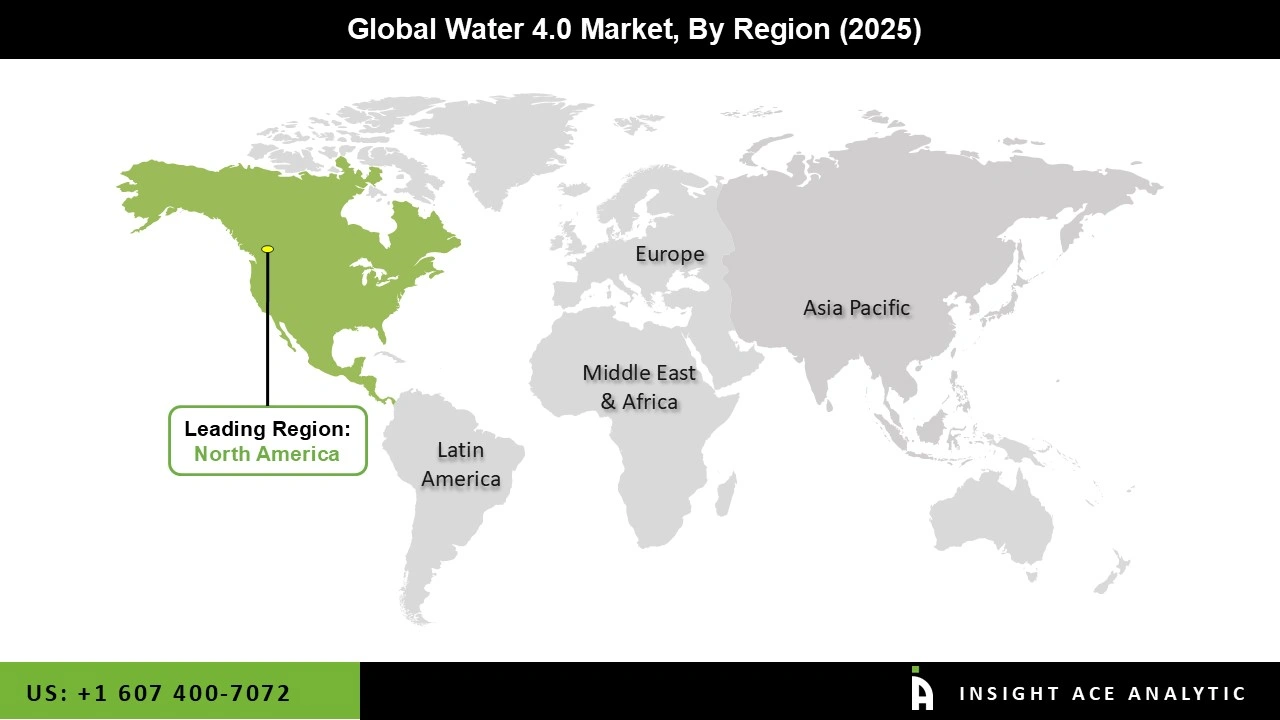
The United States already has substantial existing infrastructure for water and wastewater management, which needs to be upgraded. There are efforts by utilities to use smart meters, Internet of Things monitoring, artificial intelligence analytics, digital twins, and maintenance solutions.
It should also be taken into consideration that North America has many technology companies, producers of water-equipment, engineering, and software firms. It is possible for the utilities to integrate the digital solutions into the existing infrastructure and not rebuild everything.
Water 4.0 Market Report Scope:
| Report Attribute | Specifications |
| Market size value in 2025 | USD 19.53 Bn |
| Revenue forecast in 2035 | USD 93.84 Bn |
| Growth Rate CAGR | CAGR of 17.2% from 2026 to 2035 |
| Quantitative Units | Representation of revenue in US$ Bn and CAGR from 2026 to 2035 |
| Historic Year | 2022 to 2025 |
| Forecast Year | 2026-2035 |
| Report Coverage | The forecast of revenue, the position of the company, the competitive market structure, growth prospects, and trends |
| Segments Covered | Solution Type, Technology, Water Cycle Stage, Application, End-user, and By Region |
| Regional Scope | North America; Europe; Asia Pacific; Latin America; Middle East & Africa |
| Country Scope | U.S.; Canada; U.K.; Germany; China; India; Japan; Brazil; Mexico; France; Italy; Spain; South Korea; Southeast Asia |
| Competitive Landscape | Xylem, Veolia, SUEZ, Siemens, Schneider Electric, Badger Meter, Itron, Bentley Systems, Grundfos, ABB, Honeywell, Emerson, Trimble, Danaher, Veralto, Kamstrup, Mueller Water Products, IBM, Autodesk, and Kando Environmental Services. |
| Customization Scope | Free customization report with the procurement of the report, Modifications to the regional and segment scope. Geographic competitive landscape. |
| Pricing and Available Payment Methods | Explore pricing alternatives that are customized to your particular study requirements. |
Segmentations Water 4.0 Market:
Water 4.0 Market by Solution Type -
- Hardware
- Software
- Services
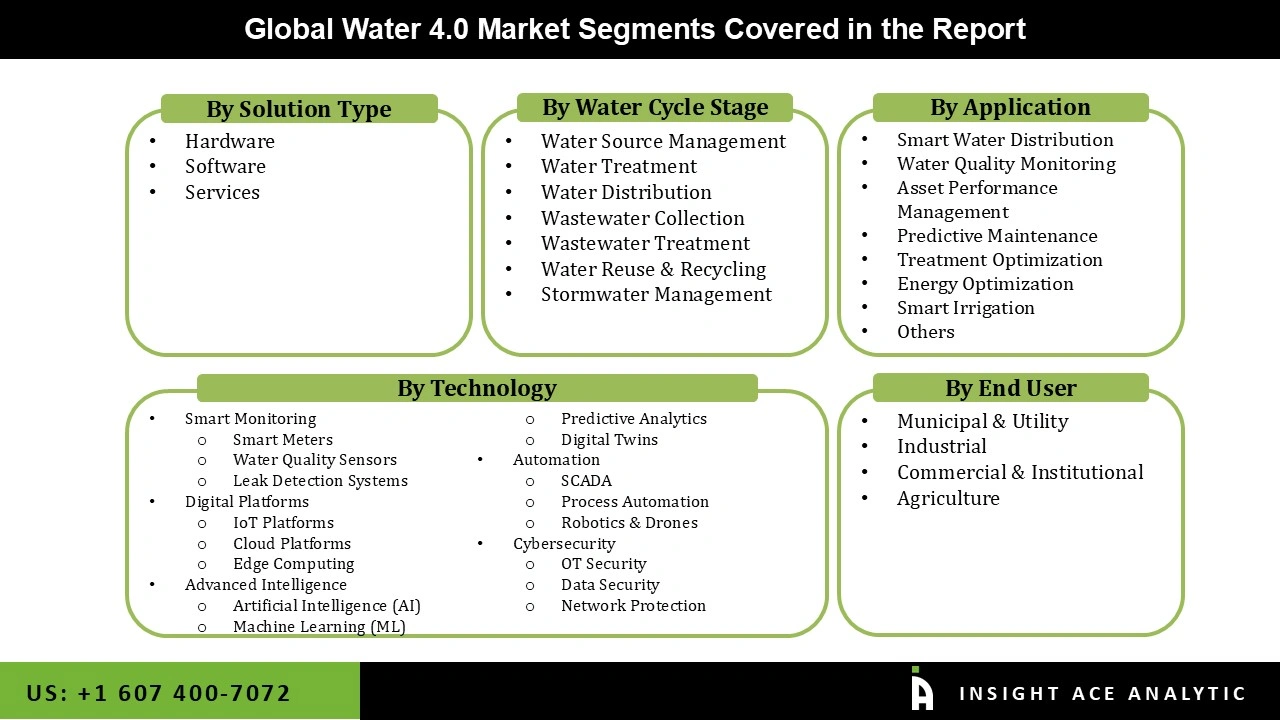
Water 4.0 Market by Technology -
- Smart Monitoring
- Digital Platforms
- Advanced Intelligence
- Automation
- Cybersecurity
Water 4.0 Market by Water Cycle Stage -
- Water Source Management
- Water Treatment
- Water Distribution
- Wastewater Collection
- Wastewater Treatment
- Water Reuse & Recycling
- Stormwater Management
Water 4.0 Market by Application-
- Smart Water Distribution
- Water Quality Monitoring
- Asset Performance Management
- Predictive Maintenance
- Treatment Optimization
- Energy Optimization
- Smart Irrigation
- Others
Water 4.0 Market by End-User-
- Municipal & Utility
- Industrial
- Commercial & Institutional
- Agriculture
Water 4.0 Market by Region-
- North America-
- The US
- Canada
- Europe-
- Germany
- The UK
- France
- Italy
- Spain
- Rest of Europe
- Asia-Pacific-
- China
- Japan
- India
- South Korea
- South East Asia
- Rest of Asia Pacific
- Latin America-
- Brazil
- Argentina
- Mexico
- Rest of Latin America
- Middle East and Africa-
- GCC Countries
- South Africa
- Rest of Middle East and Africa
Research Design and Approach
This study employed a multi-step, mixed-method research approach that integrates:
- Secondary research
- Primary research
- Data triangulation
- Hybrid top-down and bottom-up modelling
- Forecasting and scenario analysis
This approach ensures a balanced and validated understanding of both macro- and micro-level market factors influencing the market.
Secondary Research
Secondary research for this study involved the collection, review, and analysis of publicly available and paid data sources to build the initial fact base, understand historical market behaviour, identify data gaps, and refine the hypotheses for primary research.
Sources Consulted
Secondary data for the market study was gathered from multiple credible sources, including:
- Government databases, regulatory bodies, and public institutions
- International organizations (WHO, OECD, IMF, World Bank, etc.)
- Commercial and paid databases
- Industry associations, trade publications, and technical journals
- Company annual reports, investor presentations, press releases, and SEC filings
- Academic research papers, patents, and scientific literature
- Previous market research publications and syndicated reports
These sources were used to compile historical data, market volumes/prices, industry trends, technological developments, and competitive insights.

Primary Research
Primary research was conducted to validate secondary data, understand real-time market dynamics, capture price points and adoption trends, and verify the assumptions used in the market modelling.
Stakeholders Interviewed
Primary interviews for this study involved:
- Manufacturers and suppliers in the market value chain
- Distributors, channel partners, and integrators
- End-users / customers (e.g., hospitals, labs, enterprises, consumers, etc., depending on the market)
- Industry experts, technology specialists, consultants, and regulatory professionals
- Senior executives (CEOs, CTOs, VPs, Directors) and product managers
Interview Process
Interviews were conducted via:
- Structured and semi-structured questionnaires
- Telephonic and video interactions
- Email correspondences
- Expert consultation sessions
Primary insights were incorporated into demand modelling, pricing analysis, technology evaluation, and market share estimation.
Data Processing, Normalization, and Validation
All collected data were processed and normalized to ensure consistency and comparability across regions and time frames.
The data validation process included:
- Standardization of units (currency conversions, volume units, inflation adjustments)
- Cross-verification of data points across multiple secondary sources
- Normalization of inconsistent datasets
- Identification and resolution of data gaps
- Outlier detection and removal through algorithmic and manual checks
- Plausibility and coherence checks across segments and geographies
This ensured that the dataset used for modelling was clean, robust, and reliable.
Market Size Estimation and Data Triangulation
Bottom-Up Approach
The bottom-up approach involved aggregating segment-level data, such as:
- Company revenues
- Product-level sales
- Installed base/usage volumes
- Adoption and penetration rates
- Pricing analysis
This method was primarily used when detailed micro-level market data were available.

Top-Down Approach
The top-down approach used macro-level indicators:
- Parent market benchmarks
- Global/regional industry trends
- Economic indicators (GDP, demographics, spending patterns)
- Penetration and usage ratios
This approach was used for segments where granular data were limited or inconsistent.
Hybrid Triangulation Approach
To ensure accuracy, a triangulated hybrid model was used. This included:
- Reconciling top-down and bottom-up estimates
- Cross-checking revenues, volumes, and pricing assumptions
- Incorporating expert insights to validate segment splits and adoption rates
This multi-angle validation yielded the final market size.
Forecasting Framework and Scenario Modelling
Market forecasts were developed using a combination of time-series modelling, adoption curve analysis, and driver-based forecasting tools.
Forecasting Methods
- Time-series modelling
- S-curve and diffusion models (for emerging technologies)
- Driver-based forecasting (GDP, disposable income, adoption rates, regulatory changes)
- Price elasticity models
- Market maturity and lifecycle-based projections
Scenario Analysis
Given inherent uncertainties, three scenarios were constructed:
- Base-Case Scenario: Expected trajectory under current conditions
- Optimistic Scenario: High adoption, favourable regulation, strong economic tailwinds
- Conservative Scenario: Slow adoption, regulatory delays, economic constraints
Sensitivity testing was conducted on key variables, including pricing, demand elasticity, and regional adoption.
Request Customization
Add countries, segments, company profiles, or extend forecast — free 10% customization with purchase.
Customize This Report →Enquire Before Buying
Speak with our analyst team about scope, methodology, pricing, or deliverable formats.
Enquire Now →Frequently Asked Questions
Water 4.0 Market Size is valued at USD 19.53 Bn in 2025 and is predicted to reach USD 93.84 Bn by the year 2035
The Water 4.0 Market is expected to grow at a 17.2% CAGR during the forecast period for 2026 to 2035
Xylem, Veolia, SUEZ, Siemens, Schneider Electric, Badger Meter, Itron, Bentley Systems, Grundfos, ABB, Honeywell, Emerson, Trimble, Danaher, Veralto, Kamstrup, Mueller Water Products, IBM, Autodesk, and Kando Environmental Services.
Water 4.0 Market is segmented into Solution Type, Technology, Water Cycle Stage, Application, End-user, and Other.
North America region is leading the Water 4.0 Market.