Healthcare Patient Financing Platform Market Size, Scope, Forecast Report 2026 to 2035
What is Healthcare Patient Financing Platform Market?
Global Healthcare Patient Financing Platform Market Size is valued at USD 7.94 Bn in 2025 and is predicted to reach USD 28.15 Bn by the year 2035 at a 13.8% CAGR during the forecast period for 2026 to 2035.
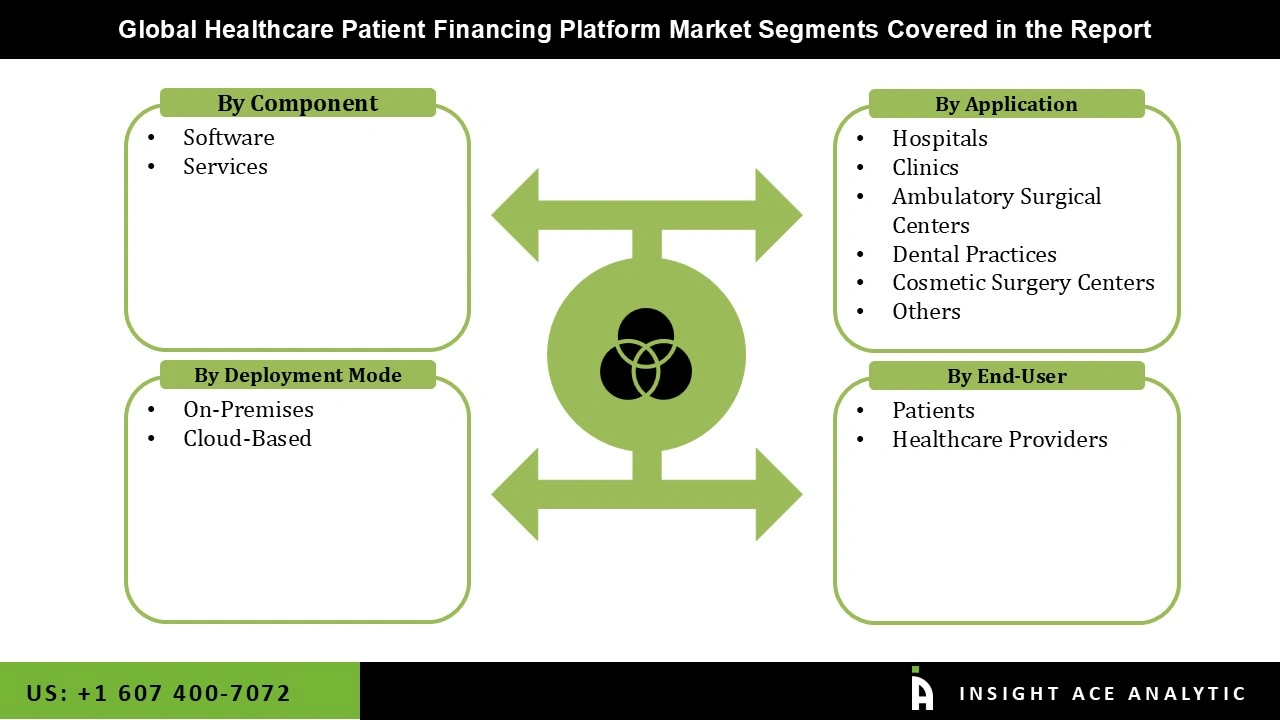
Healthcare Patient Financing Platform Market Size, Share & Trends Analysis Distribution by Component (Services and Software), Application (Hospitals, Clinics, Dental Practices, Cosmetic Surgery Centers, Ambulatory Surgical Centers, and Others), Deployment Mode (Cloud-Based and On-Premises), End-user (Patients and Healthcare Providers), and Segment Forecasts, 2026 to 2035.
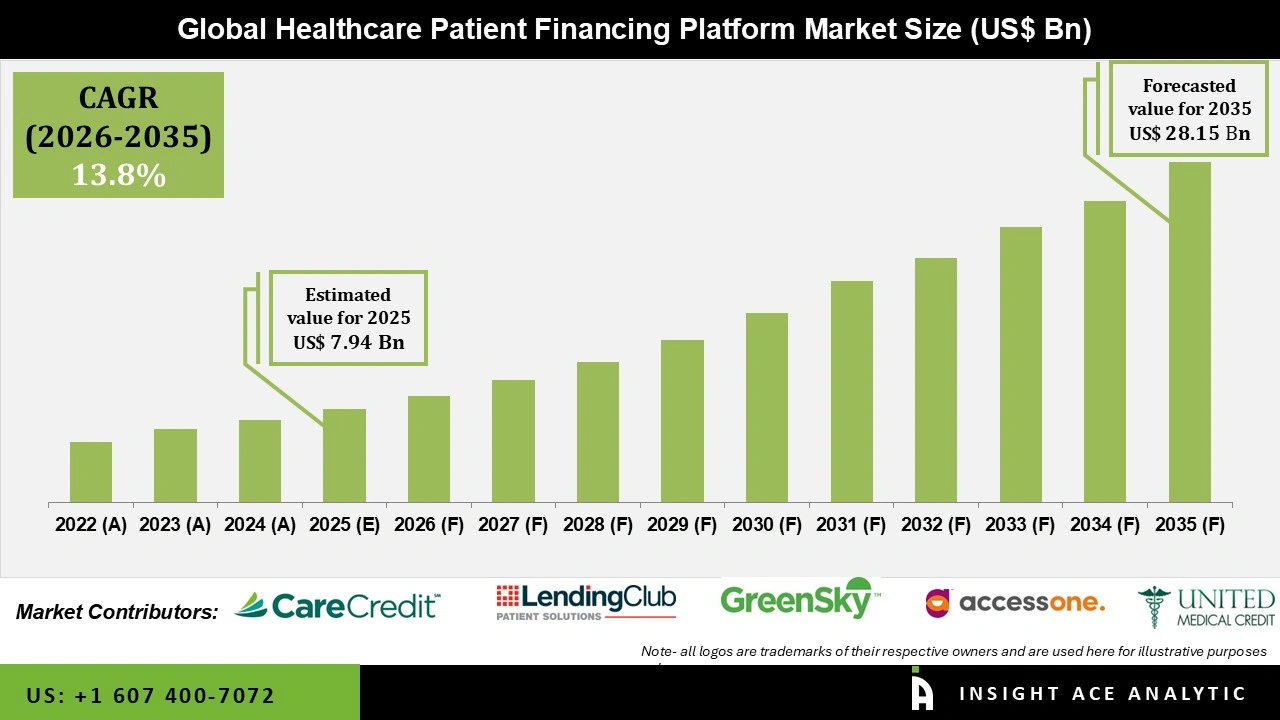
A computerized tool called a healthcare patient financing platform allows patients to manage and cover medical costs using organized financial choices like credit lines, loans, or installment plans. By acting as middlemen between financial institutions, patients, and healthcare providers, these platforms streamline the payment process and increase access to care by lowering upfront costs. They provide real-time cost estimations, eligibility checks, and adjustable payback options based on a patient's financial circumstances through integration with hospital billing systems and electronic health data. The high medical costs, the growing demand for flexible payment options, and the expanding use of digital healthcare technology globally are the main factors driving the healthcare patient financing platform market's expansion.
The healthcare patient financing platform market has been fueled by patients' growing need for financial aid to cover their out-of-pocket costs as healthcare costs continue to rise. A variety of products that meet various patient needs and preferences, such as credit cards, personal loans, and installment payment plans, are what define the industry. Furthermore, the growing spectrum of medical procedures needing substantial financial investment, the rising prevalence of chronic diseases, and rising healthcare expenses are further drivers driving the healthcare patient financing platform market expansion. Additionally, online applications and quick credit approvals are examples of how technology is incorporated into the patient finance process to improve the entire experience for both patients and doctors.
In addition, the need for more effective financial management systems and the growing complexity of healthcare funding are driving a revolutionary era in the healthcare patient financing platform market. Innovative solutions that improve revenue cycle management, expedite billing procedures, and boost patient financial engagement are sought after by stakeholders, including payers and healthcare providers. Additionally, the increasing focus on value-based care, which calls for a more integrated approach to financial operations, has a significant impact on the healthcare patient financing platform market growth. As a result, businesses are investing in cloud-based platforms, artificial intelligence, and sophisticated analytics to streamline their financial processes, leading to an increase in the use of technology.
Competitive Landscape
Which are the Leading Players in Healthcare Patient Financing Platform Market?
- United Medical Credit
- CareCredit
- GreenSky
- ClearBalance
- Parasail Health
- AccessOne
- LendingClub Patient Solutions
- MedLoan Finance
- Simplee
- DocPay
- Sunbit
- PrimaHealth Credit
- PayZen
- PatientFi
- Ally Lending
- Health Credit Services
- Scratchpay
- Commerce Bank Health Services Financing
- FinMkt
- iVitaFi
Market Dynamics
Driver
Rising Cost of Healthcare Services
The rising cost of healthcare services worldwide is one of the main factors driving the healthcare patient financing platform market. Patients frequently have to pay high out-of-pocket costs as medical costs continue to grow, particularly for elective operations and treatments that are not covered by insurance. The demand for flexible payment solutions that might lessen the immediate financial impact on patients and their families has increased as a result of this financial hardship. Furthermore, the patient financing options, such as credit lines and installment payment plans, provide people with a convenient method to get essential medical care without having to worry about making upfront payments. The aging population, which is more prone to chronic illnesses and frequent medical demands, exacerbates this trend and increases the need for financing options to control ongoing medical costs.
Restrain/Challenge
Complicated Regulatory Environment and a Fragmented Market
The healthcare patient financing platform market is still fragmented, with several companies operating in different sectors, such as government programs, health insurance, and medical loans. Customers may find it difficult to comprehend and evaluate various financing solutions as a result of this lack of consolidation. Furthermore, the regulatory landscape across various regions is frequently complicated due to the involvement of numerous parties, including governmental organizations, private insurers, fintech businesses, and healthcare providers. Additionally, complicated terms, interest rates, and other costs are common in healthcare financing options like medical loans, which may deter prospective clients from choosing these services. Some financing solutions' lack of transparency also makes it more difficult for people to make educated judgments, which impedes the healthcare patient financing platform market's overall expansion.
Software Segment is Expected to Drive the Healthcare Patient Financing Platform Market
The software category held the largest share in the Healthcare Patient Financing Platform market in 2025 driven by patients' and healthcare providers' growing need for integrated, user-friendly, and secure digital solutions. Automated eligibility checks, personalized payment plans, and real-time interaction with healthcare administration systems are just a few of the many features available on contemporary patient finance software platforms. These platforms are intended to improve the entire patient experience, simplify the patient financing process, and lessen administrative duties. Furthermore, the increasing use of AI and machine learning features in these software programs allows for more precise risk management and credit evaluations, which increases their attractiveness to healthcare institutions.
Hospitals Segment is Growing at the Highest Rate in the Healthcare Patient Financing Platform Market
In 2025, the hospitals category dominated the Healthcare Patient Financing Platform market driven by their large patient numbers, wide range of services, and substantial financial platforms. The healthcare patient financing platforms are a crucial instrument for enhancing patient access to care and guaranteeing prompt payments due to the intricacy of hospital billing systems and the frequency of expensive operations. In order to improve customer satisfaction, lower bad debt, and provide flexible payment choices, hospitals are progressively implementing these platforms, which will help them compete more successfully in the market. Additionally, hospitals' competitive position in the healthcare patient financing platform market is being strengthened by the use of AI-driven risk assessment tools and advanced analytics, which allow them to provide more individualized and efficient financing options.
Why North America Led the Healthcare Patient Financing Platform Market?
The Healthcare Patient Financing Platform market was dominated by North America region in 2025 propelled by the region's strong presence of significant healthcare IT vendors, early adoption of digital banking platforms, and highly established healthcare infrastructure. In order to increase billing accuracy, expedite revenue cycle management, and boost operational efficiency within hospitals, clinics, and healthcare networks, healthcare organizations in North America are rapidly implementing innovative healthcare finance solutions into practice.
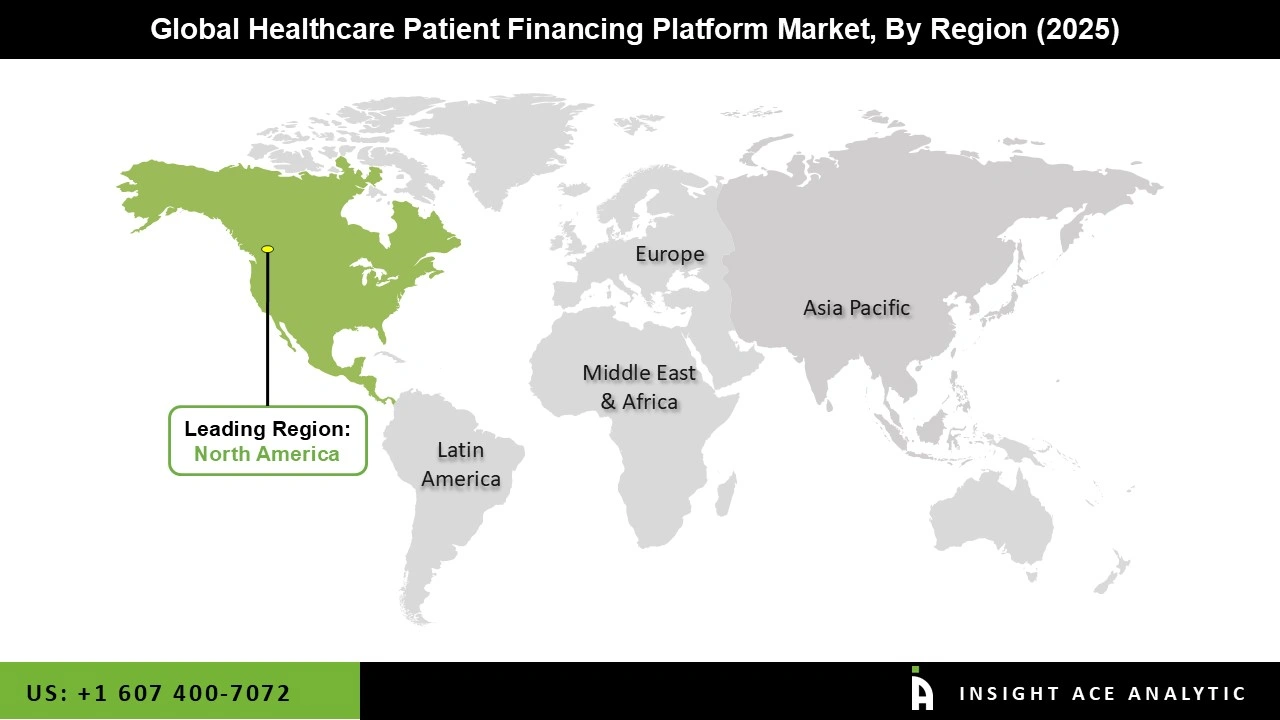
Furthermore, strong healthcare spending, the growing need to manage expanding patient loads, and the increasing complexity of healthcare reimbursement frameworks all contribute to the broad use of healthcare patient financing platforms. These platforms are becoming a crucial part of contemporary healthcare operations as insurance companies and healthcare providers prioritize digital financial management tools to improve financial performance, streamline administrative procedures, and guarantee regulatory compliance.
Healthcare Patient Financing Platform Market Report Scope:
| Report Attribute | Specifications |
| Market size value in 2025 | USD 7.94 Bn |
| Revenue forecast in 2035 | USD 28.14 Bn |
| Growth Rate CAGR | CAGR of 13.8% from 2026 to 2035 |
| Quantitative Units | Representation of revenue in US$ Bn and CAGR from 2026 to 2035 |
| Historic Year | 2022 to 2025 |
| Forecast Year | 2026-2035 |
| Report Coverage | The forecast of revenue, the position of the company, the competitive market structure, growth prospects, and trends |
| Segments Covered | Component, Application, Deployment Mode, End-user, and By Region |
| Regional Scope | North America; Europe; Asia Pacific; Latin America; Middle East & Africa |
| Country Scope | U.S.; Canada; U.K.; Germany; China; India; Japan; Brazil; Mexico; The UK; France; Italy; Spain; China; Japan; India; South Korea; Southeast Asia; South Korea; Southeast Asia |
| Competitive Landscape | United Medical Credit, CareCredit, GreenSky, ClearBalance, Parasail Health, AccessOne, LendingClub Patient Solutions, MedLoan Finance, Simplee, DocPay, Sunbit, PrimaHealth Credit, PayZen, PatientFi, Ally Lending, Health Credit Services, Scratchpay, Commerce Bank Health Services Financing, FinMkt, and iVitaFi. |
| Customization Scope | Free customization report with the procurement of the report, Modifications to the regional and segment scope. Geographic competitive landscape. |
| Pricing and Available Payment Methods | Explore pricing alternatives that are customized to your particular study requirements. |
Segmentations of Healthcare Patient Financing Platform Market:
Healthcare Patient Financing Platform Market, by Component-
- Services
- Software
Healthcare Patient Financing Platform Market, by Application-
- Hospitals
- Clinics
- Dental Practices
- Cosmetic Surgery Centers
- Ambulatory Surgical Centers
- Others
Healthcare Patient Financing Platform Market, by Deployment Mode-
- Cloud-Based
- On-Premises
Healthcare Patient Financing Platform Market, by End-user-
- Patients
- Healthcare Providers
Healthcare Patient Financing Platform Market, by Region-
- North America-
- The US
- Canada
- Europe-
- Germany
- The UK
- France
- Italy
- Spain
- Rest of Europe
- Asia-Pacific-
- China
- Japan
- India
- South Korea
- South East Asia
- Rest of Asia Pacific
- Latin America-
- Brazil
- Argentina
- Mexico
- Rest of Latin America
- Middle East and Africa-
- GCC Countries
- South Africa
- Rest of Middle East and Africa
Research Design and Approach
This study employed a multi-step, mixed-method research approach that integrates:
- Secondary research
- Primary research
- Data triangulation
- Hybrid top-down and bottom-up modelling
- Forecasting and scenario analysis
This approach ensures a balanced and validated understanding of both macro- and micro-level market factors influencing the market.
Secondary Research
Secondary research for this study involved the collection, review, and analysis of publicly available and paid data sources to build the initial fact base, understand historical market behaviour, identify data gaps, and refine the hypotheses for primary research.
Sources Consulted
Secondary data for the market study was gathered from multiple credible sources, including:
- Government databases, regulatory bodies, and public institutions
- International organizations (WHO, OECD, IMF, World Bank, etc.)
- Commercial and paid databases
- Industry associations, trade publications, and technical journals
- Company annual reports, investor presentations, press releases, and SEC filings
- Academic research papers, patents, and scientific literature
- Previous market research publications and syndicated reports
These sources were used to compile historical data, market volumes/prices, industry trends, technological developments, and competitive insights.

Primary Research
Primary research was conducted to validate secondary data, understand real-time market dynamics, capture price points and adoption trends, and verify the assumptions used in the market modelling.
Stakeholders Interviewed
Primary interviews for this study involved:
- Manufacturers and suppliers in the market value chain
- Distributors, channel partners, and integrators
- End-users / customers (e.g., hospitals, labs, enterprises, consumers, etc., depending on the market)
- Industry experts, technology specialists, consultants, and regulatory professionals
- Senior executives (CEOs, CTOs, VPs, Directors) and product managers
Interview Process
Interviews were conducted via:
- Structured and semi-structured questionnaires
- Telephonic and video interactions
- Email correspondences
- Expert consultation sessions
Primary insights were incorporated into demand modelling, pricing analysis, technology evaluation, and market share estimation.
Data Processing, Normalization, and Validation
All collected data were processed and normalized to ensure consistency and comparability across regions and time frames.
The data validation process included:
- Standardization of units (currency conversions, volume units, inflation adjustments)
- Cross-verification of data points across multiple secondary sources
- Normalization of inconsistent datasets
- Identification and resolution of data gaps
- Outlier detection and removal through algorithmic and manual checks
- Plausibility and coherence checks across segments and geographies
This ensured that the dataset used for modelling was clean, robust, and reliable.
Market Size Estimation and Data Triangulation
Bottom-Up Approach
The bottom-up approach involved aggregating segment-level data, such as:
- Company revenues
- Product-level sales
- Installed base/usage volumes
- Adoption and penetration rates
- Pricing analysis
This method was primarily used when detailed micro-level market data were available.

Top-Down Approach
The top-down approach used macro-level indicators:
- Parent market benchmarks
- Global/regional industry trends
- Economic indicators (GDP, demographics, spending patterns)
- Penetration and usage ratios
This approach was used for segments where granular data were limited or inconsistent.
Hybrid Triangulation Approach
To ensure accuracy, a triangulated hybrid model was used. This included:
- Reconciling top-down and bottom-up estimates
- Cross-checking revenues, volumes, and pricing assumptions
- Incorporating expert insights to validate segment splits and adoption rates
This multi-angle validation yielded the final market size.
Forecasting Framework and Scenario Modelling
Market forecasts were developed using a combination of time-series modelling, adoption curve analysis, and driver-based forecasting tools.
Forecasting Methods
- Time-series modelling
- S-curve and diffusion models (for emerging technologies)
- Driver-based forecasting (GDP, disposable income, adoption rates, regulatory changes)
- Price elasticity models
- Market maturity and lifecycle-based projections
Scenario Analysis
Given inherent uncertainties, three scenarios were constructed:
- Base-Case Scenario: Expected trajectory under current conditions
- Optimistic Scenario: High adoption, favourable regulation, strong economic tailwinds
- Conservative Scenario: Slow adoption, regulatory delays, economic constraints
Sensitivity testing was conducted on key variables, including pricing, demand elasticity, and regional adoption.
Request Customization
Add countries, segments, company profiles, or extend forecast — free 10% customization with purchase.
Customize This Report →Enquire Before Buying
Speak with our analyst team about scope, methodology, pricing, or deliverable formats.
Enquire Now →Frequently Asked Questions
Healthcare Patient Financing Platform Market Size is valued at USD 7.94 Bn in 2025 and is predicted to reach USD 28.15 Bn by the year 2035
The Healthcare Patient Financing Platform Market is expected to grow at a 13.8% CAGR during the forecast period for 2026 to 2035
United Medical Credit, CareCredit, GreenSky, ClearBalance, Parasail Health, AccessOne, LendingClub Patient Solutions, MedLoan Finance, Simplee, DocPay, Sunbit, PrimaHealth Credit, PayZen, PatientFi, Ally Lending, Health Credit Services, Scratchpay, Commerce Bank Health Services Financing, FinMkt, iVitaFi and Others
Healthcare Patient Financing Platform Market is segmented into Component, Application, Deployment Mode, End-user, and Other.
North America region is leading the Healthcare Patient Financing Platform Market.