Golf Simulators Market Size, Scope, Forecast Report 2026 to 2035
What is Golf Simulators Market Size?
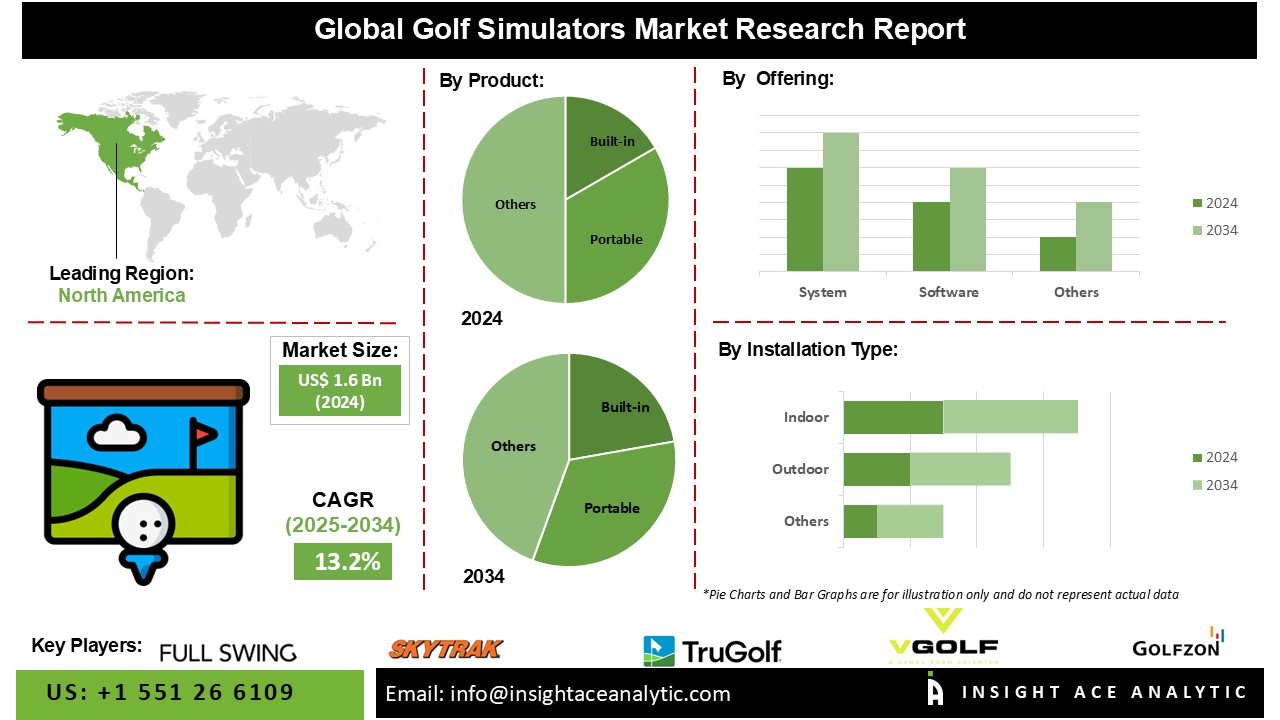
Golf Simulators Market Size is valued at USD 2.15 Bn in 2025 and is predicted to reach USD 4.95 Bn by the year 2035 at a 8.8% CAGR during the forecast period for 2026 to 2035.
Golf Simulators Market Size, Share & Trends Analysis By Offering (Hardware, Software, and Services), By Tracking Technology (Doppler Radar Systems, Photometric High-Speed Camera Systems, Hybrid Radar-Plus-Camera Systems, Infrared & Optical Sensor-Array Systems, and Emerging Sensing Architectures), By System Configuration (Portable & Non-Enclosed Systems, Component-Built (DIY) Simulator Bays, Vendor-Bundled Turnkey Packages, Proprietary Integrated Simulator Rooms, and Automated Screen-Golf Cabins), By Price Band — Installed Cost per Bay (Entry, Value, Mid-premium, Premium, and Ultra-premium), By End User (Residential, Commercial Entertainment & Hospitality, Golf Facility & Trade, Instruction, Performance & Institutional, and Equipment OEM & Research), By Revenue Model (One-time equipment sale, Software subscription and content licensing, Equipment-as-a-service, lease and vendor financing, Service, maintenance and support contracts, and Revenue-share and per-round technology fees), By Distribution Channel (Manufacturer direct sales and direct-to-consumer, Specialist simulator retailers and e-commerce, Value-added integrators, custom installers and AV trade, Golf retail, pro-shop and off-course specialty channel, Regional distributors and master resellers, and Franchise and master-licence channel), By Region, and Segment Forecasts, 2026 to 2035
Golf Simulators Market Key Takeaways:
|
A golf simulator offers an engaging and authentic golf experience indoors, utilizing sophisticated technology to monitor and replicate real-life gameplay. This makes it a great asset for both recreational purposes and dedicated training. It provides precise extended evaluation, realistic golf course simulation, a variety of strategies, and instruction tools to replicate the sensation of practicing golf. Display screens, software that records the golfer's motion statistics, and fast cameras or multiple sensors are usually included.
They provide a number of benefits, such as the chance to practice and improve the person's motion in a secure setting, access to a range of instruction, and the capacity to enjoy golf all the time, independent of the climate. The rise in acceptance of golf simulators is largely due to the quick construction of new golf facilities. There will likely be greater preparation activities and ongoing projects with individual engagement. In this case, the golf simulator industry is anticipated to grow.
However, the absence of understanding between prospective purchasers is one of the factors hurting the golf simulator industry. Despite the growing popularity of golf simulators, many individuals and businesses are still ignorant of the full range of capabilities, benefits, and availability offered by this latest innovation. Without sufficient knowledge, it may be challenging for producers and retailers of golf simulators to reach their intended demographic successfully.
However, regarding the industry's position for golf simulators, COVID-19 has had some good effects. There was a surge in enthusiasm for interior golf activities throughout the epidemic since many golf facilities had to be shut down or regulated. Players could continue to practice and play the activity from the ease of their homes with golf simulators, which offered a handy and safe option. Sales of golf simulators for vendors and producers increased as a result of this increase in demand. A rising need for home entertainment alternatives resulted from individuals investing longer at home during lockdowns and limitations.
Competitive Landscape:
Some Major Key Players In The Golf Simulators Market:
- TrackMan
- Foresight Sports
- Full Swing Golf
- GOLFZON
- HD Golf (Interactive Sports Technologies / IST)
- TruGolf
- Uneekor
- SkyTrak
- OptiShot Golf (Red Stakes Golf)
- ProTee United
- aboutGOLF (aG)
- GSA Advanced Golf Simulators LLC (GSA Golf)
- X-Golf
- Other Market Players
Market Segmentation:
The golf simulator market is segmented based on offering, installation type, product, and end-user. According to the offering, the market is segmented into systems, software, and services. By installation type, the market is segmented into outdoor and indoor. By product, the market is segmented into built-in, portable, and free-standing. By end-user, the market is segmented into corporate, commercial, residential, and educational institutes.
Based On The End-User, The Residential Segment Is Accounted As A Major Contributor To The Golf Simulators Market
The residential golf simulator market is expected to hold a major global market share in 2023. Because more people are looking for advanced sports simulations that provide a more enjoyable playing experience, the residential sector is expected to grow during this portion. With capabilities such as gesture-based gambling and better graphics to enhance the gaming experience, it is expected that the residential sector will expand.
In The Region, The Asia Pacific Golf Simulators Market Holds a Significant Revenue Share.
The Asia Pacific golf simulator market is expected to report the highest share of the revenue market in the near future. This can be because of the growing adoption of cutting-edge technologies by sports organizations and instructional centres to provide more realistic and productive entertainment. The installation of accelerating platforms at local theatres to support electronic sports and auto racing will also contribute to the expansion of the golf simulator sector. In addition, Europe is likely to grow rapidly in the global golf simulator market due to the significant advancements made in simulator-based gaming environments. In addition, there is a growing market for athletic simulators due to the rising need for them, as well as the advent of cheaper virtual reality (VR), superior technology, and more financial resources.
Recent Developments:
- In January 2024, Golf simulators were introduced as an innovative method of experiencing golf, an activity that requires accuracy, talent, and endurance. Thanks to these state-of-the-art gadgets, golfers can finally play eighteen holes from the convenience of their residences or interior infrastructure, all while simulating a real golf course. The team will discuss the thrilling world of using a golf simulation to play eighteen holes and the reason it's growing increasingly common for players of every ability level in the article below.
- In March 2024, Uneekor is excited to reveal carefully considered price adjustments for their EYE XO2, EYE XO, and QED expenses launched sensors. This calculated action reaffirms Uneekor's dedication to "MORE GOLF" and increasing accessibility to golf simulators for everybody.
Golf Simulators Market Report Scope :
| Report Attribute | Specifications |
| Market Size Value In 2025 | USD 2.15 Bn |
| Revenue Forecast In 2035 | USD 4.95 Bn |
| Growth Rate CAGR | CAGR of 8.8% from 2026 to 2035 |
| Quantitative Units | Representation of revenue in US$ Bn and CAGR from 2026 to 2035 |
| Historic Year | 2022 to 2025 |
| Forecast Year | 2026-2035 |
| Report Coverage | The forecast of revenue, the position of the company, the competitive market structure, growth prospects, and trends |
| Segments Covered | Product Type, Tracking Technology, End User, Price Tier, Software / Subscription Type and Region |
| Regional Scope | North America; Europe; Asia Pacific; Latin America; Middle East & Africa |
| Country Scope | U.S.; Canada; U.K.; Germany; China; India; Japan; Brazil; Mexico; France; Italy; Spain; South East Asia; South Korea |
| Competitive Landscape | TrackMan, Foresight Sports, Full Swing Golf, GOLFZON, HD Golf (Interactive Sports Technologies / IST), TruGolf, Uneekor, SkyTrak, OptiShot Golf (Red Stakes Golf), ProTee United, aboutGOLF (aG), GSA Advanced Golf Simulators LLC (GSA Golf), X-Golf and Others |
| Customization Scope | Free customization report with the procurement of the report and modifications to the regional and segment scope. Particular Geographic competitive landscape. |
| Pricing And Available Payment Methods | Explore pricing alternatives that are customized to your particular study requirements. |
Segmentation of Golf Simulators Market-
Golf Simulators Market By Offering (Component):
• Hardware
◦ Ball & Club Tracking Systems
◦ Projection & Display Systems
◦ Enclosures, Impact Screens & Framing
◦ Hitting & Playing Surfaces
◦ Motion & Automation Hardware
◦ Compute, Control & Networking Hardware
◦ Peripheral & Accessory Hardware
• Software
◦ Course Play & Simulation Engines
◦ Course Content & Licensing
◦ Practice, Fitting & Performance Analytics
◦ Venue, Bay & Facility Management Platforms
◦ Competition, League & Networked Play Platforms
• Services
◦ Professional Services
◦ Recurring Services
◦ Enablement Services
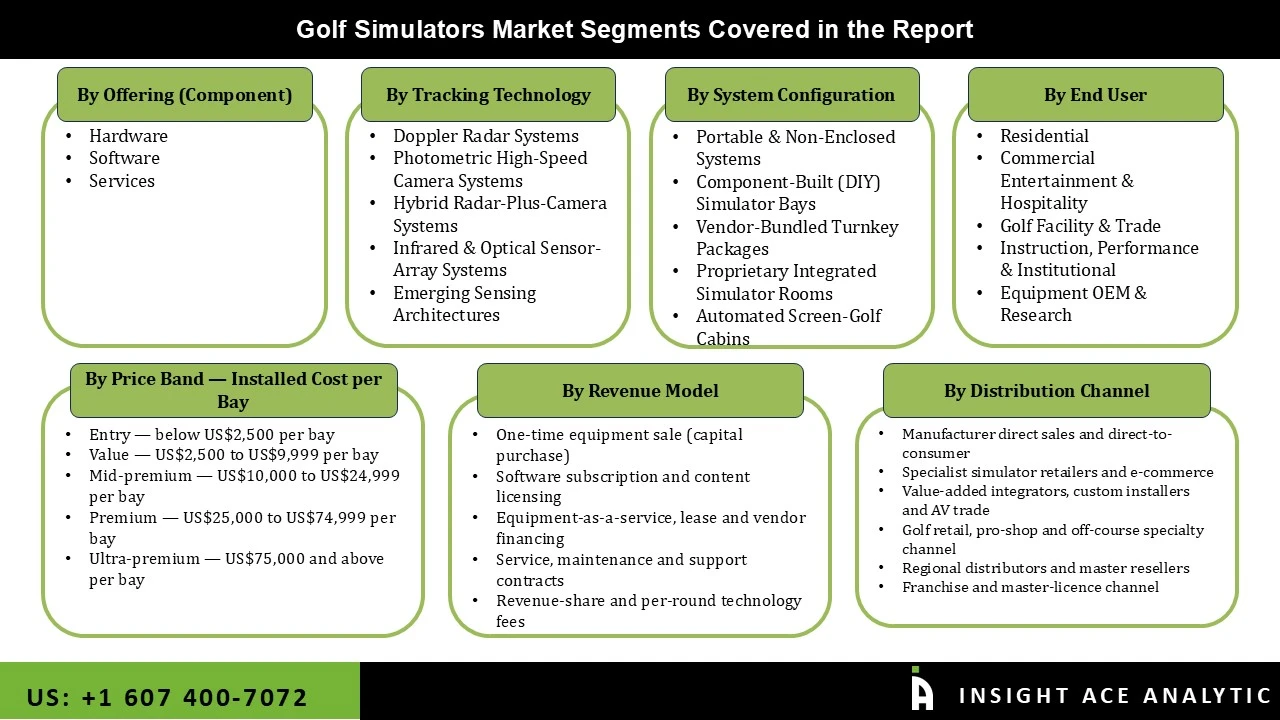
Golf Simulators Market By Tracking Technology
• Doppler Radar Systems
• Photometric High-Speed Camera Systems
• Hybrid Radar-Plus-Camera Systems
• Infrared & Optical Sensor-Array Systems
• Emerging Sensing Architectures
Golf Simulators Market By System Configuration
• Portable & Non-Enclosed Systems
• Component-Built (DIY) Simulator Bays
• Vendor-Bundled Turnkey Packages
• Proprietary Integrated Simulator Rooms
• Automated Screen-Golf Cabins
Golf Simulators Market By Price Band — Installed Cost per Bay
• Entry — below US$2,500 per bay
• Value — US$2,500 to US$9,999 per bay
• Mid-premium — US$10,000 to US$24,999 per bay
• Premium — US$25,000 to US$74,999 per bay
• Ultra-premium — US$75,000 and above per bay
Golf Simulators Market By End User
• Residential
• Commercial Entertainment & Hospitality
• Golf Facility & Trade
• Instruction, Performance & Institutional
• Equipment OEM & Research
Golf Simulators Market By Revenue Model
• One-time equipment sale (capital purchase)
• Software subscription and content licensing (recurring)
• Equipment-as-a-service, lease and vendor financing
• Service, maintenance and support contracts (recurring)
• Revenue-share and per-round technology fees
Golf Simulators Market By Distribution Channel
• Manufacturer direct sales and direct-to-consumer
• Specialist simulator retailers and e-commerce
• Value-added integrators, custom installers and AV trade
• Golf retail, pro-shop and off-course specialty channel
• Regional distributors and master resellers
• Franchise and master-licence channel
Golf Simulators Market By Region:
North America-
• United States
• Canada
• Mexico
Europe-
• United Kingdom
• Germany
• France
• Italy
• Spain
• Norway
• Sweden
• Finland
• Denmark
• Rest of Europe
Asia Pacific-
• South Korea
• Japan
• China
• Australia & New Zealand
• India
• Southeast Asia
• Rest of Asia Pacific
Latin America-
• Brazil
• Rest of Latin America
Middle East & Africa-
• United Arab Emirates
• Saudi Arabia
• South Africa
• Rest of Middle East & Africa
Research Design and Approach
This study employed a multi-step, mixed-method research approach that integrates:
- Secondary research
- Primary research
- Data triangulation
- Hybrid top-down and bottom-up modelling
- Forecasting and scenario analysis
This approach ensures a balanced and validated understanding of both macro- and micro-level market factors influencing the market.
Secondary Research
Secondary research for this study involved the collection, review, and analysis of publicly available and paid data sources to build the initial fact base, understand historical market behaviour, identify data gaps, and refine the hypotheses for primary research.
Sources Consulted
Secondary data for the market study was gathered from multiple credible sources, including:
- Government databases, regulatory bodies, and public institutions
- International organizations (WHO, OECD, IMF, World Bank, etc.)
- Commercial and paid databases
- Industry associations, trade publications, and technical journals
- Company annual reports, investor presentations, press releases, and SEC filings
- Academic research papers, patents, and scientific literature
- Previous market research publications and syndicated reports
These sources were used to compile historical data, market volumes/prices, industry trends, technological developments, and competitive insights.

Primary Research
Primary research was conducted to validate secondary data, understand real-time market dynamics, capture price points and adoption trends, and verify the assumptions used in the market modelling.
Stakeholders Interviewed
Primary interviews for this study involved:
- Manufacturers and suppliers in the market value chain
- Distributors, channel partners, and integrators
- End-users / customers (e.g., hospitals, labs, enterprises, consumers, etc., depending on the market)
- Industry experts, technology specialists, consultants, and regulatory professionals
- Senior executives (CEOs, CTOs, VPs, Directors) and product managers
Interview Process
Interviews were conducted via:
- Structured and semi-structured questionnaires
- Telephonic and video interactions
- Email correspondences
- Expert consultation sessions
Primary insights were incorporated into demand modelling, pricing analysis, technology evaluation, and market share estimation.
Data Processing, Normalization, and Validation
All collected data were processed and normalized to ensure consistency and comparability across regions and time frames.
The data validation process included:
- Standardization of units (currency conversions, volume units, inflation adjustments)
- Cross-verification of data points across multiple secondary sources
- Normalization of inconsistent datasets
- Identification and resolution of data gaps
- Outlier detection and removal through algorithmic and manual checks
- Plausibility and coherence checks across segments and geographies
This ensured that the dataset used for modelling was clean, robust, and reliable.
Market Size Estimation and Data Triangulation
Bottom-Up Approach
The bottom-up approach involved aggregating segment-level data, such as:
- Company revenues
- Product-level sales
- Installed base/usage volumes
- Adoption and penetration rates
- Pricing analysis
This method was primarily used when detailed micro-level market data were available.

Top-Down Approach
The top-down approach used macro-level indicators:
- Parent market benchmarks
- Global/regional industry trends
- Economic indicators (GDP, demographics, spending patterns)
- Penetration and usage ratios
This approach was used for segments where granular data were limited or inconsistent.
Hybrid Triangulation Approach
To ensure accuracy, a triangulated hybrid model was used. This included:
- Reconciling top-down and bottom-up estimates
- Cross-checking revenues, volumes, and pricing assumptions
- Incorporating expert insights to validate segment splits and adoption rates
This multi-angle validation yielded the final market size.
Forecasting Framework and Scenario Modelling
Market forecasts were developed using a combination of time-series modelling, adoption curve analysis, and driver-based forecasting tools.
Forecasting Methods
- Time-series modelling
- S-curve and diffusion models (for emerging technologies)
- Driver-based forecasting (GDP, disposable income, adoption rates, regulatory changes)
- Price elasticity models
- Market maturity and lifecycle-based projections
Scenario Analysis
Given inherent uncertainties, three scenarios were constructed:
- Base-Case Scenario: Expected trajectory under current conditions
- Optimistic Scenario: High adoption, favourable regulation, strong economic tailwinds
- Conservative Scenario: Slow adoption, regulatory delays, economic constraints
Sensitivity testing was conducted on key variables, including pricing, demand elasticity, and regional adoption.
Request Customization
Add countries, segments, company profiles, or extend forecast — free 10% customization with purchase.
Customize This Report →Enquire Before Buying
Speak with our analyst team about scope, methodology, pricing, or deliverable formats.
Enquire Now →Frequently Asked Questions
Golf Simulators Market Size is valued at USD 2.15 Bn in 2025 and is predicted to reach USD 4.95 Bn by the year 2035
Global Golf Simulators Market is expected to grow at a 8.8% CAGR during the forecast period for 2026 to 2035.
TrackMan, Foresight Sports, Full Swing Golf, GOLFZON, HD Golf (Interactive Sports Technologies / IST), TruGolf, Uneekor, SkyTrak, OptiShot Golf (Red Stakes Golf), ProTee United, aboutGOLF (aG), GSA Advanced Golf Simulators LLC (GSA Golf), X-Golf and Others
Product Type, Tracking Technology, End User, Price Tier, Software / Subscription Type and Region are the key segments of the Golf Simulators Market.
North America region is leading the Golf Simulators Market.