AI-Based Fever Detection Camera Market Forecast with Size and Share Analysis 2026 to 2035
What is AI-Based Fever Detection Camera Market Size?
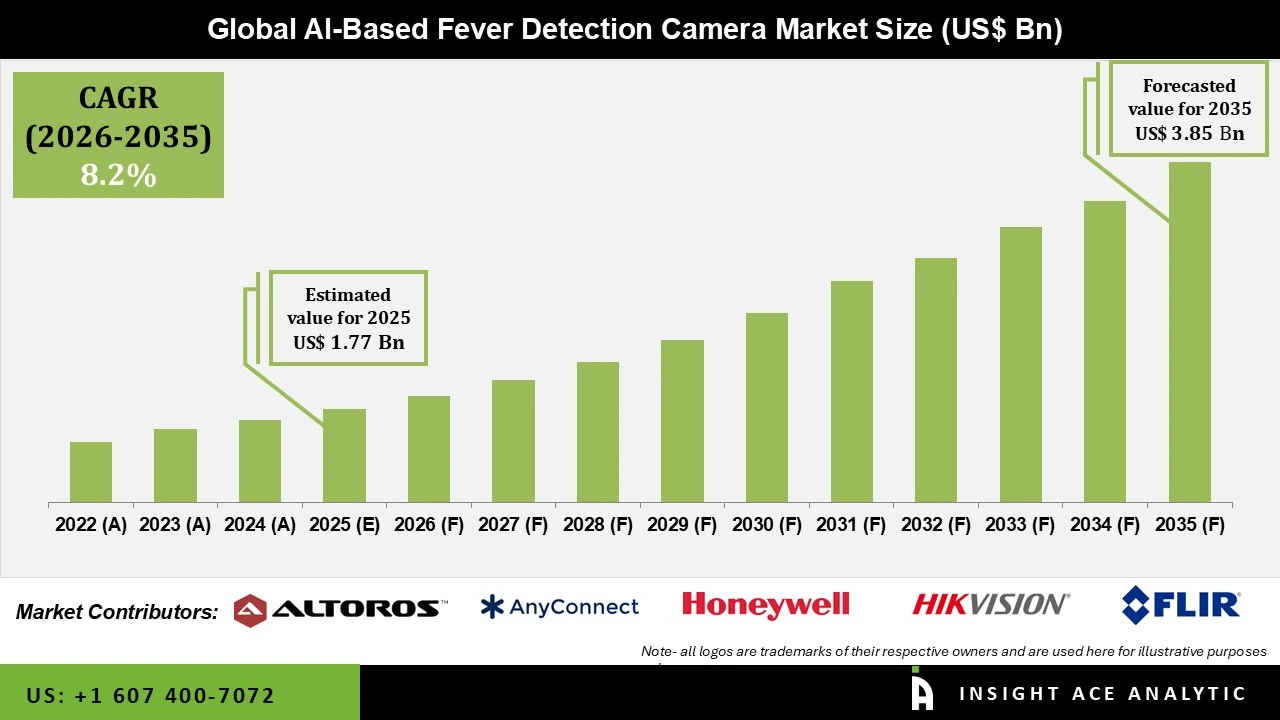
Global AI-Based Fever Detection Camera Market Size is valued at USD 1.77 billion in 2025 and is predicted to reach USD 3.85 billion by the year 2035 at an 8.2% CAGR during the forecast period for 2026 to 2035.
AI-Based Fever Detection Camera Market Size, Share & Trends Analysis Report By Type (Turret/Bullet Cameras, and Handheld Cameras), By End-User (Airports, Hospitals, Public Places, Enterprises/Factories, Banks), By Region, And By Segment Forecasts, 2026 to 2035
AI-Based Fever Detection Camera Market Key Takeaways:
|
Artificial intelligence (AI) powered cameras for detecting fevers are highly valuable instruments for improving public health and safety, particularly during periods of infectious disease outbreaks. By integrating thermal imaging with sophisticated artificial intelligence, these devices offer rapid, precise, and non-intrusive fever screening, aiding in the detection and isolation of potentially infectious persons prior to the transmission of sickness. The main objective of this system is to detect people who could be displaying symptoms of fever.
Due to the COVID-19 pandemic and the increasing awareness of the necessity of controlling infectious diseases, there has been a considerable rise in the demand for non-contact temperature screening in public areas, companies, and transit centres. AI-enabled thermal imaging cameras provide a dependable and effective solution for this requirement. The continuous progress in AI technology, enhancing the precision and efficiency of temperature measurements, continues to propel the market.
Nevertheless, the substantial upfront expenses linked to the implementation of AI-powered fever detection camera systems provide a noteworthy obstacle. The expenses encompass the expenditures for cameras, advanced software, installation, and routine maintenance. The cost burden associated with implementing these systems can be significant, posing challenges for small and medium-sized companies (SMEs) and organizations with restricted resources. Furthermore, the apprehensions regarding privacy and data security, considering the fact that these cameras handle delicate health information and the possibility of inaccurate results owing to external environmental variables, continue to impede the broad acceptance of these cameras.
Competitive Landscape
Some Major Key Players In The AI-Based Fever Detection Camera Market:
- Altoros
- AnyConnect Private Limited
- Athena Security, Inc.
- Australia PTY LTD.
- FLIR Systems, Inc.
- Hangzhou Hikvision Digital Technology Co., Ltd.
- Honeywell International Inc.
- Johnson Controls
- Kogniz, Inc.
- Mantra Softech
- Nippon Avionics Co., Ltd.
- Platinum CCTV
- Scylla
- Vantage Security
- Other Market Players
Market Segmentation:
The AI-Based Fever Detection Camera market is segmented on the basis of Type and End-user. Based on type, the market is segmented into Turret/Bullet Cameras and Handheld Cameras. By End-user, the market is segmented into Airports, Hospitals, Public Places, Enterprises/Factories, Banks, and Others (Schools, Residential Buildings, etc.).
Based On Type, The Turret/Bullet Cameras Segment Is Accounted As A Major Contributor In The AI-Based Fever Detection Camera Market
The Turret/Bullet Cameras category is expected to hold a major share in the global AI-Based Fever Detection Camera market in 2023. It is predicted that the turret and bullet camera sectors have the highest market since these cameras eliminate the danger and expense associated with hiring staff members to use handheld equipment at entrances in order to assess individual temperatures. Most of the time, these cameras are installed in locations such as building entrances, airports, industries, and commercial facilities. They are often fixed on the wall. These cameras have a range of 8 to 30 feet, allowing them to scan.
Public Places Segment Witnessed Growth At A Rapid Rate
The Public Places segment is predicted to grow rapidly in the global AI-Based Fever Detection Camera market. AI-powered thermal imaging cameras are mostly used in densely populated areas to detect individuals with elevated body temperatures. These cameras have the ability to scan anybody who enters, regardless of whether they are wearing a mask or not. These gadgets enhance the efficiency of operations at facilities and also alert the authorities in the event of detecting individuals with elevated body temperatures. They assist in segregating the individual from the masses. These cameras are anticipated to assist organizations, such as grocery shops and enterprises, in carrying out their important operations with less danger.
In the region, the North American AI-Based Fever Detection Camera Market Holds A Significant Revenue Share.
As the largest region, North America dominated the AI-based fever detection camera market, primarily due to numerous significant factors. The region's sophisticated healthcare infrastructure, robust health and safety standards, and pervasive use of cutting-edge technology significantly influence market growth. The market in North America is further fortified by substantial investments in public health and safety measures and the presence of prominent industry leaders.
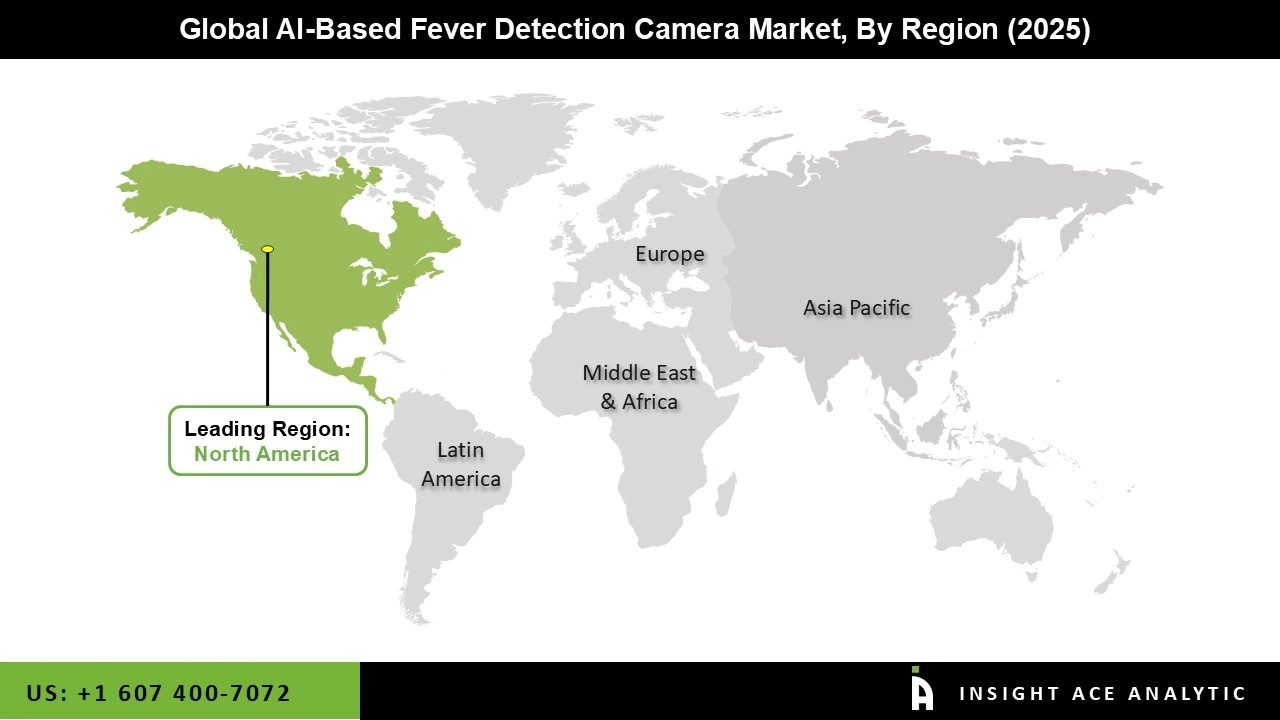
On the other hand, the Asia-Pacific region is anticipated to experience the most significant growth rate during the projection period. The burgeoning awareness of public health, the escalating government initiatives to improve healthcare systems, and the increasing demand for advanced surveillance technology in densely populated countries may all be contributing factors to the exponential expansion. Additionally, the numerous smart city initiatives and the substantial investments in technological advancements have a significant influence. Furthermore, the region's prior experiences with pandemics have heightened the importance of establishing robust health surveillance systems, thereby accelerating the adoption of fever detection cameras that employ artificial intelligence.
Recent Developments:
- In May 2021, Teledyne Technologies acquired FLIR Systems Inc. for a total of $8 billion. The acquisition was made with the intention of broadening Teledyne's range of sensors and sensor solutions. FLIR Systems focuses on the development and production of AI thermal imaging systems, infrared cameras, and sensor technologies.
- In January 2020, AnyConnect and ASUS collaborated to introduce an intelligent camera platform that utilizes AI at the edge, providing compatibility for Wi-Fi, 4G, and 5G networks. This partnership integrates AnyConnect's Application Enablement Platform and AI Containers with ASUS Tinker Edge T, facilitating the development of AI camera technology for the security, transportation, and retail sectors.
AI-Based Fever Detection Camera Market Report Scope :
| Report Attribute | Specifications |
| Market Size Value In 2025 | USD 1.77 Bn |
| Revenue Forecast In 2035 | USD 3.85 Bn |
| Growth Rate CAGR | CAGR of 8.2% from 2026 to 2035 |
| Quantitative Units | Representation of revenue in US$ Bn and CAGR from 2026 to 2035 |
| Historic Year | 2022 to 2024 |
| Forecast Year | 2026 to 2035 |
| Report Coverage | The forecast of revenue, the position of the company, the competitive market structure, growth prospects, and trends |
| Segments Covered | Type and End-User |
| Regional Scope | North America; Europe; Asia Pacific; Latin America; Middle East & Africa |
| Country Scope | U.S.; Canada; U.K.; Germany; China; India; Japan; Brazil; Mexico; France; Italy; Spain; Southeast Asia; South Korea |
| Competitive Landscape | Altoros, AnyConnect Private Limited, Athena Security, Inc., Australia PTY LTD., FLIR Systems, Inc., Hangzhou Hikvision Digital Technology Co., Ltd., Honeywell International Inc., Johnson Controls, Kogniz, Inc., Mantra Softech, Nippon Avionics Co., Ltd., Platinum CCTV, Scylla, and Vantage Security. |
| Customization Scope | Free customization report with the procurement of the report and modifications to the regional and segment scope. Particular Geographic competitive landscape. |
| Pricing And Available Payment Methods | Explore pricing alternatives that are customized to your particular study requirements. |
Segmentation of AI-Based Fever Detection Camera Market :
AI-Based Fever Detection Camera Market By Type-
- Turret/Bullet Cameras
- Handheld Cameras
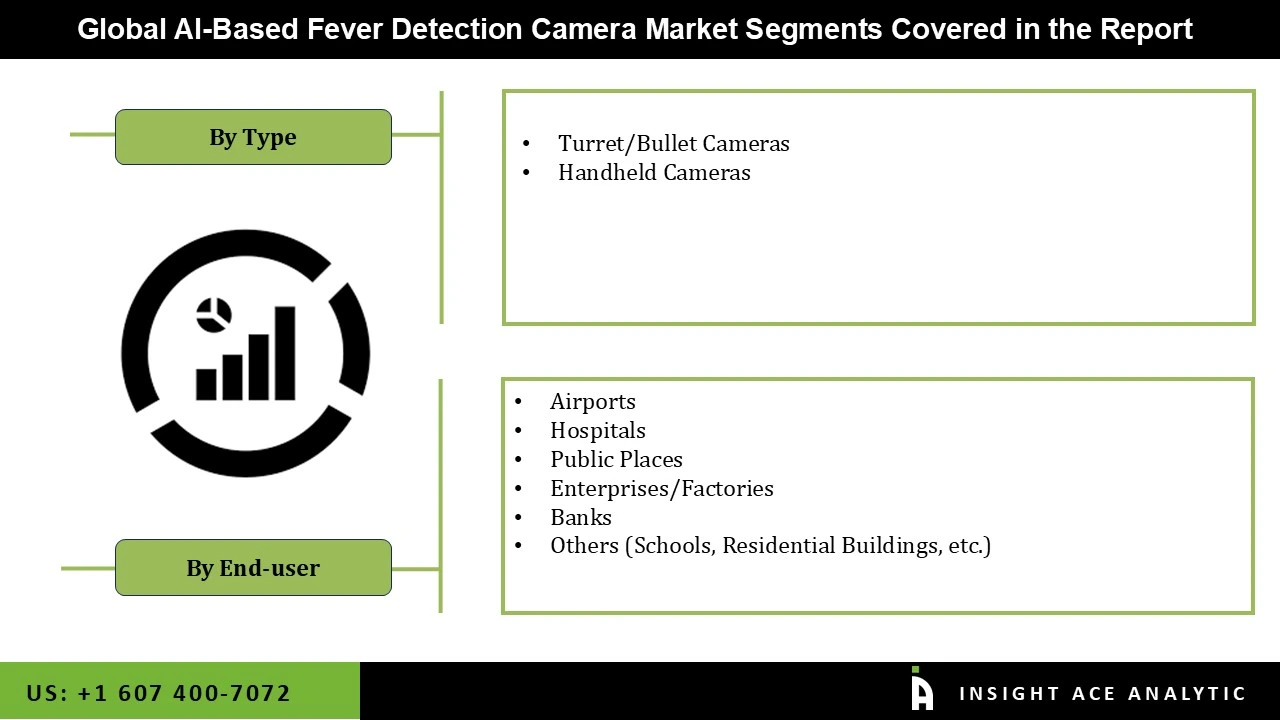
AI-Based Fever Detection Camera Market By End-user-
- Airports
- Hospitals
- Public Places
- Enterprises/Factories
- Banks
- Others (Schools, Residential Buildings, etc.)
AI-Based Fever Detection Camera Market By Region-
- North America-
- The US
- Canada
- Europe-
- Germany
- The UK
- France
- Italy
- Spain
- Rest of Europe
- Asia-Pacific-
- China
- Japan
- India
- South Korea
- South East Asia
- Rest of Asia Pacific
- Latin America-
- Brazil
- Argentina
- Mexico
- Rest of Latin America
- Middle East & Africa-
- GCC Countries
- South Africa
- Rest of Middle East and Africa
Research Design and Approach
This study employed a multi-step, mixed-method research approach that integrates:
- Secondary research
- Primary research
- Data triangulation
- Hybrid top-down and bottom-up modelling
- Forecasting and scenario analysis
This approach ensures a balanced and validated understanding of both macro- and micro-level market factors influencing the market.
Secondary Research
Secondary research for this study involved the collection, review, and analysis of publicly available and paid data sources to build the initial fact base, understand historical market behaviour, identify data gaps, and refine the hypotheses for primary research.
Sources Consulted
Secondary data for the market study was gathered from multiple credible sources, including:
- Government databases, regulatory bodies, and public institutions
- International organizations (WHO, OECD, IMF, World Bank, etc.)
- Commercial and paid databases
- Industry associations, trade publications, and technical journals
- Company annual reports, investor presentations, press releases, and SEC filings
- Academic research papers, patents, and scientific literature
- Previous market research publications and syndicated reports
These sources were used to compile historical data, market volumes/prices, industry trends, technological developments, and competitive insights.

Primary Research
Primary research was conducted to validate secondary data, understand real-time market dynamics, capture price points and adoption trends, and verify the assumptions used in the market modelling.
Stakeholders Interviewed
Primary interviews for this study involved:
- Manufacturers and suppliers in the market value chain
- Distributors, channel partners, and integrators
- End-users / customers (e.g., hospitals, labs, enterprises, consumers, etc., depending on the market)
- Industry experts, technology specialists, consultants, and regulatory professionals
- Senior executives (CEOs, CTOs, VPs, Directors) and product managers
Interview Process
Interviews were conducted via:
- Structured and semi-structured questionnaires
- Telephonic and video interactions
- Email correspondences
- Expert consultation sessions
Primary insights were incorporated into demand modelling, pricing analysis, technology evaluation, and market share estimation.
Data Processing, Normalization, and Validation
All collected data were processed and normalized to ensure consistency and comparability across regions and time frames.
The data validation process included:
- Standardization of units (currency conversions, volume units, inflation adjustments)
- Cross-verification of data points across multiple secondary sources
- Normalization of inconsistent datasets
- Identification and resolution of data gaps
- Outlier detection and removal through algorithmic and manual checks
- Plausibility and coherence checks across segments and geographies
This ensured that the dataset used for modelling was clean, robust, and reliable.
Market Size Estimation and Data Triangulation
Bottom-Up Approach
The bottom-up approach involved aggregating segment-level data, such as:
- Company revenues
- Product-level sales
- Installed base/usage volumes
- Adoption and penetration rates
- Pricing analysis
This method was primarily used when detailed micro-level market data were available.

Top-Down Approach
The top-down approach used macro-level indicators:
- Parent market benchmarks
- Global/regional industry trends
- Economic indicators (GDP, demographics, spending patterns)
- Penetration and usage ratios
This approach was used for segments where granular data were limited or inconsistent.
Hybrid Triangulation Approach
To ensure accuracy, a triangulated hybrid model was used. This included:
- Reconciling top-down and bottom-up estimates
- Cross-checking revenues, volumes, and pricing assumptions
- Incorporating expert insights to validate segment splits and adoption rates
This multi-angle validation yielded the final market size.
Forecasting Framework and Scenario Modelling
Market forecasts were developed using a combination of time-series modelling, adoption curve analysis, and driver-based forecasting tools.
Forecasting Methods
- Time-series modelling
- S-curve and diffusion models (for emerging technologies)
- Driver-based forecasting (GDP, disposable income, adoption rates, regulatory changes)
- Price elasticity models
- Market maturity and lifecycle-based projections
Scenario Analysis
Given inherent uncertainties, three scenarios were constructed:
- Base-Case Scenario: Expected trajectory under current conditions
- Optimistic Scenario: High adoption, favourable regulation, strong economic tailwinds
- Conservative Scenario: Slow adoption, regulatory delays, economic constraints
Sensitivity testing was conducted on key variables, including pricing, demand elasticity, and regional adoption.
Request Customization
Add countries, segments, company profiles, or extend forecast — free 10% customization with purchase.
Customize This Report →Enquire Before Buying
Speak with our analyst team about scope, methodology, pricing, or deliverable formats.
Enquire Now →Frequently Asked Questions
AI-Based Fever Detection Camera Market Size is valued at USD 1.77 billion in 2025 and is predicted to reach USD 3.85 billion by the year 2035
AI-Based Fever Detection Camera Market is expected to grow at a 8.2% CAGR during the forecast period for 2026 to 2035
Altoros, AnyConnect Private Limited, Athena Security, Inc., Australia PTY LTD., FLIR Systems, Inc., Hangzhou Hikvision Digital Technology Co., Ltd., Honeywell International Inc., Johnson Controls, Kogniz, Inc., Mantra Softech, Nippon Avionics Co., Ltd., Platinum CCTV, Scylla, and Vantage Security.
AI-Based Fever Detection Camera Market is segmented by Type (Turret/Bullet Cameras, and Handheld Cameras and by End-User (Airports, Hospitals, Public Places, Enterprises/Factories, Banks).
North America region is leading the AI-Based Fever Detection Camera Market.