Fuel Cells for Data Centers Market Size, Scope, Forecast Report 2026 to 2035
What is Fuel Cells for Data Centers Market Size?
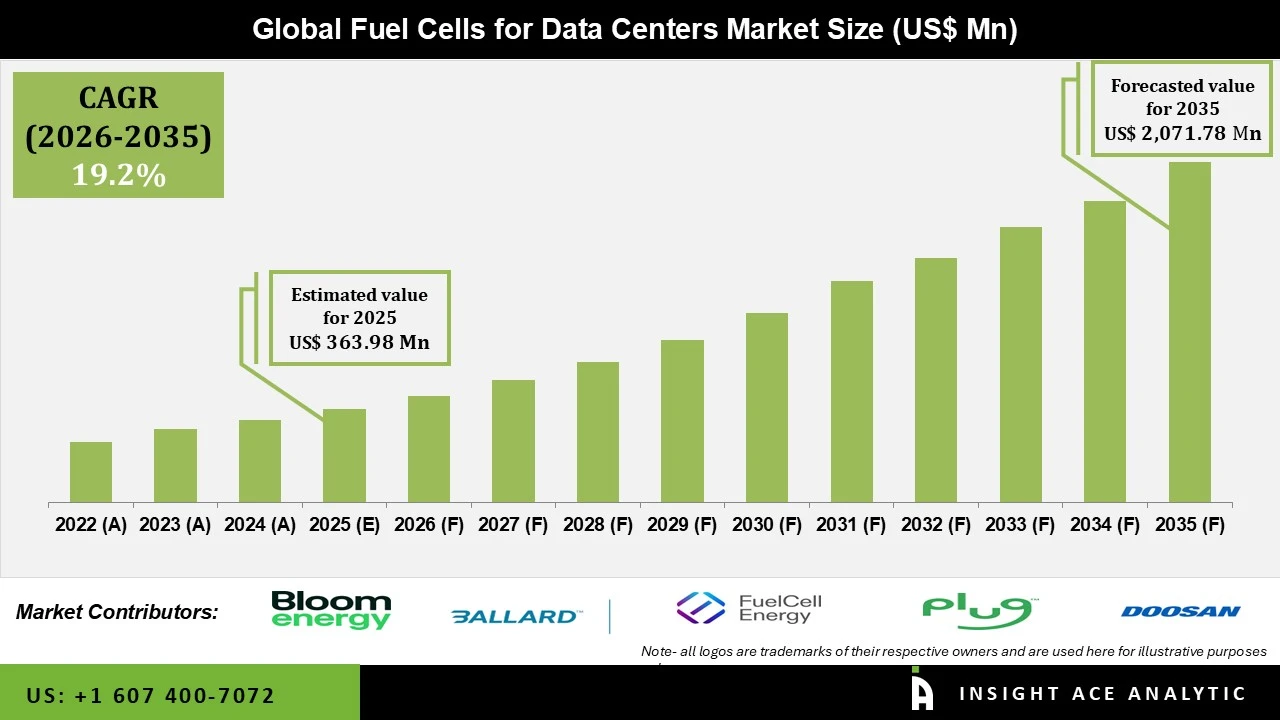
Fuel Cells for Data Centers Market Size is valued at USD 363.98 Mn in 2025 and is predicted to reach USD 2,071.78 Mn by the year 2035 at a 19.2% CAGR during the forecast period for 2026 to 2035.
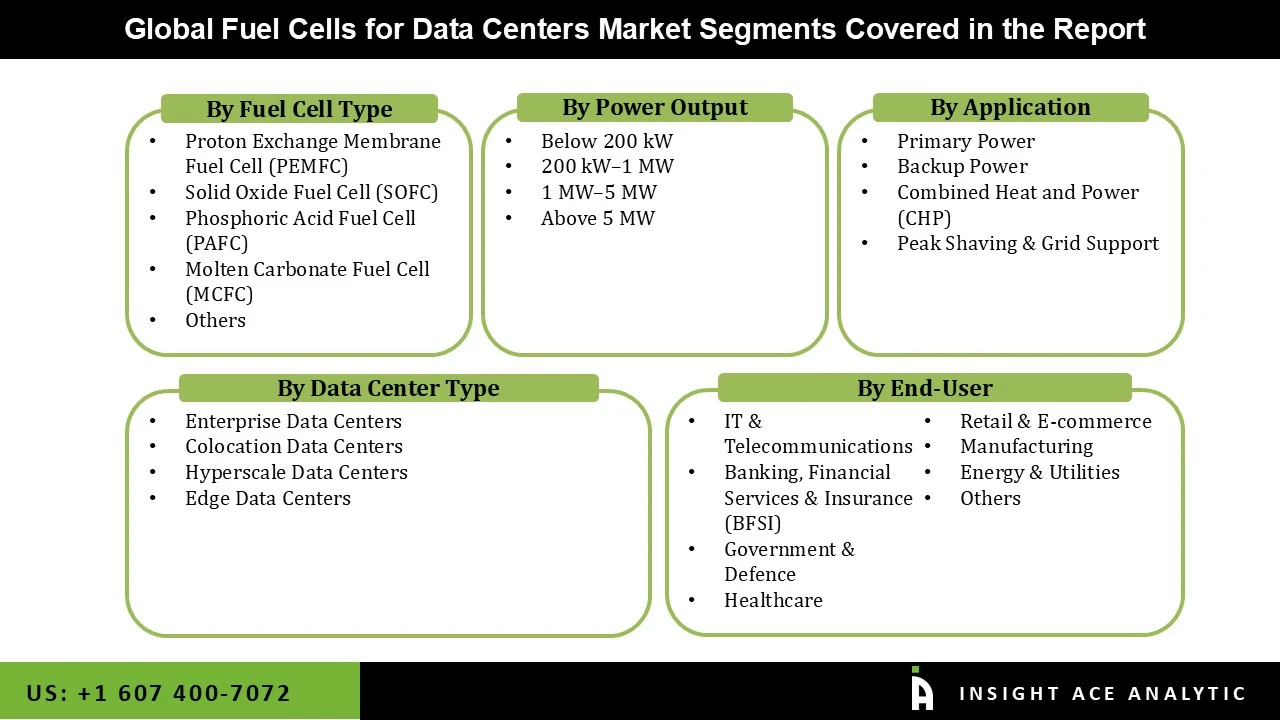
Fuel Cells for Data Centers Market Size, Share & Trends Analysis By Fuel Cell Type (Proton Exchange Membrane Fuel Cell (PEMFC), Solid Oxide Fuel Cell (SOFC), Phosphoric Acid Fuel Cell (PAFC), Molten Carbonate Fuel Cell (MCFC), Others) By Power Output (Below 200 kW, 200 kW–1 MW, 1 MW–5 MW, Above 5 MW) By Application (Primary Power, Backup Power, Combined Heat and Power (CHP), Peak Shaving & Grid Support) By Data Center Type (Enterprise Data Centers, Colocation Data Centers, Hyperscale Data Centers, Edge Data Centers) By End User (IT & Telecommunications, Banking, BFSI, Government & Defence, Healthcare, Retail & E-commerce, Manufacturing, Energy & Utilities, Others), and Segment Forecasts, 2026 to 2035
Fuel cells for data centers denote power generation systems installed at a stationary site that generate electricity through an electrochemical reaction by burning hydrogen, natural gas, biogas, or any other fuel. Such systems can be deployed as primary power, as back-up power or as an integral part of hybrid energy systems. Due to the possibility of continuously generating on-site power, these systems become crucial for data centers in which short power failures may negatively impact servers, cloud operations, and AI processes.
The growth of fuel cells for data centers market becomes apparent in the context of the growing demand for electricity due to artificial intelligence, cloud computing, high-performance computing, and hyperscale applications in the data center industry. At the same time, there is a trend towards growing difficulties in connecting data centers to the grid and providing transmission capacity. Fuel cell-based power generation allows bypassing such problems, since power can be produced close to the place of consumption. It is especially useful for data centers that need extra capacity faster than the traditional grid system can provide it.
Also, sustainability targets motivate data centers' operators to move away from diesel generators and traditional systems connected to the grid. Hydrogen-based PEM fuel cells do not produce onsite emissions when operated on hydrogen, while SOFC fuel cells allow producing efficiently continuous power from natural gas, biogas, or hydrogen. Thus, the fuel cells for data centers market moves to the integration of fuel cells, batteries, renewable power and microgrids.
Competitive Landscape
Which are the Leading Players in Fuel Cells for Data Centers Market?
• Bloom Energy
• FuelCell Energy
• Plug Power
• Ballard Power Systems
• Doosan Fuel Cell
• Toshiba Energy Systems & Solutions Corporation
• SFC Energy
• Cummins
• Ceres Power
• Panasonic Holdings
• Bosch
• Mitsubishi Power
• AFC Energy
• Hydrogenics
• Nuvera Fuel Cells
• Altergy
• Vertiv
Market Dynamics
Driver
Growing Demand for Reliable Onsite Power
One of the driving factors expected to continue pushing the market for fuel cells for data centers will be the rise in the electricity demand of the current generation of data centers. The demand for uninterrupted supply of electricity by AI-enabled facilities and hyperscale data centers will be high, and grid connectivity may take several years in some parts of the world. The use of fuel cells will become an alternative for power generation and hence reduced dependency on the capacity of the grid. This has been shown in the activities of Bloom Energy company. Bloom Energy Company entered into an extension of their deal with Equinix in February 2025, providing fuel cell installations in excess of 100 MW capacity for 19 data centers in six states of America.
This included 75 MW installed at that time plus an additional 30 MW in development. With the growth in AI deployment, the approach of data center operators towards assessing the power infrastructure is changing. The systems used in fuel cells can be deployed in a modular manner and are able to run continuously, and thus, they are ideal for large-scale facilities facing limitations due to available power. Moreover, Bloom Energy has indicated that its systems have been deployed in over 40 data centers in the USA.
Restrain/Challenge
High Initial Investment and Hydrogen Infrastructure Limitations
The one of the key issues impacting the development of the worldwide market of fuel cells for data centers is a relatively high price tag of fuel cells and necessary infrastructure. The expenses to be covered include those associated with the purchasing of fuel cell modules, hydrogen or another fuel supplies, the installation of power conditioning, cooling, hydrogen storage systems as well as maintenance and integration costs. It should be noted that under conditions where only short emergency power supplies are required, fuel cell generators are less economically justified than traditional ones used as backup generators. The scarcity of hydrogen fuel, in particular, in case of polymer electrolyte membrane (PEM) fuel cell generators, is also an issue that needs to be addressed. Sufficient hydrogen distribution network, hydrogen fuel storage systems, its delivery mechanisms and high-quality hydrogen fuels are required for fuel cell generation to become more common. In some markets, hydrogen infrastructure may not be developed yet. Moreover, industry analyses also show that a path to fuel cell technology as a main source of zero-carbon power is much longer than to back-up use.
Hyperscale Data Centers Segment is Expected to Drive the Fuel Cells for Data Centers Market
It is projected that the hyperscale data centers will continue being a key demand source for fuel cell technology owing to their constant and large electricity needs. Higher electricity needs owing to cloud computing services, AI training programs, generative AI and denser computing have been witnessed coupled with pressure on these hyperscale data centers to cut down emissions and improve efficiency. The fuel cells will be able to assist such data centers with electricity supply via either main on-site production, supplementary use of power or for backup purposes. They have a unique ability to expand power generation capacity with growing computing demands thanks to their modularity.
Solid Oxide Fuel Cells Segment is Growing at a Significant Rate in the Fuel Cells for Data Centers Market
Solid Oxide fuel cells receive significant attention due to their ability to offer efficient, on-site continuous electricity and possibility to use natural gas, biogas, etc., and further shift to hydrogen. Moreover, the technology is well-suited for use when there is a demand for baseload electricity by data centers, rather than only for back-up. Bloom Energy offers its Energy Server one of the existing and proven technologies used widely in the industry. Specifically, Equinix uses this platform and installed 100 MW+ of it for more than a decade now. At the same time, there are manufacturers of megawatt scale fuel cells that are able to produce both electricity and heat.
Why North America Led the Fuel Cells for Data Centers Market?
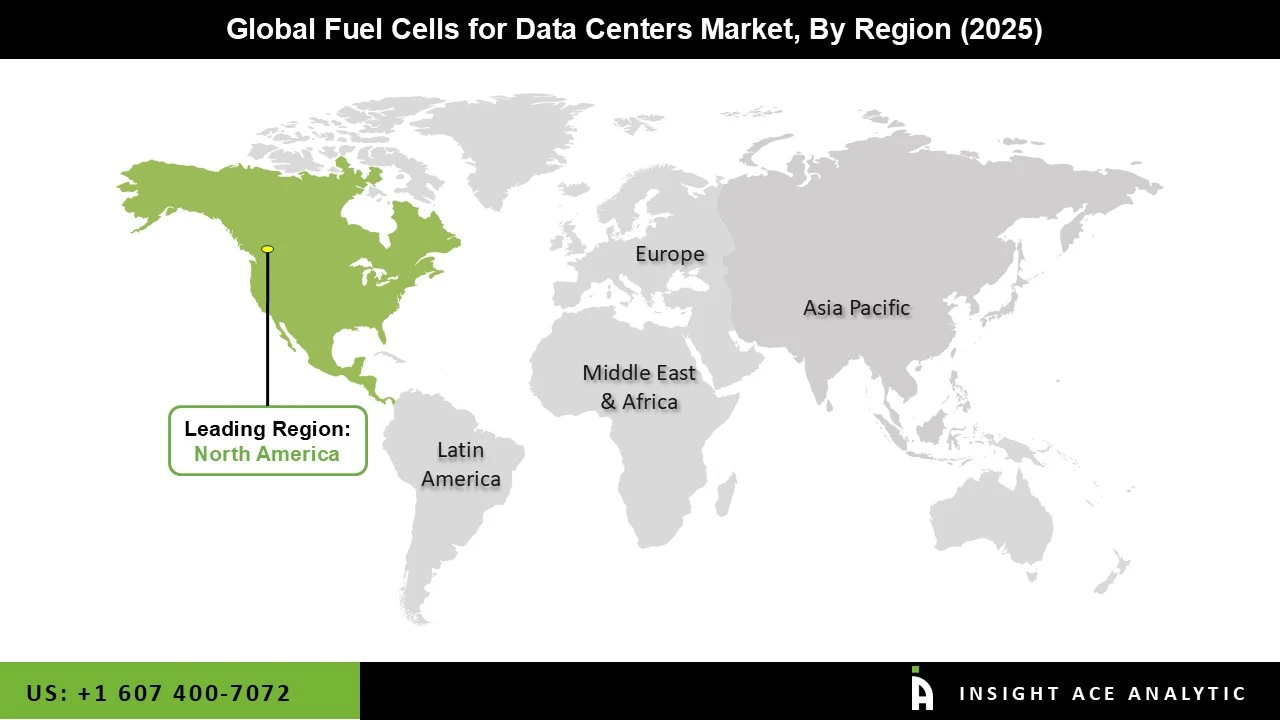
North America will remain one of the key markets for fuel cells for data centers owing to the large number of hyperscale and colocation data centers in this region, investments in AI infrastructure, and pressure on the region's power grids. North America is seeing increasing demand for onsite and behind-the-meter generation owing to prolonged periods of grid connection by data center operators. Further, the commercial success of Bloom Energy, FuelCell Energy, Plug Power, and Ballard Power Systems is propelling technology adoption in the region. Besides, cooperation among fuel cell makers, utilities, data center operators, and infrastructure providers will push the adoption of this technology from demonstration to larger scale commercialization. A strong rise in the adoption rate is predicted for Asia Pacific during the forecast period.
Key Development
• In July 2025, Bloom Energy and Oracle have announced the collaboration on deployment of their respective technologies in order to generate onsite power for AI and cloud workload. The company stated that the installations should generate power for selected Oracle Cloud Infrastructure data centers in the U.S. In addition, the company also stated that it was possible to supply power for an entire data center during a short deployment timeframe.
Fuel Cells for Data Centers Market Report Scope:
| Report Attribute | Specifications |
| Market size value in 2025 | USD 363.98 Bn |
| Revenue forecast in 2035 | USD 2071.78 Mn |
| Growth Rate CAGR | CAGR of 19.2% from 2026 to 2035 |
| Quantitative Units | Representation of revenue in US$ Mn and CAGR from 2026 to 2035 |
| Historic Year | 2022 to 2025 |
| Forecast Year | 2026-2035 |
| Report Coverage | The forecast of revenue, the position of the company, the competitive market structure, growth prospects, and trends |
| Segments Covered | Fuel Cell Type, Power Output, Application, Data Center Type, End-user, and By Region |
| Regional Scope | North America; Europe; Asia Pacific; Latin America; Middle East & Africa |
| Country Scope | U.S.; Canada; U.K.; Germany; China; India; Japan; Brazil; Mexico; The UK; France; Italy; Spain; China; Japan; India; South Korea; Southeast Asia; South Korea; Southeast Asia |
| Competitive Landscape | Bloom Energy, FuelCell Energy, Plug Power, Ballard Power Systems, Doosan Fuel Cell, Toshiba Energy Systems & Solutions Corporation, SFC Energy, Cummins, Ceres Power, Panasonic Holdings, Bosch, Mitsubishi Power, AFC Energy, Hydrogenics, Nuvera Fuel Cells, Altergy, and Vertiv. |
| Customization Scope | Free customization report with the procurement of the report, Modifications to the regional and segment scope. Geographic competitive landscape. |
| Pricing and Available Payment Methods | Explore pricing alternatives that are customized to your particular study requirements. |
Market Segmentation:
Fuel Cells for Data Centers Market By Fuel Cell Type -
• Proton Exchange Membrane Fuel Cell (PEMFC)
• Solid Oxide Fuel Cell (SOFC)
• Phosphoric Acid Fuel Cell (PAFC)
• Molten Carbonate Fuel Cell (MCFC)
• Others
Fuel Cells for Data Centers Market By Power Output -
• Below 200 kW
• 200 kW–1 MW
• 1 MW–5 MW
• Above 5 MW
Fuel Cells for Data Centers Market By Application-
• Primary Power
• Backup Power
• Combined Heat and Power (CHP)
• Peak Shaving & Grid Support
Fuel Cells for Data Centers Market By Data Center Type -
• Enterprise Data Centers
• Colocation Data Centers
• Hyperscale Data Centers
• Edge Data Centers
Fuel Cells for Data Centers Market By End-User-
• IT & Telecommunications
• Banking
• BFSI
• Government & Defence
• Healthcare
• Retail & E-commerce
• Manufacturing
• Energy & Utilities
• Others
Fuel Cells for Data Centers Market By Region-
North America-
• The US
• Canada
Europe-
• Germany
• The UK
• France
• Italy
• Spain
• Rest of Europe
Asia-Pacific-
• China
• Japan
• India
• South Korea
• South East Asia
• Rest of Asia Pacific
Latin America-
• Brazil
• Argentina
• Mexico
• Rest of Latin America
Middle East & Africa-
• GCC Countries
• South Africa
• Rest of Middle East and Africa
Research Design and Approach
This study employed a multi-step, mixed-method research approach that integrates:
- Secondary research
- Primary research
- Data triangulation
- Hybrid top-down and bottom-up modelling
- Forecasting and scenario analysis
This approach ensures a balanced and validated understanding of both macro- and micro-level market factors influencing the market.
Secondary Research
Secondary research for this study involved the collection, review, and analysis of publicly available and paid data sources to build the initial fact base, understand historical market behaviour, identify data gaps, and refine the hypotheses for primary research.
Sources Consulted
Secondary data for the market study was gathered from multiple credible sources, including:
- Government databases, regulatory bodies, and public institutions
- International organizations (WHO, OECD, IMF, World Bank, etc.)
- Commercial and paid databases
- Industry associations, trade publications, and technical journals
- Company annual reports, investor presentations, press releases, and SEC filings
- Academic research papers, patents, and scientific literature
- Previous market research publications and syndicated reports
These sources were used to compile historical data, market volumes/prices, industry trends, technological developments, and competitive insights.

Primary Research
Primary research was conducted to validate secondary data, understand real-time market dynamics, capture price points and adoption trends, and verify the assumptions used in the market modelling.
Stakeholders Interviewed
Primary interviews for this study involved:
- Manufacturers and suppliers in the market value chain
- Distributors, channel partners, and integrators
- End-users / customers (e.g., hospitals, labs, enterprises, consumers, etc., depending on the market)
- Industry experts, technology specialists, consultants, and regulatory professionals
- Senior executives (CEOs, CTOs, VPs, Directors) and product managers
Interview Process
Interviews were conducted via:
- Structured and semi-structured questionnaires
- Telephonic and video interactions
- Email correspondences
- Expert consultation sessions
Primary insights were incorporated into demand modelling, pricing analysis, technology evaluation, and market share estimation.
Data Processing, Normalization, and Validation
All collected data were processed and normalized to ensure consistency and comparability across regions and time frames.
The data validation process included:
- Standardization of units (currency conversions, volume units, inflation adjustments)
- Cross-verification of data points across multiple secondary sources
- Normalization of inconsistent datasets
- Identification and resolution of data gaps
- Outlier detection and removal through algorithmic and manual checks
- Plausibility and coherence checks across segments and geographies
This ensured that the dataset used for modelling was clean, robust, and reliable.
Market Size Estimation and Data Triangulation
Bottom-Up Approach
The bottom-up approach involved aggregating segment-level data, such as:
- Company revenues
- Product-level sales
- Installed base/usage volumes
- Adoption and penetration rates
- Pricing analysis
This method was primarily used when detailed micro-level market data were available.

Top-Down Approach
The top-down approach used macro-level indicators:
- Parent market benchmarks
- Global/regional industry trends
- Economic indicators (GDP, demographics, spending patterns)
- Penetration and usage ratios
This approach was used for segments where granular data were limited or inconsistent.
Hybrid Triangulation Approach
To ensure accuracy, a triangulated hybrid model was used. This included:
- Reconciling top-down and bottom-up estimates
- Cross-checking revenues, volumes, and pricing assumptions
- Incorporating expert insights to validate segment splits and adoption rates
This multi-angle validation yielded the final market size.
Forecasting Framework and Scenario Modelling
Market forecasts were developed using a combination of time-series modelling, adoption curve analysis, and driver-based forecasting tools.
Forecasting Methods
- Time-series modelling
- S-curve and diffusion models (for emerging technologies)
- Driver-based forecasting (GDP, disposable income, adoption rates, regulatory changes)
- Price elasticity models
- Market maturity and lifecycle-based projections
Scenario Analysis
Given inherent uncertainties, three scenarios were constructed:
- Base-Case Scenario: Expected trajectory under current conditions
- Optimistic Scenario: High adoption, favourable regulation, strong economic tailwinds
- Conservative Scenario: Slow adoption, regulatory delays, economic constraints
Sensitivity testing was conducted on key variables, including pricing, demand elasticity, and regional adoption.
Request Customization
Add countries, segments, company profiles, or extend forecast — free 10% customization with purchase.
Customize This Report →Enquire Before Buying
Speak with our analyst team about scope, methodology, pricing, or deliverable formats.
Enquire Now →Frequently Asked Questions
Fuel Cells for Data Centers Market Size is valued at USD 363.98 Mn in 2025 and is predicted to reach USD 2,071.78 Mn by the year 2035
Fuel Cells for Data Centers Market is expected to grow at a 19.2% CAGR during the forecast period for 2026 to 2035.
Bloom Energy, FuelCell Energy, Plug Power, Ballard Power Systems, Doosan Fuel Cell, Toshiba Energy Systems & Solutions Corporation, SFC Energy, Cummins, Ceres Power, Panasonic Holdings, Bosch, Mitsubishi Power, AFC Energy, Hydrogenics, Nuvera Fuel Cells, Altergy, and Vertiv.
Fuel Cells for Data Centers Market is segmented into Fuel Cell Type, Power Output, Application, Data Center Type, End-user, and By Region
North America region is leading the Fuel Cells for Data Centers Market.