Optical Sorter Market Size, Trend, Revenue Report 2026 to 2035
What is Optical Sorter Market Size?
Optical Sorter Market Size is valued at USD 2.49 Bn in 2025 and is predicted to reach USD 6.45 Bn by the year 2035 at a 10.2% CAGR during the forecast period for 2026 to 2035.
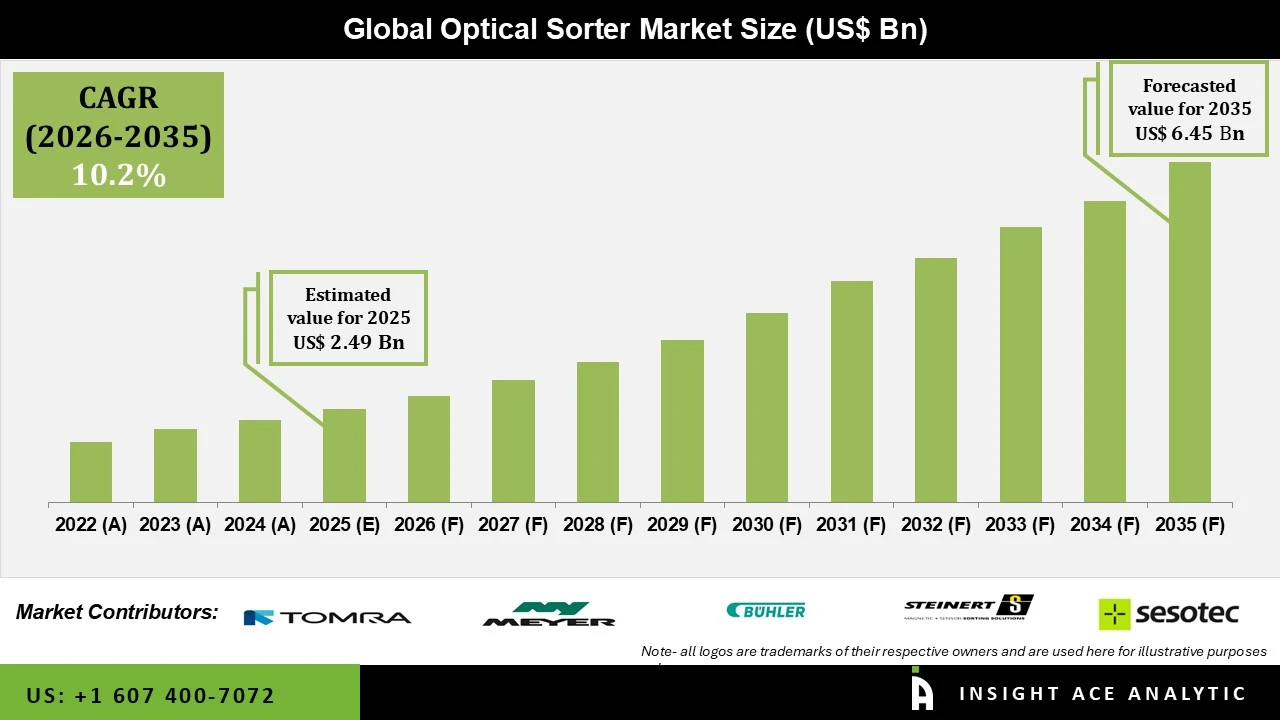
Optical Sorter Market Size, Share & Trends Analysis By Offering (Feed System, Optical System, Image Processing, Separation System), Type (Cameras, NIR, Hyperspectral, XRT), Platform (Belt, Freefall, Lane), Application (Food & Beverages, Recycling), and Segment Forecasts, 2026 to 2035
An optical sorter is an automatic machine that uses a camera, sensor, lighting system, image processing, and software to detect and classify objects based on various features such as color, size, composition, shape, and others. Optical sorters are commonly used in various sectors such as food processing, recycling, mining, and others because of the need for consistency in quality and accurate sorting. Automation, precision in sorting, low losses of products, and high quality control contribute to the growth of the optical sorter market.
The optical sorter market emerged due to the adoption of automated processing systems in food industry, recycling sector, mining sector, and other fields of activities. Food industry uses optical sorting systems in order to detect defective products, contaminants, discolorations, and variations in quality. In recycling sector, the adoption of optical sorting systems grows due to the needs to separate plastics, paper, metals, and other materials to increase purity of the recovered material. The growing focus on recycling, circular economy, and resources recovery creates additional demand for optical sorters.
Moreover, the advances in artificial intelligence, machine learning, deep learning, hyperspectral imaging, near-infrared sensing, and high-speed cameras help optical sorters to work with increasingly complex material streams. Contemporary systems are able to detect defects and materials that cannot be classified using traditional methods of sorting. For instance, TOMRA has noted the role of deep learning and real-time monitoring in automated sorting systems. Also, Bühler has introduced deep-learning-based optical sorting in food processing industry.
Competitive Landscape
Which are the Leading Players in Optical Sorter Market?
• TOMRA Systems ASA
• Bühler Group
• Hefei Meyer Optoelectronic Technology Inc.
• Satake Corporation
• Key Technology, LLC
• STEINERT GmbH
• Sesotec GmbH
• Allgaier Werke GmbH
• Pellenc ST
• National Recovery Technologies, LLC
• Raytec Vision S.p.A.
• Techik Instrument (Shanghai) Co., Ltd.
• Binder+Co
• Cimbria
• Mesutronic GmbH
• RealTech Machinery Co., Ltd.
• Eagle Vizion Inc.
• Machinex Industries Inc.
Market Dynamics
Driver
Growing Demand for Automated and High-Precision Sorting
The optical sorter market is expected to grow in the coming years because of the growing trend towards automation and precision processing of materials. Companies in the food industry, recycling, and mining are in need of technology that can help in improving the accuracy of sorting while reducing their reliance on manual checking. The use of artificial intelligence and machine vision is now enabling companies to enhance the efficiency of the sorters. Using deep learning models, companies can detect complex defect types that might not be possible through the use of conventional sorting rules. TOMRA has observed that deep learning is being used for solving complex sorting problems such as separating food grade plastics from non-food grade plastics.
Restrain/Challenge
High Initial Investment and Integration Requirements
Some of the challenges for the global optical sorter market include the relatively high costs of investing in modern optical sorters. This is because they require the use of specialized cameras, sensors, lighting, software, ejecting air, conveyors, and control systems. The investment becomes even higher if the company is forced to make changes to the already existing processing lines and combine several technologies.
There is also a challenge that requires the company to have skilled operators and technical support. While modern machines are increasingly easy to operate, companies will still need personnel that can handle such operations as sorting parameters, sensor management, ejectors, software and data management.
The optical sorter market is projected to expand in the coming years due to the increasing trend towards automation and precision in material processing. There is need for companies in industries like food processing, recycling, and mining to have technology that will enable them to enhance the accuracy of their processes without relying entirely on manual checks.
Artificial Intelligence and machine vision are some of the technologies that have enabled companies to increase efficiency of their optical sorters. With the use of deep learning algorithms, companies can identify complex defects that would not have been detected using the traditional sorting rules. It has been noted that companies are using deep learning to solve complex sorting challenges such as sorting of food grade plastics from other plastics.
Recycling Segment is Expected to Drive the Optical Sorter Market
The recycling section is likely to be a key growth avenue for the optical sorters owing to the growing focus on waste management, material recovery and recycled content. Optical sorting provides recycling centers with the means to sort various polymers, colors, materials and grades with high accuracy. Recycling is expected to experience a high growth rate over the forecast period. More complex recycling streams are being treated by employing the technologies such as NIR sensors, cameras, AI and deep learning algorithms. These technologies enable better material purity and minimize waste of recyclables.
NIR and AI-based Sorting Technologies are Gaining Importance
However, NIR optical sorting systems are becoming more popular in the use cases that make materials undifferentiable using visible colors. The NIR sensors are capable of sensing chemical compositions of the materials; thus, they will be extremely helpful in sorting plastic, recycling, mining, and other uses cases. In addition, there is now a growing trend of using AI and deep learning algorithms in sorting systems to analyze objects and defects rather than using fixed sorting rules only. Thus, they are capable of recognizing image patterns using training datasets which can improve sorting results under different materials’ conditions.
Why North America Led the Optical Sorter Market?
North America dominated the optical sorters market in 2025 on account of strong existing industries related to food processing, recycling, mining, and industrial activities across the region. Availability of high-end manufacturing facilities and the use of advanced automation is prompting firms to deploy high performance optical sorters. Moreover, there has been a recent inclination toward use of AI-based sorting and recycling solutions. Optical sorting is increasingly gaining popularity at modern recycling plants to achieve higher efficiency in sorting and quality in recycled outputs. Furthermore, presence of established technology vendors and investment in recycling infrastructure adds to growth opportunities.
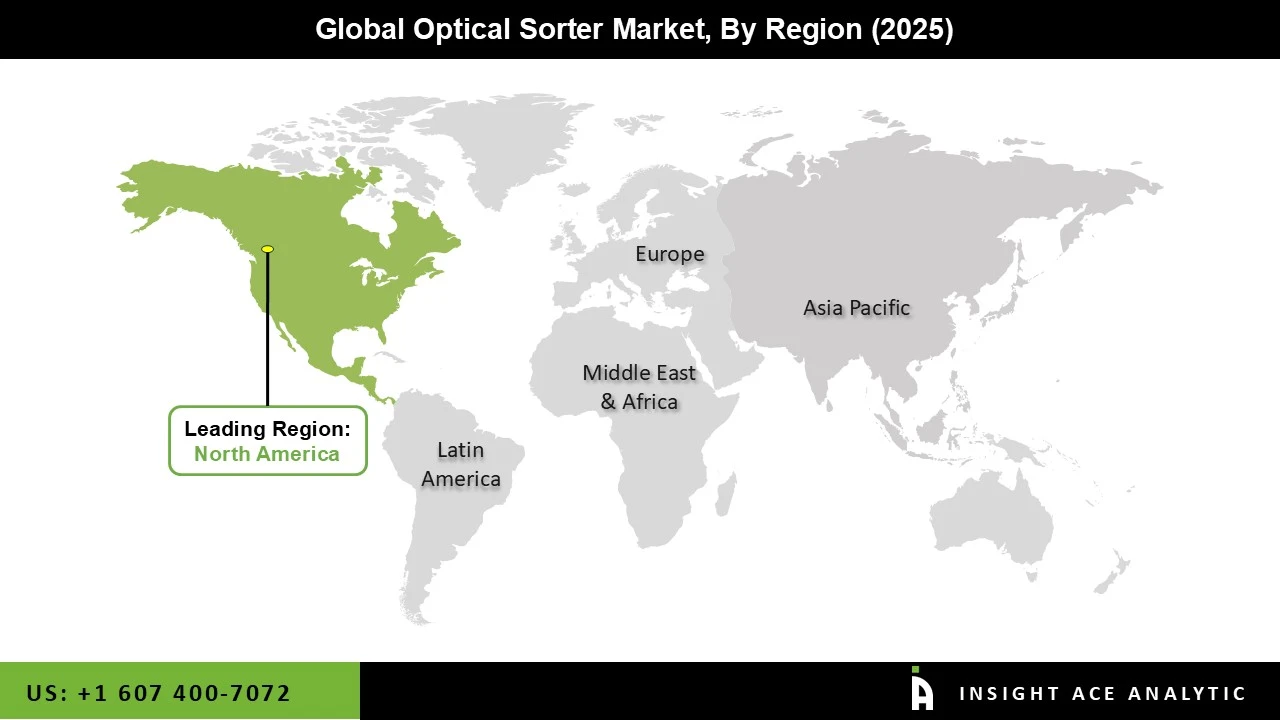
Asia-Pacific region is poised to emerge as the fast growing regional segment during the forecast period. Asia-Pacific boasts substantial presence of food processing, manufacturing industry, recycling activity, and industrial automation. Some of the prominent countries where demand is rising for advanced sorting solutions include China, Japan, India, and South Korea.
Key Development:
• In September 2025, TOMRA released the TOMRA 4C – a smart optical sorter created for processing nuts and individually quick-frozen (IQF) foods. The system features artificial intelligence and advanced sensors which help enhance detection efficiency, simplify the operation of the equipment, and reduce downtime.
• In May 2025, Bühler launched the optical sorter SORTEX AI700 that employs deep learning technologies and was designed to be used for eliminating gluten-containing grains from oats. The goal is to improve the accuracy of sorting as well as product quality and yield of the food processors.
Optical Sorter Market Report Scope:
| Report Attribute | Specifications |
| Market size value in 2025 | USD 2.49 Bn |
| Revenue forecast in 2035 | USD 6.45 Bn |
| Growth Rate CAGR | CAGR of 10.2% from 2026 to 2035 |
| Quantitative Units | Representation of revenue in US$ Bn and CAGR from 2026 to 2035 |
| Historic Year | 2022 to 2025 |
| Forecast Year | 2026-2035 |
| Report Coverage | The forecast of revenue, the position of the company, the competitive market structure, growth prospects, and trends |
| Segments Covered | Type, Offering, Application, and By Region |
| Regional Scope | North America; Europe; Asia Pacific; Latin America; Middle East & Africa |
| Country Scope | U.S.; Canada; U.K.; Germany; China; India; Japan; Brazil; Mexico; The UK; France; Italy; Spain; China; Japan; India; South Korea; Southeast Asia. |
| Competitive Landscape | OMRA Systems ASA, Bühler Group, Key Technology, Inc. (Duravant), Satake Corporation, Hefei Meyer Optoelectronic Technology Inc., STEINERT GmbH, Sesotec GmbH, Binder+Co AG, Cimbria A/S, Pellenc ST, Allgaier Werke GmbH, Raytec Vision S.p.A., National Recovery Technologies, LLC, Techik Instrument Co., Ltd., Machinex Industries Inc., and Hefei Taihe Intelligent Technology Co., Ltd. |
| Customization Scope | Free customization report with the procurement of the report, Modifications to the regional and segment scope. Geographic competitive landscape. |
| Pricing and Available Payment Methods | Explore pricing alternatives that are customized to your particular study requirements. |
Market Segmentation:
Optical Sorter Market by Offering -
• Feed System
• Optical System
• Image Processing
• Separation System
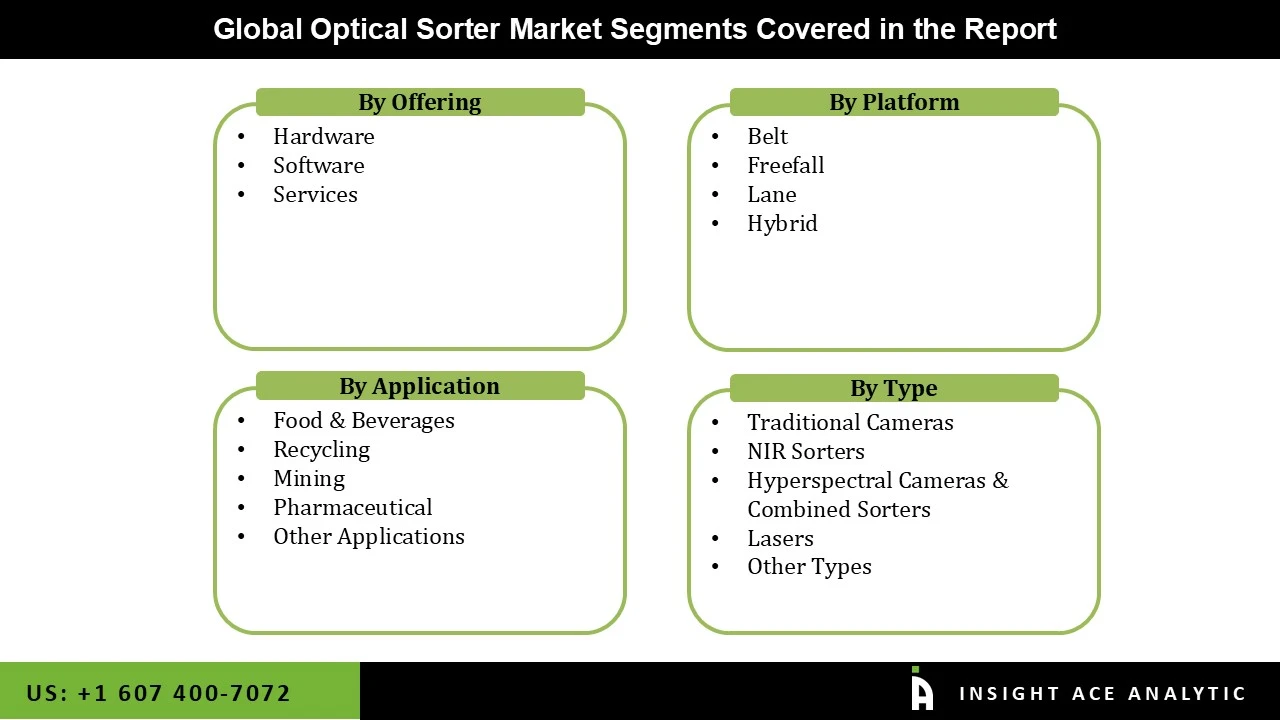
Optical Sorter Market by Type-
• Cameras
• NIR
• Hyperspectral
• XRT
Optical Sorter Market by Platform -
• Belt
• Freefall
• Lane
Optical Sorter Market by Application-
• Food
• Recycling
• Mining
• Pharmaceuticals
• Waste Management
• Others
Optical Sorter Market By Region-
North America-
• The US
• Canada
Europe-
• Germany
• The UK
• France
• Italy
• Spain
• Rest of Europe
Asia-Pacific-
• China
• Japan
• India
• South Korea
• South East Asia
• Rest of Asia Pacific
Latin America-
• Brazil
• Argentina
• Mexico
• Rest of Latin America
Middle East & Africa-
• GCC Countries
• South Africa
• Rest of Middle East and Africa
Research Design and Approach
This study employed a multi-step, mixed-method research approach that integrates:
- Secondary research
- Primary research
- Data triangulation
- Hybrid top-down and bottom-up modelling
- Forecasting and scenario analysis
This approach ensures a balanced and validated understanding of both macro- and micro-level market factors influencing the market.
Secondary Research
Secondary research for this study involved the collection, review, and analysis of publicly available and paid data sources to build the initial fact base, understand historical market behaviour, identify data gaps, and refine the hypotheses for primary research.
Sources Consulted
Secondary data for the market study was gathered from multiple credible sources, including:
- Government databases, regulatory bodies, and public institutions
- International organizations (WHO, OECD, IMF, World Bank, etc.)
- Commercial and paid databases
- Industry associations, trade publications, and technical journals
- Company annual reports, investor presentations, press releases, and SEC filings
- Academic research papers, patents, and scientific literature
- Previous market research publications and syndicated reports
These sources were used to compile historical data, market volumes/prices, industry trends, technological developments, and competitive insights.

Primary Research
Primary research was conducted to validate secondary data, understand real-time market dynamics, capture price points and adoption trends, and verify the assumptions used in the market modelling.
Stakeholders Interviewed
Primary interviews for this study involved:
- Manufacturers and suppliers in the market value chain
- Distributors, channel partners, and integrators
- End-users / customers (e.g., hospitals, labs, enterprises, consumers, etc., depending on the market)
- Industry experts, technology specialists, consultants, and regulatory professionals
- Senior executives (CEOs, CTOs, VPs, Directors) and product managers
Interview Process
Interviews were conducted via:
- Structured and semi-structured questionnaires
- Telephonic and video interactions
- Email correspondences
- Expert consultation sessions
Primary insights were incorporated into demand modelling, pricing analysis, technology evaluation, and market share estimation.
Data Processing, Normalization, and Validation
All collected data were processed and normalized to ensure consistency and comparability across regions and time frames.
The data validation process included:
- Standardization of units (currency conversions, volume units, inflation adjustments)
- Cross-verification of data points across multiple secondary sources
- Normalization of inconsistent datasets
- Identification and resolution of data gaps
- Outlier detection and removal through algorithmic and manual checks
- Plausibility and coherence checks across segments and geographies
This ensured that the dataset used for modelling was clean, robust, and reliable.
Market Size Estimation and Data Triangulation
Bottom-Up Approach
The bottom-up approach involved aggregating segment-level data, such as:
- Company revenues
- Product-level sales
- Installed base/usage volumes
- Adoption and penetration rates
- Pricing analysis
This method was primarily used when detailed micro-level market data were available.

Top-Down Approach
The top-down approach used macro-level indicators:
- Parent market benchmarks
- Global/regional industry trends
- Economic indicators (GDP, demographics, spending patterns)
- Penetration and usage ratios
This approach was used for segments where granular data were limited or inconsistent.
Hybrid Triangulation Approach
To ensure accuracy, a triangulated hybrid model was used. This included:
- Reconciling top-down and bottom-up estimates
- Cross-checking revenues, volumes, and pricing assumptions
- Incorporating expert insights to validate segment splits and adoption rates
This multi-angle validation yielded the final market size.
Forecasting Framework and Scenario Modelling
Market forecasts were developed using a combination of time-series modelling, adoption curve analysis, and driver-based forecasting tools.
Forecasting Methods
- Time-series modelling
- S-curve and diffusion models (for emerging technologies)
- Driver-based forecasting (GDP, disposable income, adoption rates, regulatory changes)
- Price elasticity models
- Market maturity and lifecycle-based projections
Scenario Analysis
Given inherent uncertainties, three scenarios were constructed:
- Base-Case Scenario: Expected trajectory under current conditions
- Optimistic Scenario: High adoption, favourable regulation, strong economic tailwinds
- Conservative Scenario: Slow adoption, regulatory delays, economic constraints
Sensitivity testing was conducted on key variables, including pricing, demand elasticity, and regional adoption.
Request Customization
Add countries, segments, company profiles, or extend forecast — free 10% customization with purchase.
Customize This Report →Enquire Before Buying
Speak with our analyst team about scope, methodology, pricing, or deliverable formats.
Enquire Now →Frequently Asked Questions
Optical Sorter Market Size is valued at USD 2.49 Bn in 2025 and is predicted to reach USD 6.45 Bn by the year 2035
Optical Sorter Market is expected to grow at a 10.2% CAGR during the forecast period for 2026 to 2035.
OMRA Systems ASA, Bühler Group, Key Technology, Inc. (Duravant), Satake Corporation, Hefei Meyer Optoelectronic Technology Inc., STEINERT GmbH, Sesotec GmbH, Binder+Co AG, Cimbria A/S, Pellenc ST, Allgaier Werke GmbH, Raytec Vision S.p.A., National Recovery Technologies, LLC, Techik Instrument Co., Ltd., Machinex Industries Inc., and Hefei Taihe Intelligent Technology Co., Ltd.
Optical Sorter Market is segmented into Type, Offering, Application, and By Region
North America region is leading the Optical Sorter Market.