Fast Charging Lithium ion Battery Market Size, Share, Revenue Report 2026 to 2035
What is Fast Charging Lithium-ion Battery Market Size?
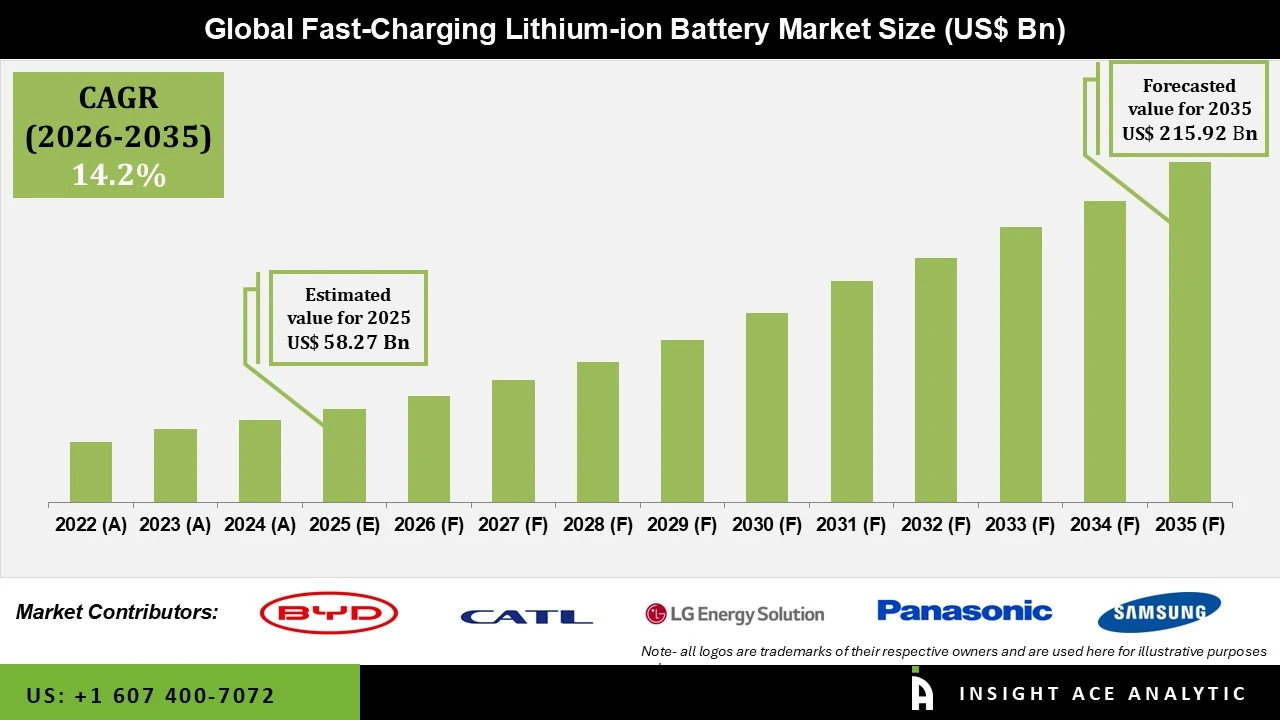
Fast Charging Lithium-ion Battery Market Size is valued at USD 58.27 Bn in 2025 and is predicted to reach USD 215.92 Bn by the year 2035 at a 14.2% CAGR during the forecast period for 2026 to 2035.
Fast Charging Lithium ion Battery Market Size, Share & Trends Analysis By Cell Format (Cylindrical, Prismatic, Pouch), Charging Capacity (<2C, 2C-4C, >4C), Application (EVs, Energy Storage Systems, Consumer Electronics, Industrial/Power Tools), and Segment Forecasts, 2026 to 2035
A fast-charging Li-ion battery refers to a system of recharging batteries which allows to increase charging capacity and decrease the time needed to replenish the amount of energy that is stored in the batteries. Fast-charging lithium-ion batteries are used in modern cars, consumer products, energy storage systems, power tools, and industrial equipment to ensure convenient work and increased efficiency due to the reduction in charging times.
As for the development of the market, it is driven by the growth of electric mobility, especially by increasing the number of commercial electric vehicles, electric bikes, etc. It is necessary to develop cell chemistry, electrode materials, thermal management system, charging architecture, etc., in order to ensure an increase in charging rate and reduce negative effects on battery longevity and safety.
It is also worth mentioning the tendency towards the increase in C-rates of batteries since there are batteries that can be charged at a higher than standard speed (2C, 3C, 4C, 6C, etc.). An increase in C-rate allows significantly reduce charging times, but there are also extra requirements related to heat dissipation, cell construction, charging infrastructure, battery management, etc.
In addition, it is necessary to emphasize that it is not only passenger vehicles which may be improved thanks to fast-charging batteries; commercial electric vehicles, electric buses, industrial equipment, power tools, and stationary storage energy systems will be able to benefit from it due to increased usage.
Competitive Landscape
Which are the leading players in Fast-Charging Lithium-ion Battery Market?
• Contemporary Amperex Technology Co. Limited (CATL)
• BYD Company Limited
• LG Energy Solution
• Panasonic Energy Co., Ltd.
• Samsung SDI Co., Ltd.
• SK On Co., Ltd.
• CALB Group Co., Ltd.
• Gotion High-Tech Co., Ltd.
• EVE Energy Co., Ltd.
• Farasis Energy
• AESC Group Ltd.
• Toshiba Corporation
• Tesla, Inc.
• StoreDot Ltd.
• Nyobolt Limited
• Amprius Technologies, Inc.
• Envision AESC
• Hitachi Energy
• Saft Groupe S.A.
• Amperex Technology Limited (ATL)
Market Dynamics
Driver
Increasing Adoption of Electric Vehicles
Increased popularity of electric cars is among major contributors to the growth of Fast-Charging Lithium-ion Battery Market. There is a demand for convenient fast charging batteries that could shorten the time of recharging close to the time of regular fuel filling. Fast-charging batteries will increase the efficiency of electric cars, trucks, taxis, vans, buses, and any other kind of electric transportation. Lithium-ion battery developers are focusing on increasing the rate of charging without reducing the energy density and safety of batteries. One such innovation by CATL is the second generation of Shenxing Superfast Charging Battery featuring peak 12C charging rate, representing an example of what the fast-charging electric car battery market can evolve to. An increase in the development of fast-charging stations further supports this process, as increased power availability of stations gives an additional motive for the producers of electric car batteries to adapt batteries to such environment.
Restrain/Challenge
Battery Degradation and Thermal Management
Charging at a high rate also leads to further generation of heat and can add to the stress on the material of batteries. Hence, if charging is not managed properly, the repetition of high-rate charging can cause degradation in battery life. Hence, companies must take into account the speed of charge, cycle life, energy density, and safety while designing and developing batteries. When it comes to high C-rates, thermal management assumes extra significance. Batteries must be equipped with efficient cooling systems and battery management software that manages heat and charge rate. It adds further complexity to batteries. Yet another constraint is charging infrastructure. If the batteries can handle high currents for fast charging, then it will be of no use if charging stations or electrical grid cannot supply adequate power.
2C-4C Segment is Expected to Remain a Major Charging Capacity Segment
It seems that this range is likely to continue to be important as it strikes the right balance between the charging time, battery longevity, cost, and needed infrastructure. The batteries from this range allow quite a fast charging without necessitating a sophisticated cooling and charging infrastructure as is the case with high C-rate battery packs. Nevertheless, there seems to be a gradual shift to even faster charging battery packs. The battery technologies exceeding the rate of 4C are increasingly becoming popular especially in premium EVs as well as those sectors where charging downtime affects the usage of the vehicle. The advancement of the 6C battery pack and beyond continues to be an important technological trend in electric vehicles and fleets.
Electric Vehicle Segment is Expected to Drive the Market
Electric cars are anticipated to be the predominant applications for quick-charging Li-ion batteries. Quick charging becomes highly beneficial in commercial electric vehicles because of reduced charging time resulting in higher usage of the vehicles each day. Quick-charging can thus take place when the commercial vehicles like buses, electric taxis, electric lorries have a stop or loading time. Consumer products such as smartphones, notebooks, tablets, and other portable electronic devices require higher charging rates.
Why Asia Pacific Led the Fast-Charging Lithium-ion Battery Market?
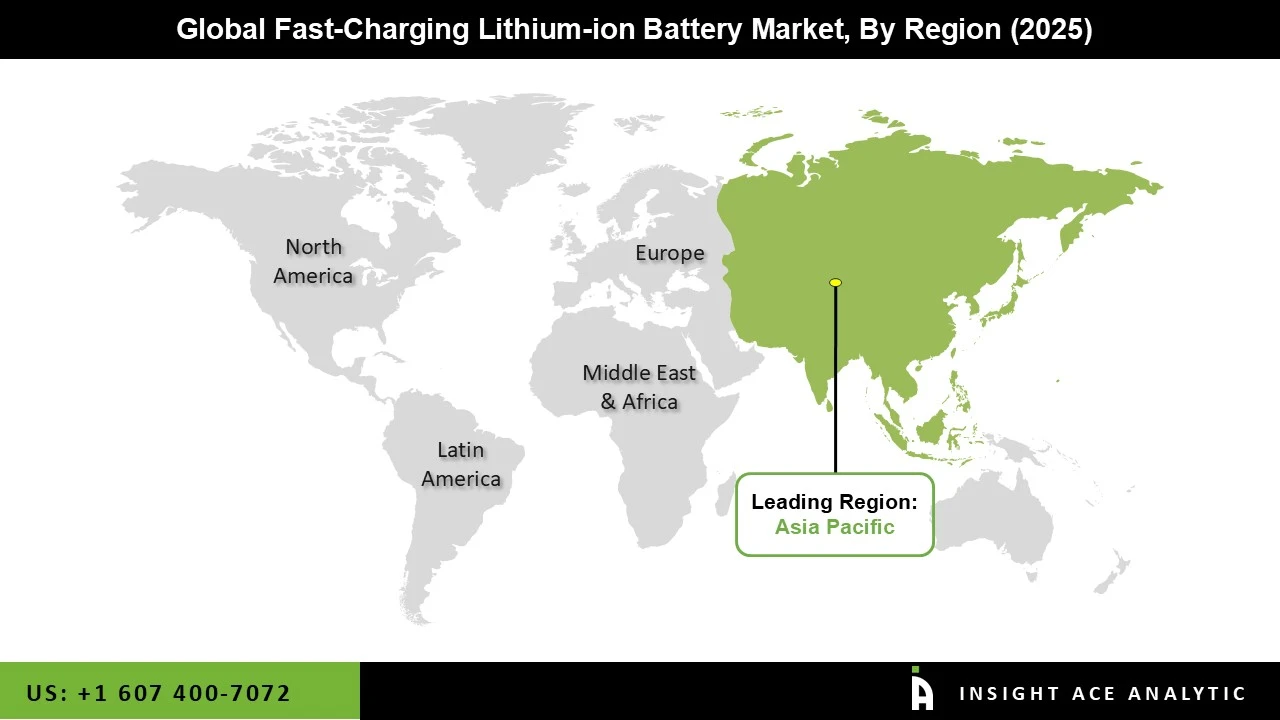
Region Asia Pacific will still be one of the leaders in the deployment of fast-charging lithium-ion batteries due to a well-developed battery industry, demand for EVs, production of electronics, and development of the fast-charging infrastructure. One of the key regions will be China due to a large share of global manufacturing of lithium-ion batteries and presence of prominent manufacturers of such batteries like CATL and BYD.
It is worth mentioning Japan and South Korea with their well-established battery manufacturing industries; the companies of both countries keep on developing technologies and investing in high-powered batteries for usage in EVs and storage. India emerges as a growing market for fast-charging of batteries due to rising popularity of EVs, battery production investments and support for electrical mobility from the government side. Fast-charging will be increasingly popular as electric bikes, passenger cars, buses, and commercial vehicles gain wider popularity in the country.
Other key regions will be North America with investments into the battery manufacturing industry and growth of high power fast-charging infrastructure and Europe due to the growing interest of car makers in electrified vehicle platforms.
Key Development:
• In April 2026, The CATL company launched its third generation of the Shenxing Superfast Charging Battery along with other innovations in battery systems. The updated versions of the Qilin, Freevoy, and other battery systems were also unveiled at the CATL's Super Technology Day.
Fast-Charging Lithium-ion Battery Market Report Scope:
| Report Attribute | Specifications |
| Market size value in 2025 | USD 58.27 Bn |
| Revenue forecast in 2035 | USD 215.92 Bn |
| Growth Rate CAGR | CAGR of 14.2% from 2026 to 2035 |
| Quantitative Units | Representation of revenue in US$ Bn and CAGR from 2026 to 2035 |
| Historic Year | 2022 to 2025 |
| Forecast Year | 2026-2035 |
| Report Coverage | The forecast of revenue, the position of the company, the competitive market structure, growth prospects, and trends |
| Segments Covered | Cell Format, Charging Capacity, Application, and By Region |
| Regional Scope | North America; Europe; Asia Pacific; Latin America; Middle East & Africa |
| Country Scope | U.S.; Canada; U.K.; Germany; China; India; Japan; Brazil; Mexico; France; Italy; Spain; South Korea; Southeast Asia |
| Competitive Landscape | CATL, BYD, LG Energy Solution, Panasonic Energy, Samsung SDI, SK On, CALB, Gotion High-Tech, EVE Energy, Farasis Energy, AESC, Tesla, StoreDot, Nyobolt, Amprius Technologies, Toshiba, Hitachi Energy, Saft, and others. |
| Customization Scope | Free customization report with the procurement of the report, Modifications to the regional and segment scope. Geographic competitive landscape. |
| Pricing and Available Payment Methods | Explore pricing alternatives that are customized to your particular study requirements. |
Market Segmentation:
Fast-Charging Lithium-ion Battery Market By Cell Format -
• Cylindrical
• Prismatic
• Pouch
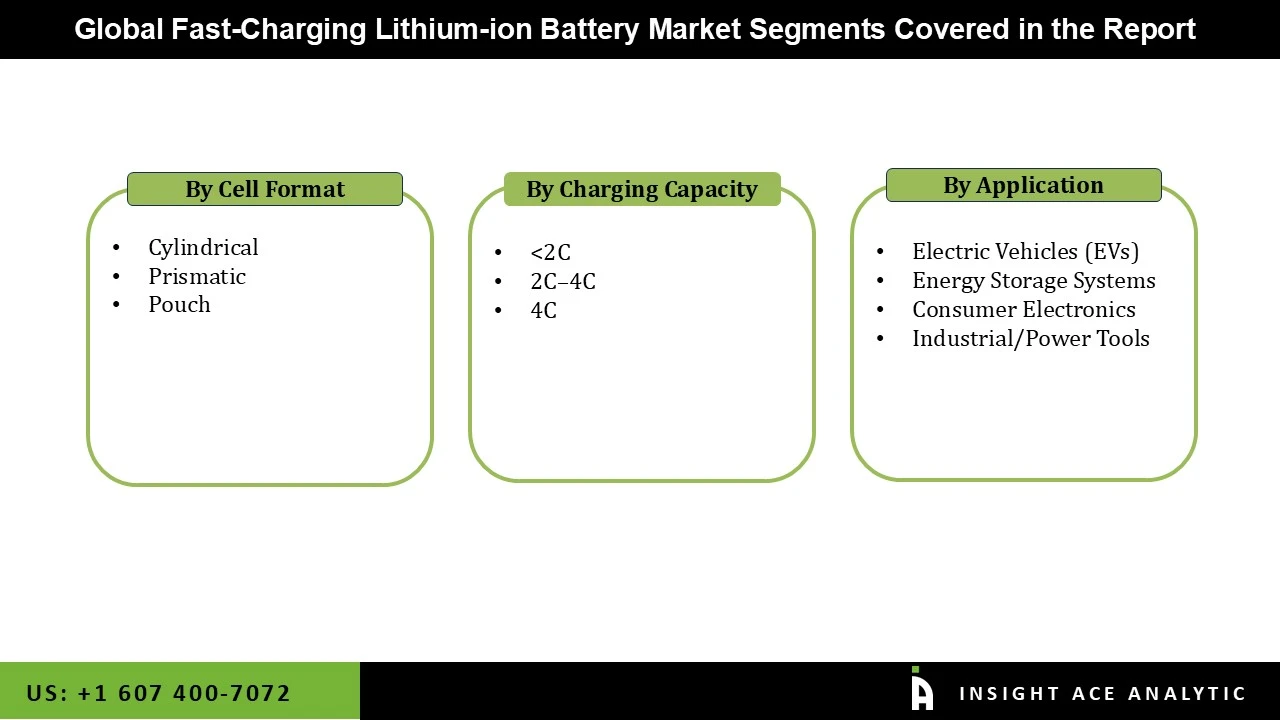
Fast-Charging Lithium-ion Battery Market By Charging Capacity -
• <2C
• 2C-4C
• >4C
Fast-Charging Lithium-ion Battery Market By Application-
• EVs
• Energy Storage Systems
• Consumer Electronics
• Industrial/Power Tools
Fast-Charging Lithium-ion Battery Market By Region-
North America-
• The US
• Canada
Europe-
• Germany
• The UK
• France
• Italy
• Spain
• Rest of Europe
Asia-Pacific-
• China
• Japan
• India
• South Korea
• South East Asia
• Rest of Asia Pacific
Latin America-
• Brazil
• Argentina
• Mexico
• Rest of Latin America
Middle East & Africa-
• GCC Countries
• South Africa
• Rest of Middle East and Africa
Research Design and Approach
This study employed a multi-step, mixed-method research approach that integrates:
- Secondary research
- Primary research
- Data triangulation
- Hybrid top-down and bottom-up modelling
- Forecasting and scenario analysis
This approach ensures a balanced and validated understanding of both macro- and micro-level market factors influencing the market.
Secondary Research
Secondary research for this study involved the collection, review, and analysis of publicly available and paid data sources to build the initial fact base, understand historical market behaviour, identify data gaps, and refine the hypotheses for primary research.
Sources Consulted
Secondary data for the market study was gathered from multiple credible sources, including:
- Government databases, regulatory bodies, and public institutions
- International organizations (WHO, OECD, IMF, World Bank, etc.)
- Commercial and paid databases
- Industry associations, trade publications, and technical journals
- Company annual reports, investor presentations, press releases, and SEC filings
- Academic research papers, patents, and scientific literature
- Previous market research publications and syndicated reports
These sources were used to compile historical data, market volumes/prices, industry trends, technological developments, and competitive insights.

Primary Research
Primary research was conducted to validate secondary data, understand real-time market dynamics, capture price points and adoption trends, and verify the assumptions used in the market modelling.
Stakeholders Interviewed
Primary interviews for this study involved:
- Manufacturers and suppliers in the market value chain
- Distributors, channel partners, and integrators
- End-users / customers (e.g., hospitals, labs, enterprises, consumers, etc., depending on the market)
- Industry experts, technology specialists, consultants, and regulatory professionals
- Senior executives (CEOs, CTOs, VPs, Directors) and product managers
Interview Process
Interviews were conducted via:
- Structured and semi-structured questionnaires
- Telephonic and video interactions
- Email correspondences
- Expert consultation sessions
Primary insights were incorporated into demand modelling, pricing analysis, technology evaluation, and market share estimation.
Data Processing, Normalization, and Validation
All collected data were processed and normalized to ensure consistency and comparability across regions and time frames.
The data validation process included:
- Standardization of units (currency conversions, volume units, inflation adjustments)
- Cross-verification of data points across multiple secondary sources
- Normalization of inconsistent datasets
- Identification and resolution of data gaps
- Outlier detection and removal through algorithmic and manual checks
- Plausibility and coherence checks across segments and geographies
This ensured that the dataset used for modelling was clean, robust, and reliable.
Market Size Estimation and Data Triangulation
Bottom-Up Approach
The bottom-up approach involved aggregating segment-level data, such as:
- Company revenues
- Product-level sales
- Installed base/usage volumes
- Adoption and penetration rates
- Pricing analysis
This method was primarily used when detailed micro-level market data were available.

Top-Down Approach
The top-down approach used macro-level indicators:
- Parent market benchmarks
- Global/regional industry trends
- Economic indicators (GDP, demographics, spending patterns)
- Penetration and usage ratios
This approach was used for segments where granular data were limited or inconsistent.
Hybrid Triangulation Approach
To ensure accuracy, a triangulated hybrid model was used. This included:
- Reconciling top-down and bottom-up estimates
- Cross-checking revenues, volumes, and pricing assumptions
- Incorporating expert insights to validate segment splits and adoption rates
This multi-angle validation yielded the final market size.
Forecasting Framework and Scenario Modelling
Market forecasts were developed using a combination of time-series modelling, adoption curve analysis, and driver-based forecasting tools.
Forecasting Methods
- Time-series modelling
- S-curve and diffusion models (for emerging technologies)
- Driver-based forecasting (GDP, disposable income, adoption rates, regulatory changes)
- Price elasticity models
- Market maturity and lifecycle-based projections
Scenario Analysis
Given inherent uncertainties, three scenarios were constructed:
- Base-Case Scenario: Expected trajectory under current conditions
- Optimistic Scenario: High adoption, favourable regulation, strong economic tailwinds
- Conservative Scenario: Slow adoption, regulatory delays, economic constraints
Sensitivity testing was conducted on key variables, including pricing, demand elasticity, and regional adoption.
Request Customization
Add countries, segments, company profiles, or extend forecast — free 10% customization with purchase.
Customize This Report →Enquire Before Buying
Speak with our analyst team about scope, methodology, pricing, or deliverable formats.
Enquire Now →Frequently Asked Questions
Fast Charging Lithium-ion Battery Market Size is valued at USD 58.27 Bn in 2025 and is predicted to reach USD 215.92 Bn by the year 2035
Fast Charging Lithium-ion Battery Market is expected to grow at a 14.2% CAGR during the forecast period for 2026 to 2035.
CATL, BYD, LG Energy Solution, Panasonic Energy, Samsung SDI, SK On, CALB, Gotion High-Tech, EVE Energy, Farasis Energy, AESC, Tesla, StoreDot, Nyobolt, Amprius Technologies, Toshiba, Hitachi Energy, Saft, and others.
Fast Charging Lithium-ion Battery Market is segmented into Cell Format, Charging Capacity, Application, and By Region
Asia Pacific region is leading the Fast Charging Lithium-ion Battery Market.