Cosmetic Pigments Market Size, Share, Trend, Forecast Report 2026 to 2035
What is Cosmetic Pigments Market Size?
Global Cosmetic Pigments Market Size is valued at USD 0.73 Bn in 2025 and is predicted to reach USD 1.72 Bn by the year 2035 at a 9.2% CAGR during the forecast period for 2026 to 2035.
Cosmetic Pigments Market Size, Share & Trends Analysis Distribution by Composition (Organic Pigments, Inorganic Pigments), By Type (Special-Effect Pigments, Surface-Treated Pigments, Nano Pigments, Natural Colorants), By Application (Facial Makeup, Eye Makeup, Lip Products, Nail Products, Hair Color Products, Special-Purpose Products, Other Applications) and Segment Forecasts, 2026 to 2035.
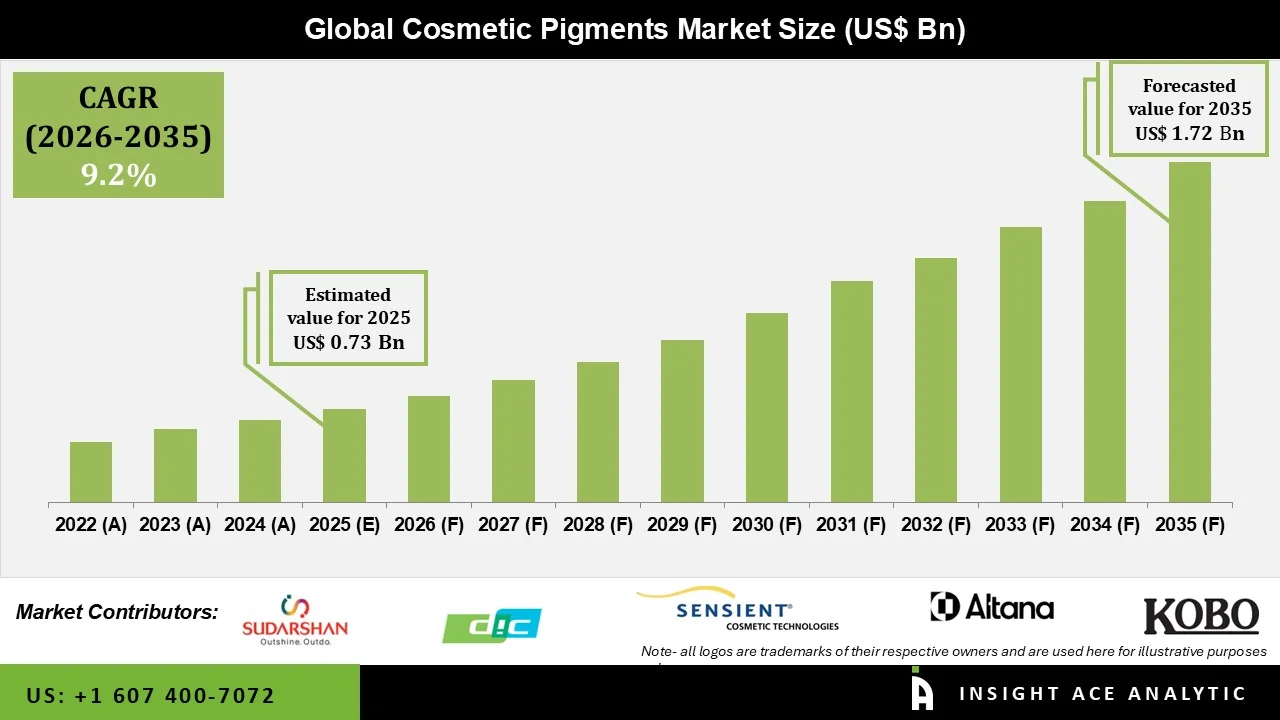
Cosmetic pigments are ingredients that give colour and certain effects in cosmetic and personal care products, helping to produce different shades, opacity, coverage, brightness, a shimmering appearance and other visual properties. Unlike dyes, which are usually soluble in the medium of the product, pigments are generally made up of insoluble particles that stay dispersed within the product. These pigments consist of organic and inorganic substances such as iron oxides, titanium dioxide, mica and various other special pigments and are used in a range of products including facial makeup, eye makeup, lip products, nail products and hair colour products. Progress in pigment technology has also allowed the creation of surface-treated, special-effect and nano pigments in order to enhance colour performance, texture, stability and visual effects.
The market for cosmetic pigments is being pushed forward by the growing use of coloured cosmetics, the rising demand from consumers for a wider variety of shades and better cosmetic effects, and ongoing innovations in the way pigments are formulated. At the same time, demand is affected by greater interest in multi-functional and naturally derived colouring agents, in high-end cosmetic products, and in formulations that provide improved performance and safety features. Manufacturers are now more and more creating pigments that have better dispersion, greater colour intensity, improved light stability, and greater compatibility with various cosmetic formulations, thus helping to get them used in a wide array of beauty and personal care products.
Competitive Landscape
Which are the Leading Players in the Cosmetic Pigments Market?
- Sudarshan Chemical Industries Limited
- DIC Corporation
- Sensient Cosmetic Technologies
- Global New Material International Holdings Limited
- ALTANA
- Kobo Products
- Kuncai Pigments
- LANXESS
- Geotech International
- Neelikon Food Dyes and Chemicals Limited
- Koel Colours Private Limited
- Vibrantzm
Market Dynamics
Driver
Growing Demand for Color Cosmetics
The rising demand for colour cosmetics is a key factor in driving the market for cosmetic pigments since pigments are a necessary component which gives these products their colour, coverage, opacity and visual effects. The fact that consumers are spending more on makeup, the expansion of the range of cosmetic products and the demand for a wider variety of shades and finishes are all leading cosmetic manufacturers to make use of a greater diversity of organic, inorganic and effect pigments. Additionally, the increasing popularity of high-end and innovative makeup products is also raising the demand for pigments that have high colour intensity, better stability, a smooth application and special effects such as shimmer and metallic finishes.
Restrain/Challenge
Stringent Regulatory and Safety Requirements
The strict regulatory and safety rules applicable to cosmetic colorants present a major difficulty for the market in the area of cosmetic pigments. The pigments used in cosmetics have to meet the regulations concerning allowed colorants, purity, heavy-metal content, impurities, and product safety, and the requirements differ in the major markets such as the U.S., Europe, and the Asia-Pacific. As a result, manufacturers must carry out thorough safety evaluations, testing, documentation, and compliance procedures before they can introduce pigments into cosmetic formulations. Such requirements can lead to higher development costs and a longer time it takes to launch products, and if there are restrictions or changes in the permitted use of certain pigments, manufacturers will have to reformulate their products and find alternative colorants.
Organic Pigments Segment is Expected to Drive the Cosmetic Pigments Market
Organic pigments are likely to lead the cosmetic pigments market thanks to their wide variety of bright and intense colours, a feature that makes them appropriate for use in lipsticks, eyeshadows, blushes and other coloured cosmetics. The ability of organic pigments to produce a wide range of shades and finishes matches the increasing demand from consumers for lively and customised makeup products, and further advances in formulation are also broadening their uses. Nevertheless, inorganic pigments such as iron oxides, titanium dioxide and mica will still enjoy strong demand because of their good opacity, stability, coverage and their extensive use in products for the complexion.
IT Operations Segment is Growing at the Highest Rate in the Cosmetic Pigments Market
Because of rising demand for cosmetics that have a shimmering, metallic, pearlescent, and other visually striking finishes, the market for special-effect pigments is expected to show strong growth. Their use is spreading in the areas of eye makeup, lip products, nail products, and in high-end cosmetics, where distinctive visual effects help to increase the attractiveness of the products. The segment's growth is also being supported by increasing consumer interest in innovative and expressive makeup looks and by the development of new effect-pigment technologies.
Why North America Led the Cosmetic Pigments Market?
North America is expected to lead the cosmetic pigments market, driven by its mature cosmetics and personal care industry, high consumer spending on beauty products, and strong demand for color cosmetics such as foundation, eye makeup, lip products, and nail products. The region boasts a well-developed range of cosmetic brands, ingredient manufacturers, and specialist pigment suppliers, which in turn enables ongoing product development and innovation.
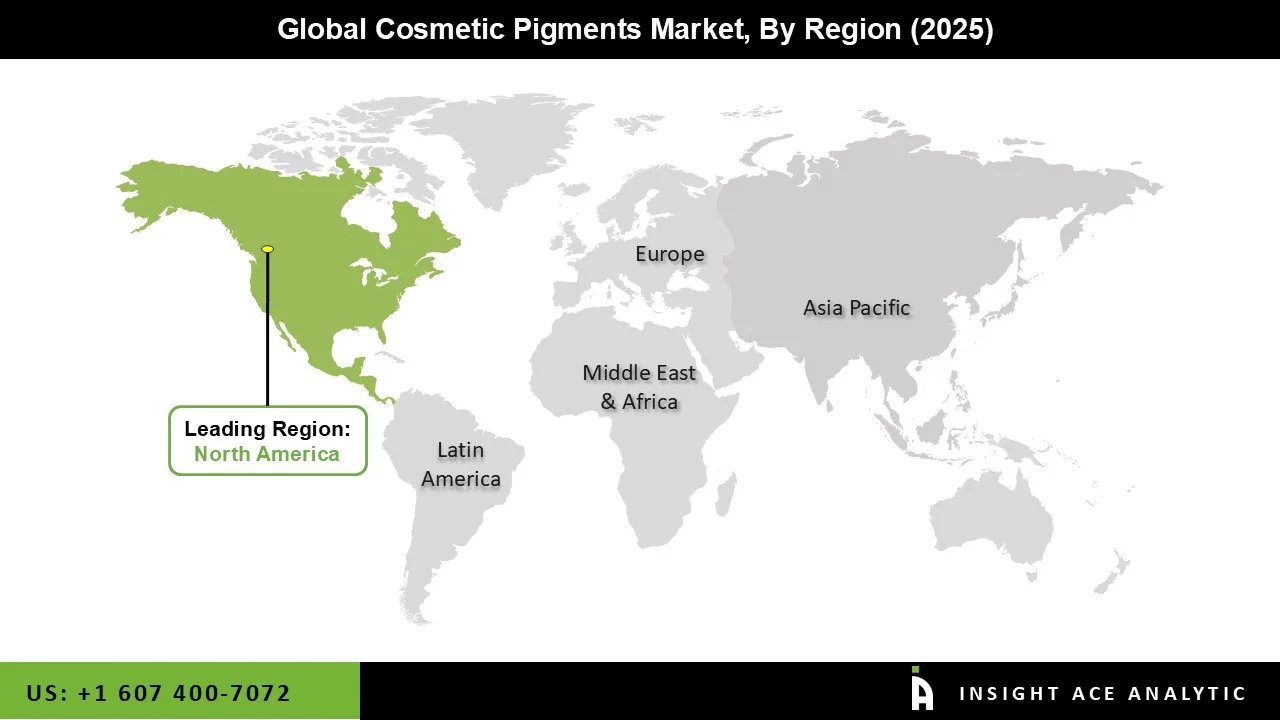
Furthermore, the increasing consumer interest in premium cosmetics, custom shades, long-wearing formulations, and special-effect finishes like metallic and pearlescent effects is boosting the demand for advanced cosmetic pigments. The region's established regulatory system together with its focus on product safety and the quality of ingredients also prompt manufacturers to create high-performance and compliant pigment solutions, thus helping to ensure the continued growth of the market.
Key Development
- March 2025: Sudarshan Chemical Industries completed the acquisition of Germany-based Heubach Group through its wholly owned subsidiary, Sudarshan Europe B.V., expanding its global footprint to 19 sites and strengthening its pigment portfolio and presence across major markets.
Cosmetic Pigments Market Report Scope:
| Report Attribute | Specifications |
| Market size value in 2025 | USD 0.73 Bn |
| Revenue forecast in 2035 | USD 1.72 Bn |
| Growth Rate CAGR | CAGR of 9.2% from 2026 to 2035 |
| Quantitative Units | Representation of revenue in US$ Bn and CAGR from 2026 to 2035 |
| Historic Year | 2022 to 2025 |
| Forecast Year | 2026-2035 |
| Report Coverage | The forecast of revenue, the position of the company, the competitive market structure, growth prospects, and trends |
| Segments Covered | Composition, Type, Application and By Region |
| Regional Scope | North America; Europe; Asia Pacific; Latin America; Middle East & Africa |
| Country Scope | U.S.; Canada; U.K.; Germany; China; India; Japan; Brazil; Mexico; France; Italy; Spain; South Korea; Southeast Asia |
| Competitive Landscape | Sudarshan Chemical Industries Limited, DIC Corporation, Sensient Cosmetic Technologies, Global New Material International Holdings Limited, ALTANA, Kobo Products, Kuncai Pigments, LANXESS, Geotech International, Neelikon Food Dyes and Chemicals Limited, Koel Colours Private Limited, Vibrantz |
| Customization Scope | Free customization report with the procurement of the report, Modifications to the regional and segment scope. Geographic competitive landscape. |
| Pricing and Available Payment Methods | Explore pricing alternatives that are customized to your particular study requirements. |
Segmentationof Cosmetic Pigments Market:
Cosmetic Pigments Market by Composition -
- Organic Pigments
- Lakes
- Toners
- Other Organic Pigments
- Inorganic Pigments
- Titanium Dioxide
- Iron Oxide
- Zinc Oxide
- Mica
- Chromium Dioxide
- Other Inorganic Pigments
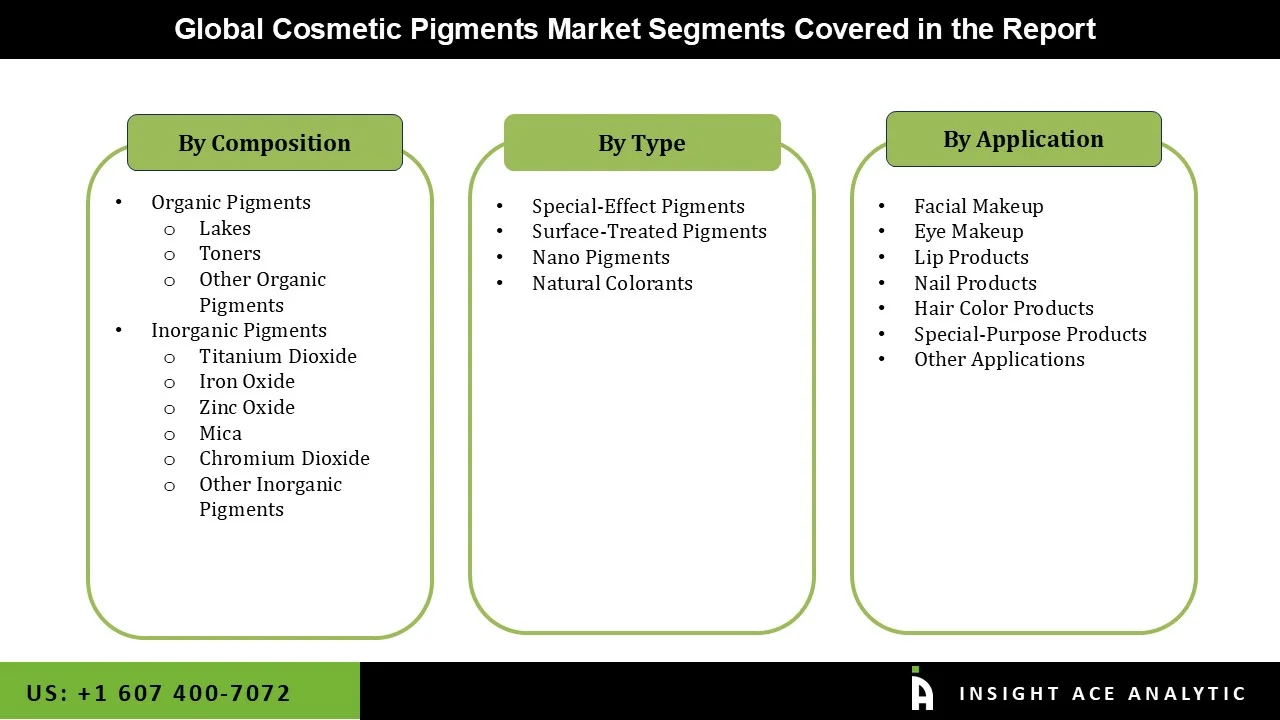
Cosmetic Pigments Market by Type -
- Special-Effect Pigments
- Surface-Treated Pigments
- Nano Pigments
- Natural Colorants
Cosmetic Pigments Market by Application -
- Facial Makeup
- Eye Makeup
- Lip Products
- Nail Products
- Hair Color Products
- Special-Purpose Products
- Other Applications
Cosmetic Pigments Market by Region-
- North America-
- The US
- Canada
- Europe-
- Germany
- The UK
- France
- Italy
- Spain
- Rest of Europe
- Asia-Pacific-
- China
- Japan
- India
- South Korea
- South East Asia
- Rest of Asia Pacific
- Latin America-
- Brazil
- Argentina
- Mexico
- Rest of Latin America
- Middle East and Africa-
- GCC Countries
- South Africa
- Rest of Middle East and Africa
Research Design and Approach
This study employed a multi-step, mixed-method research approach that integrates:
- Secondary research
- Primary research
- Data triangulation
- Hybrid top-down and bottom-up modelling
- Forecasting and scenario analysis
This approach ensures a balanced and validated understanding of both macro- and micro-level market factors influencing the market.
Secondary Research
Secondary research for this study involved the collection, review, and analysis of publicly available and paid data sources to build the initial fact base, understand historical market behaviour, identify data gaps, and refine the hypotheses for primary research.
Sources Consulted
Secondary data for the market study was gathered from multiple credible sources, including:
- Government databases, regulatory bodies, and public institutions
- International organizations (WHO, OECD, IMF, World Bank, etc.)
- Commercial and paid databases
- Industry associations, trade publications, and technical journals
- Company annual reports, investor presentations, press releases, and SEC filings
- Academic research papers, patents, and scientific literature
- Previous market research publications and syndicated reports
These sources were used to compile historical data, market volumes/prices, industry trends, technological developments, and competitive insights.

Primary Research
Primary research was conducted to validate secondary data, understand real-time market dynamics, capture price points and adoption trends, and verify the assumptions used in the market modelling.
Stakeholders Interviewed
Primary interviews for this study involved:
- Manufacturers and suppliers in the market value chain
- Distributors, channel partners, and integrators
- End-users / customers (e.g., hospitals, labs, enterprises, consumers, etc., depending on the market)
- Industry experts, technology specialists, consultants, and regulatory professionals
- Senior executives (CEOs, CTOs, VPs, Directors) and product managers
Interview Process
Interviews were conducted via:
- Structured and semi-structured questionnaires
- Telephonic and video interactions
- Email correspondences
- Expert consultation sessions
Primary insights were incorporated into demand modelling, pricing analysis, technology evaluation, and market share estimation.
Data Processing, Normalization, and Validation
All collected data were processed and normalized to ensure consistency and comparability across regions and time frames.
The data validation process included:
- Standardization of units (currency conversions, volume units, inflation adjustments)
- Cross-verification of data points across multiple secondary sources
- Normalization of inconsistent datasets
- Identification and resolution of data gaps
- Outlier detection and removal through algorithmic and manual checks
- Plausibility and coherence checks across segments and geographies
This ensured that the dataset used for modelling was clean, robust, and reliable.
Market Size Estimation and Data Triangulation
Bottom-Up Approach
The bottom-up approach involved aggregating segment-level data, such as:
- Company revenues
- Product-level sales
- Installed base/usage volumes
- Adoption and penetration rates
- Pricing analysis
This method was primarily used when detailed micro-level market data were available.

Top-Down Approach
The top-down approach used macro-level indicators:
- Parent market benchmarks
- Global/regional industry trends
- Economic indicators (GDP, demographics, spending patterns)
- Penetration and usage ratios
This approach was used for segments where granular data were limited or inconsistent.
Hybrid Triangulation Approach
To ensure accuracy, a triangulated hybrid model was used. This included:
- Reconciling top-down and bottom-up estimates
- Cross-checking revenues, volumes, and pricing assumptions
- Incorporating expert insights to validate segment splits and adoption rates
This multi-angle validation yielded the final market size.
Forecasting Framework and Scenario Modelling
Market forecasts were developed using a combination of time-series modelling, adoption curve analysis, and driver-based forecasting tools.
Forecasting Methods
- Time-series modelling
- S-curve and diffusion models (for emerging technologies)
- Driver-based forecasting (GDP, disposable income, adoption rates, regulatory changes)
- Price elasticity models
- Market maturity and lifecycle-based projections
Scenario Analysis
Given inherent uncertainties, three scenarios were constructed:
- Base-Case Scenario: Expected trajectory under current conditions
- Optimistic Scenario: High adoption, favourable regulation, strong economic tailwinds
- Conservative Scenario: Slow adoption, regulatory delays, economic constraints
Sensitivity testing was conducted on key variables, including pricing, demand elasticity, and regional adoption.
Request Customization
Add countries, segments, company profiles, or extend forecast — free 10% customization with purchase.
Customize This Report →Enquire Before Buying
Speak with our analyst team about scope, methodology, pricing, or deliverable formats.
Enquire Now →Frequently Asked Questions
Cosmetic Pigments Market Size is valued at USD 0.73 Bn in 2025 and is predicted to reach USD 1.72 Bn by the year 2035
The Cosmetic Pigments Market is expected to grow at a 9.2% CAGR during the forecast period for 2026 to 2035
udarshan Chemical Industries Limited, DIC Corporation, Sensient Cosmetic Technologies, Global New Material International Holdings Limited, ALTANA, Kobo Products, Kuncai Pigments, LANXESS, Geotech International, Neelikon Food Dyes and Chemicals Limited, Koel Colours Private Limited, Vibrantz
Cosmetic Pigments Market is segmented into Composition, Type, Application and Other.
North America region is leading the Cosmetic Pigments Market.