Bone Cement Delivery System Market Key Players Analysis 2026 to 2035
Global Bone Cement Delivery System Market Size is valued at USD 382.8 Mn in 2025 and is predicted to reach USD 838.8 Mn by the year 2035 at a 8.5% CAGR during the forecast period for 2026 to 2035.
Bone Cement Delivery System Market Size, Share & Trends Analysis Distribution By Surgical Procedure (Hip Arthroplasty, Knee Arthroplasty, Vertebroplasty, and Kyphoplasty), By End-user (Hospitals, Ambulatory Surgery Centers, and Specialty Clinics), and Segment Forecasts, 2026 to 2035
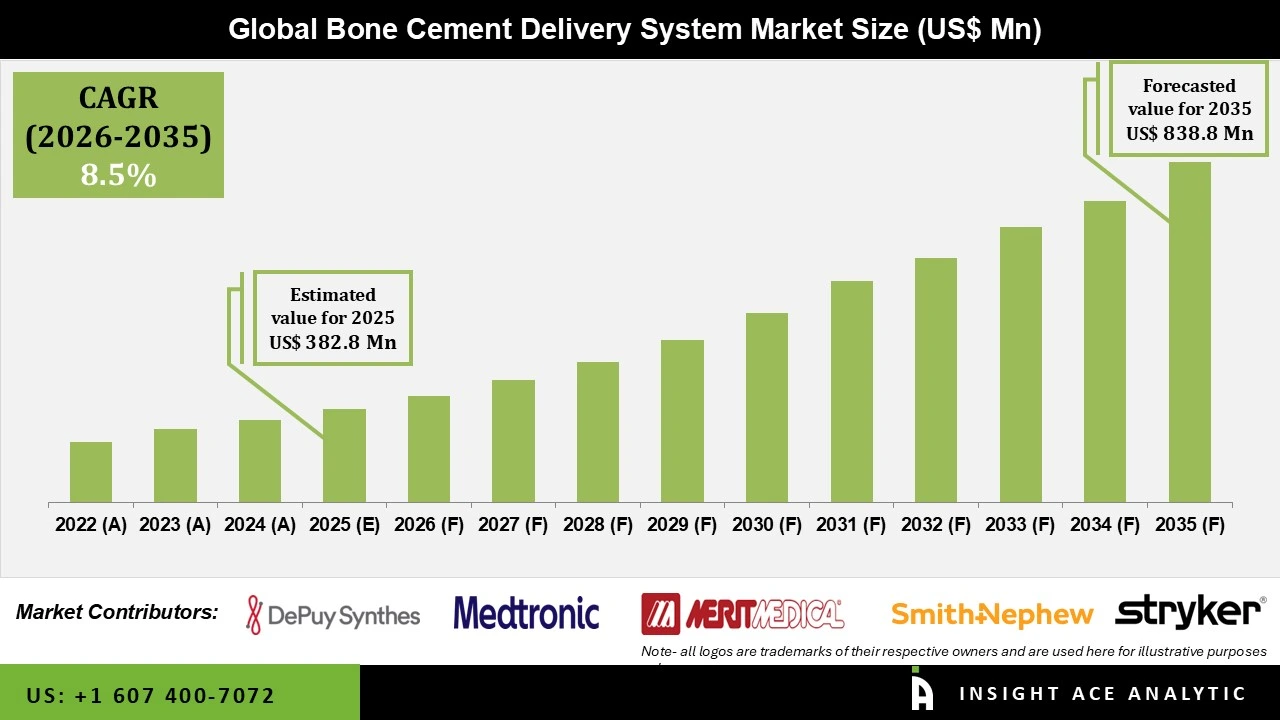
The bone cement delivery systems market is essential to the medical device industry, offering vital solutions for various orthopedic and surgical applications. These systems are crucial for the delivery of bone cement, which is mostly utilized in orthopedic procedures to manage fractures and fix implants. In orthopedic surgeries, especially hip and knee joint replacements, where accurate bone cement distribution is necessary to guarantee the stability and longevity of implants, bone cement delivery devices are crucial. In order to assist patients in restoring mobility following joint degradation brought on by conditions like osteoarthritis and osteoporosis, these devices are essential for securing prosthetic joints to the bone. The bone cement delivery system market is becoming more and more important as the need for orthopedic surgeries is growing due to an aging population and an increase in osteoporosis and fractures.
The bone cement delivery system market is mostly driven by the growing expenditure on healthcare worldwide. To enhance patient care and outcomes, governments and commercial healthcare organizations are investing more in cutting-edge medical device technology. The adoption of sophisticated bone cement delivery systems in hospitals and surgical facilities is quickening due to rising costs. Additionally, more people can employ the cutting-edge technologies due to better healthcare financing and infrastructure, which is propelling the bone cement delivery system market growth. Patients can more easily afford the complex procedures because of favorable reimbursement policies in many nations, which speeds up market expansion. Moreover, the bone cement delivery system market is expected to develop as the need for minimally invasive surgery increases. These operations are growing in popularity because they have fewer adverse effects, shorter recovery times, and fewer hospital stays. Since minimally invasive orthopaedic procedures depend on bone cement delivery devices, the bone cement delivery system industry is expanding.
The bone cement delivery system market is significantly impacted by the rise of sports-related injuries brought on by increased participation in physical activities and sports. Fractures, ligament injuries, and other orthopedic issues that often require surgery are common among athletes and physically active individuals. Since serious injuries require prompt and efficient treatment in order to recover quickly and resume activities, the need for precise and effective bone cement delivery systems is growing. The bone cement delivery system market is expanding as a result of products made specifically to satisfy the needs of sports medicine. However, obstacles like the high cost of sophisticated equipment and legal restrictions may prevent the bone cement delivery system market from developing. Potential obstacles include the necessity for thorough clinical evaluations and increased competition from alternative fixation techniques.
Competitive Landscape
Which are the Leading Players in Bone Cement Delivery System Market?
- DePuy Synthes
- Medtronic
- Merit Medical Systems
- Smith & Nephew
- Stryker
- Zimmer Biomet
- Biopsybell
- IMEDICOM
- IZI Medical Products
- Spirit Spine
- Synimed
Market Dynamics
Driver
Increasing Number of Sports Injuries, Trauma Cases and Chronic Illnesses
The increasing number of sports injuries and trauma cases requiring surgical intervention is driving the bone cement delivery system market's growth trajectory. The prevalence of injuries requiring orthopedic and trauma operations has increased in tandem with the popularity of sports among various age groups. The need for effective and dependable bone cement delivery devices is being driven by the increase in surgical operations. Furthermore, by improving the efficacy and safety of surgical procedures, ongoing advancements in medical technology—particularly in the creation of biodegradable and biocompatible bone cements—are expected to open up new market growth prospects. Moreover, the rising prevalence of chronic illnesses that cause bone fractures, especially in urban populations with sedentary lifestyles, is another factor driving the bone cement delivery system market expansion. The demand for sophisticated delivery methods is expected to be driven by the necessity of surgical repair and the ensuing need for bone cement.
Restrain/Challenge
Stringent Regulations for Bone Cement Delivery System
One of the main obstacles in the bone cement delivery system market is the stringent restrictions. To ensure safety and effectiveness, obtaining approval from regulatory bodies like the FDA and EMA requires extensive study and clinical trials. The process could be costly and time-consuming, potentially postponing product launches and increasing development expenses. For businesses looking to expand overseas, regulatory changes and regional differences in requirements can make the permitting process more difficult. The obstacles may hinder the bone cement delivery system industry expansion and discourage smaller companies from growing or joining the industry. Additionally, problems like cement leakage and thermal necrosis that result from bone cement operations can impede the bone cement delivery system market expansion. The effectiveness and safety of bone cement materials are also closely examined since orthopedic surgeons may be discouraged from utilizing specific products due to possible negative patient reactions.
Knee Arthroplasty Segment is Expected to Drive the Bone Cement Delivery System Market
The Knee Arthroplasty segment held the largest share in the bone cement delivery system market in 2025 because age-related joint deterioration and knee osteoarthritis are becoming more common worldwide. Globally, the frequency of complete and partial knee replacement procedures has dramatically increased due to an aging population, rising obesity rates, and sedentary lifestyles. In order to achieve robust implant attachment and long-term prosthesis stability, bone cement delivery systems are crucial to knee arthroplasty because they guarantee consistent, precise, and controlled cement administration. Vacuum mixing, pressured cement distribution, and reduced porosity systems are examples of technological innovations that have further enhanced surgical results, limited cement leakage, and decreased the risk of problems. As a result, surgeons are choosing more modern delivery methods.
Hospitals Segment is Growing at the Highest Rate in the Bone Cement Delivery System Market
In 2025, the hospitals segment dominated the bone cement delivery system market. The need for bone-cement delivery systems in this market is driven by the increased number of orthopedic, trauma, and spinal procedures carried out in hospital settings, as well as the accessibility of cutting-edge surgical infrastructure. Additionally, the access to highly qualified surgeons and interdisciplinary teams also helps hospitals employ sophisticated and cutting-edge cement delivery technology. The integration of cutting-edge bone-cement delivery technologies continues to be a primary focus as hospitals work to improve surgical results and operational efficiency.
Why North America Led the Bone Cement Delivery System Market?
The bone cement delivery system market was dominated by North America region in 2025. The region's expansion is fueled by a sizable number of orthopedic procedures carried out each year, strong adoption rates of cutting-edge technology, and sophisticated healthcare infrastructure. Due to its strong healthcare system and growing elderly population, the United States in particular dominates the industry.
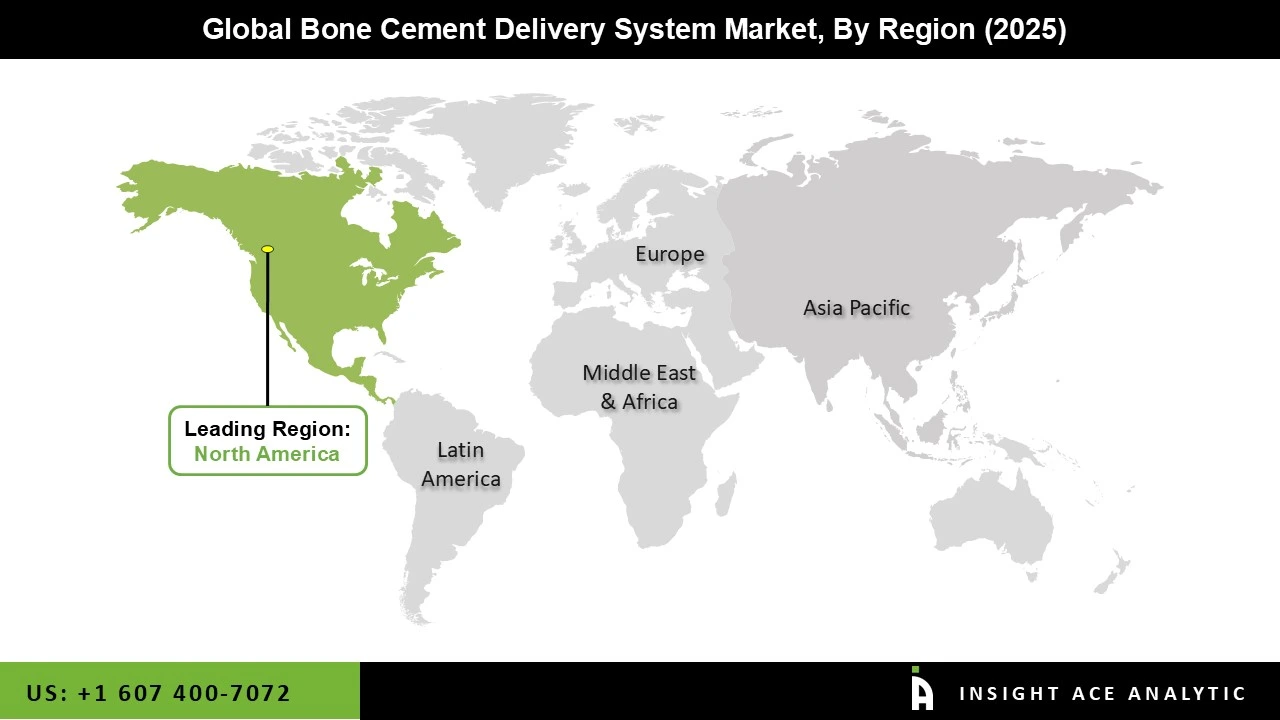
Additionally, the government programs that encourage joint replacement surgeries, including those run by the Centers for Medicare & Medicaid Services (CMS), also contribute to the expansion of the industry. The region is well-positioned for future growth due to its emphasis on research and development and high healthcare spending. Furthermore, the market is mostly driven by the growing number of older people in North America. The aging population is more likely to have conditions like osteoarthritis and osteoporosis, which increases the demand for joint replacement procedures.
Key Development
- June 2025: A new series of bioactive bone cements from B. Braun Melsungen AG lowers the risk of infection during orthopedic procedures and encourages bone regeneration. In the market for bone cement delivery systems, B. Braun's dedication to innovation and patient safety is demonstrated by this product launch.
- April 2024: Through its DePuy Synthes division, Johnson & Johnson purchased Tecres S.p.A., an Italian bone cement manufacturer. DePuy Synthes will be able to strengthen its bone cement and increase its market share in Europe thanks to the acquisition. When it comes to cutting-edge bone cement compositions for trauma and joint replacement treatments, Tecres is a well-known leader.
- August 2023: Medtronic declared that it will increase the amount of bone cement delivery devices it produces in India. The Asia-Pacific region's increasing need for orthopedic operations was the driving force for this choice. In addition to satisfying local market demands, the expansion seeks to establish Medtronic as a significant participant in developing Southeast Asian markets. This initiative's significance indicates a focus on local manufacturing and lowering supply chain vulnerabilities.
Bone Cement Delivery System Market Report Scope :
| Report Attribute | Specifications |
| Market size value in 2025 | USD 382.8 Mn |
| Revenue forecast in 2035 | USD 838.8 Mn |
| Growth Rate CAGR | CAGR of 8.5% from 2026 to 2035 |
| Quantitative Units | Representation of revenue in US$ Bn and CAGR from 2026 to 2035 |
| Historic Year | 2022 to 2025 |
| Forecast Year | 2026-2035 |
| Report Coverage | The forecast of revenue, the position of the company, the competitive market structure, growth prospects, and trends |
| Segments Covered | By Surgical Procedure, By Age Group, By Treatment Duration, By End-user, By Distribution Channel, and By Region |
| Regional Scope | North America; Europe; Asia Pacific; Latin America; Middle East & Africa |
| Country Scope | U.S.; Canada; U.K.; Germany; China; India; Japan; Brazil; Mexico; The UK; France; Italy; Spain; China; Japan; India; South Korea; Southeast Asia; South Korea; Southeast Asia |
| Competitive Landscape | DePuy Synthes, Medtronic, Merit Medical Systems, Smith & Nephew, Stryker, Zimmer Biomet, Biopsybell, IMEDICOM, IZI Medical Products, Spirit Spine, and Synimed. |
| Customization Scope | Free customization report with the procurement of the report, Modifications to the regional and segment scope. Geographic competitive landscape. |
| Pricing and Available Payment Methods | Explore pricing alternatives that are customized to your particular study requirements. |
Segmentation of Bone Cement Delivery System Market:
Bone Cement Delivery System Market by Surgical Procedure
- Hip Arthroplasty
- Knee Arthroplasty
- Vertebroplasty
- Kyphoplasty

Bone Cement Delivery System Market by End-user
- Hospitals
- Ambulatory Surgery Centers
- Specialty Clinics
Bone Cement Delivery System Market-By Region
- North America-
- The US
- Canada
- Europe-
- Germany
- The UK
- France
- Italy
- Spain
- Rest of Europe
- Asia-Pacific-
- China
- Japan
- India
- South Korea
- South East Asia
- Rest of Asia Pacific
- Latin America-
- Brazil
- Argentina
- Mexico
- Rest of Latin America
- Middle East & Africa-
- GCC Countries
- South Africa
- Rest of Middle East and Africa
Research Design and Approach
This study employed a multi-step, mixed-method research approach that integrates:
- Secondary research
- Primary research
- Data triangulation
- Hybrid top-down and bottom-up modelling
- Forecasting and scenario analysis
This approach ensures a balanced and validated understanding of both macro- and micro-level market factors influencing the market.
Secondary Research
Secondary research for this study involved the collection, review, and analysis of publicly available and paid data sources to build the initial fact base, understand historical market behaviour, identify data gaps, and refine the hypotheses for primary research.
Sources Consulted
Secondary data for the market study was gathered from multiple credible sources, including:
- Government databases, regulatory bodies, and public institutions
- International organizations (WHO, OECD, IMF, World Bank, etc.)
- Commercial and paid databases
- Industry associations, trade publications, and technical journals
- Company annual reports, investor presentations, press releases, and SEC filings
- Academic research papers, patents, and scientific literature
- Previous market research publications and syndicated reports
These sources were used to compile historical data, market volumes/prices, industry trends, technological developments, and competitive insights.

Primary Research
Primary research was conducted to validate secondary data, understand real-time market dynamics, capture price points and adoption trends, and verify the assumptions used in the market modelling.
Stakeholders Interviewed
Primary interviews for this study involved:
- Manufacturers and suppliers in the market value chain
- Distributors, channel partners, and integrators
- End-users / customers (e.g., hospitals, labs, enterprises, consumers, etc., depending on the market)
- Industry experts, technology specialists, consultants, and regulatory professionals
- Senior executives (CEOs, CTOs, VPs, Directors) and product managers
Interview Process
Interviews were conducted via:
- Structured and semi-structured questionnaires
- Telephonic and video interactions
- Email correspondences
- Expert consultation sessions
Primary insights were incorporated into demand modelling, pricing analysis, technology evaluation, and market share estimation.
Data Processing, Normalization, and Validation
All collected data were processed and normalized to ensure consistency and comparability across regions and time frames.
The data validation process included:
- Standardization of units (currency conversions, volume units, inflation adjustments)
- Cross-verification of data points across multiple secondary sources
- Normalization of inconsistent datasets
- Identification and resolution of data gaps
- Outlier detection and removal through algorithmic and manual checks
- Plausibility and coherence checks across segments and geographies
This ensured that the dataset used for modelling was clean, robust, and reliable.
Market Size Estimation and Data Triangulation
Bottom-Up Approach
The bottom-up approach involved aggregating segment-level data, such as:
- Company revenues
- Product-level sales
- Installed base/usage volumes
- Adoption and penetration rates
- Pricing analysis
This method was primarily used when detailed micro-level market data were available.

Top-Down Approach
The top-down approach used macro-level indicators:
- Parent market benchmarks
- Global/regional industry trends
- Economic indicators (GDP, demographics, spending patterns)
- Penetration and usage ratios
This approach was used for segments where granular data were limited or inconsistent.
Hybrid Triangulation Approach
To ensure accuracy, a triangulated hybrid model was used. This included:
- Reconciling top-down and bottom-up estimates
- Cross-checking revenues, volumes, and pricing assumptions
- Incorporating expert insights to validate segment splits and adoption rates
This multi-angle validation yielded the final market size.
Forecasting Framework and Scenario Modelling
Market forecasts were developed using a combination of time-series modelling, adoption curve analysis, and driver-based forecasting tools.
Forecasting Methods
- Time-series modelling
- S-curve and diffusion models (for emerging technologies)
- Driver-based forecasting (GDP, disposable income, adoption rates, regulatory changes)
- Price elasticity models
- Market maturity and lifecycle-based projections
Scenario Analysis
Given inherent uncertainties, three scenarios were constructed:
- Base-Case Scenario: Expected trajectory under current conditions
- Optimistic Scenario: High adoption, favourable regulation, strong economic tailwinds
- Conservative Scenario: Slow adoption, regulatory delays, economic constraints
Sensitivity testing was conducted on key variables, including pricing, demand elasticity, and regional adoption.
Request Customization
Add countries, segments, company profiles, or extend forecast — free 10% customization with purchase.
Customize This Report →Enquire Before Buying
Speak with our analyst team about scope, methodology, pricing, or deliverable formats.
Enquire Now →Frequently Asked Questions
Bone Cement Delivery System Market Size is valued at USD 382.8 Mn in 2025 and is predicted to reach USD 838.8 Mn by the year 2035
Bone Cement Delivery System Market is expected to grow at a 8.5% CAGR during the forecast period for 2026 to 2035.
DePuy Synthes, Medtronic, Merit Medical Systems, Smith & Nephew, Stryker, Zimmer Biomet, Biopsybell, IMEDICOM, IZI Medical Products, Spirit Spine, and Synimed.
Surgical Procedure, Age Group, Treatment Duration, End-user and Distribution Channel are the key segments of the Bone Cement Delivery System Market.
North America region is leading the Bone Cement Delivery System Market.