Chromoendoscopy Agents Market Size, Share, Trend, Scope Report 2026 to 2035
What is Chromoendoscopy Agents Market Size?
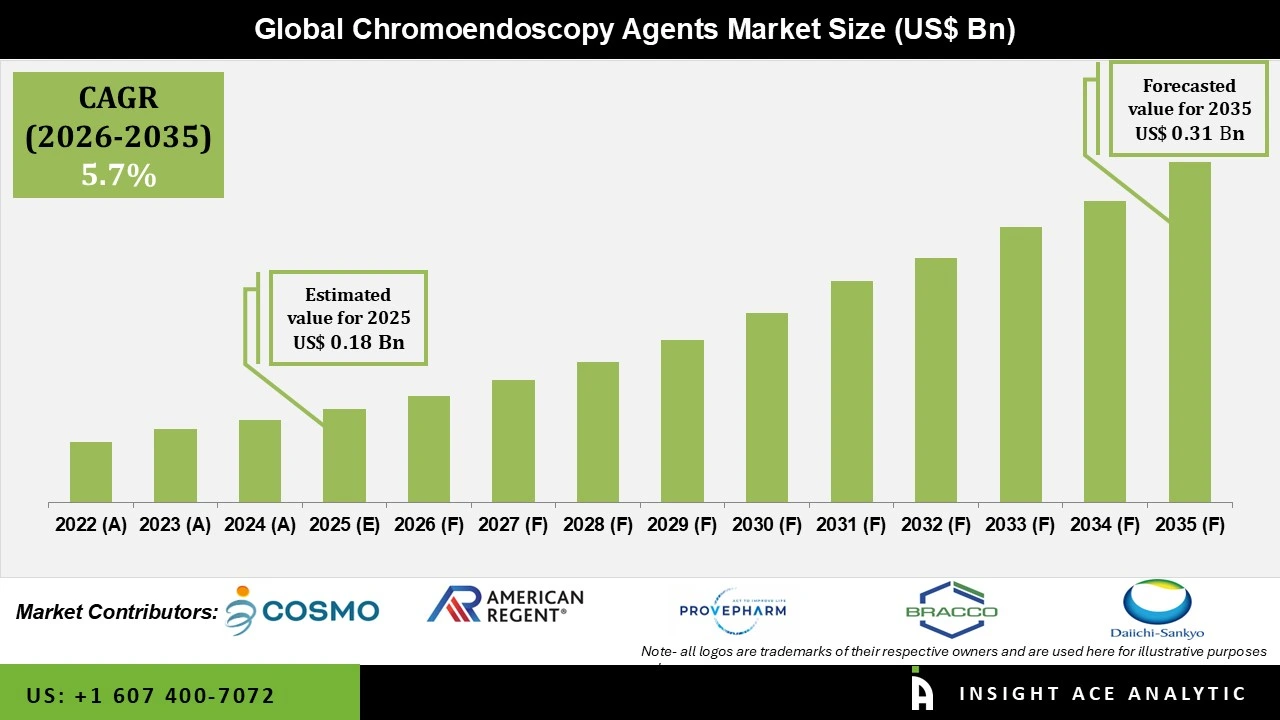
Chromoendoscopy Agents Market Size is valued at USD 0.18 Bn in 2025 and is predicted to reach USD 0.31 Bn by the year 2035 at a 5.7% CAGR during the forecast period for 2026 to 2035.
Chromoendoscopy Agents Market Size, Share & Trends Analysis Distribution by Type (Absorptive Agents, Reactive Agents, and Contrast Agents), Application (Colonoscopy, Barrett's Esophagus Surveillance, Gastroscopy, Inflammatory Bowel Disease Surveillance, Esophagogastroduodenoscopy (EGD), and Others), End-user (Hospitals, Ambulatory Surgery Centers (ASCs), and Specialty Gastroenterology Clinics), and Segment Forecasts, 2026 to 2035
Chromoendoscopy agents are specific dyes or contrast materials that are used during endoscopic procedures to improve the gastrointestinal tract's mucosal surface visibility. In order to enhance the identification, description, and delineation of anomalies like early malignancies, dysplasia, inflammation, or precancerous lesions, these chemicals are directly applied to tissues during procedures like colonoscopy or gastroscopy. Chromoendoscopy is essential for early diagnosis and targeted biopsy, which improves the accuracy of managing gastrointestinal diseases by boosting contrast and identifying subtle mucosal alterations that may not be seen during regular white-light endoscopy. The chromoendoscopy agents market is expanding rapidly because of advances in technology, the rise in gastrointestinal illnesses, and the growing use of minimally invasive diagnostic techniques.
The chromoendoscopy agents market is seeing notable developments, mostly due to improvements in imaging technologies and growing awareness of early cancer detection. Novel chromoendoscopy agents, such as methylene blue and indigo carmine, are becoming more popular because of their improved viewing capabilities, which support focused therapies and precise diagnosis. Additionally, there is an increasing need for these drugs due to the aging population and the rise in gastrointestinal illnesses. Furthermore, the chromoendoscopy agents market is anticipated to increase due to the increasing use of chromoendoscopy, the growing focus on minimally invasive diagnostic techniques, and technological developments in chromoendoscopy technology.
Moreover, the increased usage of high-definition colonoscopies, the rise in IBD surveillance, and the growing regulatory support for oral-tablet dye formulations are driving the chromoendoscopy agents market's expansion. The value case for the market for chromoendoscopy agents is being strengthened by hospitals and ambulatory surgery centers implementing targeted biopsy methods to reduce histopathology expenses without sacrificing diagnostic accuracy. However, the regulatory obstacles and the requirement for lengthy clinical trials provide serious constraints that could postpone the release of new products. Companies should employ agile development processes and strong compliance frameworks to overcome these obstacles. Organizations can accelerate approval processes, for example, by actively interacting with regulatory agencies during the development phase.
Competitive Landscape
Which are the Leading Players in Chromoendoscopy Agents Market?
• Medtronic plc
• Eastman Chemical Company
• BD
• Cosmo Pharmaceuticals N.V.
• Dalichi Sankyo Co., Ltd.
• Vanshi Chemicals
• FUJIFILM Wako Pure Chemical
• C2 Pharma
• American Regent Inc.
• Provepharm Life Solutions
• Thermo Fisher Scientific
• TruBlue Beacon Gi Marker (Gl Supply)
• Otsuka Pharmaceutical Co.
• Merck KGaA
• Boston Scientific Corp.
• Macsen Laboratories
• Bracco Diagnostics Inc.
• Olympus Corp.
• Others
Market Dynamics
Driver
Growing Interest in Early Disease Detection
One of the main factors driving the chromoendoscopy agents market is the growing emphasis on early disease detection and diagnosis. The need for advanced diagnostic methods has grown as healthcare systems around the world shift their emphasis to preventive medicine. Early detection of gastrointestinal disorders, particularly colorectal cancer, depends on chromoendoscopy, which enhances the visibility of mucosal lesions during endoscopic procedures. Additionally, the chromoendoscopy agents are becoming widely used in clinical settings as medical practitioners quickly realize their potential to increase diagnostic output. Furthermore, the growing patient and healthcare provider understanding of the advantages of early intervention in improving patient outcomes supports this tendency. Consequently, it is anticipated that the market for chromoendoscopy agents would grow significantly in the next few years.
Restrain/Challenge
Restricted Agent Availability
The chromoendoscopy agents market's expansion will be constrained by the agents' limited availability. This limitation is caused by a number of factors, including production limitations, supply chain disruptions, and regulatory problems. These agents are specialized contrast agents used to enhance visualization during endoscopic procedures and may become unavailable or scarce as a result of manufacturing delays, regulatory obstacles, or variations in the availability of raw materials. Moreover, the lengthy and intricate process of developing and licensing new chromoendoscopy agents might exacerbate supply shortages. By delaying or restricting access to chromoendoscopy procedures, agent scarcity can affect patient therapy by making precise lesion detection and characterization challenging. Furthermore, in the absence of appropriate chromoendoscopy agents, medical professionals can find it challenging to schedule procedures or might have to think about other diagnostic methods.
Contrast Agents Segment is Expected to Drive the Chromoendoscopy Agents Market
The contrast agents category held the largest share in the chromoendoscopy agents market in 2025. In chromoendoscopic procedures, contrast stains are one of the most commonly utilized dyes. They improve the visibility of gastrointestinal system irregularities and make it simple to identify inflammation, malignant cells, and polyps. Additionally, the contrast dyes are easier to apply than other dye types; they just need to be applied topically using a spraying apparatus. When applied to the mucosal surface, contrast stains offer selective staining, highlighting the target areas and making it simple for the technician to distinguish between normal and diseased tissues. Indigo carmine is the most popular contrast stain because of its many essential uses.
Colonoscopy Segment is Growing at the Highest Rate in the Chromoendoscopy Agents Market
In 2025, the colonoscopy category dominated the chromoendoscopy agents market due to the increased emphasis on early identification of colorectal cancer and preventative healthcare. Colonoscopy is actually the most important screening method. It is essential for the diagnosis and treatment of several gastrointestinal problems because it gives medical experts a direct view of the colon's inner lining. By adding certain chemicals that improve the visibility of specific mucosal patterns, chromoendoscopy alters colonoscopy procedures. Additionally, the enhanced sensitivity is crucial for the early identification of malignant growths and dysplastic tissues, which will enable prompt therapies and greatly improve patient outcomes.
Why North America Led the Chromoendoscopy Agents Market?
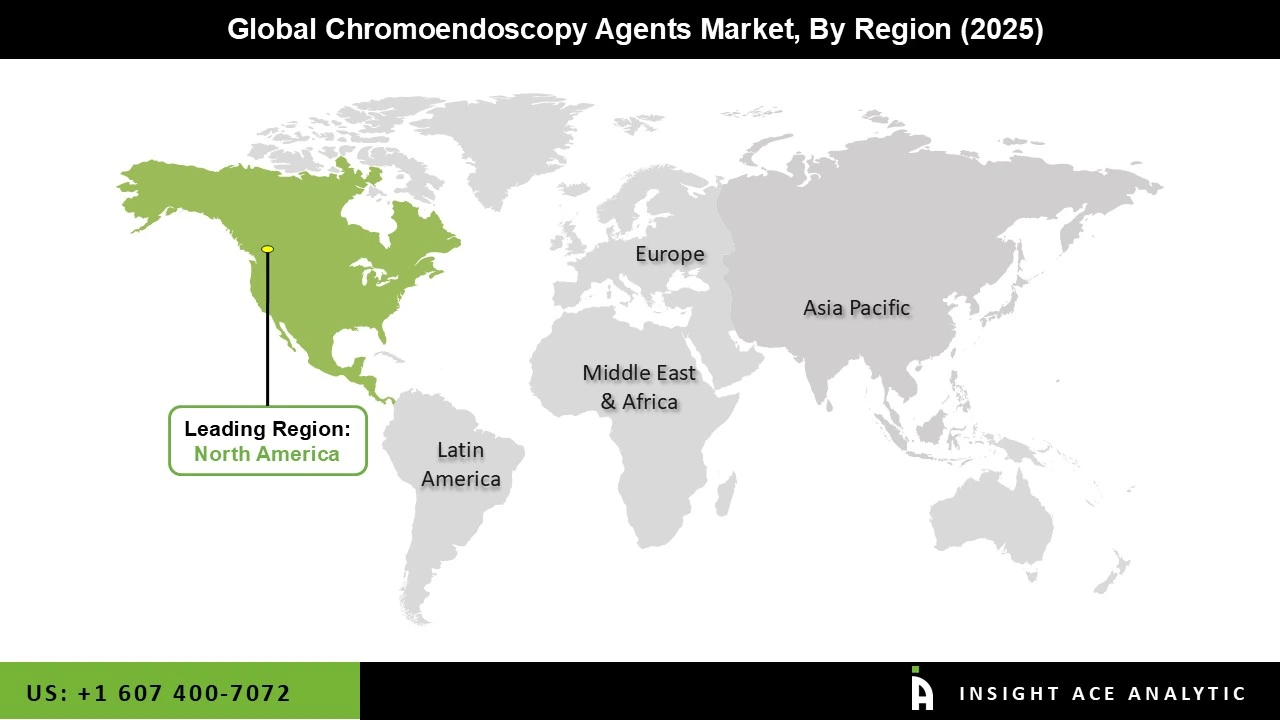
The chromoendoscopy agents market was dominated by North America region in 2025 due to rising cancer awareness, a sizable patient base, the existence of significant medical device manufacturers, and an increase in the elderly population. A number of other factors, such as the growing need for better diagnostic tools, favorable health reimbursement schemes, and an increase in endoscopic procedures, are also contributing to the expansion. Additionally, the employment of chromoendoscopy agents for better diagnosis accuracy is motivated by the region's developed healthcare infrastructure and high level of knowledge regarding gastrointestinal disorders. Because of its sophisticated healthcare system and an increase in gastrointestinal illnesses, the United States leads the North American chromoendoscopy agents market, and its market value is predicted to develop steadily.
Chromoendoscopy Agents Market Report Scope:
| Report Attribute | Specifications |
| Market size value in 2025 | USD 0.18 Bn |
| Revenue forecast in 2035 | USD 0.31 Bn |
| Growth Rate CAGR | CAGR of 5.7% from 2026 to 2035 |
| Quantitative Units | Representation of revenue in US$ Bn and CAGR from 2026 to 2035 |
| Historic Year | 2022 to 2025 |
| Forecast Year | 2026-2035 |
| Report Coverage | The forecast of revenue, the position of the company, the competitive market structure, growth prospects, and trends |
| Segments Covered | Type, Application, End-user, and By Region |
| Regional Scope | North America; Europe; Asia Pacific; Latin America; Middle East & Africa |
| Country Scope | U.S.; Canada; U.K.; Germany; China; India; Japan; Brazil; Mexico; The UK; France; Italy; Spain; China; Japan; India; South Korea; Southeast Asia; South Korea; Southeast Asia |
| Competitive Landscape | Medtronic plc, Eastman Chemical Company, BD, Cosmo Pharmaceuticals N.V., Dalichi Sankyo Co., Ltd., Vanshi Chemicals, FUJIFILM Wako Pure Chemical, C2 Pharma, American Regent Inc., Provepharm Life Solutions, Thermo Fisher Scientific, TruBlue Beacon Gi Marker (Gl Supply), Otsuka Pharmaceutical Co., Merck KGaA, Boston Scientific Corp., Macsen Laboratories, Bracco Diagnostics Inc., Olympus Corp., and Others |
| Customization Scope | Free customization report with the procurement of the report, Modifications to the regional and segment scope. Geographic competitive landscape. |
| Pricing and Available Payment Methods | Explore pricing alternatives that are customized to your particular study requirements. |
Market Segmentation:
Chromoendoscopy Agents Market by Type-
• Absorptive Agents
• Reactive Agents
• Contrast Agents
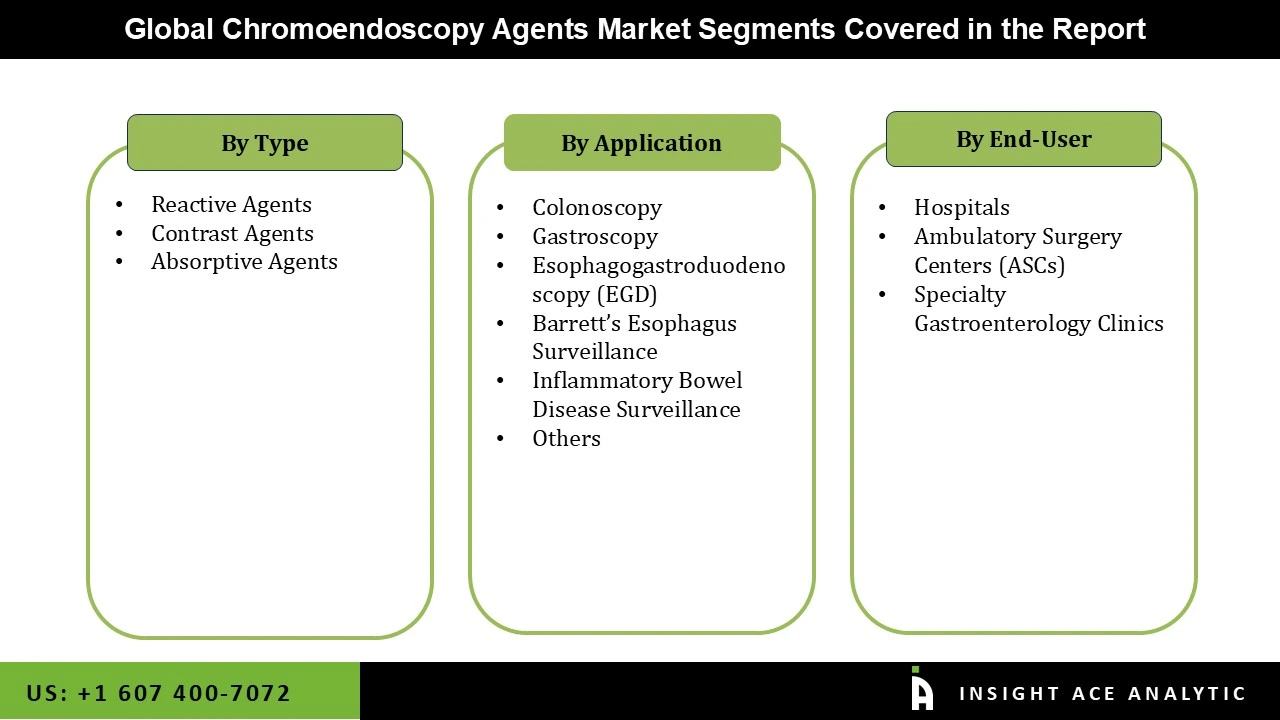
Chromoendoscopy Agents Market by Application-
• Colonoscopy
• Barrett's Esophagus Surveillance
• Gastroscopy
• Inflammatory Bowel Disease Surveillance
• Esophagogastroduodenoscopy (EGD)
• Others
Chromoendoscopy Agents Market by End-user-
• Hospitals
• Ambulatory Surgery Centers (ASCs)
• Specialty Gastroenterology Clinics
Chromoendoscopy Agents Market By Region-
North America-
• The US
• Canada
Europe-
• Germany
• The UK
• France
• Italy
• Spain
• Rest of Europe
Asia-Pacific-
• China
• Japan
• India
• South Korea
• South East Asia
• Rest of Asia Pacific
Latin America-
• Brazil
• Argentina
• Mexico
• Rest of Latin America
Middle East & Africa-
• GCC Countries
• South Africa
• Rest of Middle East and Africa
Research Design and Approach
This study employed a multi-step, mixed-method research approach that integrates:
- Secondary research
- Primary research
- Data triangulation
- Hybrid top-down and bottom-up modelling
- Forecasting and scenario analysis
This approach ensures a balanced and validated understanding of both macro- and micro-level market factors influencing the market.
Secondary Research
Secondary research for this study involved the collection, review, and analysis of publicly available and paid data sources to build the initial fact base, understand historical market behaviour, identify data gaps, and refine the hypotheses for primary research.
Sources Consulted
Secondary data for the market study was gathered from multiple credible sources, including:
- Government databases, regulatory bodies, and public institutions
- International organizations (WHO, OECD, IMF, World Bank, etc.)
- Commercial and paid databases
- Industry associations, trade publications, and technical journals
- Company annual reports, investor presentations, press releases, and SEC filings
- Academic research papers, patents, and scientific literature
- Previous market research publications and syndicated reports
These sources were used to compile historical data, market volumes/prices, industry trends, technological developments, and competitive insights.

Primary Research
Primary research was conducted to validate secondary data, understand real-time market dynamics, capture price points and adoption trends, and verify the assumptions used in the market modelling.
Stakeholders Interviewed
Primary interviews for this study involved:
- Manufacturers and suppliers in the market value chain
- Distributors, channel partners, and integrators
- End-users / customers (e.g., hospitals, labs, enterprises, consumers, etc., depending on the market)
- Industry experts, technology specialists, consultants, and regulatory professionals
- Senior executives (CEOs, CTOs, VPs, Directors) and product managers
Interview Process
Interviews were conducted via:
- Structured and semi-structured questionnaires
- Telephonic and video interactions
- Email correspondences
- Expert consultation sessions
Primary insights were incorporated into demand modelling, pricing analysis, technology evaluation, and market share estimation.
Data Processing, Normalization, and Validation
All collected data were processed and normalized to ensure consistency and comparability across regions and time frames.
The data validation process included:
- Standardization of units (currency conversions, volume units, inflation adjustments)
- Cross-verification of data points across multiple secondary sources
- Normalization of inconsistent datasets
- Identification and resolution of data gaps
- Outlier detection and removal through algorithmic and manual checks
- Plausibility and coherence checks across segments and geographies
This ensured that the dataset used for modelling was clean, robust, and reliable.
Market Size Estimation and Data Triangulation
Bottom-Up Approach
The bottom-up approach involved aggregating segment-level data, such as:
- Company revenues
- Product-level sales
- Installed base/usage volumes
- Adoption and penetration rates
- Pricing analysis
This method was primarily used when detailed micro-level market data were available.

Top-Down Approach
The top-down approach used macro-level indicators:
- Parent market benchmarks
- Global/regional industry trends
- Economic indicators (GDP, demographics, spending patterns)
- Penetration and usage ratios
This approach was used for segments where granular data were limited or inconsistent.
Hybrid Triangulation Approach
To ensure accuracy, a triangulated hybrid model was used. This included:
- Reconciling top-down and bottom-up estimates
- Cross-checking revenues, volumes, and pricing assumptions
- Incorporating expert insights to validate segment splits and adoption rates
This multi-angle validation yielded the final market size.
Forecasting Framework and Scenario Modelling
Market forecasts were developed using a combination of time-series modelling, adoption curve analysis, and driver-based forecasting tools.
Forecasting Methods
- Time-series modelling
- S-curve and diffusion models (for emerging technologies)
- Driver-based forecasting (GDP, disposable income, adoption rates, regulatory changes)
- Price elasticity models
- Market maturity and lifecycle-based projections
Scenario Analysis
Given inherent uncertainties, three scenarios were constructed:
- Base-Case Scenario: Expected trajectory under current conditions
- Optimistic Scenario: High adoption, favourable regulation, strong economic tailwinds
- Conservative Scenario: Slow adoption, regulatory delays, economic constraints
Sensitivity testing was conducted on key variables, including pricing, demand elasticity, and regional adoption.
Request Customization
Add countries, segments, company profiles, or extend forecast — free 10% customization with purchase.
Customize This Report →Enquire Before Buying
Speak with our analyst team about scope, methodology, pricing, or deliverable formats.
Enquire Now →Frequently Asked Questions
Chromoendoscopy Agents Market Size is valued at USD 0.18 Bn in 2025 and is predicted to reach USD 0.31 Bn by the year 2035
Chromoendoscopy Agents Market Size is predicted to grow at a 5.7% CAGR during the forecast period for 2026 to 2035.
Medtronic plc, Eastman Chemical Company, BD, Cosmo Pharmaceuticals N.V., Dalichi Sankyo Co., Ltd., Vanshi Chemicals, FUJIFILM Wako Pure Chemical, C2 Pharma, American Regent Inc., Provepharm Life Solutions, Thermo Fisher Scientific, TruBlue Beacon Gi Marker (Gl Supply), Otsuka Pharmaceutical Co., Merck KGaA, Boston Scientific Corp., Macsen Laboratories, Bracco Diagnostics Inc., Olympus Corp., and Others
Chromoendoscopy Agents Market is segmented into Type, Application, End-user, and By Region
North America region is leading the Chromoendoscopy Agents Market.