Automotive Data Monetization Market Size, Share Detailed Report 2026 to 2035
What is Automotive Data Monetization Market Size?
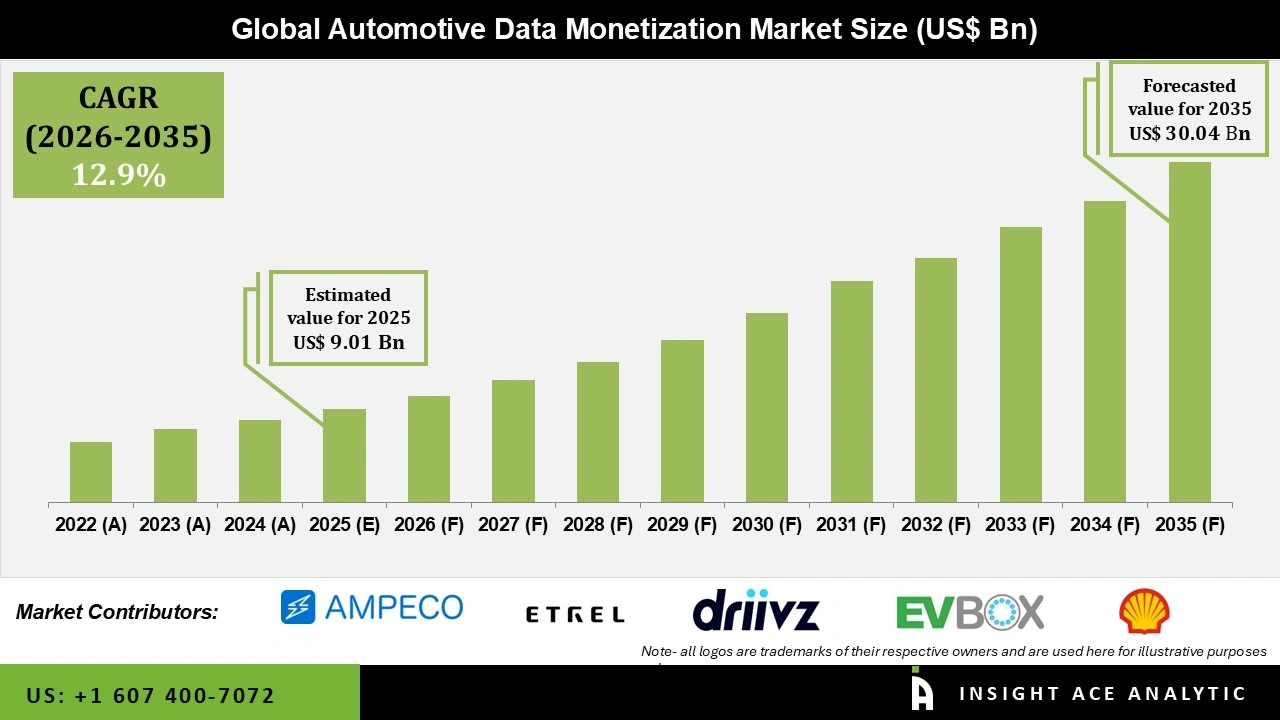
Global Automotive Data Monetization Market Size is valued at USD 9.01 Bn in 2025 and is predicted to reach USD 30.04 Bn by the year 2035 at a 12.9% CAGR during the forecast period for 2026 to 2035.
Automotive Data Monetization Market Size, Share & Trends Analysis Distribution by Type (Direct Monetization and Indirect Monetization), Deployment Mode (Cloud and On-premises), Application (Insurance, Fleet Management, Predictive Maintenance, Government & Infrastructure, Mobility-as-a-Service (MaaS), and Others), End-user (Fleet Operators, OEM, Third-party Service Providers, and Others), By Region and Segment Forecasts, 2026 to 2035.
Automotive Data Monetization Market Key Takeaways:
|
Automotive data monetization refers to the process of generating revenue from the vast amounts of data generated by connected vehicles, fleets, and mobility ecosystems. Modern vehicles produce terabytes of data daily through sensors, cameras, telematics units, infotainment systems, ADAS, and over-the-air updates covering driving behavior, location, vehicle health, usage patterns, road conditions, and more. Manufacturers, OEMs, suppliers, insurers, fleet operators, mobility service providers, and third-party data aggregators are increasingly monetizing this data through various models
In order to monetize this data, it must be used for things like targeted advertising, personalized insurance, predictive maintenance, and improving in-car services like navigation and entertainment. The automotive data monetization market is expanding due to the increasing use of connected automobiles and electric vehicles (EVs).
The exponential increase in connected cars and the ensuing need for real-time telematics-based services from OEMs, insurers, fleet operators, and third-party developers are the main factors propelling the expansion of the automotive data monetization market. Another factor in the global automotive data monetization market is the growing use of data monetization tools by automakers and service providers to assess the performance of their goods and services and potentially help with corrective maintenance. Furthermore, the automotive data monetization market is anticipated to increase as a result of the Advanced Driving Assistance System (ADAS) being used to track on-road driver and vehicle behavior and monetize the data to promote industry benefits like insurance premiums, predictive maintenance, etc.
The automotive data monetization market environment is also changing as a result of the growth of on-demand and subscription-based mobility services. Businesses are using data to provide individualized and flexible services as a result of consumers' growing preferences for flexible transportation options. Additionally, the automotive data monetization market dynamics are being influenced by legal frameworks centered on data security and privacy, which are pressuring businesses to have strong data governance procedures. These trends and factors are expected to unleash significant value as the automotive sector develops further, providing profitable opportunities for ecosystem players. However, difficulties with data management are anticipated to impede the automotive data monetization market expansion. A suitable data processing and storage system is required since connected and autonomous cars communicate with other intelligent transportation systems, which produce a lot of data.
Competitive Landscape
Which are the Leading Players in Automotive Data Monetization Market?
- IBM
- Airlinq Inc.
- Geotab
- Bosch
- Continental
- Harman International
- Cox Automotive
- Oracle
- Urgent.ly Inc (Otonomo)
- Caruso GmbH
- Other Prominent Players
Market Dynamics
Driver
Growth of Digitalization Projects for Fleet Management and Logistics
The automotive data monetization market is seeing substantial growth due to the increase of fleet management and logistics digitization projects. In order to obtain real-time visibility into vehicle location, performance, fuel consumption, and driver behavior, fleet operators and logistics firms are progressively implementing connected vehicle technology. Additionally, the need for sophisticated analytics, predictive maintenance, and optimization services derived from connected car data is rising as a result of this increased reliance on data-driven fleet management. Furthermore, automotive OEMs and data service providers now have more ways to make money off of vehicle data due to subscription-based platforms, data analytics services, and value-added solutions designed to boost fleet productivity and cut expenses as logistics networks continue to digitize. The adoption of automotive data monetization services is therefore being accelerated by the increased emphasis on digital transformation in fleet and logistics operations.
Restrain/Challenge
Strict Data Privacy and Automotive Data Protection Laws
The automotive data monetization market's expansion is being severely hampered by strict data privacy and automotive data protection laws in different jurisdictions. Strict frameworks that require clear user consent and strong data security procedures have been put in place by governments and regulatory agencies to control the gathering, storing, processing, and sharing of personal and vehicle data. The automotive OEMs and service providers must make greater investments in order to comply with these standards, especially when it comes to large-scale commercialization and cross-border data exchange. Furthermore, market parties' capacity to freely profit from connected automobile data is restricted by changing regulatory norms, which breed uncertainty. Consequently, these legal restrictions limit the full monetization potential of connected automotive data and impede the rate of service uptake, which limits the automotive data monetization market growth.
Insurance Segment is Expected to Drive the Automotive Data Monetization Market
The insurance category held the largest share in the Automotive Data Monetization market in 2025. The system that insurance firms have adopted enables them to effectively establish pricing depending on the risk they absorbed by analyzing driving behavior and tailoring policies, hence facilitating the wider adoption of risk-based pricing systems. Furthermore, a lot of insurance firms are starting to use car analytics to track the performance and behavior of drivers. They achieve this by implementing the "Pay-as-you-drive" approach in order to monetize their data and provide opportunities for new business models that could largely help with efficient income creation. The growing use of vehicle analytics in many cars across the globe is therefore a major driver that is probably going to boost the insurance category into the global automotive data monetization market.
OEM Segment is Growing at the Highest Rate in the Automotive Data Monetization Market
In 2025, the OEM category dominated the Automotive Data Monetization market. The growing interconnectedness of automobiles puts OEMs in a unique position to take advantage of the massive volumes of data produced by these cars. Through creative commercial strategies, this data—which includes driver behavior, vehicle performance, and diagnostics can be made profitable. Additionally, OEMs may streamline operations, generate new revenue streams, and improve customer experiences by implementing data-driven initiatives. The automotive data monetization market is driven by developments in machine learning and artificial intelligence. It is difficult for OEMs to profitably use this data, which calls for strong alliances and technology integration. As the automobile industry changes, OEMs need to put data security and management first in order to win over customers and adhere to legal requirements.
Why North America Led the Automotive Data Monetization Market?
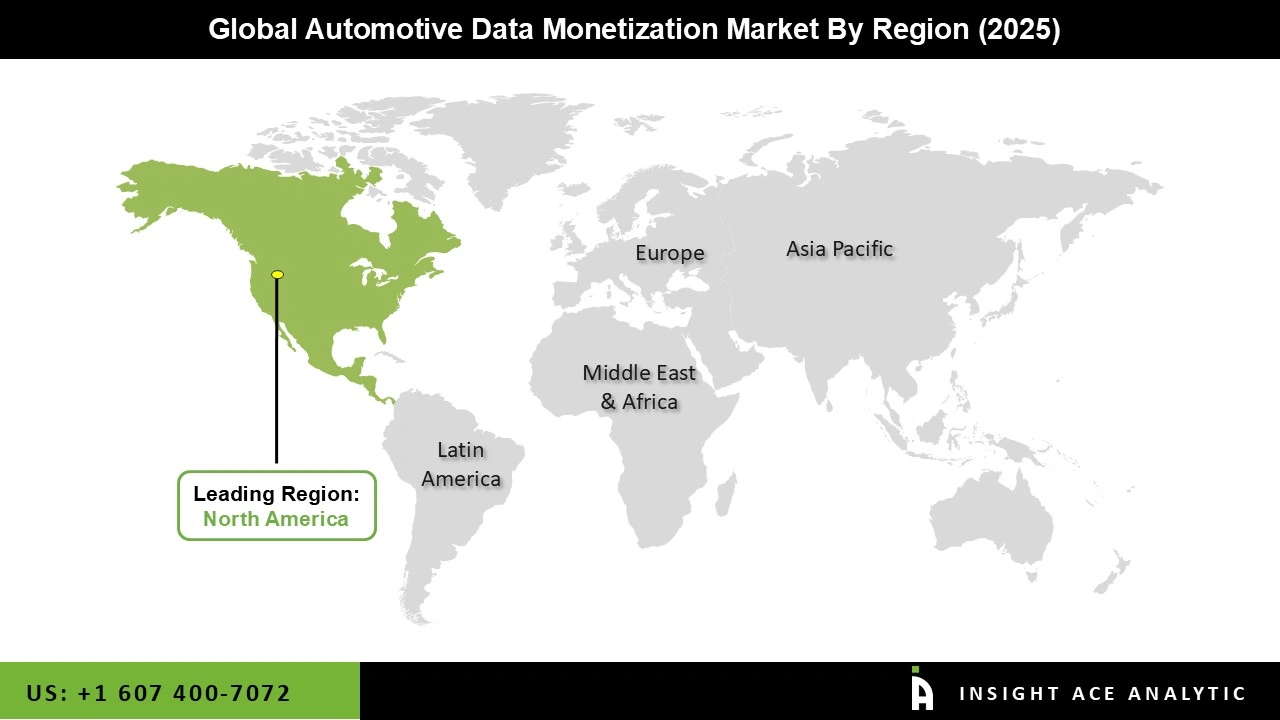
The Automotive Data Monetization market was dominated by North America region in 2025 ascribed to factors including the region's high adoption rate of connected and autonomous automobiles. Increased car safety regulations and greater IoT integration in the automotive sector are also credited with this revenue growth. When it comes to legal frameworks that facilitate data utilization in insurance and car diagnostics, such as the expanding use of usage-based insurance (UBI) models, the United States leads the region.
Furthermore, the increasing use of Advanced Driver Assistant Systems (ADAS) in US automobiles to reduce human casualties and provide safety for drivers and passengers through the use of sophisticated sensors, cameras, and voice recorders is expected to accelerate the growth of the North American automotive data monetization market in the upcoming years.
Automotive Data Monetization Market Report Scope :
| Report Attribute | Specifications |
| Market size value in 2025 | USD 9.01 Bn |
| Revenue forecast in 2035 | USD 30.04 Bn |
| Growth Rate CAGR | CAGR of 12.9% from 2026 to 2035 |
| Quantitative Units | Representation of revenue in US$ Bn and CAGR from 2026 to 2035 |
| Historic Year | 2022 to 2025 |
| Forecast Year | 2026-2035 |
| Report Coverage | The forecast of revenue, the position of the company, the competitive market structure, growth prospects, and trends |
| Segments Covered | Type, Deployment Mode, Application, End-user, and By Region |
| Regional Scope | North America; Europe; Asia Pacific; Latin America; Middle East & Africa |
| Country Scope | U.S.; Canada; U.K.; Germany; China; India; Japan; Brazil; Mexico; The UK; France; Italy; Spain; China; Japan; India; South Korea; Southeast Asia; South Korea; Southeast Asia |
| Competitive Landscape | IBM, Airlinq Inc., Geotab, Bosch, Continental, Harman International, Cox Automotive, Oracle, Urgent.ly Inc (Otonomo), and Caruso GmbH |
| Customization Scope | Free customization report with the procurement of the report, Modifications to the regional and segment scope. Geographic competitive landscape. |
| Pricing and Available Payment Methods | Explore pricing alternatives that are customized to your particular study requirements. |
Segmentation of Automotive Data Monetization Market :
Automotive Data Monetization Market by Type-
- Direct Monetization
- Indirect Monetization
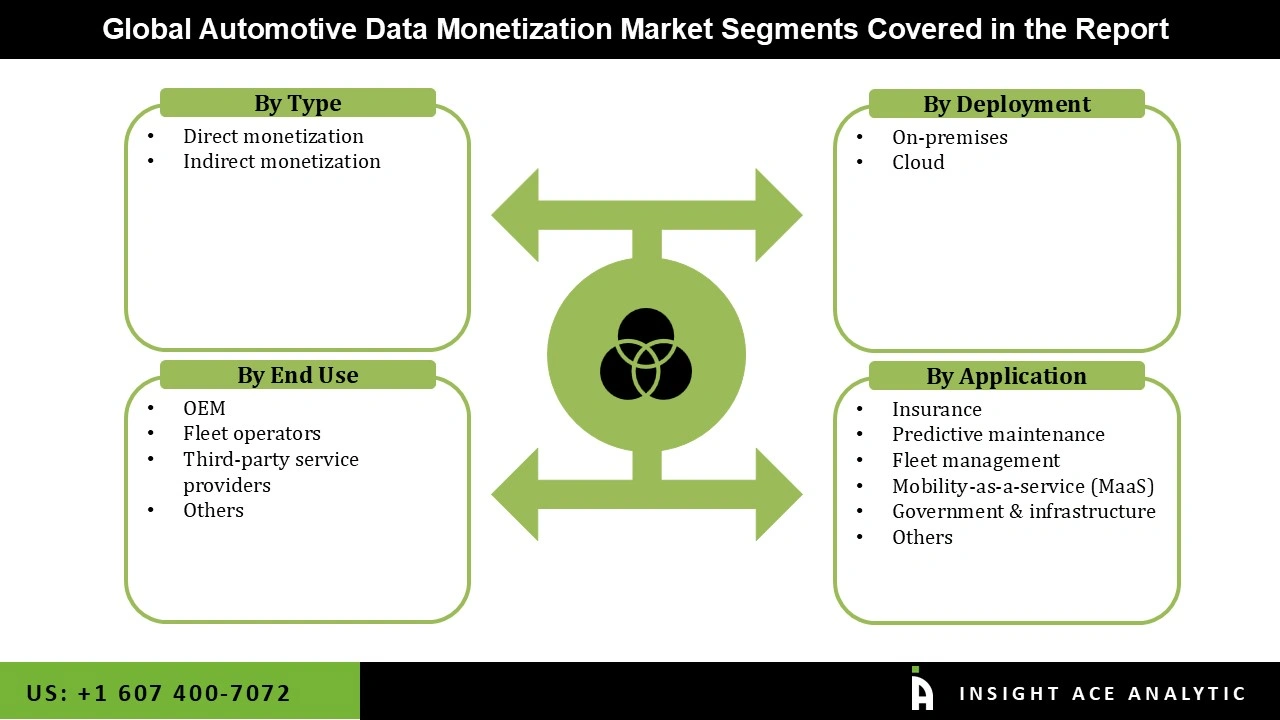
Automotive Data Monetization Market by Deployment Mode-
- Cloud
- On-premises
Automotive Data Monetization Market by Application-
- Insurance
- Fleet Management
- Predictive Maintenance
- Government & Infrastructure
- Mobility-as-a-Service (MaaS)
- Others
Automotive Data Monetization Market by End-user-
- Fleet Operators
- OEM
- Third-party Service Providers
- Others
Automotive Data Monetization Market By Region-
- North America-
- The US
- Canada
- Europe-
- Germany
- The UK
- France
- Italy
- Spain
- Rest of Europe
- Asia-Pacific-
- China
- Japan
- India
- South Korea
- South East Asia
- Rest of Asia Pacific
- Latin America-
- Brazil
- Argentina
- Mexico
- Rest of Latin America
- Middle East & Africa-
- GCC Countries
- South Africa
- Rest of Middle East and Africa
Research Design and Approach
This study employed a multi-step, mixed-method research approach that integrates:
- Secondary research
- Primary research
- Data triangulation
- Hybrid top-down and bottom-up modelling
- Forecasting and scenario analysis
This approach ensures a balanced and validated understanding of both macro- and micro-level market factors influencing the market.
Secondary Research
Secondary research for this study involved the collection, review, and analysis of publicly available and paid data sources to build the initial fact base, understand historical market behaviour, identify data gaps, and refine the hypotheses for primary research.
Sources Consulted
Secondary data for the market study was gathered from multiple credible sources, including:
- Government databases, regulatory bodies, and public institutions
- International organizations (WHO, OECD, IMF, World Bank, etc.)
- Commercial and paid databases
- Industry associations, trade publications, and technical journals
- Company annual reports, investor presentations, press releases, and SEC filings
- Academic research papers, patents, and scientific literature
- Previous market research publications and syndicated reports
These sources were used to compile historical data, market volumes/prices, industry trends, technological developments, and competitive insights.

Primary Research
Primary research was conducted to validate secondary data, understand real-time market dynamics, capture price points and adoption trends, and verify the assumptions used in the market modelling.
Stakeholders Interviewed
Primary interviews for this study involved:
- Manufacturers and suppliers in the market value chain
- Distributors, channel partners, and integrators
- End-users / customers (e.g., hospitals, labs, enterprises, consumers, etc., depending on the market)
- Industry experts, technology specialists, consultants, and regulatory professionals
- Senior executives (CEOs, CTOs, VPs, Directors) and product managers
Interview Process
Interviews were conducted via:
- Structured and semi-structured questionnaires
- Telephonic and video interactions
- Email correspondences
- Expert consultation sessions
Primary insights were incorporated into demand modelling, pricing analysis, technology evaluation, and market share estimation.
Data Processing, Normalization, and Validation
All collected data were processed and normalized to ensure consistency and comparability across regions and time frames.
The data validation process included:
- Standardization of units (currency conversions, volume units, inflation adjustments)
- Cross-verification of data points across multiple secondary sources
- Normalization of inconsistent datasets
- Identification and resolution of data gaps
- Outlier detection and removal through algorithmic and manual checks
- Plausibility and coherence checks across segments and geographies
This ensured that the dataset used for modelling was clean, robust, and reliable.
Market Size Estimation and Data Triangulation
Bottom-Up Approach
The bottom-up approach involved aggregating segment-level data, such as:
- Company revenues
- Product-level sales
- Installed base/usage volumes
- Adoption and penetration rates
- Pricing analysis
This method was primarily used when detailed micro-level market data were available.

Top-Down Approach
The top-down approach used macro-level indicators:
- Parent market benchmarks
- Global/regional industry trends
- Economic indicators (GDP, demographics, spending patterns)
- Penetration and usage ratios
This approach was used for segments where granular data were limited or inconsistent.
Hybrid Triangulation Approach
To ensure accuracy, a triangulated hybrid model was used. This included:
- Reconciling top-down and bottom-up estimates
- Cross-checking revenues, volumes, and pricing assumptions
- Incorporating expert insights to validate segment splits and adoption rates
This multi-angle validation yielded the final market size.
Forecasting Framework and Scenario Modelling
Market forecasts were developed using a combination of time-series modelling, adoption curve analysis, and driver-based forecasting tools.
Forecasting Methods
- Time-series modelling
- S-curve and diffusion models (for emerging technologies)
- Driver-based forecasting (GDP, disposable income, adoption rates, regulatory changes)
- Price elasticity models
- Market maturity and lifecycle-based projections
Scenario Analysis
Given inherent uncertainties, three scenarios were constructed:
- Base-Case Scenario: Expected trajectory under current conditions
- Optimistic Scenario: High adoption, favourable regulation, strong economic tailwinds
- Conservative Scenario: Slow adoption, regulatory delays, economic constraints
Sensitivity testing was conducted on key variables, including pricing, demand elasticity, and regional adoption.
Request Customization
Add countries, segments, company profiles, or extend forecast — free 10% customization with purchase.
Customize This Report →Enquire Before Buying
Speak with our analyst team about scope, methodology, pricing, or deliverable formats.
Enquire Now →Frequently Asked Questions
Automotive Data Monetization Market Size is valued at USD 9.01 Bn in 2025 and is predicted to reach USD 30.04 Bn by the year 2035.
Automotive Data Monetization Market is expected to grow at a 12.9% CAGR during the forecast period for 2026 to 2035
IBM, Airlinq Inc., Geotab, Bosch, Continental, Harman International, Cox Automotive, Oracle, Urgent.ly Inc (Otonomo), Caruso GmbH and Other.
Automotive Data Monetization Market is segmented into by Type (Direct Monetization and Indirect Monetization), Deployment Mode (Cloud and On-premises), Application (Insurance, Fleet Management, Predictive Maintenance, Government & Infrastructure, Mobility-as-a-Service (MaaS), and Others), End-user (Fleet Operators, OEM, Third-party Service Providers, and Others), and Other.
North America region is leading the Automotive Data Monetization Market.