Rocket Upper Stage Engine Market Size, Share Analysis Report 2026 to 2035
Global Rocket Upper Stage Engine Market Size is valued at USD 1,102.7 Mn in 2025 and is predicted to reach USD 2,497.4 Mn by the year 2035 at a 9.0% CAGR during the forecast period for 2026 to 2035.
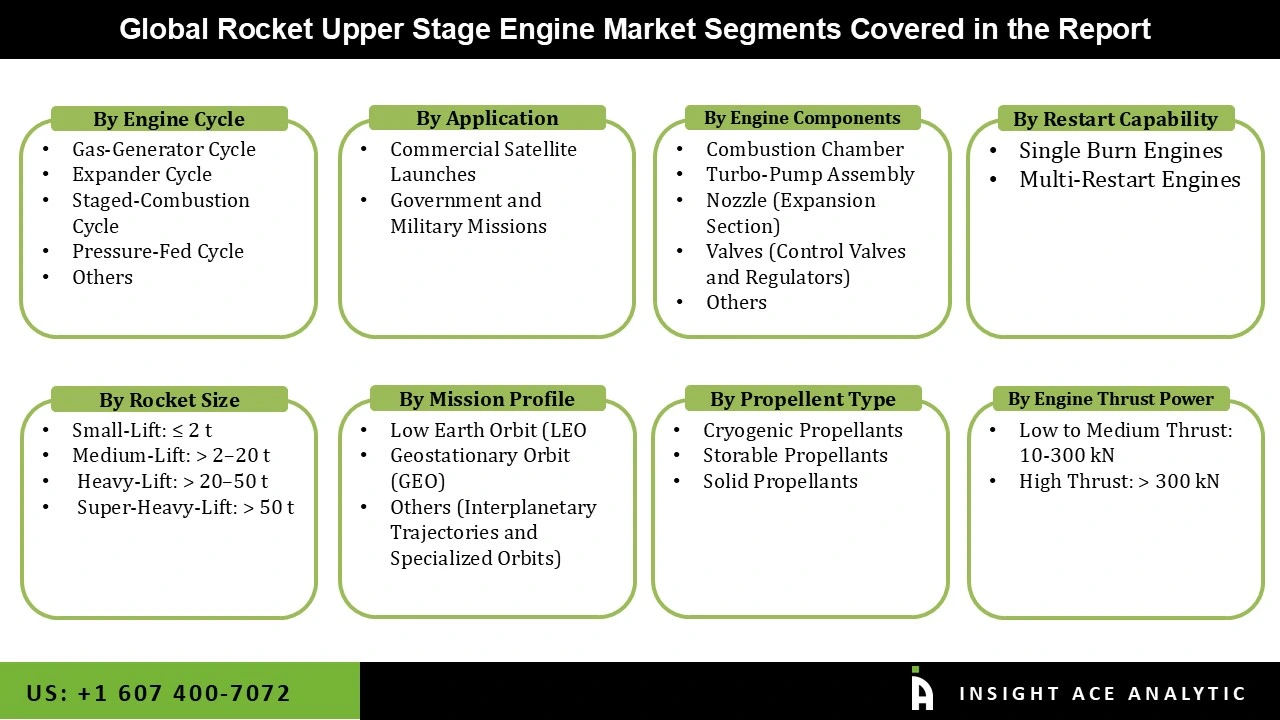
Rocket Upper Stage Engine Market Size, Share & Trends Analysis Distribution by Engine Cycle (Expander Cycle, Gas-Generator Cycle, Pressure-Fed Cycle, Staged-Combustion Cycle, and Others), By Engine Components (Turbo-Pump Assembly, Combustion Chamber, Valves (Control Valves and Regulators), Nozzle (Expansion Section), and Others), By Propellant Type (Solid Propellants, Cryogenic Propellants, and Storable Propellants), By Application (Government and Military Missions, Commercial Satellite Launches), By Restart Capability (Single Burn Engines and Multi-Restart Engines), By Engine Thrust Power (Low to Medium Thrust: 10-300 kN and High Thrust: > 300 kN), By Rocket Size (Small-Lift: ≤ 2 t, Medium-Lift: > 2–20 t, Heavy-Lift: > 20–50 t, and Super-Heavy-Lift: > 50 t), By Mission Profile, By Region and Segment Forecasts, 2026 to 2035
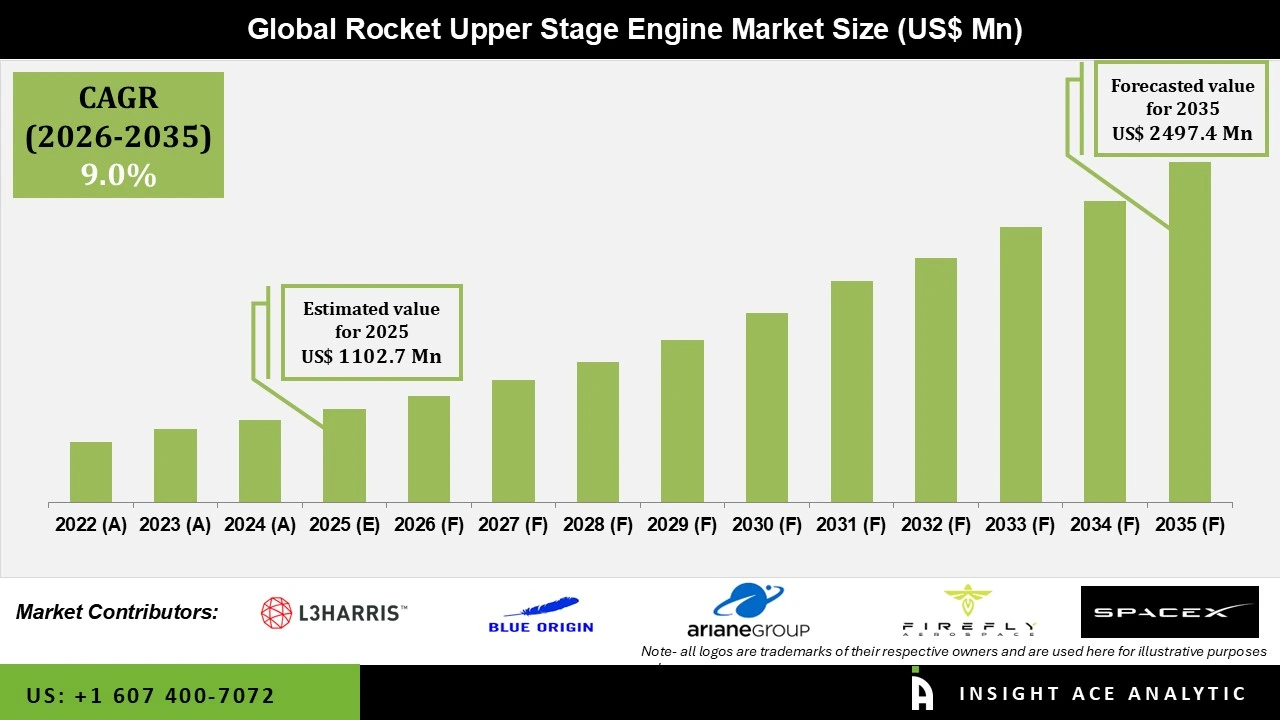
A rocket upper stage engine is a specialized propulsion system designed to operate in the vacuum of space after the lower stages have separated and the vehicle has exited Earth's dense atmosphere. Its main job is to provide precise, efficient thrust to place payloads into exact orbits, perform orbital adjustments, or send spacecraft on interplanetary paths. These engines feature large expansion ratio nozzles to maximize performance in low-pressure conditions and use high-efficiency propellants such as liquid hydrogen/oxygen, hypergolic fuels, or methane. They are lightweight, reliable, and often restartable, making them essential for successful space missions, satellite deployment, and advanced reusable launch vehicles.
The rocket upper stage engine market is mostly driven by the growing demand for space exploration and satellite launches worldwide. To enable Earth observation, communication, navigation, and scientific missions, governments and corporate space organizations are investing heavily in cutting-edge launch vehicle technologies.
Additionally, highly effective and dependable upper stage engines that can execute precise orbital insertion, repeated restarts, and long-duration burns in vacuum conditions are becoming increasingly necessary as space missions become more complex. The adoption of next-generation upper stage engines with better performance, higher thrust-to-weight ratios, and more thermal efficiency is also accelerating because of the growing emphasis on affordable and reusable launch vehicles.
In addition, the rocket upper stage engine market is growing due to the increased deployment of advanced propulsion technologies made possible by attractive government financing programs and rising space infrastructure. Furthermore, there is an increasing need for high-efficiency upper stage engines that are designed for vacuum operation due to the expansion of deep-space missions, lunar exploration initiatives, and interplanetary probes.
The advanced upper stage propulsion technologies are essential for these missions because they demand precise trajectory control and fuel efficiency. Since frequent launches require reliable and scalable upper stage technologies, the growth of small satellite constellations and commercial launch service providers has also aided in the rocket upper stage engine market's progress.
Competitive Landscape
Which are the Leading Players in Rocket Upper Stage Engine Market?
- L3Harris Technologies, Inc.
- BLUE ORIGIN
- ARIANEGROUP
- Firefly Aerospace Inc.
- SPACEX
- Northrop Grumman
- ROCKET LAB USA
- Sierra Nevada Company, LLC.
- ISRO
- MITSUBISHI HEAVY INDUSTRIES, LTD.
- URSA MAJOR Technologies Inc.
- ABL Space Systems
- AVIO SPA
- Skyrora Limited
- United Launch Alliance, LLC
- Others
Market Dynamics
Driver
Growing Number of Satellite Launches
The rocket upper solid engine market is anticipated to develop in the future due to the growing number of satellite launches. Since satellites are essential for improving connectivity and facilitating faster and more dependable data transmission for internet, television, and telecommunications services, particularly in remote and underserved areas, the rising demand for communication is the primary factor in the increasing number of satellite launches. For satellite deployment, a rocket upper solid engine is crucial because it provides the thrust and dependability needed to precisely position satellites into their proper orbits.
Restrain/Challenge
High Cost of Manufacturing
The rocket upper solid engine market's expansion is anticipated to be hampered by the high cost of manufacturing and acquiring the machinery and equipment needed to produce rocket engines. The rocket upper solid engine are complicated systems that depend on cutting-edge combustion technology for effective spacecraft propulsion, requiring large R&D expenditures and expensive, specialized parts.
The infrastructure for testing, R&D initiatives, and hiring specialists all depend on funding. Costs are further increased by the complex procedures and strict quality control associated with manufacturing operations. The total capital investment is heavily influenced by the costs of materials, precise production, and testing, which are anticipated to impede the rocket upper solid engine market expansion.
Commercial Satellite Launches Segment is Expected to Drive the Rocket Upper Stage Engine Market
The Commercial Satellite Launches category held the largest share in the Rocket Upper Stage Engine market in 2025 because of the rising need for satellite-based services, including Earth observation, navigation, and communication. The need for frequent and affordable satellite launches has been fueled by the growing reliance on satellite technology across a number of industries, including defense, agriculture, and telecommunications.
The cost of satellite deployment has dropped as private space companies continue to create cutting-edge, reusable launch technologies, further propelling market expansion. Additionally, the improvements in small satellite technologies also help the commercial satellite launch industry by making it simpler and more affordable to launch constellations of satellites into orbit.
Low Earth Orbit (LEO) Segment is Growing at the Highest Rate in the Rocket Upper Stage Engine Market
In 2025, the Low Earth Orbit (LEO) category dominated the Rocket Upper Stage Engine market, spurred by the quick growth of satellite deployment, particularly for CubeSats and constellations of tiny spacecraft. Manufacturers and launch service providers have given priority to upper stage engines designed for frequent, economical LEO flights as demand for LEO launch services rises, driven by industries like broadband communications, Earth observation, and space-based data infrastructures. Additionally, by lowering operating costs and turnaround times, advancements in propulsion technologies—such as reusable engines, increased fuel efficiency, and modular designs—have expedited this trend.
Why North America Led the Rocket Upper Stage Engine Market?
The Rocket Upper Stage Engine market was dominated by North America region in 2025 due to the presence of important industry players, advanced defense infrastructure, and an extensive space exploration program. There will always be a need for a dependable rocket upper solid engine because the United Arab Emirates is a leader in space launches and defensive missile projects.
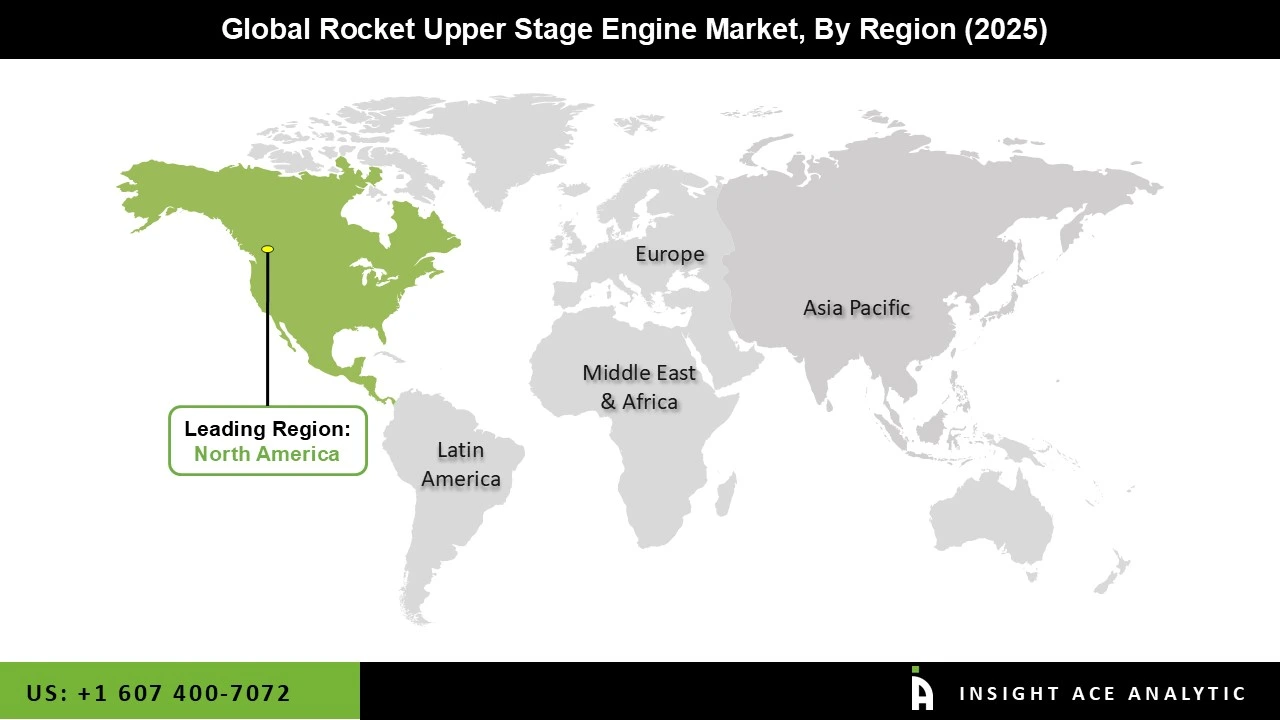
Government-funded initiatives like NASA's Artemis program and the Department of Defense's missile modernization further strengthen the region's leadership. Its ties with private enterprises and continuous innovation reinforce its dominance. Additionally, North America is a global center for engine production, propulsion research, and launch services because of its strong regulatory frameworks, established industrial base, and thriving innovation environment.
Rocket Upper Stage Engine Market Report Scope :
| Report Attribute | Specifications |
| Market size value in 2025 | USD 1,102.7 Mn |
| Revenue forecast in 2035 | USD 2,497.4 Mn |
| Growth Rate CAGR | CAGR of 9.0% from 2026 to 2035 |
| Quantitative Units | Representation of revenue in US$ Bn and CAGR from 2026 to 2035 |
| Historic Year | 2022 to 2025 |
| Forecast Year | 2026-2035 |
| Report Coverage | The forecast of revenue, the position of the company, the competitive market structure, growth prospects, and trends |
| Segments Covered | Engine Cycle, Engine Components, Propellant Type, Application, Restart Capability, Engine Thrust Power, Rocket Size, Mission Profile, and By Region |
| Regional Scope | North America; Europe; Asia Pacific; Latin America; Middle East & Africa |
| Country Scope | U.S.; Canada; U.K.; Germany; China; India; Japan; Brazil; Mexico; The UK; France; Italy; Spain; China; Japan; India; South Korea; Southeast Asia; South Korea; Southeast Asia |
| Competitive Landscape | L3Harris Technologies, Inc., BLUE ORIGIN, ARIANEGROUP, Firefly Aerospace Inc., SPACEX, Northrop Grumman, ROCKET LAB USA, Sierra Nevada Company, LLC., ISRO, MITSUBISHI HEAVY INDUSTRIES, LTD., URSA MAJOR Technologies Inc., ABL Space Systems, AVIO SPA, Skyrora Limited, United Launch Alliance, LLC, and Others. |
| Customization Scope | Free customization report with the procurement of the report, Modifications to the regional and segment scope. Geographic competitive landscape. |
| Pricing and Available Payment Methods | Explore pricing alternatives that are customized to your particular study requirements. |
Segmentation of Rocket Upper Stage Engine Market :
Rocket Upper Stage Engine Market, by Engine Cycle-
- Expander Cycle
- Gas-Generator Cycle
- Pressure-Fed Cycle
- Staged-Combustion Cycle
- Others
Rocket Upper Stage Engine Market, by Engine Components-
- Turbo-Pump Assembly
- Combustion Chamber
- Valves (Control Valves and Regulators)
- Nozzle (Expansion Section)
- Others
Rocket Upper Stage Engine Market, by Propellant Type-
- Solid Propellants
- Cryogenic Propellants
- Storable Propellants
Rocket Upper Stage Engine Market, by Application-
- Government and Military Missions
- Commercial Satellite Launches
Rocket Upper Stage Engine Market, by Restart Capability-
- Single Burn Engines
- Multi-Restart Engines
Rocket Upper Stage Engine Market, by Engine Thrust Power-
- Low to Medium Thrust: 10-300 kN
- High Thrust: > 300 kN
Rocket Upper Stage Engine Market, by Rocket Size-
- Small-Lift: ≤ 2 t
- Medium-Lift: > 2–20 t
- Heavy-Lift: > 20–50 t
- Super-Heavy-Lift: > 50 t
Rocket Upper Stage Engine Market, by Mission Profile-
- Geostationary Orbit (GEO)
- Low Earth Orbit (LEO)
- Others (Interplanetary Trajectories and Specialized Orbits)
Rocket Upper Stage Engine Market, by Region-
- North America-
- The US
- Canada
- Europe-
- Germany
- The UK
- France
- Italy
- Spain
- Rest of Europe
- Asia-Pacific-
- China
- Japan
- India
- South Korea
- South East Asia
- Rest of Asia Pacific
- Latin America-
- Brazil
- Argentina
- Mexico
- Rest of Latin America
- Middle East & Africa-
- GCC Countries
- South Africa
- Rest of Middle East and Africa
Research Design and Approach
This study employed a multi-step, mixed-method research approach that integrates:
- Secondary research
- Primary research
- Data triangulation
- Hybrid top-down and bottom-up modelling
- Forecasting and scenario analysis
This approach ensures a balanced and validated understanding of both macro- and micro-level market factors influencing the market.
Secondary Research
Secondary research for this study involved the collection, review, and analysis of publicly available and paid data sources to build the initial fact base, understand historical market behaviour, identify data gaps, and refine the hypotheses for primary research.
Sources Consulted
Secondary data for the market study was gathered from multiple credible sources, including:
- Government databases, regulatory bodies, and public institutions
- International organizations (WHO, OECD, IMF, World Bank, etc.)
- Commercial and paid databases
- Industry associations, trade publications, and technical journals
- Company annual reports, investor presentations, press releases, and SEC filings
- Academic research papers, patents, and scientific literature
- Previous market research publications and syndicated reports
These sources were used to compile historical data, market volumes/prices, industry trends, technological developments, and competitive insights.

Primary Research
Primary research was conducted to validate secondary data, understand real-time market dynamics, capture price points and adoption trends, and verify the assumptions used in the market modelling.
Stakeholders Interviewed
Primary interviews for this study involved:
- Manufacturers and suppliers in the market value chain
- Distributors, channel partners, and integrators
- End-users / customers (e.g., hospitals, labs, enterprises, consumers, etc., depending on the market)
- Industry experts, technology specialists, consultants, and regulatory professionals
- Senior executives (CEOs, CTOs, VPs, Directors) and product managers
Interview Process
Interviews were conducted via:
- Structured and semi-structured questionnaires
- Telephonic and video interactions
- Email correspondences
- Expert consultation sessions
Primary insights were incorporated into demand modelling, pricing analysis, technology evaluation, and market share estimation.
Data Processing, Normalization, and Validation
All collected data were processed and normalized to ensure consistency and comparability across regions and time frames.
The data validation process included:
- Standardization of units (currency conversions, volume units, inflation adjustments)
- Cross-verification of data points across multiple secondary sources
- Normalization of inconsistent datasets
- Identification and resolution of data gaps
- Outlier detection and removal through algorithmic and manual checks
- Plausibility and coherence checks across segments and geographies
This ensured that the dataset used for modelling was clean, robust, and reliable.
Market Size Estimation and Data Triangulation
Bottom-Up Approach
The bottom-up approach involved aggregating segment-level data, such as:
- Company revenues
- Product-level sales
- Installed base/usage volumes
- Adoption and penetration rates
- Pricing analysis
This method was primarily used when detailed micro-level market data were available.

Top-Down Approach
The top-down approach used macro-level indicators:
- Parent market benchmarks
- Global/regional industry trends
- Economic indicators (GDP, demographics, spending patterns)
- Penetration and usage ratios
This approach was used for segments where granular data were limited or inconsistent.
Hybrid Triangulation Approach
To ensure accuracy, a triangulated hybrid model was used. This included:
- Reconciling top-down and bottom-up estimates
- Cross-checking revenues, volumes, and pricing assumptions
- Incorporating expert insights to validate segment splits and adoption rates
This multi-angle validation yielded the final market size.
Forecasting Framework and Scenario Modelling
Market forecasts were developed using a combination of time-series modelling, adoption curve analysis, and driver-based forecasting tools.
Forecasting Methods
- Time-series modelling
- S-curve and diffusion models (for emerging technologies)
- Driver-based forecasting (GDP, disposable income, adoption rates, regulatory changes)
- Price elasticity models
- Market maturity and lifecycle-based projections
Scenario Analysis
Given inherent uncertainties, three scenarios were constructed:
- Base-Case Scenario: Expected trajectory under current conditions
- Optimistic Scenario: High adoption, favourable regulation, strong economic tailwinds
- Conservative Scenario: Slow adoption, regulatory delays, economic constraints
Sensitivity testing was conducted on key variables, including pricing, demand elasticity, and regional adoption.
Request Customization
Add countries, segments, company profiles, or extend forecast — free 10% customization with purchase.
Customize This Report →Enquire Before Buying
Speak with our analyst team about scope, methodology, pricing, or deliverable formats.
Enquire Now →Frequently Asked Questions
Rocket Upper Stage Engine Market Size is valued at USD 1,102.7 Mn in 2025 and is predicted to reach USD 2,497.4 Mn by the year 2035
Rocket Upper Stage Engine Market is expected to grow at a 9.0% CAGR during the forecast period for 2026 to 2035
L3Harris Technologies, Inc., BLUE ORIGIN, ARIANEGROUP, Firefly Aerospace Inc., SPACEX, Northrop Grumman, ROCKET LAB USA, Sierra Nevada Company, LLC., ISRO, MITSUBISHI HEAVY INDUSTRIES, LTD., URSA MAJOR Technologies Inc., ABL Space Systems, AVIO SPA, Skyrora Limited, United Launch Alliance, LLC, and Others.
Engine Cycle, Engine Components, Propellant Type, Application, Restart Capability, Engine Thrust Power, Rocket Size and Mission Profile are the key segments of the Rocket Upper Stage Engine Market
North America region is leading the Rocket Upper Stage Engine Market.