Automotive Cybersecurity Homologation Market Size, Scope, Revenue Report 2026 to 2035
What is Automotive Cybersecurity Homologation Market Size?
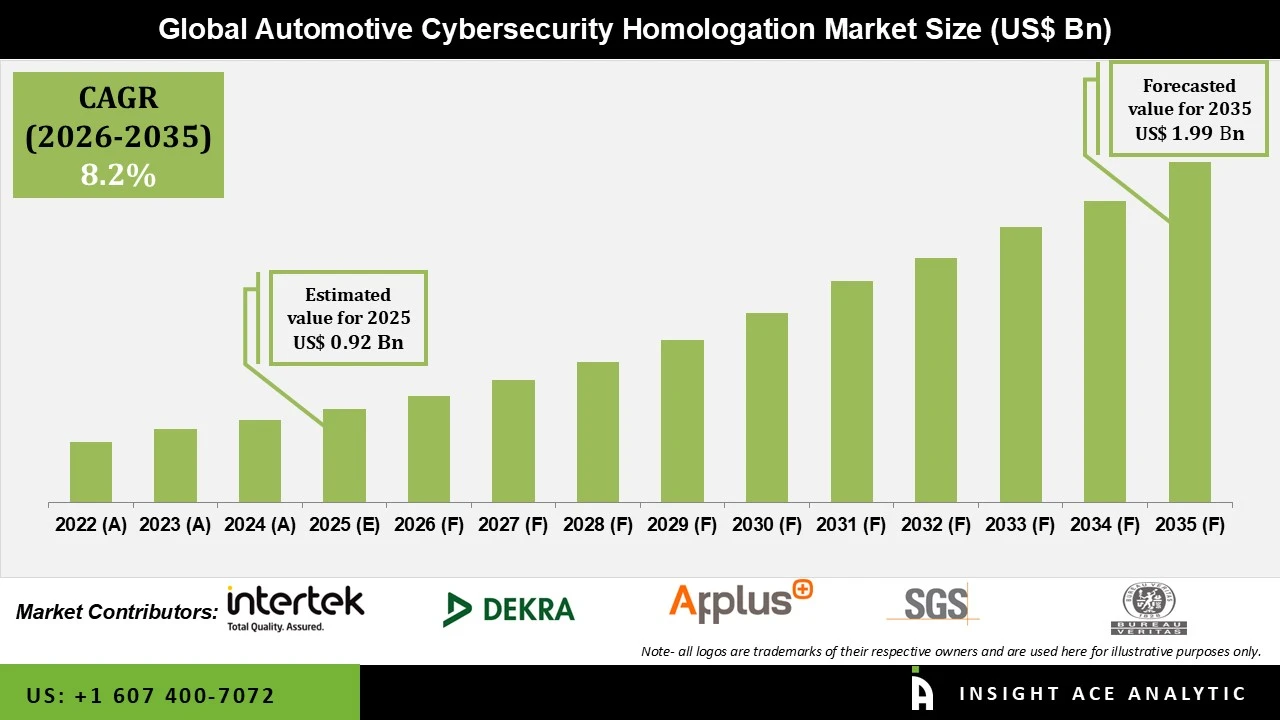
Automotive Cybersecurity Homologation Market Size is valued at USD 0.92 Bn in 2025 and is predicted to reach USD 1.99 Bn by the year 2035 at a 8.2% CAGR during the forecast period for 2026 to 2035.
Automotive Cybersecurity Homologation Market Size, Share & Trends Analysis Distribution by Service Type (Compliance Verification, Type Approval Testing, Conformity Assessment, and Post-Homologation Auditing), By Vehicle Category (Passenger Vehicles, Autonomous Vehicles, Commercial Vehicles, and Electric Vehicles), By Application (Software Security Testing, OEM Certification, Fleet Compliance, and Component Validation), and Segment Forecasts, 2026 to 2035
Automotive cybersecurity homologation is the process of assessing, testing, and certifying a car's cybersecurity systems to make sure they meet legal requirements before the car can be marketed in a particular country. It entails confirming that automakers have put strong cybersecurity safeguards in place throughout the lifecycle of the vehicle, including risk assessment, threat detection, incident response, and secure software update procedures. Authorized testing organizations and certification authorities are usually responsible for automotive cybersecurity homologation. They guarantee the integrity and safety of software-defined and networked cars. The automotive cybersecurity homologation market is driven by the quick development of software-defined, connected, and electrified vehicles, which has greatly increased the complexity of vehicle systems and legal requirements.
The automotive cybersecurity homologation market is mostly driven by the increased enforcement of strict automotive cybersecurity rules, as governments and regulatory agencies require adherence to frameworks like UNECE WP.29 (R155 and R156) for vehicle clearance. The need for testing, validation, and certification services has greatly expanded as a result of automakers' need to put in place strong cybersecurity management systems, safe software update procedures, and ongoing risk assessment procedures. Furthermore, the potential attack surface has increased due to the quick development of software-defined, connected, and electrified cars, making cybersecurity compliance a must rather than a choice. Growing customer awareness of data privacy and car safety further supports this change by motivating automakers to give certified cybersecurity solutions top priority.
In addition, it is anticipated that the automotive cybersecurity homologation market will change as a result of continuing technology developments and growing regional regulatory harmonization. Comprehensive homologation services will probably become even more necessary as innovative vehicle designs, such as autonomous driving systems and over-the-air updates, continue to be developed. Long-term demand will be sustained by regulatory bodies' increased emphasis on lifecycle cybersecurity management, which calls for ongoing monitoring and recertification. Additionally, the automotive cybersecurity homologation market is moving toward integrated and specialized compliance services that are suited to particular vehicle platforms and local regulations. The need for trustworthy homologation services is anticipated to develop gradually as awareness of cybersecurity threats rises, bolstering the market's overall expansion.
Competitive Landscape
Which are the Leading Players in Automotive Cybersecurity Homologation Market?
• SGS SA
• TÜV Rheinland AG
• TÜV SÜD AG
• Intertek Group plc
• Bureau Veritas SA
• Applus+ IDIADA
• UL Solutions Inc.
• Dekra SE
• CSA Group
Market Dynamics
Driver
Enforcement of Strict Regulatory Frameworks
The global enforcement of strict regulatory frameworks, especially UNECE WP.29 standards (R155 and R156), is one of the major factors driving the automotive cybersecurity homologation market. Automakers are now required by these requirements to provide secure software update procedures and certified Cybersecurity Management Systems (CSMS) in order to receive vehicle type certification. In contrast to previous voluntary guidelines, new regulations enforce legal responsibilities, which means that vehicles may not be allowed to enter important markets like Europe and other adopting regions if they do not comply. Additionally, the automakers are depending more and more on outside experts to guarantee compliance as the scope of regulations continues to broaden globally, which is greatly propelling the automotive cybersecurity homologation market expansion.
Restrain/Challenge
High Cost and Compliance Complexity
The high expense and complexity of establishing and maintaining regulatory compliance are significant barriers to the automotive cybersecurity homologation market. It takes a significant investment in cutting-edge technologies, testing infrastructure, and qualified staff to implement cybersecurity protections throughout the whole vehicle lifecycle. Furthermore, homologation entails a lot of paperwork, frequent testing, audits, and recertification, all of which raise operating expenses. These costs can be especially onerous for small and mid-sized enterprises, which restrict their capacity to effectively compete. Additionally, because cyber threats are constantly changing, security measures must be updated, which raises the complexity and cost of long-term compliance.
Type Approval Testing Segment is Expected to Drive the Automotive Cybersecurity Homologation Market
The type approval testing segment held the largest share in the automotive cybersecurity homologation market in 2025. Type approval testing, which covers the whole regulatory authorization of a vehicle model or system, is the most thorough and valuable service within homologation. It usually takes six to twenty-four months for each program and entails cooperation between various UNECE regulations, country annexes, and applicant technical paperwork. Volume growth in type approval testing services has been directly impacted by the increasing number of new car nameplates introduced each year by both established OEMs and newly emerging EV manufacturers. Furthermore, type approval is changing from a one-time occurrence to an ongoing service relationship for software-defined cars that require periodic OTA update homologation, greatly increasing provider revenue visibility and contract value.
Passenger Vehicles Segment is Growing at the Highest Rate in the Automotive Cybersecurity Homologation Market
In 2025, the passenger vehicles segment dominated the automotive cybersecurity homologation market. The segment's leadership position is maintained by the sheer number of new passenger car models introduced worldwide, as well as the growing regulatory complexity related to EV powertrains, ADAS integration, and cybersecurity standards. More than 280 new passenger car nameplates entered or attempted to enter European markets in 2025, all of which required thorough WVTA procedures. Because BEVs and PHEVs must meet additional rules for battery safety, EMC, and charging system interoperability in addition to standard ICE criteria, the growing proportion of BEVs and PHEVs in new car debuts increases the cost of homologation for each model.
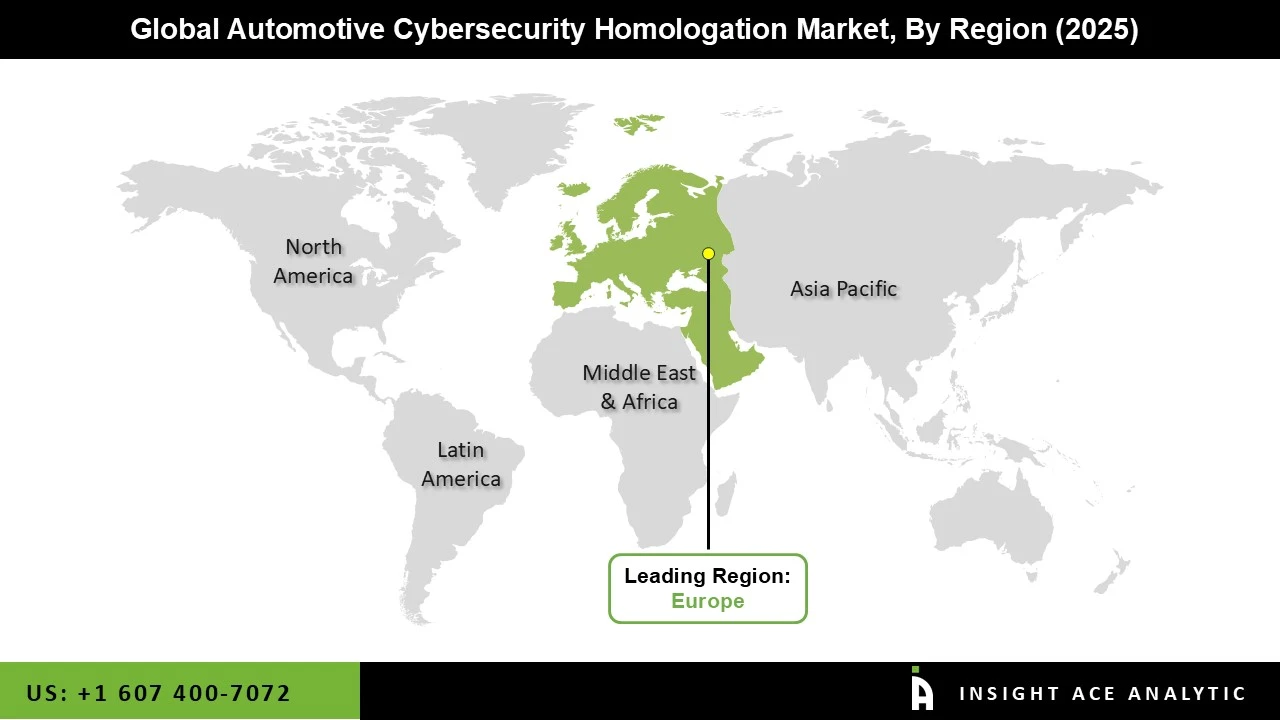
Why North America Led the Automotive Cybersecurity Homologation Market?
The automotive cybersecurity homologation market was dominated by North America region in 2025 propelled by the region's growing use of software-defined and connected automobiles. Leading automakers and IT firms, such as Ford Motor Company, General Motors, and Tesla, Inc., have accelerated the integration of cutting-edge digital architectures, raising the demand for reliable cybersecurity validation and compliance services. The region's need for cybersecurity homologation and testing services is also being driven by the increased prevalence of automotive cyberthreats, rising investment in autonomous and electric vehicles, and greater emphasis on data privacy and safety. Additionally, the market is expanding due to the region's high R&D investments, strong emphasis on innovation, and expanding alliances between automakers and cybersecurity companies.
Key Development
February 2024: The AutoCrypt CSTP was introduced by AUTOCRYPT Corp., a cybersecurity and mobility solutions company with headquarters in South Korea. The distinctive feature of AutoCrypt CSTP is its extensive cybersecurity testing platform, which permits integrated cybersecurity testing for vehicle type certification in accordance with SAC's GB and GB/T standards and UNECE's Regulations 155/156. Using test cases created especially for these regulations, it provides a range of vulnerability testing methods.
Automotive Cybersecurity Homologation Market Report Scope:
| Report Attribute | Specifications |
| Market size value in 2025 | USD 0.92 Bn |
| Revenue forecast in 2035 | USD 1.99 Bn |
| Growth Rate CAGR | CAGR of 8.2% from 2026 to 2035 |
| Quantitative Units | Representation of revenue in US$ Bn and CAGR from 2026 to 2035 |
| Historic Year | 2022 to 2025 |
| Forecast Year | 2026-2035 |
| Report Coverage | The forecast of revenue, the position of the company, the competitive market structure, growth prospects, and trends |
| Segments Covered | Service Type, Vehicle Category, Application, End-user, Distribution Channel, and By Region |
| Regional Scope | North America; Europe; Asia Pacific; Latin America; Middle East & Africa |
| Country Scope | U.S.; Canada; U.K.; Germany; China; India; Japan; Brazil; Mexico; The UK; France; Italy; Spain; China; Japan; India; South Korea; Southeast Asia; South Korea; Southeast Asia |
| Competitive Landscape | SGS SA, TÜV Rheinland AG, TÜV SÜD AG, Intertek Group plc, Bureau Veritas SA, Applus+ IDIADA, UL Solutions Inc., Dekra SE, and CSA Group. |
| Customization Scope | Free customization report with the procurement of the report, Modifications to the regional and segment scope. Geographic competitive landscape. |
| Pricing and Available Payment Methods | Explore pricing alternatives that are customized to your particular study requirements. |
Automotive Cybersecurity Homologation Market Segmentation:
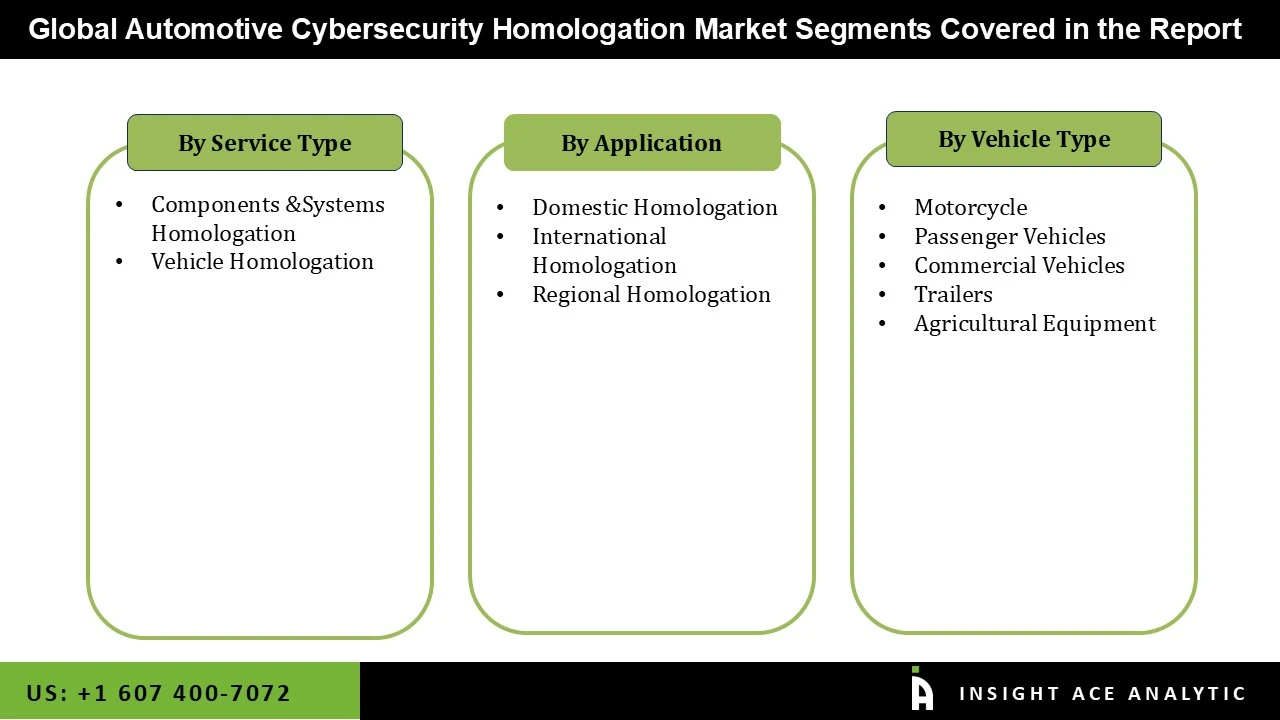
Automotive Cybersecurity Homologation Market by Service Type-
• Compliance Verification
• Type Approval Testing
• Conformity Assessment
• Post-Homologation Auditing
Automotive Cybersecurity Homologation Market by Vehicle Category-
• Passenger Vehicles
• Autonomous Vehicles
• Commercial Vehicles
• Electric Vehicles
Automotive Cybersecurity Homologation Market by Application-
• Software Security Testing
• OEM Certification
• Fleet Compliance
• Component Validation
Automotive Cybersecurity Homologation Market- By Region
North America-
• The US
• Canada
Europe-
• Germany
• The UK
• France
• Italy
• Spain
• Rest of Europe
Asia-Pacific-
• China
• Japan
• India
• South Korea
• South East Asia
• Rest of Asia Pacific
Latin America-
• Brazil
• Argentina
• Mexico
• Rest of Latin America
Middle East & Africa-
• GCC Countries
• South Africa
• Rest of Middle East and Africa
Research Design and Approach
This study employed a multi-step, mixed-method research approach that integrates:
- Secondary research
- Primary research
- Data triangulation
- Hybrid top-down and bottom-up modelling
- Forecasting and scenario analysis
This approach ensures a balanced and validated understanding of both macro- and micro-level market factors influencing the market.
Secondary Research
Secondary research for this study involved the collection, review, and analysis of publicly available and paid data sources to build the initial fact base, understand historical market behaviour, identify data gaps, and refine the hypotheses for primary research.
Sources Consulted
Secondary data for the market study was gathered from multiple credible sources, including:
- Government databases, regulatory bodies, and public institutions
- International organizations (WHO, OECD, IMF, World Bank, etc.)
- Commercial and paid databases
- Industry associations, trade publications, and technical journals
- Company annual reports, investor presentations, press releases, and SEC filings
- Academic research papers, patents, and scientific literature
- Previous market research publications and syndicated reports
These sources were used to compile historical data, market volumes/prices, industry trends, technological developments, and competitive insights.

Primary Research
Primary research was conducted to validate secondary data, understand real-time market dynamics, capture price points and adoption trends, and verify the assumptions used in the market modelling.
Stakeholders Interviewed
Primary interviews for this study involved:
- Manufacturers and suppliers in the market value chain
- Distributors, channel partners, and integrators
- End-users / customers (e.g., hospitals, labs, enterprises, consumers, etc., depending on the market)
- Industry experts, technology specialists, consultants, and regulatory professionals
- Senior executives (CEOs, CTOs, VPs, Directors) and product managers
Interview Process
Interviews were conducted via:
- Structured and semi-structured questionnaires
- Telephonic and video interactions
- Email correspondences
- Expert consultation sessions
Primary insights were incorporated into demand modelling, pricing analysis, technology evaluation, and market share estimation.
Data Processing, Normalization, and Validation
All collected data were processed and normalized to ensure consistency and comparability across regions and time frames.
The data validation process included:
- Standardization of units (currency conversions, volume units, inflation adjustments)
- Cross-verification of data points across multiple secondary sources
- Normalization of inconsistent datasets
- Identification and resolution of data gaps
- Outlier detection and removal through algorithmic and manual checks
- Plausibility and coherence checks across segments and geographies
This ensured that the dataset used for modelling was clean, robust, and reliable.
Market Size Estimation and Data Triangulation
Bottom-Up Approach
The bottom-up approach involved aggregating segment-level data, such as:
- Company revenues
- Product-level sales
- Installed base/usage volumes
- Adoption and penetration rates
- Pricing analysis
This method was primarily used when detailed micro-level market data were available.

Top-Down Approach
The top-down approach used macro-level indicators:
- Parent market benchmarks
- Global/regional industry trends
- Economic indicators (GDP, demographics, spending patterns)
- Penetration and usage ratios
This approach was used for segments where granular data were limited or inconsistent.
Hybrid Triangulation Approach
To ensure accuracy, a triangulated hybrid model was used. This included:
- Reconciling top-down and bottom-up estimates
- Cross-checking revenues, volumes, and pricing assumptions
- Incorporating expert insights to validate segment splits and adoption rates
This multi-angle validation yielded the final market size.
Forecasting Framework and Scenario Modelling
Market forecasts were developed using a combination of time-series modelling, adoption curve analysis, and driver-based forecasting tools.
Forecasting Methods
- Time-series modelling
- S-curve and diffusion models (for emerging technologies)
- Driver-based forecasting (GDP, disposable income, adoption rates, regulatory changes)
- Price elasticity models
- Market maturity and lifecycle-based projections
Scenario Analysis
Given inherent uncertainties, three scenarios were constructed:
- Base-Case Scenario: Expected trajectory under current conditions
- Optimistic Scenario: High adoption, favourable regulation, strong economic tailwinds
- Conservative Scenario: Slow adoption, regulatory delays, economic constraints
Sensitivity testing was conducted on key variables, including pricing, demand elasticity, and regional adoption.
Request Customization
Add countries, segments, company profiles, or extend forecast — free 10% customization with purchase.
Customize This Report →Enquire Before Buying
Speak with our analyst team about scope, methodology, pricing, or deliverable formats.
Enquire Now →Frequently Asked Questions
Automotive Cybersecurity Homologation Market Size is valued at USD 0.92 Bn in 2025 and is predicted to reach USD 1.99 Bn by the year 2035
Automotive Cybersecurity Homologation Market is expected to grow at a 8.2% CAGR during the forecast period for 2026 to 2035.
SGS SA, TÜV Rheinland AG, TÜV SÜD AG, Intertek Group plc, Bureau Veritas SA, Applus+ IDIADA, UL Solutions Inc., Dekra SE, and CSA Group.
Automotive Cybersecurity Homologation Market is segmented into Service Type, Vehicle Category, Application, End-user, Distribution Channel, and By Region
North America region is leading the Automotive Cybersecurity Homologation Market.