AI in Data Management Market Size, Scope, Revenue Report 2026 to 2035
AI in Data Management Market Size is valued at USD 38.67 Bn in 2025 and is predicted to reach USD 314.27 Bn by the year 2035 at a 23.6% CAGR during the forecast period for 2026 to 2035.
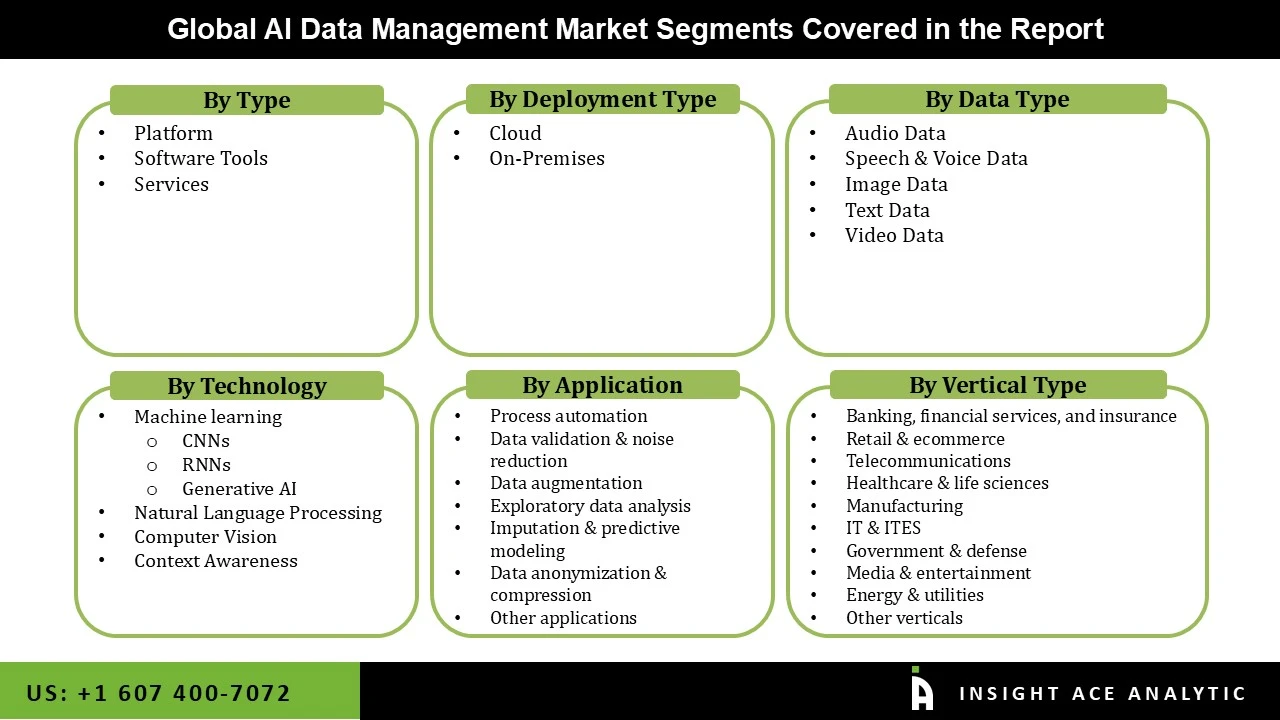
AI in Data Management Market Size, Share & Trends Analysis Distribution by Type (Platform, Services, and Software Tools), Data Type (Audio Data, Speech & Voice Data, Image Data, Video Data, and Text Data), Deployment Mode (Cloud and On-premises), Application (Process Automation, Data Validation & Noise Reduction, Data Augmentation, Exploratory Data Analysis, Imputation & Predictive Modeling, Data Anonymization & Compression, and Others), Technology (Machine Learning, Natural Language Processing, Computer Vision, and Context Awareness), End-user (Banking, Financial Services, and Insurance, Retail & Ecommerce, Telecommunications, Healthcare & Life Sciences, Manufacturing, IT & ITES, Government & Defense, Media & Entertainment, and Energy & Utilities), and Segment Forecasts, 2026 to 2035
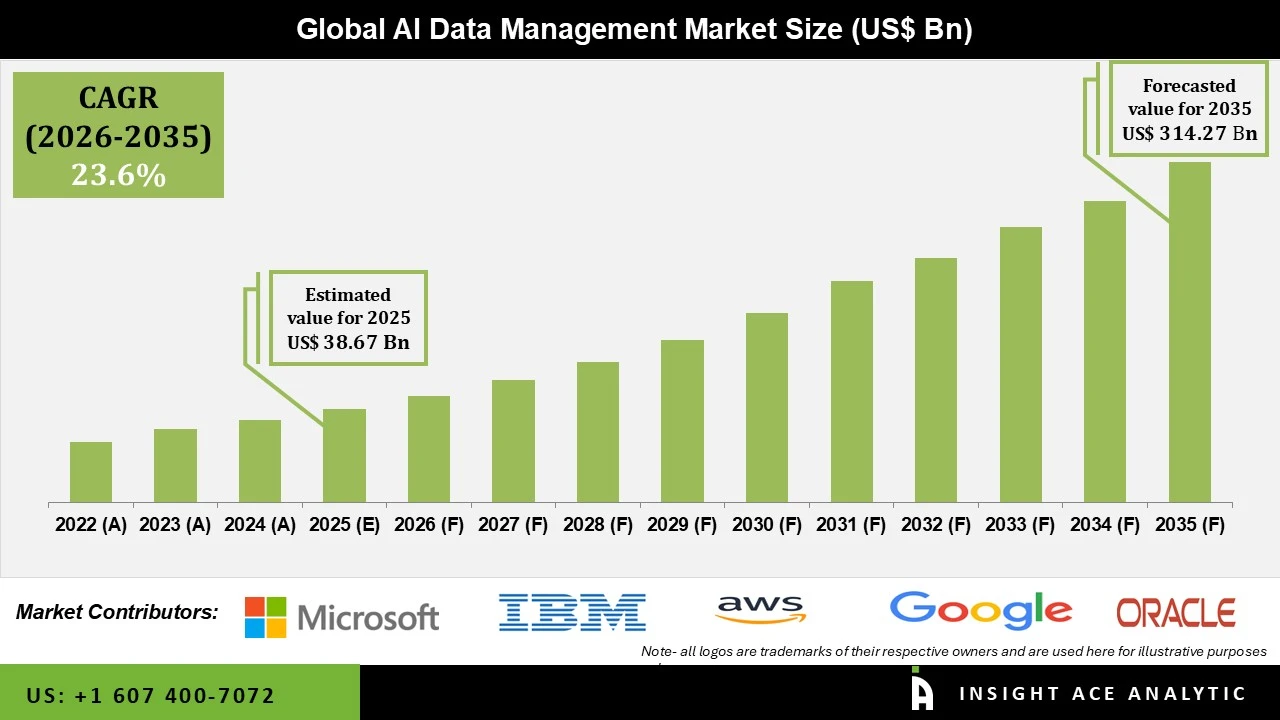
Artificial intelligence (AI) in data management solutions refers to a variety of technologies that combine AI with data management software to improve the organization, storage, processing, analysis, and use of massive amounts of data in businesses. These solutions are made to serve a wide range of industries, such as telecom, healthcare, retail, and BFSI. It uses artificial intelligence (AI) technology, such as predictive analytics, to manage and automate the processing of massive amounts of data, derive insightful information from data, and improve decision-making procedures. The need for better data quality and availability, as well as the increasing requirement for automation to handle massive data quantities, are the main factors propelling AI in data management market.
The AI in data management market has grown dramatically along with the global economy and industries such as BFSI, telecom, retail, healthcare, etc. Globalization and economic interdependence have made it possible for companies to grow internationally, leading to the establishment of corporate offices all over the world. Additionally, favorable investment policies, tax breaks, and regulatory frameworks in many areas have promoted business expansion and entrepreneurship. The governments of nations like Saudi Arabia and India have developed a number of initiatives that have accelerated the AI in data management market expansion. Furthermore, the AI in data management market is expanding due to the extensive use of chatbots powered by AI in a variety of industries to improve customer support.
In addition, a shift toward more data-driven decision-making processes is suggested by the incorporation of advanced analytics into data management procedures, allowing businesses to extract useful insights from their data assets. Furthermore, the growing significance of data governance and compliance appears to have an impact on the AI in data management market. Businesses are realizing more and more how important it is to manage their data in accordance with legal standards. This tendency suggests that solutions that guarantee data security and integrity while also streamlining data administration could expand. The AI in data management market will probably keep changing as the environment does, adding cutting-edge technologies to satisfy the varied demands of companies in different industries.
Competitive Landscape
Which are the Leading Players in AI in Data Management Market?
• Datamatics Business Solutions
• Accenture
• Tamr
• Microsoft
• AWS
• IBM
• ThoughtSpot
• Salesforce
• DOWNLOAD PDF
• INQUIRE NOT
• Ataccama
• Reltio
• Google
• TIBCO Software
• Qlik
• Collibra
• Oracle SAP
• SAS Institute
• HPE
• Snowflake
• Teradata
• Informatica
• Databricks
• Dataiku
• Clarifai
• DDN Storage
• Altery
• AtScale
• Alation
• Dataloop Al
• Astera Software
Market Dynamics
Driver
Growing Trend Towards Cloud-based Systems
The AI in data management market is anticipated to increase in the future due to a trend towards cloud-based systems. Cloud services are becoming more and more popular because they can support the scalability and agility requirements of contemporary enterprises, promote digital transformation, and facilitate remote work. By automating data integration, analysis, and governance, artificial intelligence (AI) in cloud-based data management platforms facilitates effective, scalable, and intelligent data processing and decision-making.
Restrain/Challenge
Increasing Restrictions on Data Transferability
One of the major issues facing the global AI in data management market is effectively adjusting to the wide variety of data types. Enhancing the accuracy of algorithms and improving data quality depend heavily on training AI models on large and diverse datasets. However, it has been noted that there are substantial difficulties in obtaining and analyzing such large and varied data pools. Large datasets require substantial resources to acquire and curate, including strong storage capacity, processing power, and sophisticated data processing abilities. As a result, data transferability has become one of the major AI in data management market due to a lack of a strong data storage infrastructure. Furthermore, as each dataset has a distinct format, quality, and granularity level, ensuring the diversity and representativeness of various datasets has become an essential procedure for businesses.
Banking, Financial Services, and Insurance Segment is Expected to Drive the AI in Data Management Market
The banking, financial services, and insurance category held the largest share in the AI in Data Management market in 2025. AI-powered data management solutions are used to optimize operations for better customer experiences, reduce risk, and increase strategic decision-making capabilities because of large amounts of financial transactions and customer data, as well as stringent regulatory requirements. Additionally, these systems offer fraud detection services and use predictive analytics approaches to customize service offerings for clients due to sophisticated algorithms that can analyze large datasets. Furthermore, they optimize investment strategies by automating standard procedures like loan approvals and insurance claim processing. These same effective technologies make it possible to comply with intricate laws like AML (Anti-Money Laundering) and KYC (Know Your Customer).
Context Awareness Segment is Growing at the Highest Rate in the AI in Data Management Market
In 2025, the context awareness category dominated the AI in Data Management market. AI-powered data management systems use this state-of-the-art technology to adjust their behavior based on contextual cues and situational conditions, such as time, location, user activities, and environmental characteristics. Additionally, context awareness technology makes superior decisions, guaranteeing increased accuracy in information analysis and strategic decision-making. Furthermore, the personalized digital interactions and resource allocation optimization in smart urban environments are only two of the many possible uses for this technology. As a result, end users' adoption of this technology is anticipated to increase in the upcoming years due to growing knowledge of its ability to provide streamlined procedures and much better results.
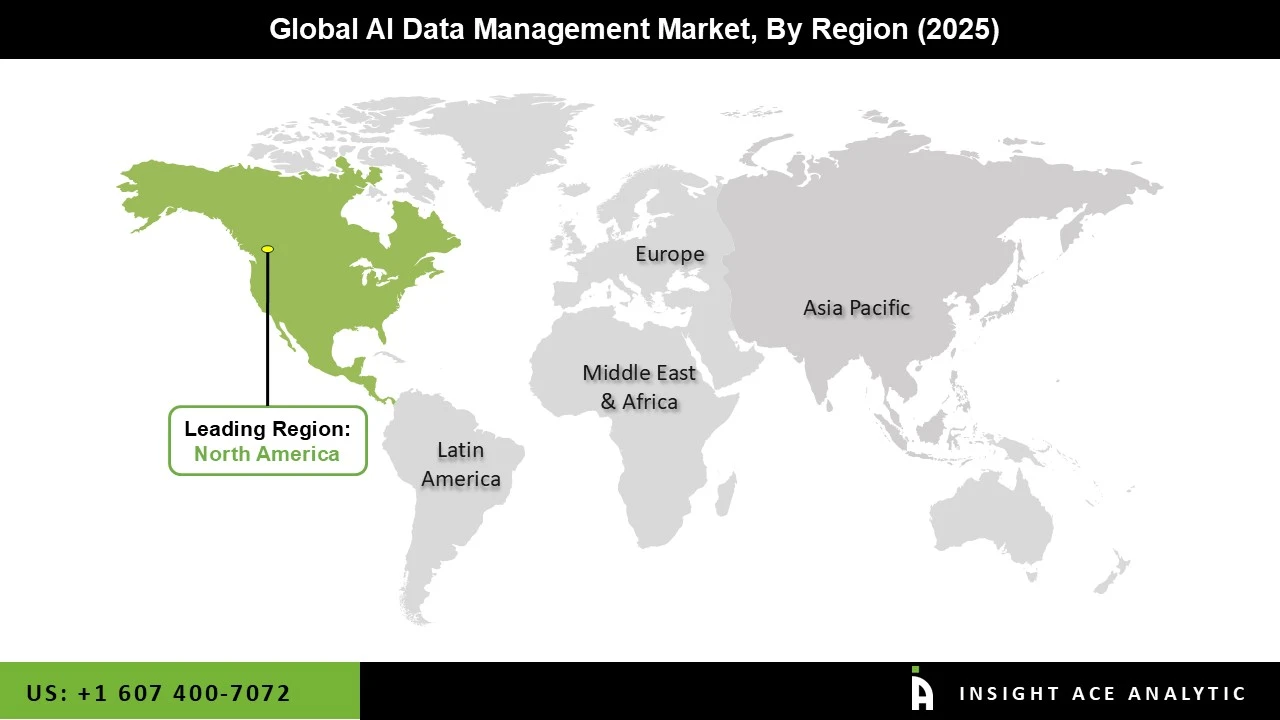
Why North America Led the AI in Data Management Market?
The AI in Data Management market was dominated by North America region in 2025 ascribed to a number of important elements that support the region's industry success. The advanced study and application of AI technologies are made possible by North America's highly developed technological infrastructure. In addition, the existence of big tech companies and startups that specialize in AI and data analytics in the US and Canada greatly promotes innovation and uptake in this area. Furthermore, the regulatory climate in North America supports the development of AI technologies. Governments and regulatory agencies have been progressive in creating frameworks that both protect consumers and promote innovation. Moreover, the widespread expansion of AI in data management is further supported by the region's businesses' high acceptance rate of cloud-based solutions. Businesses in industries like healthcare, banking, and retail are depending more and more on AI to handle enormous volumes of data, which is driving industry expansion.
Key Development
April 2024: Saudi Arabia's first AI-powered Intelligent Data Management Cloud (IDMC) was introduced by US software company Informatica Inc. The platform makes use of Informatica's CLAIRE AI technology to simplify data integration, automate data management operations, and boost overall business results. IDMC is a complete cloud-native solution that enables enterprises to efficiently manage their data across multi-cloud and hybrid environments by connecting, unifying, and democratizing data. By utilizing AI and machine learning capabilities to expedite procedures and enhance decision-making, the platform seeks to facilitate data-led changes.
AI in Data Management Market Report Scope:
| Report Attribute | Specifications |
| Market size value in 2025 | USD 38.67 Bn |
| Revenue forecast in 2035 | USD 314.27 Bn |
| Growth Rate CAGR | CAGR of 23.6% from 2026 to 2035 |
| Quantitative Units | Representation of revenue in US$ Bn and CAGR from 2026 to 2035 |
| Historic Year | 2022 to 2025 |
| Forecast Year | 2026-2035 |
| Report Coverage | The forecast of revenue, the position of the company, the competitive market structure, growth prospects, and trends |
| Segments Covered | Type, Data Type, Deployment Mode, Application, Technology, End-user, and By Region |
| Regional Scope | North America; Europe; Asia Pacific; Latin America; Middle East & Africa |
| Country Scope | U.S.; Canada; U.K.; Germany; China; India; Japan; Brazil; Mexico; The UK; France; Italy; Spain; China; Japan; India; South Korea; Southeast Asia; South Korea; Southeast Asia |
| Competitive Landscape | Datamatics Business Solutions, Accenture, Tamr, Microsoft, AWS, IBM, ThoughtSpot, Salesforce, Ataccama, Reltio, Google, TIBCO Software, Qlik, Collibra, Oracle, SAP, SAS Institute, HPE, Snowflake, Teradata, Informatica, Databricks, Dataiku, Clarifai, DDN Storage, Alteryx, AtScale, Alation, Dataloop AI, and Astera Software. |
| Customization Scope | Free customization report with the procurement of the report, Modifications to the regional and segment scope. Geographic competitive landscape. |
| Pricing and Available Payment Methods | Explore pricing alternatives that are customized to your particular study requirements. |
Market Segmentation:
AI in Data Management Market by Type-
• Platform
• Services
• Software Tools
AI in Data Management Market by Data Type-
• Audio Data
• Speech & Voice Data
• Image Data
• Video Data
• Text Data
AI in Data Management Market by Deployment Mode-
• Cloud
• On-premises
AI in Data Management Market by Application-
• Process Automation
• Data Validation & Noise Reduction
• Data Augmentation
• Exploratory Data Analysis
• Imputation & Predictive Modeling
• Data Anonymization & Compression
• Others
AI in Data Management Market by Technology-
• Machine Learning
• Natural Language Processing
• Computer Vision
• Context Awareness
AI in Data Management Market by End-user-
• Banking, Financial Services, and Insurance
• Retail & Ecommerce
• Telecommunications
• Healthcare & Life Sciences
• Manufacturing
• IT & ITES
• Government & Defense
• Media & Entertainment
• Energy & Utilities
AI in Data Management Market by Region-
North America-
• The US
• Canada
Europe-
• Germany
• The UK
• France
• Italy
• Spain
• Rest of Europe
Asia-Pacific-
• China
• Japan
• India
• South Korea
• South East Asia
• Rest of Asia Pacific
Latin America-
• Brazil
• Argentina
• Mexico
• Rest of Latin America
Middle East & Africa-
• GCC Countries
• South Africa
• Rest of Middle East and Africa
Research Design and Approach
This study employed a multi-step, mixed-method research approach that integrates:
- Secondary research
- Primary research
- Data triangulation
- Hybrid top-down and bottom-up modelling
- Forecasting and scenario analysis
This approach ensures a balanced and validated understanding of both macro- and micro-level market factors influencing the market.
Secondary Research
Secondary research for this study involved the collection, review, and analysis of publicly available and paid data sources to build the initial fact base, understand historical market behaviour, identify data gaps, and refine the hypotheses for primary research.
Sources Consulted
Secondary data for the market study was gathered from multiple credible sources, including:
- Government databases, regulatory bodies, and public institutions
- International organizations (WHO, OECD, IMF, World Bank, etc.)
- Commercial and paid databases
- Industry associations, trade publications, and technical journals
- Company annual reports, investor presentations, press releases, and SEC filings
- Academic research papers, patents, and scientific literature
- Previous market research publications and syndicated reports
These sources were used to compile historical data, market volumes/prices, industry trends, technological developments, and competitive insights.

Primary Research
Primary research was conducted to validate secondary data, understand real-time market dynamics, capture price points and adoption trends, and verify the assumptions used in the market modelling.
Stakeholders Interviewed
Primary interviews for this study involved:
- Manufacturers and suppliers in the market value chain
- Distributors, channel partners, and integrators
- End-users / customers (e.g., hospitals, labs, enterprises, consumers, etc., depending on the market)
- Industry experts, technology specialists, consultants, and regulatory professionals
- Senior executives (CEOs, CTOs, VPs, Directors) and product managers
Interview Process
Interviews were conducted via:
- Structured and semi-structured questionnaires
- Telephonic and video interactions
- Email correspondences
- Expert consultation sessions
Primary insights were incorporated into demand modelling, pricing analysis, technology evaluation, and market share estimation.
Data Processing, Normalization, and Validation
All collected data were processed and normalized to ensure consistency and comparability across regions and time frames.
The data validation process included:
- Standardization of units (currency conversions, volume units, inflation adjustments)
- Cross-verification of data points across multiple secondary sources
- Normalization of inconsistent datasets
- Identification and resolution of data gaps
- Outlier detection and removal through algorithmic and manual checks
- Plausibility and coherence checks across segments and geographies
This ensured that the dataset used for modelling was clean, robust, and reliable.
Market Size Estimation and Data Triangulation
Bottom-Up Approach
The bottom-up approach involved aggregating segment-level data, such as:
- Company revenues
- Product-level sales
- Installed base/usage volumes
- Adoption and penetration rates
- Pricing analysis
This method was primarily used when detailed micro-level market data were available.

Top-Down Approach
The top-down approach used macro-level indicators:
- Parent market benchmarks
- Global/regional industry trends
- Economic indicators (GDP, demographics, spending patterns)
- Penetration and usage ratios
This approach was used for segments where granular data were limited or inconsistent.
Hybrid Triangulation Approach
To ensure accuracy, a triangulated hybrid model was used. This included:
- Reconciling top-down and bottom-up estimates
- Cross-checking revenues, volumes, and pricing assumptions
- Incorporating expert insights to validate segment splits and adoption rates
This multi-angle validation yielded the final market size.
Forecasting Framework and Scenario Modelling
Market forecasts were developed using a combination of time-series modelling, adoption curve analysis, and driver-based forecasting tools.
Forecasting Methods
- Time-series modelling
- S-curve and diffusion models (for emerging technologies)
- Driver-based forecasting (GDP, disposable income, adoption rates, regulatory changes)
- Price elasticity models
- Market maturity and lifecycle-based projections
Scenario Analysis
Given inherent uncertainties, three scenarios were constructed:
- Base-Case Scenario: Expected trajectory under current conditions
- Optimistic Scenario: High adoption, favourable regulation, strong economic tailwinds
- Conservative Scenario: Slow adoption, regulatory delays, economic constraints
Sensitivity testing was conducted on key variables, including pricing, demand elasticity, and regional adoption.
Request Customization
Add countries, segments, company profiles, or extend forecast — free 10% customization with purchase.
Customize This Report →Enquire Before Buying
Speak with our analyst team about scope, methodology, pricing, or deliverable formats.
Enquire Now →Frequently Asked Questions
AI in Data Management Market Size is valued at USD 38.67 Bn in 2025 and is predicted to reach USD 314.27 Bn by the year 2035
AI in Data Management Market is predicted to grow at a 23.6% CAGR during the forecast period for 2026 to 2035.
Datamatics Business Solutions, Accenture, Tamr, Microsoft, AWS, IBM, ThoughtSpot, Salesforce, Ataccama, Reltio, Google, TIBCO Software, Qlik, Collibra, Oracle, SAP, SAS Institute, HPE, Snowflake, Teradata, Informatica, Databricks, Dataiku, Clarifai, DDN Storage, Alteryx, AtScale, Alation, Dataloop AI, and Astera Software.
AI in Data Management Market is segmented into Type, Data Type, Deployment Mode, Application, Technology, End-user, and By Region
North America region is leading the AI in Data Management Market.