Network Automation Market Size, Scope, Forecast Report 2026 to 2035
What is Network Automation Market Size?
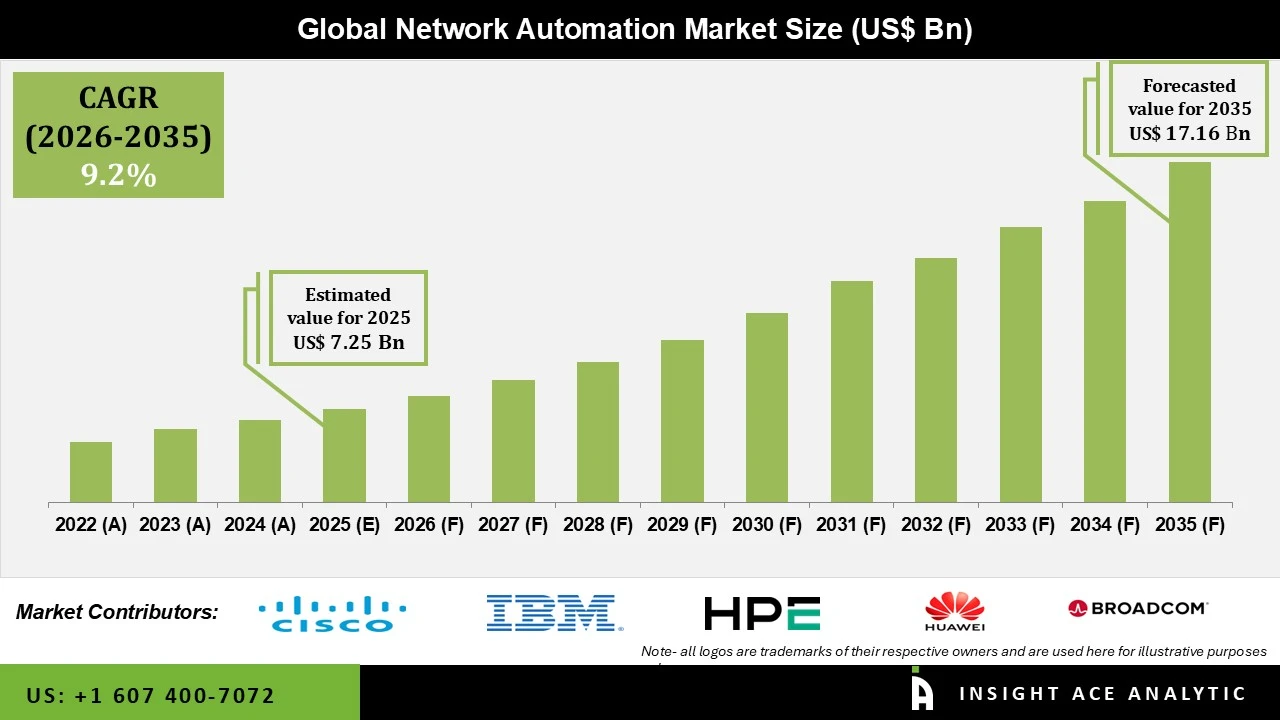
Network Automation Market Size is valued at USD 7.25 Bn in 2025 and is predicted to reach USD 17.16 Bn by the year 2035 at a 9.2% CAGR during the forecast period for 2026 to 2035.
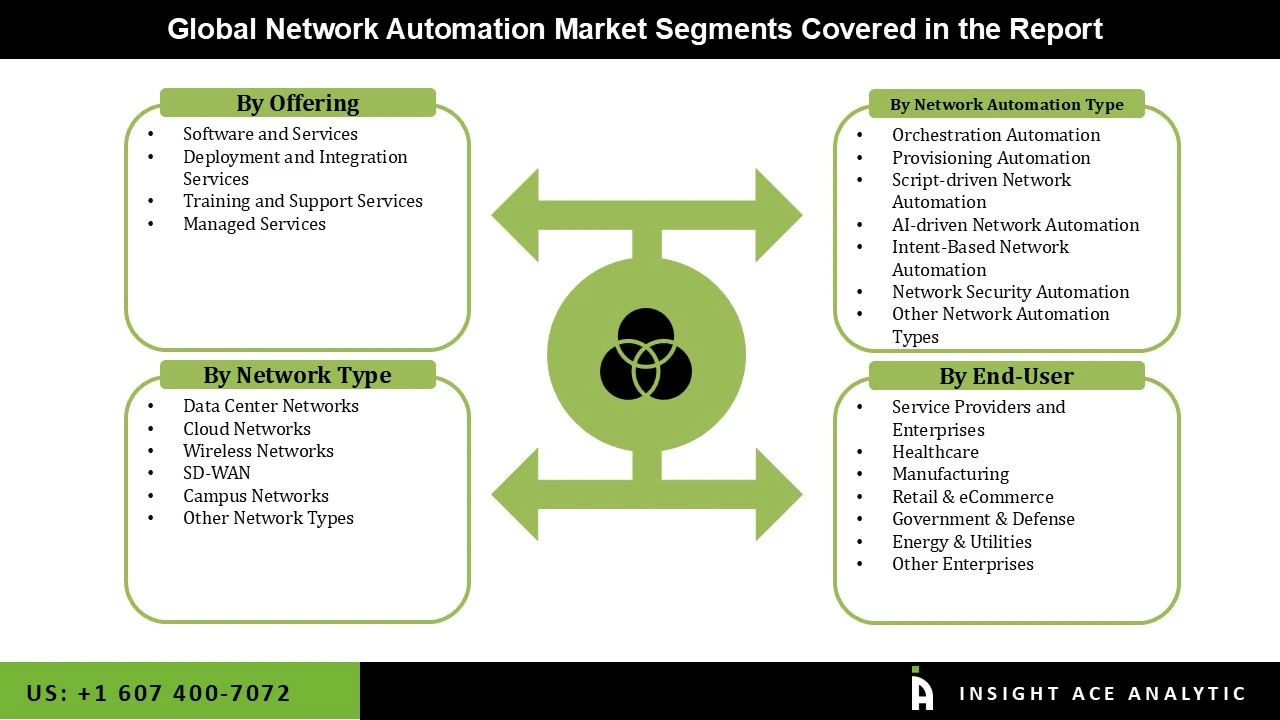
Network Automation Market Size, Share & Trends Analysis Distribution by Offering (Software and Services, Deployment and Integration Services, Training and Support Services, Managed Services), by Network Automation Type (Orchestration Automation, Provisioning Automation, Script-driven Network Automation, AI-driven Network Automation, Intent-Based Network Automation, Network Security Automation, Other Network Automation Type), by Network Type (Data Center Networks, Cloud Networks, Wireless Networks, SD-WAN, Campus Networks, Other Network Type), by End User (Service Providers and Enterprises, Healthcare, Manufacturing, Retail & eCommerce, Government & Defense, Energy & Utilities, Other Enterprises) and Segment Forecasts, 2026 to 2035
Network automation is becoming an increasingly important part of modern IT and telecommunications infrastructure as organisations seek faster, more reliable, and more efficient ways to manage increasingly complex networks. Network automation uses software, orchestration tools, APIs, artificial intelligence, and policy-based technologies to automate tasks such as network configuration, provisioning, monitoring, troubleshooting, security management, and performance optimisation. These capabilities help organisations reduce manual workloads, minimise configuration errors, and improve overall network operations efficiency. As more organisations use cloud computing, data centres, SDN, SD-WAN, 5G, and hybrid IT setups, the need for network automation is growing. Managing larger, more distributed networks makes manual work slow and hard to scale. Automation standardises routine tasks, speeds up service delivery, and adapts quickly to new network needs. Because of this, more companies are turning to automation to boost efficiency, reliability, and support digital transformation.
Technological advancements are further expanding network automation capabilities. Modern solutions increasingly incorporate artificial intelligence and machine learning to identify network anomalies, predict potential failures, optimise traffic, and support automated troubleshooting. Intent-based networking is also gaining attention by letting organisations define desired network outcomes, while automation platforms translate those requirements into appropriate configurations and policies. Integration with APIs, orchestration platforms, cloud management tools, and security solutions helps organisations create more coordinated, automated network environments. Organisations choose different types of network automation depending on their needs. Orchestration automation coordinates tasks across many devices and systems, while provisioning automation makes it easier to set up and configure network resources.
AI-driven and intent-based automation are becoming more important as networks get smarter and more self-managing. Security automation is also on the rise, helping businesses respond quickly to threats, policy issues, and management. Cloud networks require automation to support dynamic infrastructure and rapidly changing workloads. Wireless networks and SD-WAN environments also benefit from centralised management and automated policy enforcement. In campus networks, automation can simplify device configuration, access management, monitoring, and troubleshooting. These applications are helping organisations manage increasingly distributed and software-defined network environments more efficiently.
Network automation benefits both service providers and businesses. Telecom companies can use automation to deliver services faster, make better use of network resources, and work more efficiently. Many industries, like healthcare, manufacturing, retail, government, and energy, are also turning to automation to support digital operations and keep networks reliable. For example, in manufacturing and energy, automation helps manage lots of connected devices and spread-out infrastructure. In healthcare and retail, having reliable and secure networks is key for digital services and connected apps. Despite these opportunities, several challenges can affect the adoption of network automation. Integrating automation platforms with legacy infrastructure can be complex, especially in organisations that run networks from multiple vendors.
Initial implementation costs, interoperability issues, security considerations, and the need for skilled networking and automation professionals can also create barriers. Organisations may need to redesign existing workflows and invest in training before they can achieve the full benefits of automation. Concerns around automated changes and network reliability can also make some businesses cautious about moving away from manual processes.
Competitive Landscape
Which are the Leading Players in the Network Automation Market ?
• Cisco
• IBM
• HPE
• Huawei
• Broadcom
• Arista Networks
• Nokia
• Ericsson
• Extreme Networks
• Fujitsu
• NetBrain Technologies
• Gluware
• SolarWinds
• Riverbed
• Forward Networks
• Palo Alto Networks
Driver
Growing Adoption of Cloud, AI, and Digital Infrastructure is Driving Network Automation
Cloud computing, data centers, SDN, SD-WAN, 5G, and hybrid IT environments are expanding quickly and driving growth in the global network automation market. As networks become more complex and spread out, organizations want to cut down on manual work, boost efficiency, and adapt faster to business needs. Network automation helps by handling repetitive tasks like device setup, provisioning, monitoring, troubleshooting, and enforcing policies, which reduces mistakes and network downtime. More organizations are using AI and machine learning, which is increasing demand for network automation. AI-powered tools can check network performance, spot problems, predict issues, and help fix them automatically. Intent-based networking is also becoming popular, letting organizations set their network goals and have automation tools handle the setup. As SD-WAN and cloud networks grow, there is a greater need for centralized and automated network management. Service providers are using automation to accelerate network provisioning, optimize resources, and improve service delivery, while enterprises are adopting it to manage complex IT environments across offices, data centers, cloud platforms, and remote locations.
Restraint/Challenge
Integration Complexity and Shortage of Skilled Professionals Can Limit Market Expansion
The complexity of integrating network automation solutions with existing infrastructure remains a major challenge for market growth. Many organizations operate networks that include legacy equipment, multiple vendors, different protocols, and a combination of physical and virtual infrastructure. Connecting these environments with modern automation platforms can require significant time, technical expertise, and investment. Organizations can also run into problems with interoperability, cybersecurity, data management, and making sure automation works with their current network systems. If automation workflows are not well designed, they can cause errors or disrupt the network, so careful testing and gradual rollout are important.
The shortage of professionals with expertise in networking, automation, cloud technologies, APIs, and AI can further slow adoption, particularly among smaller organizations. Companies may need to invest in employee training, professional services, and new management tools before achieving the full benefits of automation. Concerns around security and control over automated network changes can also make organizations cautious about implementing highly automated environments. To overcome these challenges, vendors are increasingly focusing on simplified deployment, open APIs, multi-vendor compatibility, centralized management, and AI-assisted automation. Greater availability of skilled professionals and improved integration capabilities will also be important for wider market adoption.
Enterprise Segment is Expected to Account for a Significant Share of the Network Automation Market
The enterprise segment is expected to represent a significant portion of the network automation market as businesses increasingly modernize their IT infrastructure and manage more complex network environments. Enterprises across healthcare, manufacturing, retail and e-commerce, government and defense, and energy and utilities are adopting automation to improve network reliability, reduce manual workloads, and support digital operations. Large enterprises often operate networks across multiple offices, data centers, cloud platforms, and remote locations. Managing these environments manually can increase operational complexity and make it difficult to maintain consistent configurations and security policies. Network automation helps organizations standardize configurations, automate provisioning, monitor network performance, and respond more quickly to network issues. The growing adoption of cloud services, connected devices, remote work environments, SD-WAN, and software-defined infrastructure is further increasing the need for automated network management.
AI-Driven Network Automation Segment is Expected to Witness Strong Growth of the Network Automation Market
AI-driven network automation is expected to grow quickly as more organizations use AI and machine learning to manage networks. Traditional automation handles set rules and repetitive tasks, but AI-driven automation can analyse large volumes of network data and make smarter decisions. AI-powered solutions can help identify unusual network behavior, detect performance issues, predict potential failures, optimize traffic, and support automated troubleshooting. This can reduce the time required to identify and resolve network problems while improving overall network visibility. The growing complexity of cloud networks, data centers, wireless infrastructure, and SD-WAN environments is creating additional demand for intelligent automation. AI can help network teams manage large numbers of devices and connections without relying entirely on manual monitoring. Integration of AI with intent-based networking can also allow organizations to define desired network outcomes while automation platforms determine and implement the appropriate actions. As AI becomes more embedded in network management platforms, features like predictive analytics, automated fixes, and smart optimisation are expected to open more opportunities for AI-driven network automation.
Why North America Led the Network Automation Market?
Asia Pacific represents a rapidly expanding market for network automation, supported by accelerating digital transformation, expanding telecommunications infrastructure, growing cloud adoption, and significant investments in data centres and enterprise connectivity.
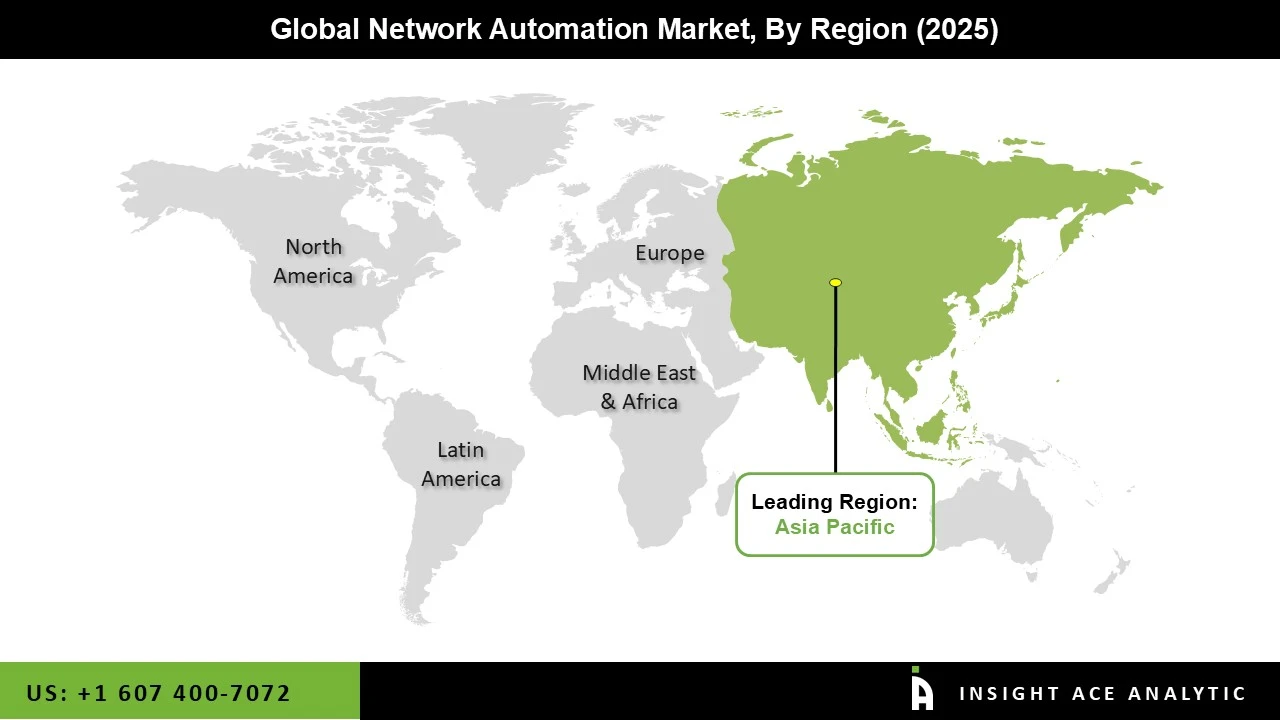
The increasing integration of artificial intelligence, machine learning, intent-based networking, autonomous network operations, and automated security management is further transforming network management across Asia Pacific. In addition, the region's expanding digital economy, growing internet and mobile connectivity, increasing data-centre capacity, and continued investments in telecommunications infrastructure are supporting the adoption of advanced network automation solutions. These factors are strengthening Asia Pacific's position as an important and rapidly evolving market for network automation.
Key Developments
• In March 2026, Huawei enhanced its Autonomous Driving Network (ADN) portfolio with new capabilities aimed at accelerating Level-4 autonomous network deployment. The solution focuses on higher scenario self-closure, single-domain network autonomy, and end-to-end experience assurance, supporting more automated network operations and reducing manual intervention.
• In May 2026, HPE introduced new self-driving network capabilities across its HPE Mist and HPE Aruba Central platforms. The enhancements use agentic AI and autonomous actions to detect, diagnose, and resolve network issues, while also supporting capacity optimization, security automation, and user-experience improvements.
Network Automation Market Report Scope:
| Report Attribute | Specifications |
| Market size value in 2025 | USD 7.25 Bn |
| Revenue forecast in 2035 | USD 17.16 Bn |
| Growth Rate CAGR | CAGR of 9.2% from 2026 to 2035 |
| Quantitative Units | Representation of revenue in US$ Bn and CAGR from 2026 to 2035 |
| Historic Year | 2021 to 2025 |
| Forecast Year | 2026-2035 |
| Report Coverage | The forecast of revenue, the position of the company, the competitive market structure, growth prospects, and trends |
| Segments Covered | Offering, Network Automation Type, Network Type, End User and By Region |
| Regional Scope | North America; Europe; Asia Pacific; Latin America; Middle East & Africa |
| Country Scope | U.S.; Canada; U.K.; Germany; China; India; Japan; Brazil; Mexico; France; Italy; Spain; South Korea; Southeast Asia |
| Competitive Landscape | Cisco, IBM, HPE, Huawei, Broadcom, Arista Networks, Nokia, Ericsson, Extreme Networks, Fujitsu, NetBrain Technologies, Gluware, SolarWinds, Riverbed, Forward Networks, Palo Alto Networks. |
| Customization Scope | Free customisation report with the procurement of the report, Modifications to the regional and segment scope. Geographic competitive landscape. |
| Pricing and Available Payment Methods | Explore pricing alternatives that are customised to your particular study requirements. |
Market Segmentation:
Network Automation Market by Offering -
• Software and Services
• Deployment and Integration Services
• Training and Support Services
• Managed Services
Network Automation Market by Network Automation Type -
• Orchestration Automation
• Provisioning Automation
• Script-driven Network Automation
• AI-driven Network Automation
• Intent-Based Network Automation
• Network Security Automation
• Other Network Automation Types
Network Automation Market by Network Type -
• Data Center Networks
• Cloud Networks
• Wireless Networks
• SD-WAN
• Campus Networks
• Other Network Types
Network Automation Market by End User -
• Service Providers and Enterprises
• Healthcare
• Manufacturing
• Retail & eCommerce
• Government & Defense
• Energy & Utilities
• Other Enterprises
Network Automation Market by Region-
North America-
• The US
• Canada
• Rest of North America
Europe-
• Germany
• United Kingdom
• France
• Italy
• Nordics
• Rest of Europe
Asia-Pacific-
• Japan
• China
• South Korea
• India
• Australia
• Rest of Asia-Pacific
Middle East and Africa-
• GCC & Saudi Arabia
• South Africa
• Rest of Middle East & Africa
Latin America-
• Brazil
• Rest of Latin America
Research Design and Approach
This study employed a multi-step, mixed-method research approach that integrates:
- Secondary research
- Primary research
- Data triangulation
- Hybrid top-down and bottom-up modelling
- Forecasting and scenario analysis
This approach ensures a balanced and validated understanding of both macro- and micro-level market factors influencing the market.
Secondary Research
Secondary research for this study involved the collection, review, and analysis of publicly available and paid data sources to build the initial fact base, understand historical market behaviour, identify data gaps, and refine the hypotheses for primary research.
Sources Consulted
Secondary data for the market study was gathered from multiple credible sources, including:
- Government databases, regulatory bodies, and public institutions
- International organizations (WHO, OECD, IMF, World Bank, etc.)
- Commercial and paid databases
- Industry associations, trade publications, and technical journals
- Company annual reports, investor presentations, press releases, and SEC filings
- Academic research papers, patents, and scientific literature
- Previous market research publications and syndicated reports
These sources were used to compile historical data, market volumes/prices, industry trends, technological developments, and competitive insights.

Primary Research
Primary research was conducted to validate secondary data, understand real-time market dynamics, capture price points and adoption trends, and verify the assumptions used in the market modelling.
Stakeholders Interviewed
Primary interviews for this study involved:
- Manufacturers and suppliers in the market value chain
- Distributors, channel partners, and integrators
- End-users / customers (e.g., hospitals, labs, enterprises, consumers, etc., depending on the market)
- Industry experts, technology specialists, consultants, and regulatory professionals
- Senior executives (CEOs, CTOs, VPs, Directors) and product managers
Interview Process
Interviews were conducted via:
- Structured and semi-structured questionnaires
- Telephonic and video interactions
- Email correspondences
- Expert consultation sessions
Primary insights were incorporated into demand modelling, pricing analysis, technology evaluation, and market share estimation.
Data Processing, Normalization, and Validation
All collected data were processed and normalized to ensure consistency and comparability across regions and time frames.
The data validation process included:
- Standardization of units (currency conversions, volume units, inflation adjustments)
- Cross-verification of data points across multiple secondary sources
- Normalization of inconsistent datasets
- Identification and resolution of data gaps
- Outlier detection and removal through algorithmic and manual checks
- Plausibility and coherence checks across segments and geographies
This ensured that the dataset used for modelling was clean, robust, and reliable.
Market Size Estimation and Data Triangulation
Bottom-Up Approach
The bottom-up approach involved aggregating segment-level data, such as:
- Company revenues
- Product-level sales
- Installed base/usage volumes
- Adoption and penetration rates
- Pricing analysis
This method was primarily used when detailed micro-level market data were available.

Top-Down Approach
The top-down approach used macro-level indicators:
- Parent market benchmarks
- Global/regional industry trends
- Economic indicators (GDP, demographics, spending patterns)
- Penetration and usage ratios
This approach was used for segments where granular data were limited or inconsistent.
Hybrid Triangulation Approach
To ensure accuracy, a triangulated hybrid model was used. This included:
- Reconciling top-down and bottom-up estimates
- Cross-checking revenues, volumes, and pricing assumptions
- Incorporating expert insights to validate segment splits and adoption rates
This multi-angle validation yielded the final market size.
Forecasting Framework and Scenario Modelling
Market forecasts were developed using a combination of time-series modelling, adoption curve analysis, and driver-based forecasting tools.
Forecasting Methods
- Time-series modelling
- S-curve and diffusion models (for emerging technologies)
- Driver-based forecasting (GDP, disposable income, adoption rates, regulatory changes)
- Price elasticity models
- Market maturity and lifecycle-based projections
Scenario Analysis
Given inherent uncertainties, three scenarios were constructed:
- Base-Case Scenario: Expected trajectory under current conditions
- Optimistic Scenario: High adoption, favourable regulation, strong economic tailwinds
- Conservative Scenario: Slow adoption, regulatory delays, economic constraints
Sensitivity testing was conducted on key variables, including pricing, demand elasticity, and regional adoption.
Request Customization
Add countries, segments, company profiles, or extend forecast — free 10% customization with purchase.
Customize This Report →Enquire Before Buying
Speak with our analyst team about scope, methodology, pricing, or deliverable formats.
Enquire Now →Frequently Asked Questions
Network Automation Market Size is valued at USD 7.25 Bn in 2025 and is predicted to reach USD 17.16 Bn by the year 2035
Network Automation Market is expected to grow at a 9.2% CAGR during the forecast period for 2026 to 2035.
Cisco, IBM, HPE, Huawei, Broadcom, Arista Networks, Nokia, Ericsson, Extreme Networks, Fujitsu, NetBrain Technologies, Gluware, SolarWinds, Riverbed, Forward Networks, Palo Alto Networks.
Network Automation Market is segmented into Offering, Network Automation Type, Network Type, End User and By Region
North America region is leading the Network Automation Market.