Workforce Management Market Size, Scope, Revenue Report 2026 to 2035
What is Workforce Management Market Size?
Workforce Management Market Size is valued at USD 10.28 Bn in 2025 and is predicted to reach USD 29.72 Bn by the year 2035 at a 11.4 % CAGR during the forecast period for 2026 to 2035.
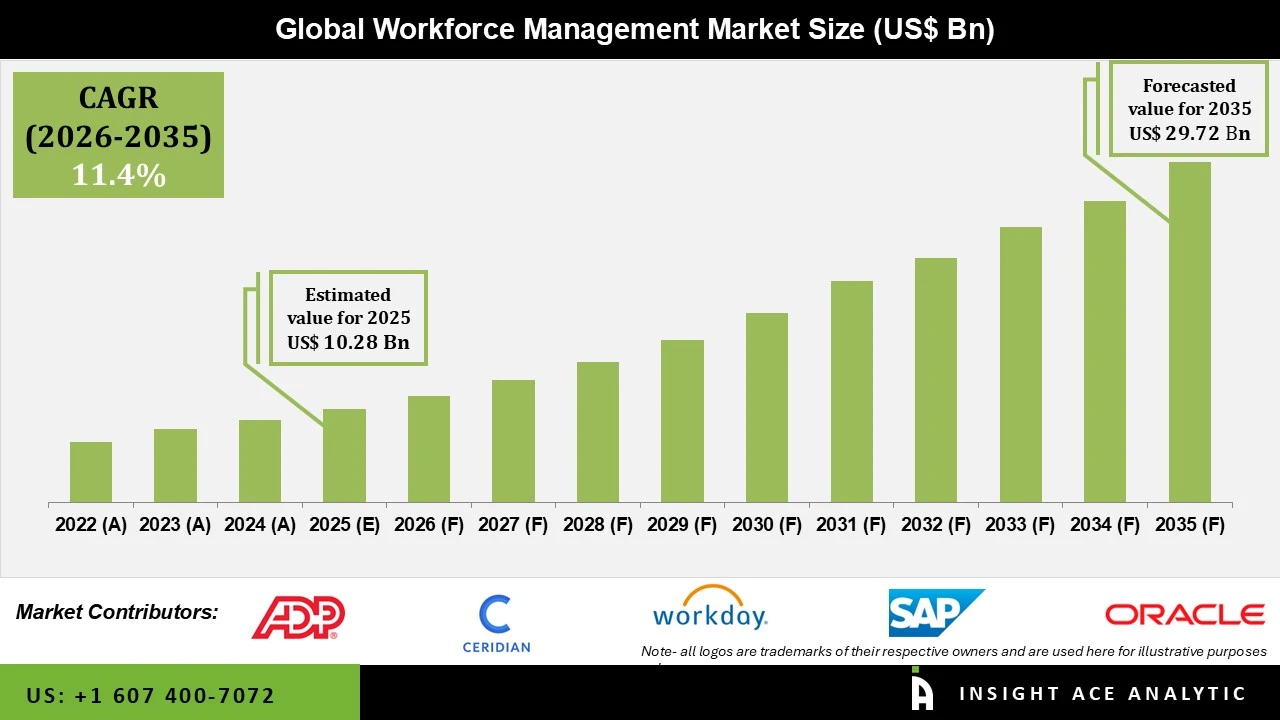
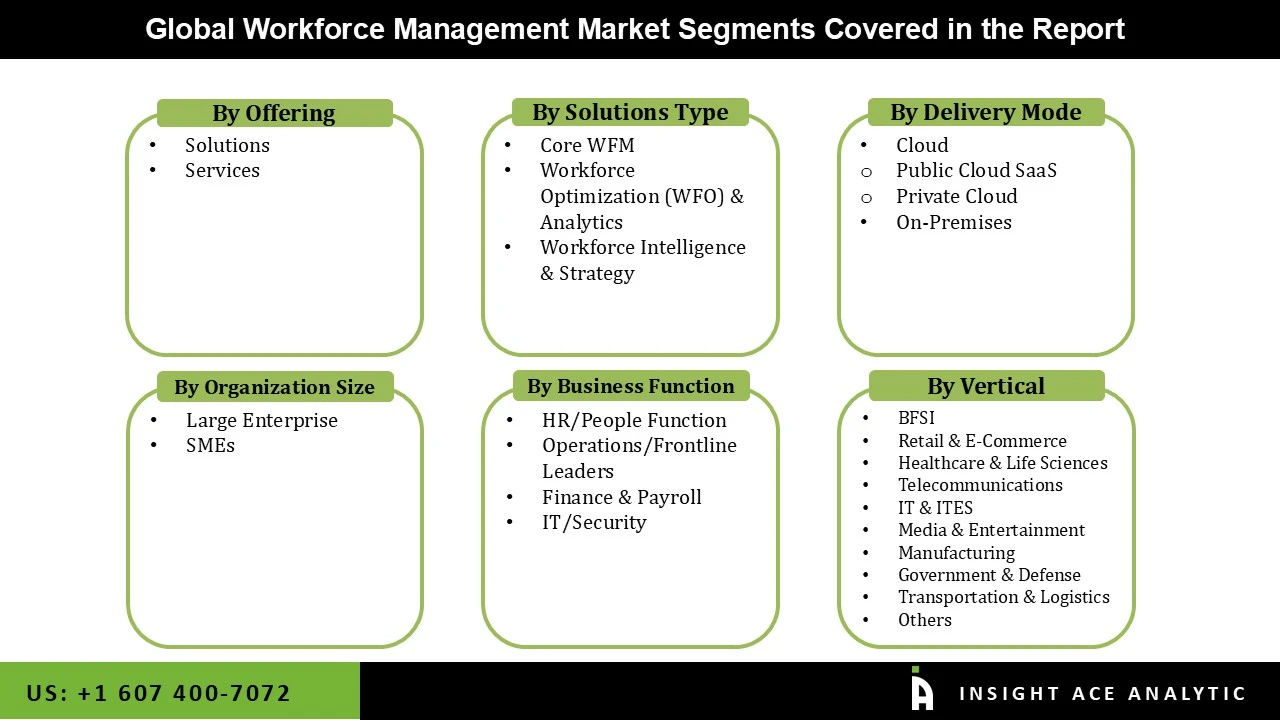
Workforce Management Market Size, Share & Trends Analysis Distribution by Offering (Solutions, Services), By Solutions Type (Core WFM, Workforce Optimization (WFO) & Analytics, Workforce Intelligence & Strategy), By Delivery Mode (Cloud, On-Premises), By Organization Size (Large Enterprise, SMEs), By Business Function (HR/People Function, Operations/Frontline Leaders, Finance & Payroll, IT/Security), By Vertical (BFSI, Retail & E-Commerce, Healthcare & Life Sciences, Telecommunications, IT & ITES, Media & Entertainment, Manufacturing, Government & Defense, Transportation & Logistics, Others) and Segment Forecasts, 2026 to 2035
Workforce management (WFM) means the range of processes, technological tools, and services that organisations use in order to plan, organise, deploy and monitor their workforce in an efficient manner. It includes things like the management of time and attendance, workforce scheduling and planning, the management of leave and absence, compliance with labour regulations, workforce forecasting, the monitoring of productivity, labour costing, and employee engagement. By means of WFM, organisations are able to match the availability of their workforce with their operational needs while at the same time gaining better visibility regarding how their employees are being used, their schedules, their productivity and other labour-related activities. In view of the fact that organisations are dealing with ever more complex workforce arrangements in office-based, hybrid, remote and frontline settings, the WFM technologies offer centralised capabilities for co-ordinating workforce activities and for supporting everyday operations.
The workforce management market consists of software and the related services which help with workforce administration, optimization, analytics, and strategic planning in various organizations. It covers standalone WFM solutions, integrated WFM suites, professional services, and managed services, all of which are provided in either cloud or on-premises environments. Nowadays, WFM platforms tend to combine the basic workforce management functions with those relating to workforce optimization, analytics, forecasting, and workforce intelligence, allowing companies to handle their workforce data and planning via integrated platforms. The market's adoption is found in a number of business areas including HR, operations, finance and payroll, and IT, and the applications are used in the BFSI, retail and e-commerce, healthcare and life sciences, telecommunications, IT and ITES, manufacturing, and defence, and transportation and logistics sectors.
Competitive Landscape
Which are the Leading Players in the Workforce Management Market?
• ADP
• SAP
• Workday
• Ceridian
• Oracle
• Paycor
• Paychex
• Infor
• BambooHR
• Atoss Software
• NICE
• IBM
• Ramco Systems
• TimeClock Plus
• SumTotal
• Avature
• Sisqual Workforce Management
• ActiveOps
• Ultimate Software
• Verint
• Mark Information
• Reflexis Systems
• Authority Software
• Paylocity
Market Dynamics
Driver
Growing Need for Workforce Optimization and Labor Cost Management
The increasing desire to make the best use of workers and to keep labour costs under control is a key factor in the growth of the workforce management market. Businesses in all kinds of industries are encountering complicated staffing needs, varying workloads, limitations due to employee availability, and rising labour expenses, which in turn leads to a demand for technologies that can match workforce capacity with operational requirements. By using workforce management platforms, organisations can automate their scheduling, keep records of time and attendance, forecast their workforce demand, monitor productivity, and handle the allocation of labour. Thanks to these features, companies are able to improve the way they utilise their workforce while also gaining better insight into labour costs. The greater application of analytics and forecasting powered by AI also contributes to more data-driven workforce planning, prompting organisations to take up WFM solutions in order to achieve more efficient workforce deployment and operational management.
Restrain/Challenge
Complexity of Integration with Existing Systems
The difficulty involved in combining workforce management solutions with the systems that already exist in an organisation is a major problem for the market. Since companies usually use a number of different systems for human resources, payroll, ERP, time-tracking, scheduling, and employee management, problems arise when attempting to introduce a single WFM platform. Integration might involve considerable data migration, extensive system configuration, the development of APIs, and changes to existing processes, thus lengthening the time and raising the costs of implementation. There is also the possibility that organisations will encounter compatibility problems with their older systems and that their current workflows will be disrupted during the rollout. These difficulties become especially important for large enterprises that have complicated IT environments, which is why some companies are hesitant to replace or consolidate their present workforce management systems.
Solutions Segment is Expected to Drive the Workforce Management Market
Solutions are expected to drive the workforce management market, supported by the increasing adoption of standalone WFM applications and integrated WFM suites that enable organizations to manage workforce scheduling, time and attendance, leave and absence, compliance, workforce planning, and analytics through centralized platforms. The increasing demand for real-time visibility of the workforce, automated workforce processes, and data-driven planning is prompting organisations to take up WFM solutions in various business functions and across different industries. Moreover, the move towards cloud-based platforms together with the integration of analytics and workforce intelligence features is enhancing the capabilities of WFM solutions and thus increasing their demand.
Workforce Intelligence & Strategy Segment is Growing at the Highest Rate in the Workforce Management Market
Workforce Intelligence & Strategy is anticipated to experience the fastest rate of growth, thanks to the rising demand for strategic workforce planning, greater employee engagement, more advanced labor analytics, and decisions based on data. Instead of merely carrying out basic workforce administration, organisations are now using workforce data to understand labour trends, predict their future workforce needs, enhance employee engagement, and ensure that their workforce strategies match the wider business objectives. The deeper integration of advanced analytics and AI features into WFM platforms is also contributing to the increased demand for workforce intelligence and strategic planning solutions.
Why North America Led the Workforce Management Market?
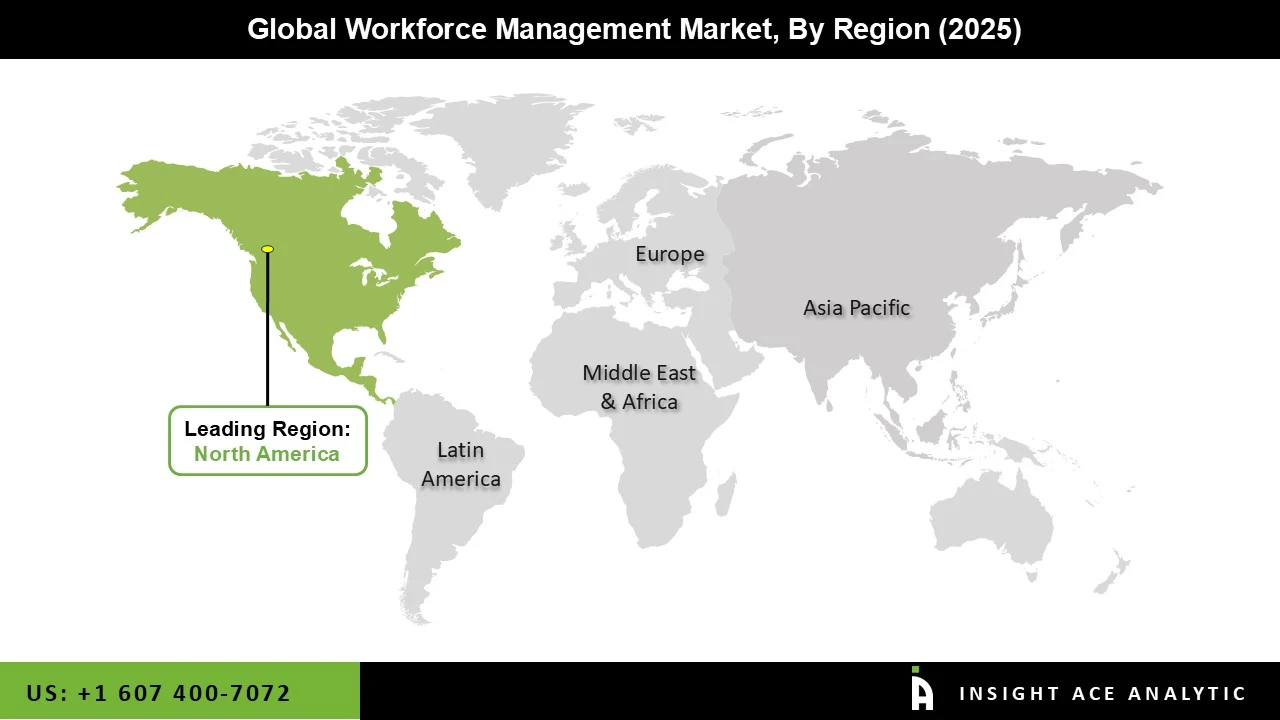
North America is expected to lead the workforce management market, supported by the region’s high adoption of cloud-based enterprise software, advanced HR technologies, workforce analytics, and automated workforce management platforms. Strong demand in the area is further supported by the availability of major WFM and enterprise technology providers and by the extensive digital transformation that has taken place in industries including BFSI, retail, healthcare, IT, and telecommunications. Moreover, organisations in North America are increasingly making use of workforce scheduling, time and attendance, labor forecasting, and analytics tools in order to manage their complex workforce arrangements and enhance operational efficiency.
Workforce Management Market Report Scope:
| Report Attribute | Specifications |
| Market size value in 2025 | USD 10.28 Bn |
| Revenue forecast in 2035 | USD 29.72 Bn |
| Growth Rate CAGR | CAGR of XX% from 2026 to 2035 |
| Quantitative Units | Representation of revenue in US$ Bn and CAGR from 2026 to 2035 |
| Historic Year | 2022 to 2025 |
| Forecast Year | 2026-2035 |
| Report Coverage | The forecast of revenue, the position of the company, the competitive market structure, growth prospects, and trends |
| Segments Covered | Offering, Solutions Type, Delivery Mode, Organization Size, Business Function, Vertical and By Region |
| Regional Scope | North America; Europe; Asia Pacific; Latin America; Middle East & Africa |
| Country Scope | U.S.; Canada; U.K.; Germany; China; India; Japan; Brazil; Mexico; The UK; France; Italy; Spain; China; Japan; India; South Korea; Southeast Asia; South Korea; Southeast Asia |
| Competitive Landscape | ADP, SAP, Workday, Ceridian, Oracle, Paycor, Paychex, Infor, BambooHR, Atoss Software, NICE, IBM, Ramco Systems, TimeClock Plus, SumTotal, Avature |
| Customization Scope | Free customization report with the procurement of the report, Modifications to the regional and segment scope. Geographic competitive landscape. |
| Pricing and Available Payment Methods | Explore pricing alternatives that are customized to your particular study requirements. |
Market Segmentation:
Workforce Management Market by Offering -
• Solutions
o Standalone WFM
o Integrated WFM Suite
• Services
o Professional Services
Implementation & Integration
Training & Consulting
Support & Maintenance
o Managed Services
Workforce Management Market by Solutions Type -
• Core WFM
o Time & Attendance Management
o Workforce Scheduling & Planning
o Leave & Absence Management
o Compliance Management
o Others
• Workforce Optimization (WFO) & Analytics
o Workforce Planning & Demand Forecasting
o Productivity & Performance Analytics
o Labor Costing
o Others
• Workforce Intelligence & Strategy
o Strategic Workforce Planning
o Employee Engagement (WEM)
o Advanced Labor Analytics
o Others
Workforce Management Market by Delivery Mode -
• Cloud
o Public Cloud SaaS
o Private Cloud
• On-Premises
Workforce Management Market by Organization Size -
• Large Enterprise
• SMEs
Workforce Management Market by Business Function -
• HR/People Function
• Operations/Frontline Leaders
• Finance & Payroll
• IT/Security
Workforce Management Market by Vertical -
• BFSI
• Retail & E-Commerce
• Healthcare & Life Sciences
• Telecommunications
• IT & ITES
• Media & Entertainment
• Manufacturing
• Government & Defense
• Transportation & Logistics
• Others
Workforce Management Market by Region-
North America-
• The US
• Canada
• Mexico
Europe-
• Germany
• The UK
• France
• Italy
• Spain
• Rest of Europe
Asia-Pacific-
• China
• Japan
• India
• South Korea
• South East Asia
• Rest of Asia Pacific
Latin America-
• Brazil
• Argentina
• Rest of Latin America
Middle East & Africa-
• GCC Countries
• South Africa
• Rest of Middle East and Africa
Research Design and Approach
This study employed a multi-step, mixed-method research approach that integrates:
- Secondary research
- Primary research
- Data triangulation
- Hybrid top-down and bottom-up modelling
- Forecasting and scenario analysis
This approach ensures a balanced and validated understanding of both macro- and micro-level market factors influencing the market.
Secondary Research
Secondary research for this study involved the collection, review, and analysis of publicly available and paid data sources to build the initial fact base, understand historical market behaviour, identify data gaps, and refine the hypotheses for primary research.
Sources Consulted
Secondary data for the market study was gathered from multiple credible sources, including:
- Government databases, regulatory bodies, and public institutions
- International organizations (WHO, OECD, IMF, World Bank, etc.)
- Commercial and paid databases
- Industry associations, trade publications, and technical journals
- Company annual reports, investor presentations, press releases, and SEC filings
- Academic research papers, patents, and scientific literature
- Previous market research publications and syndicated reports
These sources were used to compile historical data, market volumes/prices, industry trends, technological developments, and competitive insights.

Primary Research
Primary research was conducted to validate secondary data, understand real-time market dynamics, capture price points and adoption trends, and verify the assumptions used in the market modelling.
Stakeholders Interviewed
Primary interviews for this study involved:
- Manufacturers and suppliers in the market value chain
- Distributors, channel partners, and integrators
- End-users / customers (e.g., hospitals, labs, enterprises, consumers, etc., depending on the market)
- Industry experts, technology specialists, consultants, and regulatory professionals
- Senior executives (CEOs, CTOs, VPs, Directors) and product managers
Interview Process
Interviews were conducted via:
- Structured and semi-structured questionnaires
- Telephonic and video interactions
- Email correspondences
- Expert consultation sessions
Primary insights were incorporated into demand modelling, pricing analysis, technology evaluation, and market share estimation.
Data Processing, Normalization, and Validation
All collected data were processed and normalized to ensure consistency and comparability across regions and time frames.
The data validation process included:
- Standardization of units (currency conversions, volume units, inflation adjustments)
- Cross-verification of data points across multiple secondary sources
- Normalization of inconsistent datasets
- Identification and resolution of data gaps
- Outlier detection and removal through algorithmic and manual checks
- Plausibility and coherence checks across segments and geographies
This ensured that the dataset used for modelling was clean, robust, and reliable.
Market Size Estimation and Data Triangulation
Bottom-Up Approach
The bottom-up approach involved aggregating segment-level data, such as:
- Company revenues
- Product-level sales
- Installed base/usage volumes
- Adoption and penetration rates
- Pricing analysis
This method was primarily used when detailed micro-level market data were available.

Top-Down Approach
The top-down approach used macro-level indicators:
- Parent market benchmarks
- Global/regional industry trends
- Economic indicators (GDP, demographics, spending patterns)
- Penetration and usage ratios
This approach was used for segments where granular data were limited or inconsistent.
Hybrid Triangulation Approach
To ensure accuracy, a triangulated hybrid model was used. This included:
- Reconciling top-down and bottom-up estimates
- Cross-checking revenues, volumes, and pricing assumptions
- Incorporating expert insights to validate segment splits and adoption rates
This multi-angle validation yielded the final market size.
Forecasting Framework and Scenario Modelling
Market forecasts were developed using a combination of time-series modelling, adoption curve analysis, and driver-based forecasting tools.
Forecasting Methods
- Time-series modelling
- S-curve and diffusion models (for emerging technologies)
- Driver-based forecasting (GDP, disposable income, adoption rates, regulatory changes)
- Price elasticity models
- Market maturity and lifecycle-based projections
Scenario Analysis
Given inherent uncertainties, three scenarios were constructed:
- Base-Case Scenario: Expected trajectory under current conditions
- Optimistic Scenario: High adoption, favourable regulation, strong economic tailwinds
- Conservative Scenario: Slow adoption, regulatory delays, economic constraints
Sensitivity testing was conducted on key variables, including pricing, demand elasticity, and regional adoption.
Request Customization
Add countries, segments, company profiles, or extend forecast — free 10% customization with purchase.
Customize This Report →Enquire Before Buying
Speak with our analyst team about scope, methodology, pricing, or deliverable formats.
Enquire Now →Frequently Asked Questions
Workforce Management Market Size is valued at USD 10.28 Bn in 2025 and is predicted to reach USD 29.72 Bn by the year 2035
Workforce Management Market is expected to grow at a 11.4 % CAGR during the forecast period for 2026 to 2035.
Workforce Management Market is segmented into Offering, Solutions Type, Delivery Mode, Organization Size, Business Function, Vertical and By Region.
ADP, SAP, Workday, Ceridian, Oracle, Paycor, Paychex, Infor, BambooHR, Atoss Software, NICE, IBM, Ramco Systems, TimeClock Plus, SumTotal, Avature
North America region is leading the Workforce Management Market.