Abdominal Wall Surgery Market Research Report with Forecast 2025 to 2034
Global Abdominal Wall Surgery Market Size is predicted to grow at an 4.8% CAGR during the forecast period for 2025 to 2034.
Abdominal Wall Surgery Market Size, Share & Trends Analysis Distribution By Type (Hernia Repair, Parastomal Hernia Repair, Abdominoplasty, and Others), By Procedure (Open Surgery, Laparoscopic Surgery, and Robotic Surgery), By Product (Mesh, Biologic Mesh, Synthetic Mesh, Composite Mesh, Fixation Devices, Sutures, Tackers, and Others), By Application (Hospitals, Ambulatory Surgical Centers, and Specialty Clinics), By End User (General Surgeons, Plastic Surgeons, and Specialized Hernia Surgeon) and Segment Forecasts, 2025 to 2034
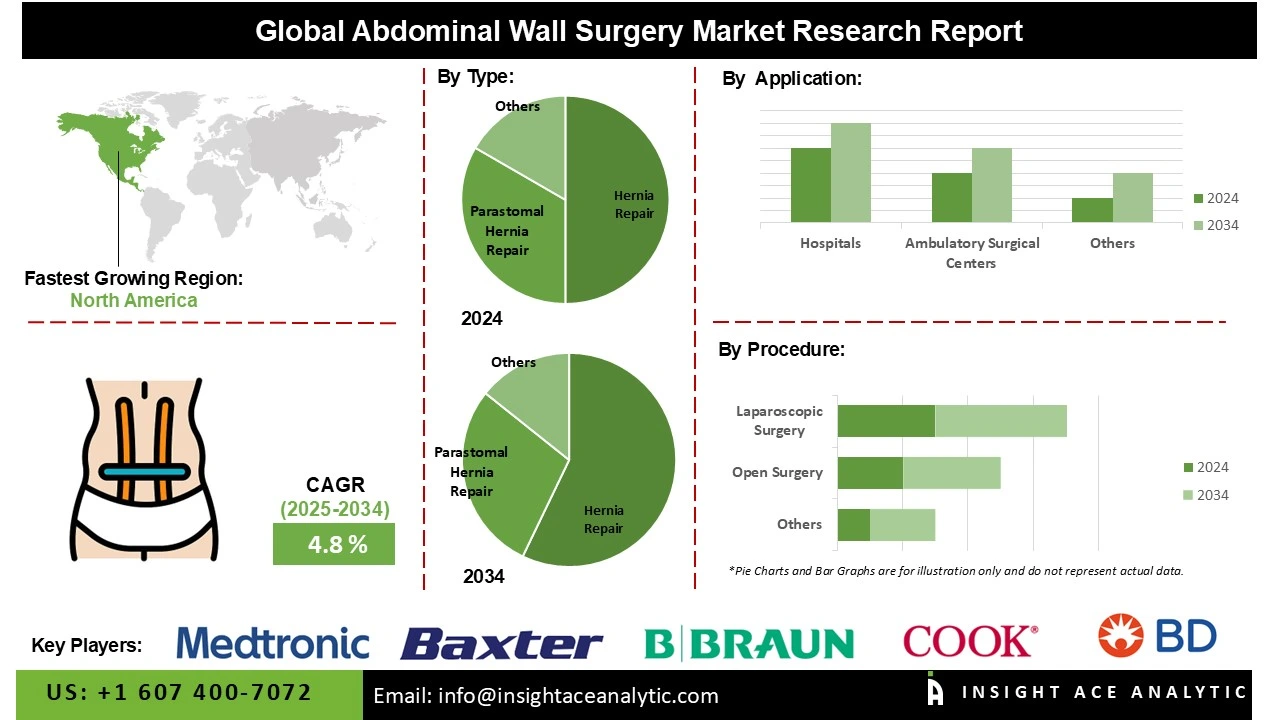
The global abdominal wall reconstruction and hernia repair market has grown steadily into a multi-billion-dollar sector, driven by high procedural volume, an aging population with cumulative fascial weakness, and continuous technological improvement in both surgical technique and implant performance.
Technological innovation is a primary growth engine for the abdominal wall surgery market. The rapid adoption of laparoscopic and robotic-assisted systems has transformed standard practice by offering magnified visualization, precise dissection, reduced wound complications, shorter hospital stays, and faster recovery.
In parallel, next-generation mesh implants—including lightweight and large-pore synthetics, partially or fully absorbable meshes, barrier-coated composites to prevent visceral adhesions, and advanced biologic/xenogeneic scaffolds—have markedly improved biocompatibility, lowered chronic pain and infection rates, and expanded treatment options for contaminated or high-risk fields. These advances enhance surgeon confidence, increase patient acceptance of elective repair, and drive premium pricing and market expansion worldwide.
The rising global prevalence of obesity stands as the single strongest clinical driver, with excess weight dramatically elevating intra-abdominal pressure, promoting hernia formation, and increasing recurrence risk after repair. Other important drivers include aging populations, higher rates of prior abdominal surgery (leading to incisional hernias), and growing awareness of the benefits of early elective repair.
However, the market faces notable challenges: elevated complication rates in obese and comorbid patients, ongoing debate over optimal mesh type and fixation method, mesh-related chronic pain and litigation in some regions, and cost pressures in resource-limited settings. Despite these hurdles, continued innovation in robotic platforms, biologically derived and self-gripping materials, and preoperative optimization protocols (weight loss, smoking cessation, botulinum toxin relaxation) is expected to sustain robust market growth while progressively addressing safety and cost-effectiveness concerns.
Competitive Landscape
Some of the Key Players in the Abdominal Wall Surgery Market:
- Medtronic
- Johnson & Johnson (Ethicon)
- Becton, Dickinson and Company (BD)
- Cook Medical
- Baxter International
- B. Braun Melsungen AG
- Integra LifeSciences
- Stryker Corporation
- AbbVie Inc.
- Smith & Nephew
- C. R. Bard, Inc.
- Lifecell Corporation
- W. L. Gore & Associates Covidien
- Atrium Medical Corporation
- TelaBio, Inc.
- Herniamesh S.r.l.
- Cousin Biotech
- Betatech Medical
- Dipromed
- Via Surgical Ltd.
- KLS Martin Group
- Mizuho OSI
- TransEasy Medical Tech Co., Ltd.
- Advanced Medical Solutions Group plc
Market Segmentation:
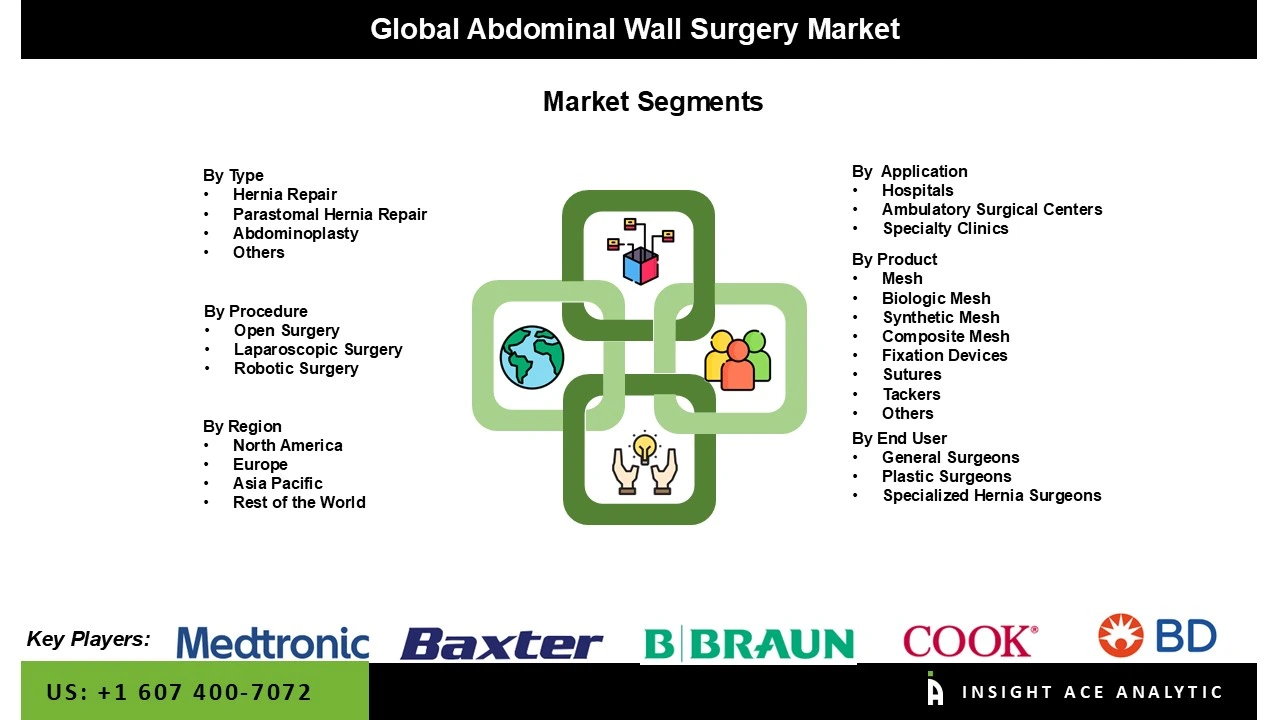
The abdominal wall surgery market is segmented by type, procedure, product, application, end-user, and By Region. By type, the market is segmented into hernia repair, parastomal hernia repair, abdominoplasty, and others. By procedure, the market is segmented into open surgery, laparoscopic surgery, and robotic surgery. By product, the market is segmented into mesh, biologic mesh, synthetic mesh, composite mesh, fixation devices, sutures, tackers, and others. By application, the market is segmented into hospitals, ambulatory surgical centers, and specialty clinics. By end-user, the market is segmented into general surgeons, plastic surgeons, and specialized hernia surgeon.
By Application, the Hospitals Segment is Expected to Drive the Abdominal Wall Surgery Market
In 2024, the hospitals held the major market share due to the rising preference for hospitals as primary centers for such procedures, given their cutting-edge surgical infrastructure, access to skilled surgeons, and availability of intensive post-operative care. Hospitals also integrate minimally invasive and robotic-assisted techniques, reducing recovery times and complications. Moreover, the rising aging and obese population drives more hospital admissions, boosting surgical volumes and market expansion.
Specialized Hernia Surgeon Segment by End-User is Growing at the Highest Rate in the Abdominal Wall Surgery Market
The abdominal wall surgery market is dominated by specialized hernia surgeon over the projected period due to rising need for specialized hernia surgeons. With rising cases of inguinal, umbilical, and incisional hernias globally, patients increasingly seek expert surgeons to ensure precise diagnosis, effective mesh placement, and reduced recurrence risk. Specialized hernia surgeons bring advanced skills in minimally invasive and robotic techniques, improving patient outcomes, reducing complications, and shortening recovery times. Their expertise also supports adoption of innovative surgical materials, driving market expansion as patients and hospitals prioritize specialized, high-quality care.
Regionally, North America Led the Abdominal Wall Surgery Market
North America dominates the market for abdominal wall surgery due to region’s aging population, which faces higher risks of abdominal wall disorders requiring surgical intervention. Advancements in minimally invasive and robotic-assisted surgery enhance patient outcomes, reduce recovery times, and drive adoption. Additionally, well-established healthcare infrastructure, strong reimbursement frameworks, and increasing awareness about early diagnosis contribute to the growing demand for abdominal wall surgeries in North America.
Moreover, Europe's abdominal wall surgery market is also fueled due to rising incidence of hernias, abdominal wall defects, and obesity-related complications. An aging population with higher vulnerability to such conditions further fuels demand for surgical interventions. Advancements in minimally invasive and robotic-assisted techniques, along with improved surgical meshes and biologics, enhance patient outcomes and reduce recovery times. Additionally, Europe’s strong healthcare infrastructure, growing awareness of early diagnosis, and government support for innovative surgical technologies are key factors driving market growth across the region.
Abdominal Wall Surgery Market Report Scope:
Segmentation of Abdominal Wall Surgery Market :
Abdominal Wall Surgery Market by Type-
· Hernia Repair
· Parastomal Hernia Repair
· Abdominoplasty
· Others
Abdominal Wall Surgery Market by Procedure-
· Open Surgery
· Laparoscopic Surgery
· Robotic Surgery
Abdominal Wall Surgery Market by Product-
· Mesh
· Biologic Mesh
· Synthetic Mesh
· Composite Mesh
· Fixation Devices
· Sutures
· Tackers
· Others
Abdominal Wall Surgery Market by Application-
· Hospitals
· Ambulatory Surgical Centers
· Specialty Clinics
Abdominal Wall Surgery Market by End User-
· General Surgeons
· Plastic Surgeons
· Specialized Hernia Surgeon
Abdominal Wall Surgery Market by Region-
North America-
· The US
· Canada
Europe-
· Germany
· The UK
· France
· Italy
· Spain
· Rest of Europe
Asia-Pacific-
· China
· Japan
· India
· South Korea
· Southeast Asia
· Rest of Asia Pacific
Latin America-
· Brazil
· Argentina
· Mexico
· Rest of Latin America
Middle East & Africa-
· GCC Countries
· South Africa
· Rest of the Middle East and Africa
Research Design and Approach
This study employed a multi-step, mixed-method research approach that integrates:
- Secondary research
- Primary research
- Data triangulation
- Hybrid top-down and bottom-up modelling
- Forecasting and scenario analysis
This approach ensures a balanced and validated understanding of both macro- and micro-level market factors influencing the market.
Secondary Research
Secondary research for this study involved the collection, review, and analysis of publicly available and paid data sources to build the initial fact base, understand historical market behaviour, identify data gaps, and refine the hypotheses for primary research.
Sources Consulted
Secondary data for the market study was gathered from multiple credible sources, including:
- Government databases, regulatory bodies, and public institutions
- International organizations (WHO, OECD, IMF, World Bank, etc.)
- Commercial and paid databases
- Industry associations, trade publications, and technical journals
- Company annual reports, investor presentations, press releases, and SEC filings
- Academic research papers, patents, and scientific literature
- Previous market research publications and syndicated reports
These sources were used to compile historical data, market volumes/prices, industry trends, technological developments, and competitive insights.

Primary Research
Primary research was conducted to validate secondary data, understand real-time market dynamics, capture price points and adoption trends, and verify the assumptions used in the market modelling.
Stakeholders Interviewed
Primary interviews for this study involved:
- Manufacturers and suppliers in the market value chain
- Distributors, channel partners, and integrators
- End-users / customers (e.g., hospitals, labs, enterprises, consumers, etc., depending on the market)
- Industry experts, technology specialists, consultants, and regulatory professionals
- Senior executives (CEOs, CTOs, VPs, Directors) and product managers
Interview Process
Interviews were conducted via:
- Structured and semi-structured questionnaires
- Telephonic and video interactions
- Email correspondences
- Expert consultation sessions
Primary insights were incorporated into demand modelling, pricing analysis, technology evaluation, and market share estimation.
Data Processing, Normalization, and Validation
All collected data were processed and normalized to ensure consistency and comparability across regions and time frames.
The data validation process included:
- Standardization of units (currency conversions, volume units, inflation adjustments)
- Cross-verification of data points across multiple secondary sources
- Normalization of inconsistent datasets
- Identification and resolution of data gaps
- Outlier detection and removal through algorithmic and manual checks
- Plausibility and coherence checks across segments and geographies
This ensured that the dataset used for modelling was clean, robust, and reliable.
Market Size Estimation and Data Triangulation
Bottom-Up Approach
The bottom-up approach involved aggregating segment-level data, such as:
- Company revenues
- Product-level sales
- Installed base/usage volumes
- Adoption and penetration rates
- Pricing analysis
This method was primarily used when detailed micro-level market data were available.

Top-Down Approach
The top-down approach used macro-level indicators:
- Parent market benchmarks
- Global/regional industry trends
- Economic indicators (GDP, demographics, spending patterns)
- Penetration and usage ratios
This approach was used for segments where granular data were limited or inconsistent.
Hybrid Triangulation Approach
To ensure accuracy, a triangulated hybrid model was used. This included:
- Reconciling top-down and bottom-up estimates
- Cross-checking revenues, volumes, and pricing assumptions
- Incorporating expert insights to validate segment splits and adoption rates
This multi-angle validation yielded the final market size.
Forecasting Framework and Scenario Modelling
Market forecasts were developed using a combination of time-series modelling, adoption curve analysis, and driver-based forecasting tools.
Forecasting Methods
- Time-series modelling
- S-curve and diffusion models (for emerging technologies)
- Driver-based forecasting (GDP, disposable income, adoption rates, regulatory changes)
- Price elasticity models
- Market maturity and lifecycle-based projections
Scenario Analysis
Given inherent uncertainties, three scenarios were constructed:
- Base-Case Scenario: Expected trajectory under current conditions
- Optimistic Scenario: High adoption, favourable regulation, strong economic tailwinds
- Conservative Scenario: Slow adoption, regulatory delays, economic constraints
Sensitivity testing was conducted on key variables, including pricing, demand elasticity, and regional adoption.
Request Customization
Add countries, segments, company profiles, or extend forecast — free 10% customization with purchase.
Customize This Report →Enquire Before Buying
Speak with our analyst team about scope, methodology, pricing, or deliverable formats.
Enquire Now →Frequently Asked Questions
Global Abdominal Wall Surgery market Size is predicted to develop a 4.8% CAGR over the forecast period.
The major players in the Abdominal Wall Surgery market are Medtronic, Johnson & Johnson (Ethicon), Becton, Dickinson and Company (BD), Cook Medical, Baxter International, B. Braun Melsungen AG, Integra LifeSciences, Stryker Corporation, AbbVie Inc., Smith & Nephew, C. R. Bard, Inc., Lifecell Corporation, W. L. Gore & Associates Covidien, Atrium Medical Corporation, TelaBio, Inc., Herniamesh S.r.l., Cousin Biotech, Betatech Medical, Dipromed, Via Surgical Ltd., KLS Martin Group, Mizuho OSI, TransEasy Medical Tech Co., Ltd., and Advanced Medical Solutions Group plc
The primary Abdominal Wall Surgery market segments are by type, by procedure, by product, by application, by end-user, and by region.
North America leads the market for Abdominal Wall Surgery due to rising hernia prevalence, supported by advanced surgical technologies and increasing demand for minimally invasive procedures.