Building the Future of Fitness Through Digital and Lifestyle Innovation
The fitness industry has undergone a paradigm shift in the past ten years due to the changing behavior of consumers. Fitness is no longer just about the availability of treadmills and weight machines. It has become an overall wellness experience that encompasses physical fitness, mental wellness, social interaction, and technology. This has led to the rise of the next-generation fitness & wellness ecosystem market, where consumers, especially Millennials and Gen Z, value experiences over transactions. The traditional gym membership model is being replaced by subscription-based, hybrid (digital + physical) models and overall wellness platforms that integrate fitness, recovery, nutrition, and socializing. The market is characterized by flexibility, personalization, and technology-driven engagement facilitated by boutique studios, multi-brand subscription platforms, franchise development, and digitally transforming big-box gyms.
This blog examines the rise of the next-generation fitness and wellness ecosystem, highlighting experience-led fitness, technology-driven and subscription models, and the convergence of diverse fitness formats, while outlining key market opportunities, competitive dynamics, regional trends, and the future outlook shaping the global industry.
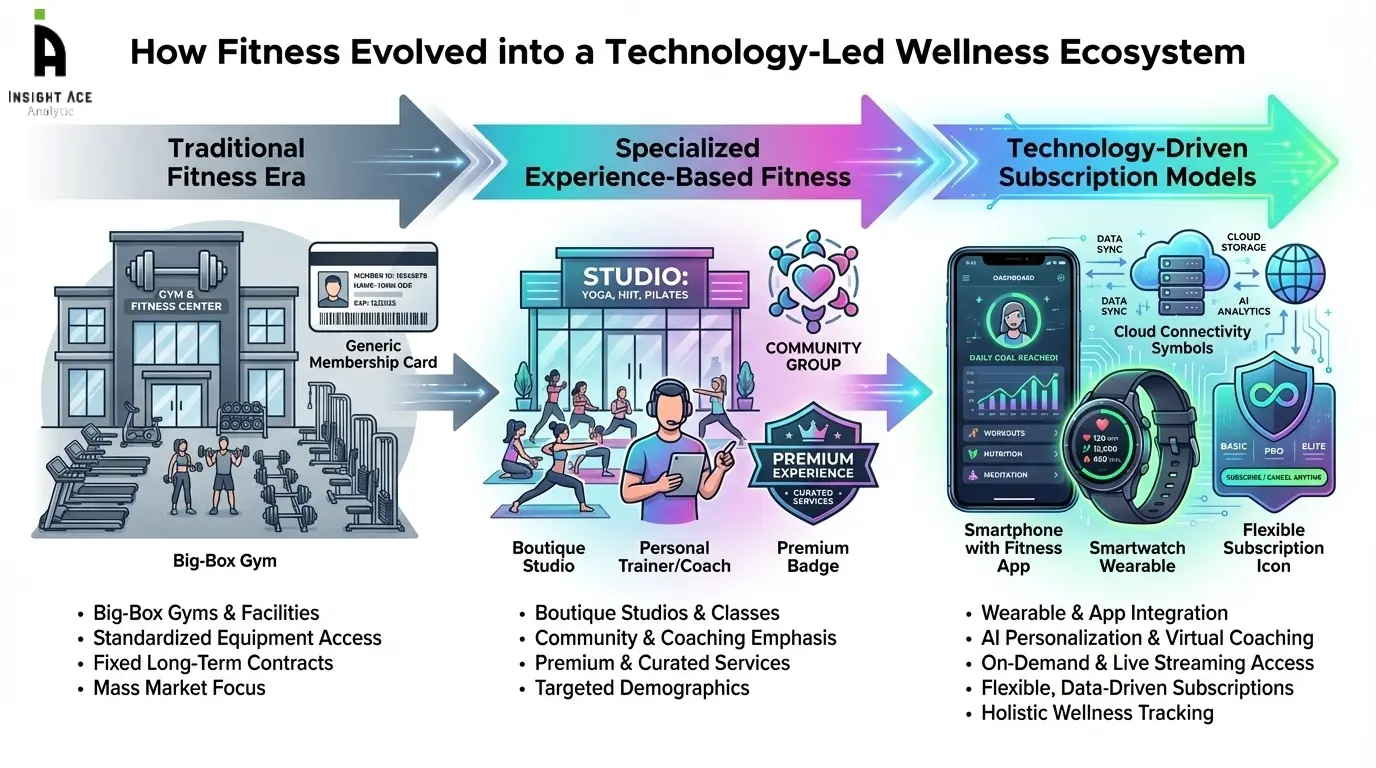
How Fitness Evolved into a Technology-Led Wellness Ecosystem
- Traditional Fitness Model Era- The industry was dominated by big-box gyms offering standardized equipment and long-term memberships, with limited personalization or engagement. Success was driven by scale and volume rather than experience or outcomes.
- Emergence of Specialized and Experience-Based Fitness- Consumer preferences shifted toward boutique, modality-focused formats that emphasized personalized coaching, community, and immersive experiences. These models enabled premium pricing, stronger brand loyalty, and higher retention.
- Rise of Technology-Driven and Subscription Models- Digital platforms, wearables, and hybrid delivery reshaped fitness access, replacing rigid memberships with flexible subscription models. This shift created connected, scalable ecosystems that blend physical and digital fitness experiences.
The Expanding Opportunity in Fitness & Wellness
- Expansion of the Overall Parent Market- Fitness has expanded beyond gyms into a broader wellness economy, including nutrition, recovery, mental well-being, and preventive health, significantly increasing the total addressable market.
- Fitness as a Lifestyle Ecosystem- Fitness is no longer episodic; it is embedded into daily lifestyles through continuous engagement across workouts, digital content, wearables, and recovery services, driving higher customer lifetime value.
- Convergence of Multiple Service Models-Boutique studios, big-box gyms, digital platforms, and subscription marketplaces are converging into integrated ecosystems, enabling flexible access, scalable growth, and diversified revenue streams.
Core Markets Shaping the Fitness & Wellness Landscape:
- Multi-Brand Operator & Subscription Ecosystem Market: The market is defined by platforms that aggregate multiple fitness and wellness brands into a single subscription, giving consumers access to studios, gyms, and digital content across different locations and formats. The market is fueled by the need for flexibility, convenience, and personalized engagement, as well as the ability for operators to create new revenue streams, tap into data, and drive network effects across physical and digital fitness ecosystems.
Key players: ClassPass, Mindbody, Wellhub (formerly Gympass), Urban Sports Club, Apple Fitness+
- Boutique Fitness Market: The boutique fitness market is focused on specialized, experience-based formats such as HIIT, yoga, Pilates, cycling, and functional training. These studios are designed to provide personalized coaching, small class sizes, and community engagement, which supports higher pricing and member retention. The market is particularly strong in urban areas and among younger consumers who are looking for immersive, lifestyle-based fitness experiences.
Key players: Orangetheory Fitness, F45 Training, Barry’s, SoulCycle, Pure Barre, Club Pilates, YogaWorks
- Franchise Fitness Expansion & Financial Performance Market: This area enables the quick expansion of the brand via franchise models. Fitness franchises offer stable revenue streams via royalties, strong brands, and operational efficiencies, and multi-unit ownership improves financial performance. Emerging market expansion and the incorporation of wellness-driven solutions continue to improve financial performance.
Key players: Anytime Fitness, Planet Fitness (franchise-heavy hybrid model), Snap Fitness, The Gym Group, Xponential Fitness (multi-brand franchise platform)
- Big Box Gyms Market: The big box gyms market includes large-scale gyms with comprehensive equipment, group fitness classes, and wide geographic reach at attractive price points. Although challenged by the rise of boutique fitness studios and digital fitness solutions, big box gyms are evolving via tiered membership models, digital hybrids, and technology-driven engagement, ensuring their position as a foundation of the overall fitness industry.
Key players: Planet Fitness, LA Fitness, 24 Hour Fitness, Gold’s Gym, Life Time Group, Equinox
Competitive and Regional Dynamics Shaping Market Expansion
Competitive Dynamics
The fitness and wellness market has become increasingly competitive as multiple business models coexist and overlap. Big box gyms compete on scale and affordability, boutique studios differentiate through experience and personalization, while digital and subscription platforms compete on flexibility and convenience. Competitive advantage is now driven less by physical footprint and more by brand strength, technology integration, community engagement, and the ability to deliver seamless omnichannel experiences. Multi-brand operators are intensifying competition by aggregating offerings and reshaping consumer loyalty.
Regional Growth Dynamics
- North America remains the most mature and competitive market, characterized by high penetration of gym memberships, rapid adoption of boutique fitness formats, and strong demand for subscription-based and hybrid fitness models. Innovation is centered on technology integration, personalization, and multi-brand platforms, with operators focusing on retention and premium experiences rather than pure expansion.
- Europe is experiencing steady growth driven by franchise-led expansion and increasing integration of wellness services such as recovery, mindfulness, and holistic health offerings. Markets in Western Europe are mature, while Central and Eastern Europe present white-space opportunities for scalable boutique and mid-tier fitness concepts.
- Asia-Pacific represents the fastest-growing region, supported by rapid urbanization, rising disposable incomes, and increasing health consciousness among younger populations. Demand is accelerating for both affordable big-box gyms and premium boutique studios, with digital fitness and mobile-first engagement playing a critical role in market adoption.
- Middle East is emerging as a premium fitness hub, driven by high per-capita spending, lifestyle-focused consumers, and government-led wellness initiatives. Franchise models and high-end boutique concepts are expanding rapidly, particularly in urban centres.
- Latin America is witnessing growing fitness participation supported by expanding middle-class populations and increasing franchise penetration. Value-driven big-box gyms and scalable boutique formats are gaining traction, supported by rising interest in structured fitness and wellness programs.
Expansion Dynamics
Fitness operators are expanding through scalable and capital-efficient strategies, including franchising, master franchise agreements, and multi-brand portfolios. Hybrid models that combine physical locations with digital platforms are enabling faster market entry and broader reach. Strategic partnerships with real estate developers, hospitality players, corporates, and health-tech companies are further accelerating expansion while diversifying revenue streams. Together, these strategies are reshaping how fitness brands grow across regions.
Future Outlook:
- Hybrid, technology-led fitness models are expected to become the industry standard, with seamless integration of physical facilities and digital platforms supported by AI, wearables, and data-driven personalization. This shift will enhance user engagement, flexibility, and measurable fitness outcomes.
- The market will continue to evolve toward integrated wellness ecosystems, moving beyond standalone workouts to include recovery, nutrition, mental well-being, and preventive health. This convergence is expected to strengthen customer loyalty, increase lifetime value, and position fitness providers as comprehensive lifestyle partners.
- North America is likely to remain the leading region, supported by high fitness participation rates, strong consumer spending on wellness, early adoption of boutique and subscription-based models, and sustained investment in technology-enabled and hybrid fitness ecosystems.
Conclusion:
The fitness industry has evolved from traditional gyms into a connected, technology-enabled wellness ecosystem driven by experience, personalization, and flexibility. The convergence of boutique studios, multi-brand subscription platforms, franchise expansion, and digitally evolving big-box gyms has expanded fitness into a lifestyle-focused market. Going forward, hybrid models and integrated wellness offerings will shape growth, with North America leading innovation, as operators that deliver seamless, personalized, and scalable experiences define the future of the Next-Generation Fitness & Wellness Ecosystem Market.