Smarter Farming, Healthier Fish: The AI Advantage in Aquaculture
global aquaculture industry had been undergoing a rapid digital transformation, driven by the need to improve productivity, ensure fish welfare, and meet increasingly strict sustainability and traceability standards. traditional manual monitoring techniques were unable to identify early indicators of stress, illness, or unfavourable environmental conditions as production intensity rose and margins narrowed. Considering this, AI-driven monitoring and fish welfare analytics market have become a crucial innovation that allows for proactive farm management, real-time health assessment, and data-driven decision-making in fish and shrimp farming operations.
In this blog, we will explore the rise of AI-driven aquaculture, highlighting advanced monitoring technologies, predictive analytics, and automation systems, while discussing the benefits for fish welfare and farm efficiency, challenges for adoption, and the future outlook of sustainable, data-driven aquaculture practices.
What is AI-Driven Monitoring and Fish Welfare Analytics?
AI-driven monitoring and fish welfare analytics referred to the application of artificial intelligence, machine learning, computer vision, and advanced data analytics to continuously monitor fish behaviour, health, and environmental conditions in aquaculture systems.
To evaluate factors like swimming patterns, feeding behavior, stress indicators, growth performance, and mortality risks, these solutions combined data from underwater cameras, acoustic sensors, water-quality sensors, and feeding systems. Aquaculture is now more productive, sustainable, and welfare-focused thanks to AI based welfare analytics, which transformed massive amounts of biological and environmental data into useful insights.
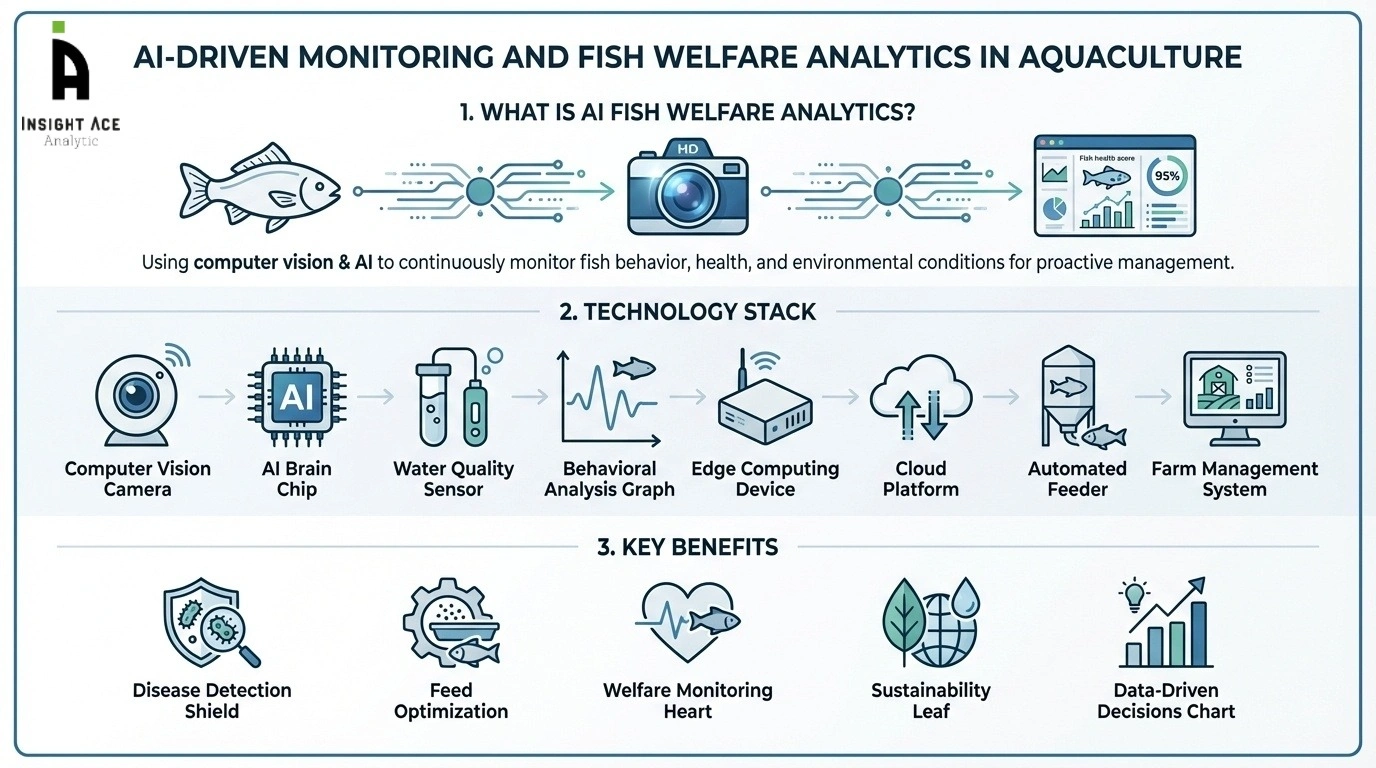
The Technology Stack Behind Intelligent Fish Welfare Monitoring :
1. Computer Vision Systems- Used with underwater cameras to monitor swimming behavior, schooling patterns, biomass, size distribution, and feeding response. Abnormal behavior is flagged as an early indicator of stress, disease, or poor welfare.
2. Machine Learning & Predictive Analytics- Analyze historical and real-time data to detect patterns, predict disease outbreaks, mortality risks, growth performance, and optimize feeding and stocking decisions.
3. IoT-Based Water Quality Sensors- Continuously track critical parameters such as dissolved oxygen, temperature, pH, salinity, ammonia, and turbidity, enabling proactive environmental management.
4. Behavioral Analytics Algorithms- Correlate fish movement, activity levels, and feeding behavior with environmental conditions to assess welfare status in real time.
5. Edge Computing- Enables on-site, real-time data processing and rapid decision-making, particularly useful in remote farms with limited internet connectivity.
6. Cloud-Based Data Platforms- Provide centralized dashboards for remote monitoring, data storage, performance benchmarking, and multi-site farm management.
7. Integration with Automated Feeding Systems- Uses AI insights to adjust feeding rates and timing, reducing feed wastage and improving feed conversion ratios (FCR).
8. Farm Management System Integration- Connects welfare analytics with production, health, and inventory systems to support end-to-end digital aquaculture operations.
Factors Fuelling the AI-Driven Monitoring and Fish Welfare Analytics Market
• Rising Focus on Fish Welfare and Ethical Aquaculture- Growing awareness of animal welfare standards and responsible farming practices drove the adoption of AI-based monitoring systems to ensure humane and stress-free rearing conditions.
• Increasing Disease Incidence and Mortality Risks- Frequent disease outbreaks in intensive aquaculture systems accelerated demand for early detection and predictive analytics to minimize losses.
• Need for Feed Cost Optimization- Feed accounted for a major share of aquaculture production costs, prompting farmers to adopt AI-driven feeding optimization and behavior-based feeding systems to improve feed conversion ratios (FCR).
• Growth of High-Density and Intensive Farming Practices- Rising stocking densities increased stress and health risks, boosting the need for continuous, real-time monitoring of fish behavior and environmental conditions.
• Advancements in AI, Computer Vision, and Sensor Technologies- Rapid improvements in imaging, data analytics, and IoT sensors enhanced accuracy, reliability, and affordability of AI-driven welfare solutions.
• Regulatory Pressure and Sustainability Compliance- Stricter regulations related to environmental impact, traceability, and animal welfare encouraged the adoption of digital monitoring and reporting tools.
• Demand for Data-Driven Farm Management- Producers increasingly shifted from reactive to predictive decision-making, using AI insights to improve productivity, survival rates, and operational efficiency.
• Expansion of Commercial Aquaculture Production- Growing global demand for seafood supported large-scale aquaculture expansion, creating a strong need for scalable and automated monitoring solutions.
Challenges in AI-Driven Monitoring and Fish Welfare Analytics Market
• High Initial Investment Costs- Significant upfront spending on cameras, sensors, AI software, and system integration limited adoption, especially among small and mid-sized farms.
• Data Accuracy and Reliability Issues- Turbid water, biofouling, poor visibility, and variable lighting affected the performance of computer vision and sensor-based monitoring systems.
• Limited Digital Infrastructure- Inconsistent internet connectivity and power supply in remote aquaculture regions restricted real-time monitoring and cloud-based analytics.
• Lack of Technical Expertise- Limited AI awareness and digital skills among farm operators slowed effective adoption and utilization of advanced analytics platforms.
• Integration Complexity- Challenges in integrating AI systems with existing feeding equipment, sensors, and farm management software increased operational complexity.
Regional Trends in AI-Driven Monitoring and Fish Welfare Analytics Market
• Europe- Led adoption due to strong fish welfare regulations, sustainability mandates, and high technology penetration in salmon farming.
• Asia-Pacific- Witnessed rapid growth driven by large-scale aquaculture production, increasing disease challenges, and rising adoption of AI solutions in shrimp and tilapia farming.
• North America- Showed steady adoption supported by advanced aquaculture infrastructure, R&D investments, and data-driven farm management practices.
• Latin America- Experienced growing uptake, particularly in Chilean salmon farming, driven by disease management needs and export-oriented production standards.
• Middle East & Africa- Remained an emerging market, with gradual adoption supported by investments in smart aquaculture and controlled-environment farming systems.
Leading companies:
- Aquabyte – AI-based computer vision for biomass estimation and fish health monitoring.
- ReelData AI – AI-driven feeding optimization and behavioral analytics.
- Ace Aquatec – Fish welfare monitoring and humane aquaculture technologies.
- BioSort (iFarm) – AI-enabled fish grading, counting, and sorting solutions.
- Manolin – Data analytics platform for fish health and farm performance.
- TidalX AI – Real-time AI monitoring for aquaculture operations.
- Aquaticode – Decision-support analytics for fish health and production efficiency.
- Innovasea – Integrated sensors and analytics for aquaculture monitoring.
- AKVA Group – Automated feeding and digital aquaculture solutions provider.
- Observe Technologies – Computer vision-based fish behavior and feeding analytics.
- GoSmart – Smart feeding and sensor-based aquaculture monitoring systems.
Future Outlook:
• From Reactive to Predictive Management: To transition to semi-autonomous farms, AI-driven welfare analytics will integrate with automated feeding, aeration, and treatment systems to enable early risk detection, disease prevention, and proactive farm management.
• Promoting ESG Compliance and Welfare Certification: AI monitoring will support ESG reporting and ethical aquaculture practices by assisting in meeting sustainability objectives, traceability requirements, and fish welfare standards.
• Asia-Pacific is expected to lead market expansion, supported by large-scale aquaculture production, rising disease challenges, and increasing adoption of AI-driven monitoring solutions in shrimp and warm-water fish farming.
Conclusion:
AI-driven aquaculture is reshaping fish farming by enabling predictive insights, proactive management, and sustainable operations. Real-time monitoring, automation, and data analytics help improve fish welfare, prevent disease, and optimize growth efficiently.
The market is growing as farms adopt smart technologies to enhance operational efficiency, ensure traceability, and meet sustainability goals. AI-powered aquaculture proves that healthy, productive, and responsible fish farming is possible with the right combination of technology and insight.