Mammalian Cell Culture CDMO Market Size, Share, Forecast Report 2026 to 2035
Segmentations Mammalian Cell Culture CDMO Market:
Mammalian Cell Culture CDMO Market by Product Type -
- Development Services
- Cell Line Development
- Process Development
- Analytical and Formulation Development
- Clinical GMP Manufacturing
- Early-Phase Clinical Manufacturing
- Late-Phase Clinical Manufacturing
- Commercial GMP Manufacturing
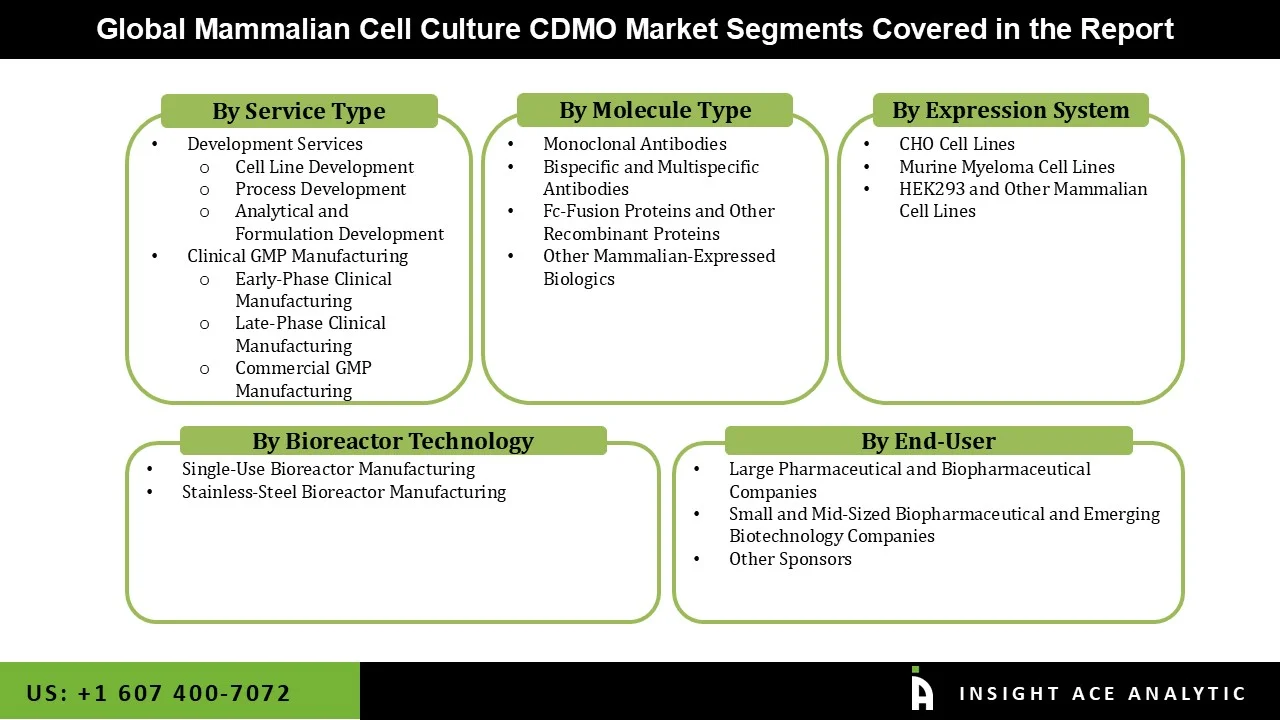
Mammalian Cell Culture CDMO Market by Molecule Type -
- Monoclonal Antibodies
- Bispecific and Multispecific Antibodies
- Fc-Fusion Proteins and Other Recombinant Proteins
- Other Mammalian-Expressed Biologics
Mammalian Cell Culture CDMO Market by Expression System -
- CHO Cell Lines
- Murine Myeloma Cell Lines
- HEK293 and Other Mammalian Cell Lines
Mammalian Cell Culture CDMO Market by End User -
- Large Pharmaceutical and Biopharmaceutical Companies
- Small and Mid-Sized Biopharmaceutical and Emerging Biotechnology Companies
- Other Sponsors
Mammalian Cell Culture CDMO Market by Bioreactor Technology-
- Single-Use Bioreactor Manufacturing
- Stainless-Steel Bioreactor Manufacturing
Mammalian Cell Culture CDMO Market by Region-
- North America-
- The US
- Canada
- Europe-
- Germany
- The UK
- France
- Italy
- Spain
- Rest of Europe
- Asia-Pacific-
- China
- Japan
- India
- South Korea
- South East Asia
- Rest of Asia Pacific
- Latin America-
- Brazil
- Argentina
- Mexico
- Rest of Latin America
- Middle East and Africa-
- GCC Countries
- South Africa
- Rest of Middle East and Africa
Chapter 1. Methodology and Scope
1.1. Research Methodology
1.2. Research Scope & Assumptions
Chapter 2. Executive Summary
Chapter 3. Global Mammalian Cell Culture CDMO Market Snapshot
Chapter 4. Global Mammalian Cell Culture CDMO Market Variables, Trends & Scope
4.1. Market Segmentation & Scope
4.2. Market Drivers
4.3. Market Challenges
4.4. Market Trends
4.5. Regulatory and Quality Compliance Landscape
4.6. Porter’s Five Forces Analysis
4.7. Incremental Opportunity Analysis (US$ Mn), 2025–2035
4.8. Market Penetration & Growth Prospect Mapping (US$ Mn), 2026–2035
4.9. Competitive Landscape & Market Share Analysis, 2026
4.10. Impact of Biologics Pipeline Expansion, Outsourcing Trends, Single-Use Bioreactor Adoption, and Manufacturing Capacity Investments on the Mammalian Cell Culture CDMO Market
Chapter 5. Mammalian Cell Culture CDMO Market Segmentation: By Service Type
5.1. Market Share, 2025 & 2035
5.2. Market Size (US$ Mn), 2022–2035
5.2.1. Development Services
5.2.1.1. Cell Line Development
5.2.1.2. Process Development
5.2.1.3. Analytical and Formulation Development
5.2.2. Clinical GMP Manufacturing
5.2.2.1. Early-Phase Clinical Manufacturing
5.2.2.2. Late-Phase Clinical Manufacturing
5.2.3. Commercial GMP Manufacturing
Chapter 6. Mammalian Cell Culture CDMO Market Segmentation: By Molecule Type
6.1. Market Share, 2025 & 2035
6.2. Market Size (US$ Mn), 2022–2035
6.2.1. Monoclonal Antibodies
6.2.2. Bispecific and Multispecific Antibodies
6.2.3. Fc-Fusion Proteins and Other Recombinant Proteins
6.2.4. Other Mammalian-Expressed Biologics
Chapter 7. Mammalian Cell Culture CDMO Market Segmentation: By Expression System
7.1. Market Share, 2025 & 2035
7.2. Market Size (US$ Mn), 2022–2035
7.2.1. CHO Cell Lines
7.2.2. Murine Myeloma Cell Lines
7.2.3. HEK293 and Other Mammalian Cell Lines
Chapter 8. Mammalian Cell Culture CDMO Market Segmentation: By End User & Bioreactor Technology
8.1. Market Share, 2025 & 2035
8.2. Market Size (US$ Mn), 2022–2035
8.3. End User
8.3.1. Large Pharmaceutical and Biopharmaceutical Companies
8.3.2. Small and Mid-Sized Biopharmaceutical and Emerging Biotechnology Companies
8.3.3. Other Sponsors
8.4. Bioreactor Technology
8.4.1. Single-Use Bioreactor Manufacturing
8.4.2. Stainless-Steel Bioreactor Manufacturing
Chapter 9. Regional Mammalian Cell Culture CDMO Market Estimates & Trend Analysis
9.1. Global Market Regional Snapshot, 2025 & 2035
9.2. North America
9.2.1. Market Revenue by Country (U.S., Canada, Mexico), 2022–2035
9.2.2. North America Mammalian Cell Culture CDMO Market Revenue by Service Type, 2022–2035
9.2.3. North America Mammalian Cell Culture CDMO Market Revenue by Molecule Type, 2022–2035
9.2.4. North America Mammalian Cell Culture CDMO Market Revenue by Expression System, 2022–2035
9.2.5. North America Mammalian Cell Culture CDMO Market Revenue by End User, 2022–2035
9.2.6. North America Mammalian Cell Culture CDMO Market Revenue by Bioreactor Technology, 2022–2035
9.3. Europe
9.3.1. Market Revenue by Country, 2022–2035
9.3.2. Europe Mammalian Cell Culture CDMO Market Revenue by Service Type, 2022–2035
9.3.3. Europe Mammalian Cell Culture CDMO Market Revenue by Molecule Type, 2022–2035
9.3.4. Europe Mammalian Cell Culture CDMO Market Revenue by Expression System, 2022–2035
9.3.5. Europe Mammalian Cell Culture CDMO Market Revenue by End User, 2022–2035
9.3.6. Europe Mammalian Cell Culture CDMO Market Revenue by Bioreactor Technology, 2022–2035
9.4. Asia Pacific
9.4.1. Market Revenue by Country, 2022–2035
9.4.2. Asia Pacific Mammalian Cell Culture CDMO Market Revenue by Service Type, 2022–2035
9.4.3. Asia Pacific Mammalian Cell Culture CDMO Market Revenue by Molecule Type, 2022–2035
9.4.4. Asia Pacific Mammalian Cell Culture CDMO Market Revenue by Expression System, 2022–2035
9.4.5. Asia Pacific Mammalian Cell Culture CDMO Market Revenue by End User, 2022–2035
9.4.6. Asia Pacific Mammalian Cell Culture CDMO Market Revenue by Bioreactor Technology, 2022–2035
9.5. Latin America
9.5.1. Market Revenue by Country, 2022–2035
9.5.2. Latin America Mammalian Cell Culture CDMO Market Revenue by Service Type, 2022–2035
9.5.3. Latin America Mammalian Cell Culture CDMO Market Revenue by Molecule Type, 2022–2035
9.5.4. Latin America Mammalian Cell Culture CDMO Market Revenue by Expression System, 2022–2035
9.5.5. Latin America Mammalian Cell Culture CDMO Market Revenue by End User, 2022–2035
9.5.6. Latin America Mammalian Cell Culture CDMO Market Revenue by Bioreactor Technology, 2022–2035
9.6. Middle East & Africa
9.6.1. Market Revenue by Country, 2022–2035
9.6.2. Middle East & Africa Mammalian Cell Culture CDMO Market Revenue by Service Type, 2022–2035
9.6.3. Middle East & Africa Mammalian Cell Culture CDMO Market Revenue by Molecule Type, 2022–2035
9.6.4. Middle East & Africa Mammalian Cell Culture CDMO Market Revenue by Expression System, 2022–2035
9.6.5. Middle East & Africa Mammalian Cell Culture CDMO Market Revenue by End User, 2022–2035
9.6.6. Middle East & Africa Mammalian Cell Culture CDMO Market Revenue by Bioreactor Technology, 2022–2035
Chapter 10. Competitive Landscape
10.1. Key Strategic Developments (Partnerships, Acquisitions, Product Launches, Capacity Expansions, and Technology Investments)
10.2. Market Share Analysis, 2026
10.3. Company Profiles
10.3.1. Leading Global Mammalian Cell Culture CDMOs
10.3.1.1. Lonza Group AG
10.3.1.2. Samsung Biologics Co., Ltd.
10.3.1.3. WuXi Biologics (Cayman) Inc.
10.3.1.4. FUJIFILM Biotechnologies (FUJIFILM Corporation)
10.3.1.5. Boehringer Ingelheim BioXcellence (Boehringer Ingelheim International GmbH)
10.3.1.6. Thermo Fisher Scientific Inc. (Patheon Pharma Services)
10.3.1.7. AGC Biologics (AGC Inc.)
10.3.1.8. Catalent, Inc. (Novo Holdings A/S)
10.3.1.9. Rentschler Biopharma SE
10.3.1.10. KBI Biopharma, Inc. (JSR Life Sciences)
10.3.2. Strategic / Regional Mammalian Cell Culture CDMOs
10.3.2.1. Just – Evotec Biologics, Inc. (Evotec SE)
10.3.2.2. Lotte Biologics Co., Ltd.
10.3.2.3. Celltrion, Inc. (Celltrion BioSolutions)
10.3.2.4. Syngene International Ltd.
10.3.2.5. Avid Bioservices, Inc.
10.3.2.6. Abzena Ltd.
10.3.2.7. Celonic Group
10.3.2.8. Rezon Bio
10.3.2.9. mAbxience (Fresenius Kabi)
10.3.2.10. AbbVie Contract Manufacturing (AbbVie Inc.)
10.3.2.11. Pfizer CentreOne (Pfizer Inc.)
10.3.2.12. ProBio (GenScript Biotech Corporation)
10.3.3. Emerging / Specialized Mammalian Cell Culture CDMOs
10.3.3.1. ProBioGen AG
10.3.3.2. 3P Biovian
10.3.3.3. Chime Biologics
10.3.3.4. MabPlex International
10.3.3.5. Binex Co., Ltd.
10.3.3.6. Kemwell Biopharma
10.3.3.7. Aurigene Pharmaceutical Services
10.3.3.8. Enzene Biosciences
10.3.3.9. Mabion S.A.
10.3.3.10. Northway Biotech
10.3.3.11. Cytovance Biologics
10.3.3.12. National Resilience, Inc.
10.3.3.13. Tanvex BioPharma
10.3.4. Adjacent Biopharmaceutical Manufacturing & Technology Companies
10.3.4.1. Sartorius AG
10.3.4.2. Cytiva (Danaher Corporation)
10.3.4.3. Merck KGaA (MilliporeSigma)
10.3.4.4. Sandoz AG
10.3.4.5. Polpharma Biologics
10.3.4.6. Samsung Epis Holdings (Samsung Bioepis)
10.3.4.7. Biocon Biologics Ltd.
10.3.4.8. WuXi XDC Cayman Inc.
10.3.4.9. Terumo Corporation
10.3.4.10. Richter-Helm BioLogics
10.3.4.11. Wacker Biotech
10.3.4.12. Charles River Laboratories
10.3.4.13. Eurofins BioPharma Product Testing
Research Design and Approach
This study employed a multi-step, mixed-method research approach that integrates:
- Secondary research
- Primary research
- Data triangulation
- Hybrid top-down and bottom-up modelling
- Forecasting and scenario analysis
This approach ensures a balanced and validated understanding of both macro- and micro-level market factors influencing the market.
Secondary Research
Secondary research for this study involved the collection, review, and analysis of publicly available and paid data sources to build the initial fact base, understand historical market behaviour, identify data gaps, and refine the hypotheses for primary research.
Sources Consulted
Secondary data for the market study was gathered from multiple credible sources, including:
- Government databases, regulatory bodies, and public institutions
- International organizations (WHO, OECD, IMF, World Bank, etc.)
- Commercial and paid databases
- Industry associations, trade publications, and technical journals
- Company annual reports, investor presentations, press releases, and SEC filings
- Academic research papers, patents, and scientific literature
- Previous market research publications and syndicated reports
These sources were used to compile historical data, market volumes/prices, industry trends, technological developments, and competitive insights.
Primary Research
Primary research was conducted to validate secondary data, understand real-time market dynamics, capture price points and adoption trends, and verify the assumptions used in the market modelling.
Stakeholders Interviewed
Primary interviews for this study involved:
- Manufacturers and suppliers in the market value chain
- Distributors, channel partners, and integrators
- End-users / customers (e.g., hospitals, labs, enterprises, consumers, etc., depending on the market)
- Industry experts, technology specialists, consultants, and regulatory professionals
- Senior executives (CEOs, CTOs, VPs, Directors) and product managers
Interview Process
Interviews were conducted via:
- Structured and semi-structured questionnaires
- Telephonic and video interactions
- Email correspondences
- Expert consultation sessions
Primary insights were incorporated into demand modelling, pricing analysis, technology evaluation, and market share estimation.
Data Processing, Normalization, and Validation
All collected data were processed and normalized to ensure consistency and comparability across regions and time frames.
The data validation process included:
- Standardization of units (currency conversions, volume units, inflation adjustments)
- Cross-verification of data points across multiple secondary sources
- Normalization of inconsistent datasets
- Identification and resolution of data gaps
- Outlier detection and removal through algorithmic and manual checks
- Plausibility and coherence checks across segments and geographies
This ensured that the dataset used for modelling was clean, robust, and reliable.
Market Size Estimation and Data Triangulation
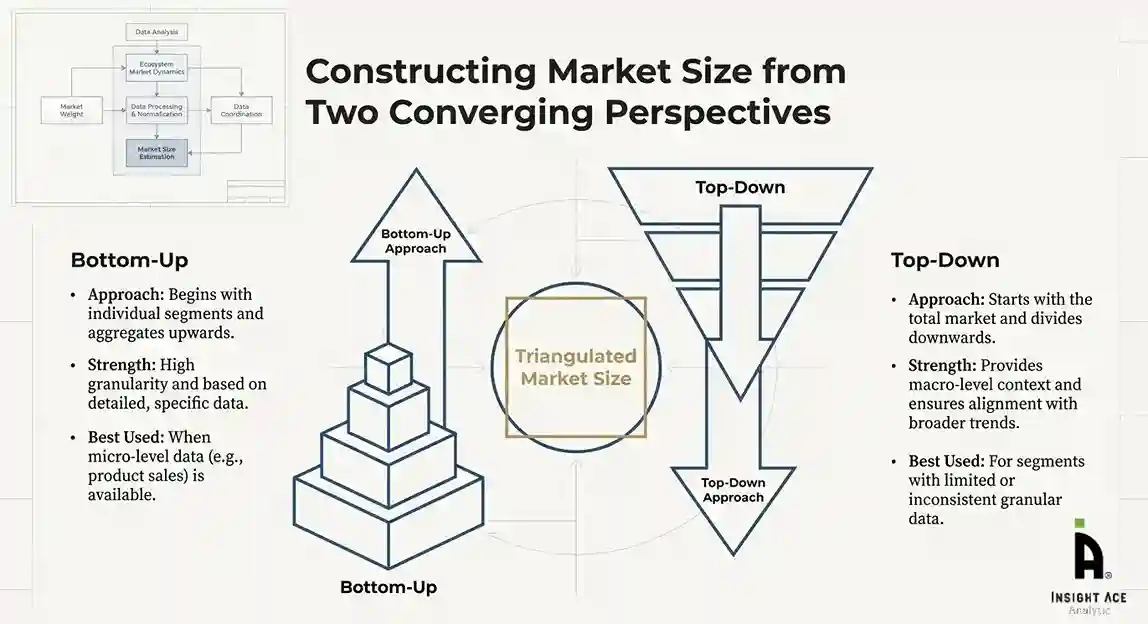
Bottom-Up Approach
The bottom-up approach involved aggregating segment-level data, such as:
- Company revenues
- Product-level sales
- Installed base/usage volumes
- Adoption and penetration rates
- Pricing analysis
This method was primarily used when detailed micro-level market data were available.
Top-Down Approach
The top-down approach used macro-level indicators:
- Parent market benchmarks
- Global/regional industry trends
- Economic indicators (GDP, demographics, spending patterns)
- Penetration and usage ratios
This approach was used for segments where granular data were limited or inconsistent.
Hybrid Triangulation Approach
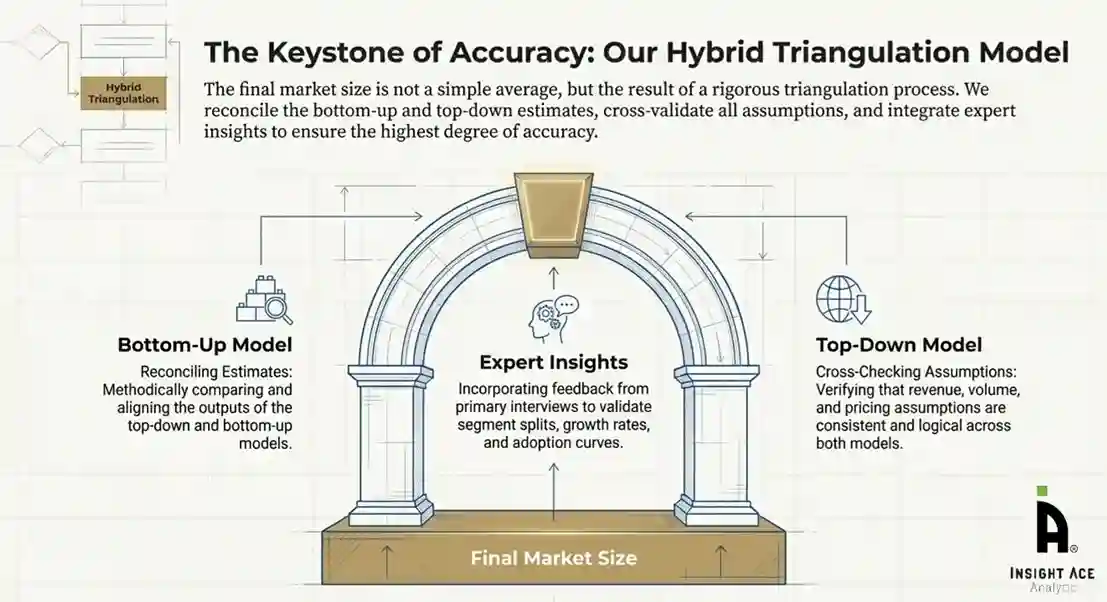
To ensure accuracy, a triangulated hybrid model was used. This included:
- Reconciling top-down and bottom-up estimates
- Cross-checking revenues, volumes, and pricing assumptions
- Incorporating expert insights to validate segment splits and adoption rates
This multi-angle validation yielded the final market size.
Forecasting Framework and Scenario Modelling
Market forecasts were developed using a combination of time-series modelling, adoption curve analysis, and driver-based forecasting tools.
Forecasting Methods
- Time-series modelling
- S-curve and diffusion models (for emerging technologies)
- Driver-based forecasting (GDP, disposable income, adoption rates, regulatory changes)
- Price elasticity models
- Market maturity and lifecycle-based projections
Scenario Analysis
Given inherent uncertainties, three scenarios were constructed:
- Base-Case Scenario: Expected trajectory under current conditions
- Optimistic Scenario: High adoption, favourable regulation, strong economic tailwinds
- Conservative Scenario: Slow adoption, regulatory delays, economic constraints
Sensitivity testing was conducted on key variables, including pricing, demand elasticity, and regional adoption.
Request Customization
Add countries, segments, company profiles, or extend forecast — free 10% customization with purchase.
Customize This Report →Enquire Before Buying
Speak with our analyst team about scope, methodology, pricing, or deliverable formats.
Enquire Now →Frequently Asked Questions
The Mammalian Cell Culture CDMO Market is expected to grow at a 11.5% CAGR during the forecast period for 2026 to 2035
Lonza Group AG, Samsung Biologics Co., Ltd., WuXi Biologics (Cayman) Inc., FUJIFILM Biotechnologies (FUJIFILM Corporation), Boehringer Ingelheim BioXcellence, Thermo Fisher Scientific Inc. (Patheon Pharma Services), AGC Biologics (AGC Inc.), Catalent, Inc. (Novo Holdings A/S), Rentschler Biopharma SE, KBI Biopharma, Inc. (JSR Life Sciences), Just – Evotec Biologics, Inc., Lotte Biologics Co., Ltd., Celltrion, Inc. (Celltrion BioSolutions), Syngene International Ltd., Avid Bioservices, Inc., Abzena Ltd., Celonic Group, Rezon Bio, mAbxience (Fresenius Kabi), AbbVie Contract Manufacturing, Pfizer CentreOne, ProBio (GenScript Biotech Corporation), ProBioGen AG, 3P Biovian, Chime Biologics, MabPlex International, Binex Co., Ltd., Kemwell Biopharma, Aurigene Pharmaceutical Services, Enzene Biosciences, Mabion S.A., Northway Biotech, Cytovance Biologics, National Resilience, Inc., Tanvex BioPharma, Sartorius AG, Cytiva (Danaher Corporation), Merck KGaA (MilliporeSigma), Sandoz AG, Polpharma Biologics, Samsung Epis Holdings (Samsung Bioepis), Biocon Biologics Ltd., WuXi XDC Cayman Inc., Terumo Corporation, Richter-Helm BioLogics, Wacker Biotech, Charles River Laboratories, Eurofins BioPharma Product Testing and Others.
Mammalian Cell Culture CDMO Market is segmented into Service Type, Molecule Type, Expression System, End User, Bioreactor Technology and Other.
North America region is leading the Mammalian Cell Culture CDMO Market.