GLP 1 Friendly Packaged Food and Beverage Market Size, Share, Trend, Forecast Report 2026 to 2035
Market Segmentation:
GLP-1 Friendly Packaged Food & Beverage Market by Product Category -
• Frozen Meals & Ready-to-Heat Entrées
• Refrigerated Prepared Meals & Salads
• Protein Bars & Nutrition Snack Bars
• Ready-to-Drink Protein Shakes & Meal Replacements
• Protein Water & Functional Hydration Beverages
• Yogurt, Skyr & Cultured Dairy
• Functional & Metabolic Support Beverages
• Soups, Broths & Liquid Meals
• Better-for-You Bakery & Baked Goods
• Savory Snacks & Jerky
• Sweet Snacks & Portion-Controlled Indulgence
• High-Protein Breakfast & Cereal
• Plant-Based & Alternative Protein Foods
• Ice Cream & Frozen Desserts (Portion-Controlled)
• Pasta, Grain Bowls & Modular Meal Components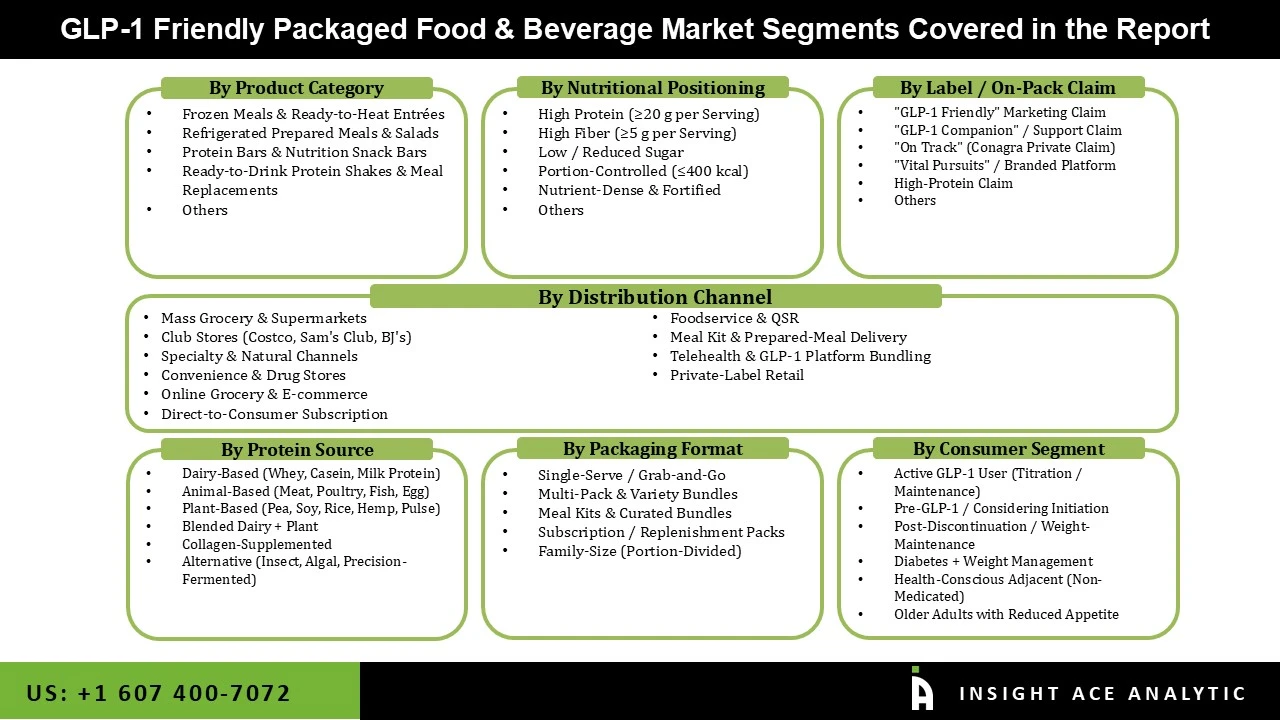
GLP-1 Friendly Packaged Food & Beverage Market by Nutritional Positioning -
• High Protein (≥20 g per Serving)
• High Fiber (≥5 g per Serving)
• Low / Reduced Sugar
• Portion-Controlled (≤400 kcal)
• Nutrient-Dense & Fortified
• Prebiotic & Gut-Health Supporting
• Metabolic Support / Blood-Sugar Friendly
• Clean Label & Minimally Processed
GLP-1 Friendly Packaged Food & Beverage Market by Label / On-Pack Claim -
• "GLP-1 Friendly" Marketing Claim
• "GLP-1 Companion" / Support Claim
• "On Track" (Conagra Private Claim)
• "Vital Pursuits" / Branded Platform
• High-Protein Claim
• Smaller-Portion & Mini-Meal Claim
• Complete Nutrition Claim
• Natural GLP-1 Support (Prebiotic Fiber-Led)
• Satiety & Appetite-Support Claim
GLP-1 Friendly Packaged Food & Beverage Market by Protein Source -
• Dairy-Based (Whey, Casein, Milk Protein)
• Animal-Based (Meat, Poultry, Fish, Egg)
• Plant-Based (Pea, Soy, Rice, Hemp, Pulse)
• Blended Dairy + Plant
• Collagen-Supplemented
• Alternative (Insect, Algal, Precision-Fermented)
GLP-1 Friendly Packaged Food & Beverage Market by Packaging Format -
• Single-Serve / Grab-and-Go
• Multi-Pack & Variety Bundles
• Meal Kits & Curated Bundles
• Subscription / Replenishment Packs
• Family-Size (Portion-Divided)
GLP-1 Friendly Packaged Food & Beverage Market by Distribution Channel -
• Mass Grocery & Supermarkets
• Club Stores (Costco, Sam's Club, BJ's)
• Specialty & Natural Channels
• Convenience & Drug Stores
• Online Grocery & E-commerce
• Direct-to-Consumer Subscription
• Foodservice & QSR
• Meal Kit & Prepared-Meal Delivery
• Telehealth & GLP-1 Platform Bundling
• Private-Label Retail
GLP-1 Friendly Packaged Food & Beverage Market by Consumer Segment -
• Active GLP-1 User (Titration / Maintenance)
• Pre-GLP-1 / Considering Initiation
• Post-Discontinuation / Weight-Maintenance
• Diabetes + Weight Management
• Health-Conscious Adjacent (Non-Medicated)
• Older Adults with Reduced Appetite
GLP-1 Friendly Packaged Food & Beverage Market by Region-
North America-
• The US
• Canada
• Mexico
Europe-
• Germany
• The UK
• France
• Italy
• Spain
• Rest of Europe
Asia-Pacific-
• China
• Japan
• India
• South Korea
• South East Asia
• Rest of Asia Pacific
Latin America-
• Brazil
• Argentina
• Rest of Latin America
Middle East & Africa-
• GCC Countries
• South Africa
• Rest of Middle East and Africa
Chapter 1. Methodology and Scope
1.1. Research Methodology
1.2. Research Scope & Assumptions
Chapter 2. Executive Summary
Chapter 3. Global GLP-1 Friendly Packaged Food & Beverage Market Snapshot
Chapter 4. Global GLP-1 Friendly Packaged Food & Beverage Market Variables, Trends & Scope
4.1. Market Segmentation & Scope
4.2. Market Drivers
4.3. Market Challenges
4.4. Market Trends
4.5. Investment & Funding Analysis
4.6. Porter’s Five Forces Analysis
4.7. Incremental Opportunity Analysis (US$ Mn), 2025–2035
4.8. Market Penetration & Growth Prospect Mapping (US$ Mn), 2026–2035
4.9. Competitive Landscape & Market Share Analysis, 2026
Chapter 5. Market Segmentation 1: By Product Category
5.1. Market Share, 2025 & 2035
5.2. Market Size (US$ Mn), 2022–2035
5.2.1. Frozen Meals & Ready-to-Heat Entrées
5.2.2. Refrigerated Prepared Meals & Salads
5.2.3. Protein Bars & Nutrition Snack Bars
5.2.4. Ready-to-Drink Protein Shakes & Meal Replacements
5.2.5. Protein Water & Functional Hydration Beverages
5.2.6. Yogurt, Skyr & Cultured Dairy
5.2.7. Functional & Metabolic Support Beverages
5.2.8. Soups, Broths & Liquid Meals
5.2.9. Better-for-You Bakery & Baked Goods
5.2.10. Savory Snacks & Jerky
5.2.11. Sweet Snacks & Portion-Controlled Indulgence
5.2.12. High-Protein Breakfast & Cereal
5.2.13. Plant-Based & Alternative Protein Foods
5.2.14. Ice Cream & Frozen Desserts (Portion-Controlled)
5.2.15. Pasta, Grain Bowls & Modular Meal Components
Chapter 6. Market Segmentation 2: By Nutritional Positioning
6.1. Market Share, 2025 & 2035
6.2. Market Size (US$ Mn), 2022–2035
6.2.1. High Protein
6.2.2. High Fiber
6.2.3. Low / Reduced Sugar
6.2.4. Portion-Controlled
6.2.5. Nutrient-Dense & Fortified
6.2.6. Prebiotic & Gut Health Supporting
6.2.7. Metabolic Support / Blood-Sugar Friendly
6.2.8. Clean Label & Minimally Processed
Chapter 7. Market Segmentation 3: By Label / On-Pack Claim
7.1. Market Share, 2025 & 2035
7.2. Market Size (US$ Mn), 2022–2035
7.2.1. “GLP-1 Friendly” Claim
7.2.2. “GLP-1 Companion” Claim
7.2.3. “On Track” Claim
7.2.4. “Vital Pursuits” Platform
7.2.5. High-Protein Claim
7.2.6. Smaller-Portion Claim
7.2.7. Complete Nutrition Claim
7.2.8. Natural GLP-1 Support Claim
7.2.9. Satiety & Appetite Support Claim
Chapter 8. Market Segmentation 4: By Protein Source
8.1. Market Share, 2025 & 2035
8.2. Market Size (US$ Mn), 2022–2035
8.2.1. Dairy-Based
8.2.2. Animal-Based
8.2.3. Plant-Based
8.2.4. Blended Dairy + Plant
8.2.5. Collagen-Supplemented
8.2.6. Alternative Protein
Chapter 9. Market Segmentation 5: By Packaging Format
9.1. Market Share, 2025 & 2035
9.2. Market Size (US$ Mn), 2022–2035
9.2.1. Single-Serve
9.2.2. Multi-Pack
9.2.3. Meal Kits & Bundles
9.2.4. Subscription Packs
9.2.5. Family-Size
Chapter 10. Market Segmentation 6: By Distribution Channel
10.1. Market Share, 2025 & 2035
10.2. Market Size (US$ Mn), 2022–2035
10.2.1. Mass Grocery & Supermarkets
10.2.2. Club Stores
10.2.3. Specialty & Natural Channels
10.2.4. Convenience & Drug Stores
10.2.5. Online Grocery & E-commerce
10.2.6. Direct-to-Consumer
10.2.7. Foodservice & QSR
10.2.8. Meal Kit Delivery
10.2.9. Telehealth Bundling
10.2.10. Private Label Retail
Chapter 11. Market Segmentation 7: By Consumer Segment
11.1. Market Share, 2025 & 2035
11.2. Market Size (US$ Mn), 2022–2035
11.2.1. Active GLP-1 Users
11.2.2. Pre-GLP-1 Consumers
11.2.3. Post-Discontinuation Users
11.2.4. Diabetes + Weight Management
11.2.5. Health-Conscious Consumers
11.2.6. Older Adults
Chapter 12. Regional Market Estimates & Trend Analysis
12.1 Global Regional Snapshot, 2025 & 2035
12.2 North America
12.2.1. Market Revenue by Country (U.S., Canada, Mexico), 2022–2035
12.2.2. North America Market Revenue (US$ Mn) By Product Category, 2022–2035
12.2.3. North America Market Revenue (US$ Mn) By Nutritional Positioning, 2022–2035
12.2.4. North America Market Revenue (US$ Mn) By Label / On-Pack Claim, 2022–2035
12.2.5. North America Market Revenue (US$ Mn) By Protein Source, 2022–2035
12.2.6. North America Market Revenue (US$ Mn) By Packaging Format, 2022–2035
12.2.7. North America Market Revenue (US$ Mn) By Distribution Channel, 2022–2035
12.2.8. North America Market Revenue (US$ Mn) By Consumer Segment, 2022–2035
12.3 Europe
12.3.1. Market Revenue by Country, 2022–2035
12.3.2. Europe Market Revenue (US$ Mn) By Product Category, 2022–2035
12.3.3. Europe Market Revenue (US$ Mn) By Nutritional Positioning, 2022–2035
12.3.4. Europe Market Revenue (US$ Mn) By Label / On-Pack Claim, 2022–2035
12.3.5. Europe Market Revenue (US$ Mn) By Protein Source, 2022–2035
12.3.6. Europe Market Revenue (US$ Mn) By Packaging Format, 2022–2035
12.3.7. Europe Market Revenue (US$ Mn) By Distribution Channel, 2022–2035
12.3.8. Europe Market Revenue (US$ Mn) By Consumer Segment, 2022–2035
12.4 Asia Pacific
12.4.1. Market Revenue by Country, 2022–2035
12.4.2. Asia Pacific Market Revenue (US$ Mn) By Product Category, 2022–2035
12.4.3. Asia Pacific Market Revenue (US$ Mn) By Nutritional Positioning, 2022–2035
12.4.4. Asia Pacific Market Revenue (US$ Mn) By Label / On-Pack Claim, 2022–2035
12.4.5. Asia Pacific Market Revenue (US$ Mn) By Protein Source, 2022–2035
12.4.6. Asia Pacific Market Revenue (US$ Mn) By Packaging Format, 2022–2035
12.4.7. Asia Pacific Market Revenue (US$ Mn) By Distribution Channel, 2022–2035
12.4.8. Asia Pacific Market Revenue (US$ Mn) By Consumer Segment, 2022–2035
12.5 Latin America
12.5.1. Market Revenue by Country, 2022–2035
12.5.2. Latin America Market Revenue (US$ Mn) By Product Category, 2022–2035
12.5.3. Latin America Market Revenue (US$ Mn) By Nutritional Positioning, 2022–2035
12.5.4. Latin America Market Revenue (US$ Mn) By Label / On-Pack Claim, 2022–2035
12.5.5. Latin America Market Revenue (US$ Mn) By Protein Source, 2022–2035
12.5.6. Latin America Market Revenue (US$ Mn) By Packaging Format, 2022–2035
12.5.7. Latin America Market Revenue (US$ Mn) By Distribution Channel, 2022–2035
12.5.8. Latin America Market Revenue (US$ Mn) By Consumer Segment, 2022–2035
12.6 Middle East & Africa
12.6.1. Market Revenue by Country, 2022–2035
12.6.2. Middle East & Africa Market Revenue (US$ Mn) By Product Category, 2022–2035
12.6.3. Middle East & Africa Market Revenue (US$ Mn) By Nutritional Positioning, 2022–2035
12.6.4. Middle East & Africa Market Revenue (US$ Mn) By Label / On-Pack Claim, 2022–2035
12.6.5. Middle East & Africa Market Revenue (US$ Mn) By Protein Source, 2022–2035
12.6.6. Middle East & Africa Market Revenue (US$ Mn) By Packaging Format, 2022–2035
12.6.7. Middle East & Africa Market Revenue (US$ Mn) By Distribution Channel, 2022–2035
12.6.8. Middle East & Africa Market Revenue (US$ Mn) By Consumer Segment, 2022–2035
Chapter 13. Competitive Landscape
13.1. Key Strategic Developments
13.2. Market Share Analysis, 2026
13.3 Company Profiles (76 Players)
13.3.1 CPG Majors with GLP-1 Lines
Conagra Brands
Nestlé S.A.
Kraft Heinz Company
General Mills
Unilever plc
Mondelez International
PepsiCo
The Coca-Cola Company
Kellanova
Post Holdings
Hormel Foods
The Campbell’s Company
The J.M. Smucker Company
Danone S.A.
Arla Foods
Tyson Foods
13.3.2 Protein & Performance Nutrition Brands
17. BellRing Brands
18. The Simply Good Foods Company
19. Glanbia plc
20. Abbott Laboratories
21. Nestlé Health Science
22. Herbalife Nutrition
23. GNC Holdings
24. Huel Ltd.
25. Kodiak Cakes
26. Chobani LLC
13.3.3 GLP-1-Native & Emerging Brands
27. Supergut
28. Lemme
29. David Protein
30. Magic Spoon
31. Daily Harvest
32. Fulfil Nutrition
33. Built Bar
34. Perfect Snacks
35. Factor
36. Nourish Ingredients
13.3.4 Functional Beverage & Hydration
37. Olipop
38. Poppi
39. Vieve Protein Water
40. Koia
41. OWYN
42. fairlife / Core Power
43. Muscle Milk
44. Iconic Protein
45. Kin Euphorics
13.3.5 Retailer Private Label & International
46. Marks & Spencer
47. Co-op UK
48. Tesco plc
49. J Sainsbury plc
50. Waitrose & Partners
51. Wm Morrison Supermarkets
52. Aldi
53. Lidl
54. Trader Joe’s
55. Amazon
56. Walmart
57. Costco Wholesale
13.3.6 Foodservice & QSR Innovators
58. Smoothie King
59. Chipotle Mexican Grill
60. Subway
61. Shake Shack
62. Darden Restaurants
63. Panera Bread
64. Starbucks Corporation
65. Sweetgreen
66. Cava Group
13.3.7 Ingredient Suppliers (B2B)
67. Ingredion Incorporated
68. Roquette Frères
69. Kerry Group plc
70. Archer Daniels Midland (ADM)
71. Tate & Lyle PLC
72. BENEO GmbH
73. dsm-firmenich
74. FrieslandCampina Ingredients
75. Nexture
76. Cargill, Incorporated
Research Design and Approach
This study employed a multi-step, mixed-method research approach that integrates:
- Secondary research
- Primary research
- Data triangulation
- Hybrid top-down and bottom-up modelling
- Forecasting and scenario analysis
This approach ensures a balanced and validated understanding of both macro- and micro-level market factors influencing the market.
Secondary Research
Secondary research for this study involved the collection, review, and analysis of publicly available and paid data sources to build the initial fact base, understand historical market behaviour, identify data gaps, and refine the hypotheses for primary research.
Sources Consulted
Secondary data for the market study was gathered from multiple credible sources, including:
- Government databases, regulatory bodies, and public institutions
- International organizations (WHO, OECD, IMF, World Bank, etc.)
- Commercial and paid databases
- Industry associations, trade publications, and technical journals
- Company annual reports, investor presentations, press releases, and SEC filings
- Academic research papers, patents, and scientific literature
- Previous market research publications and syndicated reports
These sources were used to compile historical data, market volumes/prices, industry trends, technological developments, and competitive insights.

Primary Research
Primary research was conducted to validate secondary data, understand real-time market dynamics, capture price points and adoption trends, and verify the assumptions used in the market modelling.
Stakeholders Interviewed
Primary interviews for this study involved:
- Manufacturers and suppliers in the market value chain
- Distributors, channel partners, and integrators
- End-users / customers (e.g., hospitals, labs, enterprises, consumers, etc., depending on the market)
- Industry experts, technology specialists, consultants, and regulatory professionals
- Senior executives (CEOs, CTOs, VPs, Directors) and product managers
Interview Process
Interviews were conducted via:
- Structured and semi-structured questionnaires
- Telephonic and video interactions
- Email correspondences
- Expert consultation sessions
Primary insights were incorporated into demand modelling, pricing analysis, technology evaluation, and market share estimation.
Data Processing, Normalization, and Validation
All collected data were processed and normalized to ensure consistency and comparability across regions and time frames.
The data validation process included:
- Standardization of units (currency conversions, volume units, inflation adjustments)
- Cross-verification of data points across multiple secondary sources
- Normalization of inconsistent datasets
- Identification and resolution of data gaps
- Outlier detection and removal through algorithmic and manual checks
- Plausibility and coherence checks across segments and geographies
This ensured that the dataset used for modelling was clean, robust, and reliable.
Market Size Estimation and Data Triangulation
Bottom-Up Approach
The bottom-up approach involved aggregating segment-level data, such as:
- Company revenues
- Product-level sales
- Installed base/usage volumes
- Adoption and penetration rates
- Pricing analysis
This method was primarily used when detailed micro-level market data were available.

Top-Down Approach
The top-down approach used macro-level indicators:
- Parent market benchmarks
- Global/regional industry trends
- Economic indicators (GDP, demographics, spending patterns)
- Penetration and usage ratios
This approach was used for segments where granular data were limited or inconsistent.
Hybrid Triangulation Approach
To ensure accuracy, a triangulated hybrid model was used. This included:
- Reconciling top-down and bottom-up estimates
- Cross-checking revenues, volumes, and pricing assumptions
- Incorporating expert insights to validate segment splits and adoption rates
This multi-angle validation yielded the final market size.
Forecasting Framework and Scenario Modelling
Market forecasts were developed using a combination of time-series modelling, adoption curve analysis, and driver-based forecasting tools.
Forecasting Methods
- Time-series modelling
- S-curve and diffusion models (for emerging technologies)
- Driver-based forecasting (GDP, disposable income, adoption rates, regulatory changes)
- Price elasticity models
- Market maturity and lifecycle-based projections
Scenario Analysis
Given inherent uncertainties, three scenarios were constructed:
- Base-Case Scenario: Expected trajectory under current conditions
- Optimistic Scenario: High adoption, favourable regulation, strong economic tailwinds
- Conservative Scenario: Slow adoption, regulatory delays, economic constraints
Sensitivity testing was conducted on key variables, including pricing, demand elasticity, and regional adoption.
Request Customization
Add countries, segments, company profiles, or extend forecast — free 10% customization with purchase.
Customize This Report →Enquire Before Buying
Speak with our analyst team about scope, methodology, pricing, or deliverable formats.
Enquire Now →Frequently Asked Questions
GLP 1 Friendly Packaged Food & Beverage Market is likely to grow with a 14.8 % CAGR during the forecast period for 2026 to 2035.
Conagra Brands (Healthy Choice On Track, Birds Eye), Nestlé S.A. (Vital Pursuits, Lean Cuisine, Stouffer\'s), Kraft Heinz Company, General Mills (Progresso, Annie\'s, Yoplait), Unilever plc, Mondelez International, PepsiCo (Quaker, Sabra, Gatorade), The Coca-Cola Company (fairlife Core Power), Kellanova (RXBar, Eggo, Special K), Post Holdings
GLP 1 Friendly Packaged Food & Beverage Market is segmented into Product Category, Nutritional Positioning, Label / On-Pack Claim, Protein Source, Packaging Format, Distribution Channel, Consumer Segment and By Region
North America region is leading the GLP 1 Friendly Packaged Food & Beverage Market.