Smart Packaging Inspection and Closed Loop Quality Intelligence Systems Market Forecast Report 2026 to 2035
What is Smart Packaging Inspection and Closed Loop Quality Intelligence Systems Market Size?
Smart Packaging Inspection and Closed Loop Quality Intelligence Systems Market Size is predicted to grow at a 10.1% CAGR during the forecast period for 2026 to 2035.
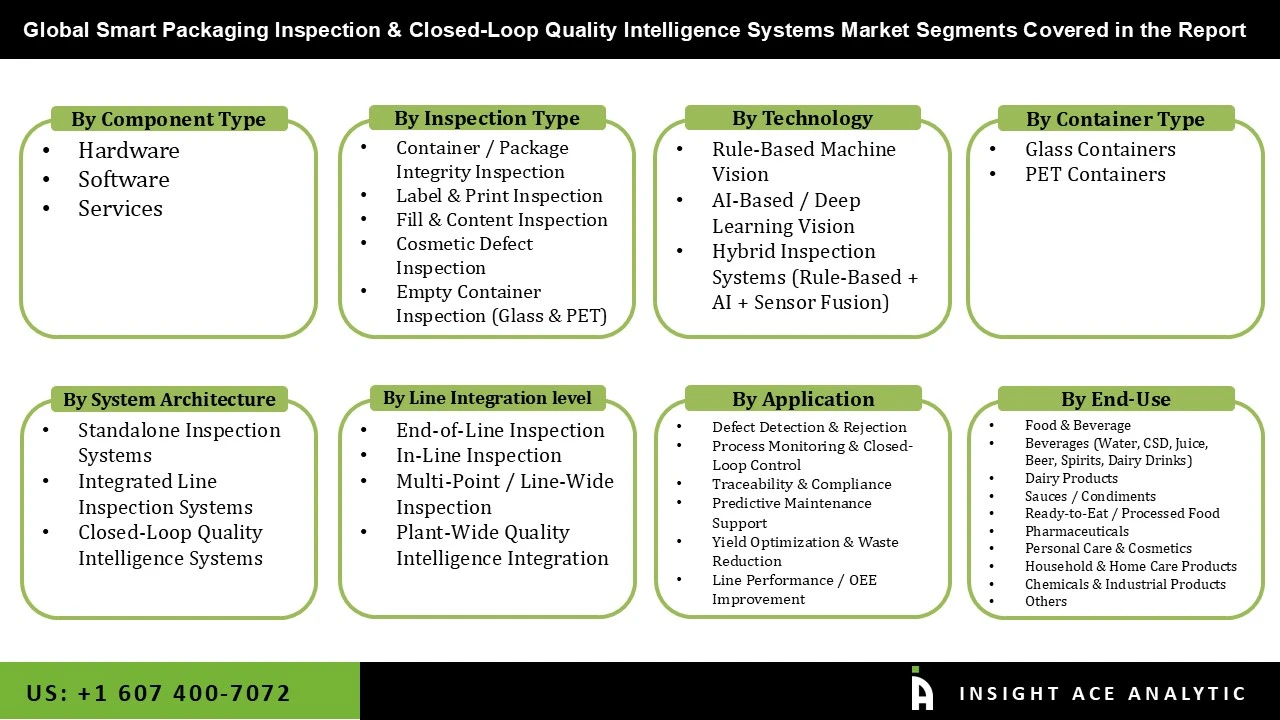
Smart Packaging Inspection and Closed-Loop Quality Intelligence Systems Market Size, Share & Trends Analysis Distribution By Component (Hardware, Software, Services), Inspection Type (Container / Package Integrity Inspection, Label & Print Inspection, Fill & Content Inspection, Cosmetic Defect Inspection, Empty Container Inspection) By Technology (Rule-Based Machine Vision, AI-Based / Deep Learning Vision, Hybrid Inspection Systems (Rule-Based + AI + Sensor Fusion), By Container Type (Glass Containers, PET Containers), By System Architecture (Standalone Inspection Systems, Integrated Line Inspection Systems, Closed-Loop Quality Intelligence Systems), By Line Integration Level (End-of-Line Inspection, In-Line Inspection, Multi-Point / Line-Wide Inspection, Plant-Wide Quality Intelligence Integration), Application (Defect Detection & Rejection, Process Monitoring & Closed-Loop Control, Traceability & Compliance, Predictive Maintenance Support, Yield Optimization & Waste Reduction, Line Performance / OEE Improvement), End-Use Industry and Segment Forecasts, 2026 to 2035
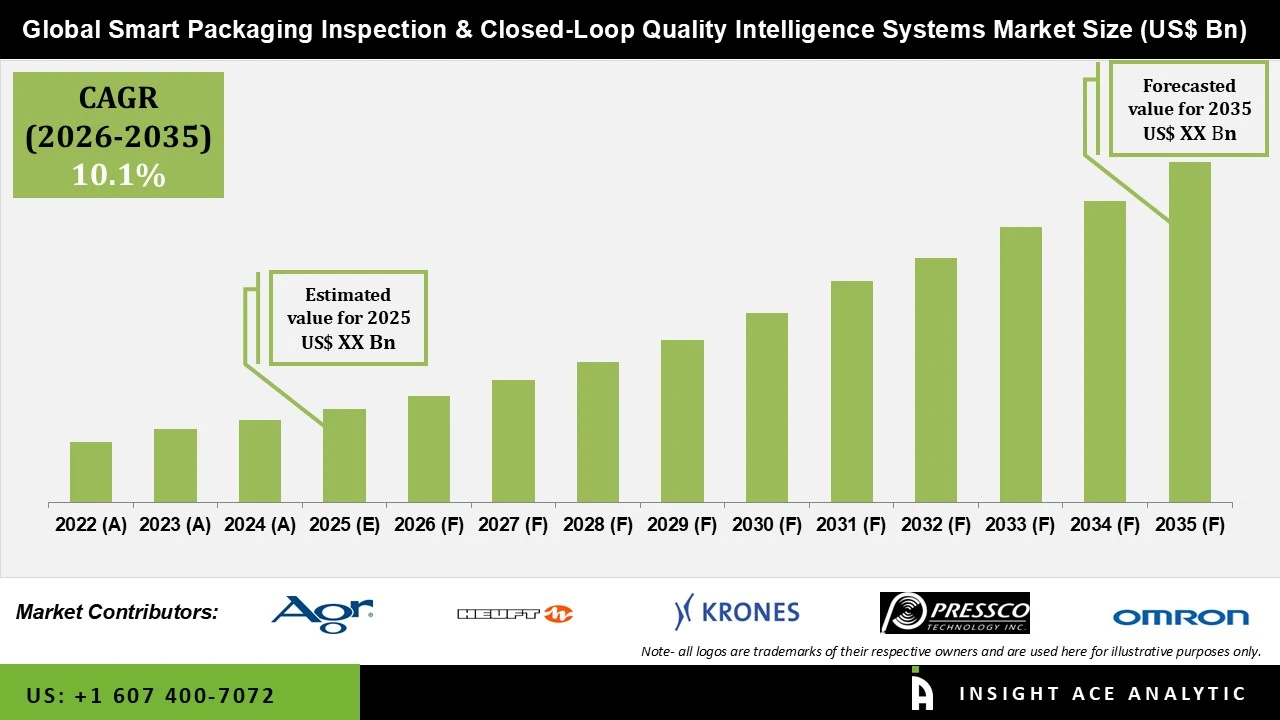
Smart Packaging Inspection and Closed-Loop Quality Intelligence Systems Market is gaining traction as manufacturers shift toward more data-driven and proactive quality management approaches. Instead of relying only on end-of-line inspection, these systems enable continuous monitoring across the entire packaging process, helping companies maintain tighter control over product integrity. By integrating intelligent inspection tools with connected production systems, manufacturers can gain deeper visibility into performance, identify patterns, and respond quickly to variations. This approach is particularly valuable in high-speed production environments where even minor inconsistencies can lead to significant losses. As a result, these systems are becoming an essential part of modern packaging strategies aimed at improving reliability, traceability, and overall process transparency.
This market is increasingly focused on reducing product recalls and protecting brand reputation, especially in industries where packaging errors can directly impact consumer safety. The growing need for traceability and real-time data insights is also driving the adoption of closed-loop quality systems, enabling companies to make faster, more informed decisions. Additionally, rising labour costs and the push for operational efficiency are prompting businesses to replace manual inspection processes with automated solutions. On the other hand, challenges remain in terms of system standardisation and compatibility across different production environments. Many manufacturers operate with legacy equipment, making it difficult to seamlessly integrate new intelligent inspection systems. Data management and cybersecurity concerns are also becoming more prominent as operations become increasingly connected. Despite these challenges, the market continues to move forward, supported by innovation and the growing recognition of the long-term value of predictive and preventive quality control.
Competitive Landscape
Which are the Leading Players in the Smart Packaging Inspection & Closed-Loop Quality Intelligence Systems Market?
- Beverage-Line Inspection & Process Control Specialists
-
- AGR International (Measurement, Gauging, Blowmolder Process Control)
- HEUFT Systemtechnik
- Krones AG
- FT System
- Pressco Technology
- Filtec
- Miho Inspection Systems
- PET / Rigid Packaging & Closure Inspection Specialists
-
- Intravis GmbH
- Sacmi
- BBULL Technology
- Vision & AI Inspection Platform Players
-
- Cognex Corporation
- Keyence Corporation
- Omron Corporation
- Mettler-Toledo International
- ISRA Vision
- Traceability + Inspection + Data Intelligence Players
-
- Antares Vision Group
- Emerging AI-Native Inspection & Quality Intelligence Platforms
-
- Elementary
- Instrumental
Market Dynamics
Driver
Rising Focus on Brand Protection and Recall Prevention
The major driver of the smart packaging inspection & closed-loop quality intelligence systems market is the increasing need for companies to minimise product recalls and safeguard their brand reputation. In today’s highly competitive, transparent market environment, even a minor packaging defect or labelling error can quickly trigger large-scale recalls, financial losses, and damage to consumer trust. As a result, manufacturers are becoming more proactive in ensuring that every product leaving the production line meets strict quality standards. Smart inspection and closed-loop systems play an important role by enabling real-time defect detection and immediate corrective actions during the production process. Instead of identifying issues after products are already distributed, companies can prevent errors at the source, significantly reducing risks. This not only helps in maintaining compliance with regulatory standards but also builds long-term customer confidence. For businesses, investing in such technologies is no longer just about operational efficiency it is about protecting their reputation and ensuring consistent product quality in an increasingly quality-conscious market.
Restrain/Challenge
Integration Challenges with Legacy Systems
The main challenge in the smart packaging inspection & closed-loop quality intelligence systems market is integrating advanced technologies with existing production systems. Many manufacturers still depend on legacy equipment that is not designed for modern digital systems, making implementation complex and costly. This process can require system upgrades and customisation and may even temporarily disrupt production, discouraging, especially small and mid-sized businesses, from quick adoption. However, companies are gradually addressing this by using phased or hybrid approaches that allow new systems to work alongside older equipment. While integration remains a key concern, improving technology and flexibility are expected to make this process easier over time.
Label & Print Inspection Segment is Expected to Drive the Smart Packaging Inspection & Closed-Loop Quality Intelligence Systems Market
Label and print inspection plays a key role in the smart packaging inspection and closed-loop quality intelligence systems market by making sure product labels are accurate and meet regulations. Labels carry important details, ensuring product labels are accurate and compliant with expiry dates, batch numbers, and barcodes, so even small mistakes can cause recalls or regulatory problems. Modern inspection systems check label presence, alignment, and print quality in real time, which cuts down on manual work and boosts efficiency. As packaging lines speed up and become more complex, companies need reliable label inspection more than ever to maintain quality, avoid costly errors, and give consumers a consistent, trustworthy product.
AI-Based / Deep Learning Vision Systems Segment is Expected to Drive the Smart Packaging Inspection & Closed-Loop Quality Intelligence Systems Market
The AI-based/deep learning vision systems segment is expected to play a leading role in driving the smart packaging inspection & closed-loop quality intelligence systems market, as manufacturers increasingly seek more accurate, intelligent inspection solutions. Unlike traditional rule-based systems, AI-powered vision technologies can learn from data, adapt to variations, and identify complex or subtle defects that may be difficult to detect using conventional methods. This makes them especially valuable in high-speed production environments where precision and consistency are critical. AI-based systems can continuously improve over time, reducing false rejections and enhancing overall inspection accuracy. They also support better decision-making by providing deeper insights into quality trends and process performance. As industries move toward automation and data-driven operations, demand for flexible, scalable inspection solutions is growing. AI-based vision systems not only improve product quality but also help manufacturers optimise processes, reduce waste, and maintain compliance more effectively, making them a key growth driver in the market.
Why Asia Pacific Led the Smart Packaging Inspection & Closed-Loop Quality Intelligence Systems Market?
Asia Pacific has emerged as a leading region in the smart packaging inspection and closed-loop quality intelligence systems market, driven by a strong combination of manufacturing growth, technological adoption, and evolving quality standards. Countries like China, India, Japan, and South Korea have become global manufacturing hubs, especially in food & beverages, pharmaceutical, and consumer goods, where packaging quality and safety are critical. As production volumes increase, companies are investing more in advanced inspection systems to ensure consistency, reduce defects, and minimise waste. Another key factor is the rapid adoption of automation and Industry 4.0 practices across the region. Manufacturers are increasingly integrating smart sensors, machine vision, and AI-powered analytics into their production lines to enable real-time monitoring and faster decision-making. This shift toward closed-loop quality systems enables companies not only to detect defects but also to automatic adjust processes to prevent them, thereby improving overall efficiency.
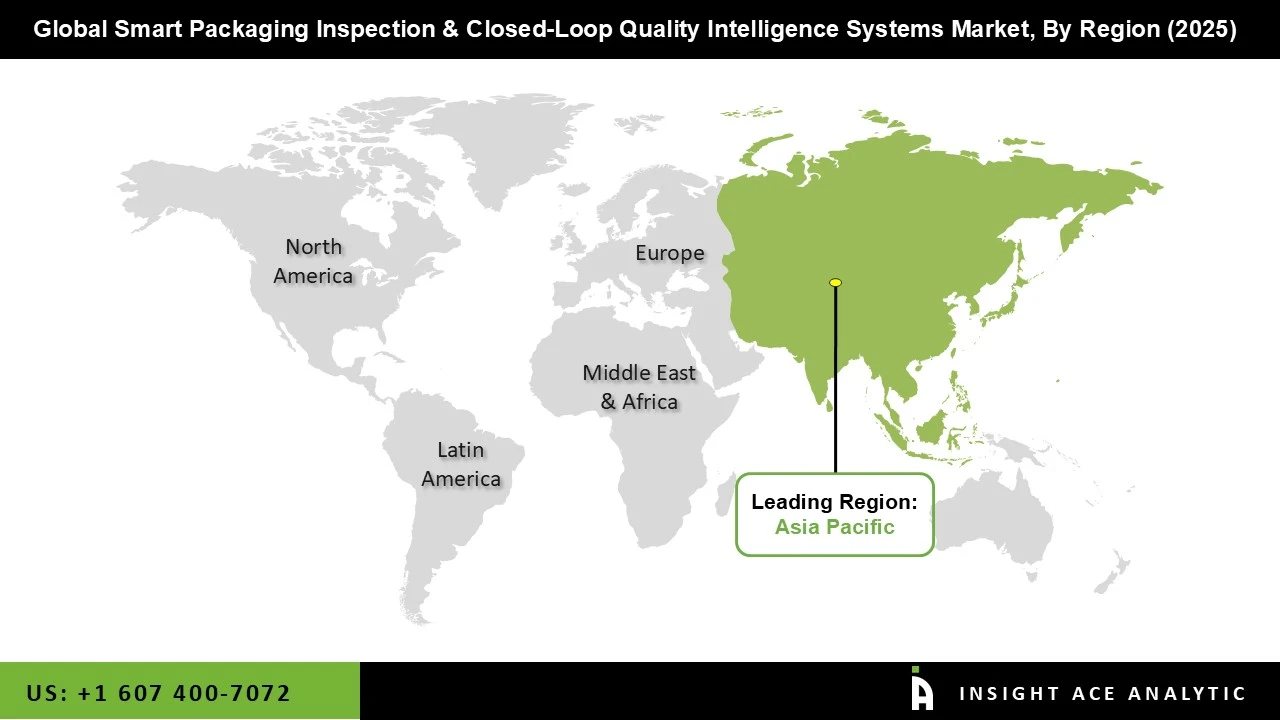
In addition, growing regulatory awareness and export demands are pushing companies to maintain higher quality standards. Asia Pacific exporters must comply with strict international packaging and safety regulations, which further drives the need for reliable inspection and traceability solutions. The availability of cost-effective manufacturing, combined with increasing investments in digital transformation, makes the region highly attractive for deploying advanced quality intelligence systems. Overall, the region’s strong industrial base, rising focus on quality assurance, and rapid technological advancements continue to position Asia Pacific as a key growth engine for this market.
Key Developments
• In March 2025, Krones AG introduced advanced integrated packaging and inspection solutions, focusing on fully automated production lines with built-in quality intelligence, supporting real-time monitoring and improved efficiency.
• In February 2025, Cognex Corporation expanded its AI-powered machine vision portfolio, enhancing deep learning-based inspection systems to improve defect detection accuracy and simplify deployment across manufacturing lines.
Smart Packaging Inspection & Closed-Loop Quality Intelligence Systems Market Report Scope:
| Report Attribute | Specifications |
| Growth Rate CAGR | CAGR of 10.1% from 2026 to 2035 |
| Quantitative Units | Representation of revenue in US$ Bn and CAGR from 2026 to 2035 |
| Historic Year | 2021 to 2025 |
| Forecast Year | 2026-2035 |
| Report Coverage | The forecast of revenue, the position of the company, the competitive market structure, growth prospects, and trends |
| Segments Covered | By Component, Inspection Type, Technology, Container Type, System Architecture,Line Integration Level, Application,End-Use Industry, and By Region |
| Regional Scope | North America; Europe; Asia Pacific; Latin America; Middle East & Africa |
| Country Scope | U.S.; Canada; U.K.; Germany; China; India; Japan; Brazil; Mexico; The UK; France; Italy; Spain; China; Japan; India; South Korea; Southeast Asia; South Korea; Southeast Asia |
| Competitive Landscape | AGR International, HEUFT Systemtechnik, Krones AG, FT System, Pressco Technology, Filtec, Miho Inspection Systems, Intravis GmbH, Sacmi, BBULL Technology, Cognex Corporation, Keyence Corporation, Omron Corporation, Mettler-Toledo International, ISRA Vision, Antares Vision Group, Elementary, Instrumental |
| Customization Scope | Free customization report with the procurement of the report, Modifications to the regional and segment scope. Geographic competitive landscape. |
| Pricing and Available Payment Methods | Explore pricing alternatives that are customized to your particular study requirements. |
Smart Packaging Inspection & Closed-Loop Quality Intelligence Systems Market Segmentation:
Smart Packaging Inspection & Closed-Loop Quality Intelligence Systems Market By Component
-
- Smart Cameras & Vision Sensors
- 2D/3D Imaging Systems
- Lighting Systems
- Edge Computing / Industrial PCs
- Inspection Sensors (Leak, Fill-Level, Pressure)
- Controllers / PLC Interface Modules
- Rejection / Sorting Modules
- Software
-
- AI / Deep Learning Inspection Software
- Defect Detection & Classification Software
- Quality Analytics & SPC Software
- Closed-Loop Process Control Software
- Traceability / Image Archiving Software
- Dashboard / Line Monitoring Software
- Services
-
- System Integration & Installation
- AI Model Development / Tuning
- Maintenance, Calibration & After-Sales Support
- Consulting & Process Optimization
Smart Packaging Inspection & Closed-Loop Quality Intelligence Systems Market By Inspection Type,
- Container / Package Integrity Inspection
-
- Seal Integrity Inspection
- Leak Detection
- Closure / Cap Inspection
- Package Shape / Deformation Inspection
- Label & Print Inspection
-
- Label Presence / Position / Alignment Inspection
- Print Quality Inspection
- Barcode / QR / DataMatrix Verification
- OCR / OCV for Batch, Lot, Expiry, Date Code
- Fill & Content Inspection
-
- Fill Level Inspection
- Foreign Object / Contaminant Detection
- Missing Product / Component Detection
- Cosmetic Defect Inspection
-
- Scratch / Dent / Crack Detection
- Surface Defect & Appearance Inspection
- Empty Container Inspection (Glass & PET)
-
- Sidewall / Base / Finish Inspection
- Residual Liquid / Caustic Detection
- Returnable Bottle Sorting & Grading
Smart Packaging Inspection & Closed-Loop Quality Intelligence Systems Market By Technology,
• Rule-Based Machine Vision
• AI-Based / Deep Learning Vision
• Hybrid Inspection Systems (Rule-Based + AI + Sensor Fusion)
Smart Packaging Inspection & Closed-Loop Quality Intelligence Systems Market By Container Type,
- Glass Containers
-
- Glass Bottles (Beverage, Food, Pharma)
- Glass Jars
- Returnable Glass Containers
- PET Containers
-
- PET Bottles (Water, CSD, Juice, Other Beverages)
- PET Preforms
- rPET / Recycled PET Containers
Smart Packaging Inspection & Closed-Loop Quality Intelligence Systems Market By System Architecture,
- Standalone Inspection Systems
- Integrated Line Inspection Systems
- Closed-Loop Quality Intelligence Systems
-
- Real-Time Monitoring & Feedback Systems
- Predictive Quality Intelligence Systems
- Self-Optimizing / Autonomous Process Control Systems
Smart Packaging Inspection & Closed-Loop Quality Intelligence Systems Market By Line Integration Level,
• End-of-Line Inspection
• In-Line Inspection
• Multi-Point / Line-Wide Inspection
• Plant-Wide Quality Intelligence Integration
Smart Packaging Inspection & Closed-Loop Quality Intelligence Systems Market By Application,
• Defect Detection & Rejection
• Process Monitoring & Closed-Loop Control
• Traceability & Compliance
• Predictive Maintenance Support
• Yield Optimization & Waste Reduction
• Line Performance / OEE Improvement
Smart Packaging Inspection & Closed-Loop Quality Intelligence Systems Market By End-Use Industry,
• Food & Beverage
• Beverages (Water, CSD, Juice, Beer, Spirits, Dairy Drinks)
• Dairy Products
• Sauces / Condiments
• Ready-to-Eat / Processed Food
• Pharmaceuticals
• Personal Care & Cosmetics
• Household & Home Care Products
• Chemicals & Industrial Products
• Others
Smart Packaging Inspection & Closed-Loop Quality Intelligence Systems Market by Region-
North America-
• The US
• Canada
Europe-
• Germany
• The UK
• France
• Italy
• Spain
• Rest of Europe
Asia-Pacific-
• China
• Japan
• India
• South Korea
• South East Asia
• Rest of Asia Pacific
Latin America-
• Brazil
• Argentina
• Mexico
• Rest of Latin America
Middle East & Africa-
• GCC Countries
• South Africa
• Rest of Middle East and Africa
Research Design and Approach
This study employed a multi-step, mixed-method research approach that integrates:
- Secondary research
- Primary research
- Data triangulation
- Hybrid top-down and bottom-up modelling
- Forecasting and scenario analysis
This approach ensures a balanced and validated understanding of both macro- and micro-level market factors influencing the market.
Secondary Research
Secondary research for this study involved the collection, review, and analysis of publicly available and paid data sources to build the initial fact base, understand historical market behaviour, identify data gaps, and refine the hypotheses for primary research.
Sources Consulted
Secondary data for the market study was gathered from multiple credible sources, including:
- Government databases, regulatory bodies, and public institutions
- International organizations (WHO, OECD, IMF, World Bank, etc.)
- Commercial and paid databases
- Industry associations, trade publications, and technical journals
- Company annual reports, investor presentations, press releases, and SEC filings
- Academic research papers, patents, and scientific literature
- Previous market research publications and syndicated reports
These sources were used to compile historical data, market volumes/prices, industry trends, technological developments, and competitive insights.

Primary Research
Primary research was conducted to validate secondary data, understand real-time market dynamics, capture price points and adoption trends, and verify the assumptions used in the market modelling.
Stakeholders Interviewed
Primary interviews for this study involved:
- Manufacturers and suppliers in the market value chain
- Distributors, channel partners, and integrators
- End-users / customers (e.g., hospitals, labs, enterprises, consumers, etc., depending on the market)
- Industry experts, technology specialists, consultants, and regulatory professionals
- Senior executives (CEOs, CTOs, VPs, Directors) and product managers
Interview Process
Interviews were conducted via:
- Structured and semi-structured questionnaires
- Telephonic and video interactions
- Email correspondences
- Expert consultation sessions
Primary insights were incorporated into demand modelling, pricing analysis, technology evaluation, and market share estimation.
Data Processing, Normalization, and Validation
All collected data were processed and normalized to ensure consistency and comparability across regions and time frames.
The data validation process included:
- Standardization of units (currency conversions, volume units, inflation adjustments)
- Cross-verification of data points across multiple secondary sources
- Normalization of inconsistent datasets
- Identification and resolution of data gaps
- Outlier detection and removal through algorithmic and manual checks
- Plausibility and coherence checks across segments and geographies
This ensured that the dataset used for modelling was clean, robust, and reliable.
Market Size Estimation and Data Triangulation
Bottom-Up Approach
The bottom-up approach involved aggregating segment-level data, such as:
- Company revenues
- Product-level sales
- Installed base/usage volumes
- Adoption and penetration rates
- Pricing analysis
This method was primarily used when detailed micro-level market data were available.

Top-Down Approach
The top-down approach used macro-level indicators:
- Parent market benchmarks
- Global/regional industry trends
- Economic indicators (GDP, demographics, spending patterns)
- Penetration and usage ratios
This approach was used for segments where granular data were limited or inconsistent.
Hybrid Triangulation Approach
To ensure accuracy, a triangulated hybrid model was used. This included:
- Reconciling top-down and bottom-up estimates
- Cross-checking revenues, volumes, and pricing assumptions
- Incorporating expert insights to validate segment splits and adoption rates
This multi-angle validation yielded the final market size.
Forecasting Framework and Scenario Modelling
Market forecasts were developed using a combination of time-series modelling, adoption curve analysis, and driver-based forecasting tools.
Forecasting Methods
- Time-series modelling
- S-curve and diffusion models (for emerging technologies)
- Driver-based forecasting (GDP, disposable income, adoption rates, regulatory changes)
- Price elasticity models
- Market maturity and lifecycle-based projections
Scenario Analysis
Given inherent uncertainties, three scenarios were constructed:
- Base-Case Scenario: Expected trajectory under current conditions
- Optimistic Scenario: High adoption, favourable regulation, strong economic tailwinds
- Conservative Scenario: Slow adoption, regulatory delays, economic constraints
Sensitivity testing was conducted on key variables, including pricing, demand elasticity, and regional adoption.
Request Customization
Add countries, segments, company profiles, or extend forecast — free 10% customization with purchase.
Customize This Report →Enquire Before Buying
Speak with our analyst team about scope, methodology, pricing, or deliverable formats.
Enquire Now →Frequently Asked Questions
Smart Packaging Inspection and Closed Loop Quality Intelligence Systems Market Size is predicted to grow at a 10.1% CAGR during the forecast period for 2026 to 2035.
AGR International, HEUFT Systemtechnik, Krones AG, FT System, Pressco Technology, Filtec, Miho Inspection Systems, Intravis GmbH, Sacmi, BBULL Technology, Cognex Corporation, Keyence Corporation, Omron Corporation, Mettler-Toledo International, ISRA Vision, Antares Vision Group, Elementary, Instrumental
Smart Packaging Inspection and Closed Loop Quality Intelligence Systems Market is segmented into By Component, Inspection Type, Technology, Container Type, System Architecture,Line Integration Level, Application,End-Use Industry, and By Region
Asia Pacific region is leading the Smart Packaging Inspection and Closed Loop Quality Intelligence Systems Market.