Venture Capital Market Forecast with Size and Share Analysis 2026 to 2035
Global Venture Capital Market Size is predicted to develop at a 10.50% CAGR during the forecast period for 2026 to 2035.
Venture Capital Market Size, Share & Trends Analysis Report By Stage (Seed Stage, Pre-Series A, Series A, Series B, Series C, Growth Stage, Late Stage), And By End-User (Real Estate, Financial Services, Healthcare, Transport & Logistics, Food & Beverages, IT & Ites, Education, Others), By Investor Typr, By Region, And By Segment Forecasts, 2026 to 2035.
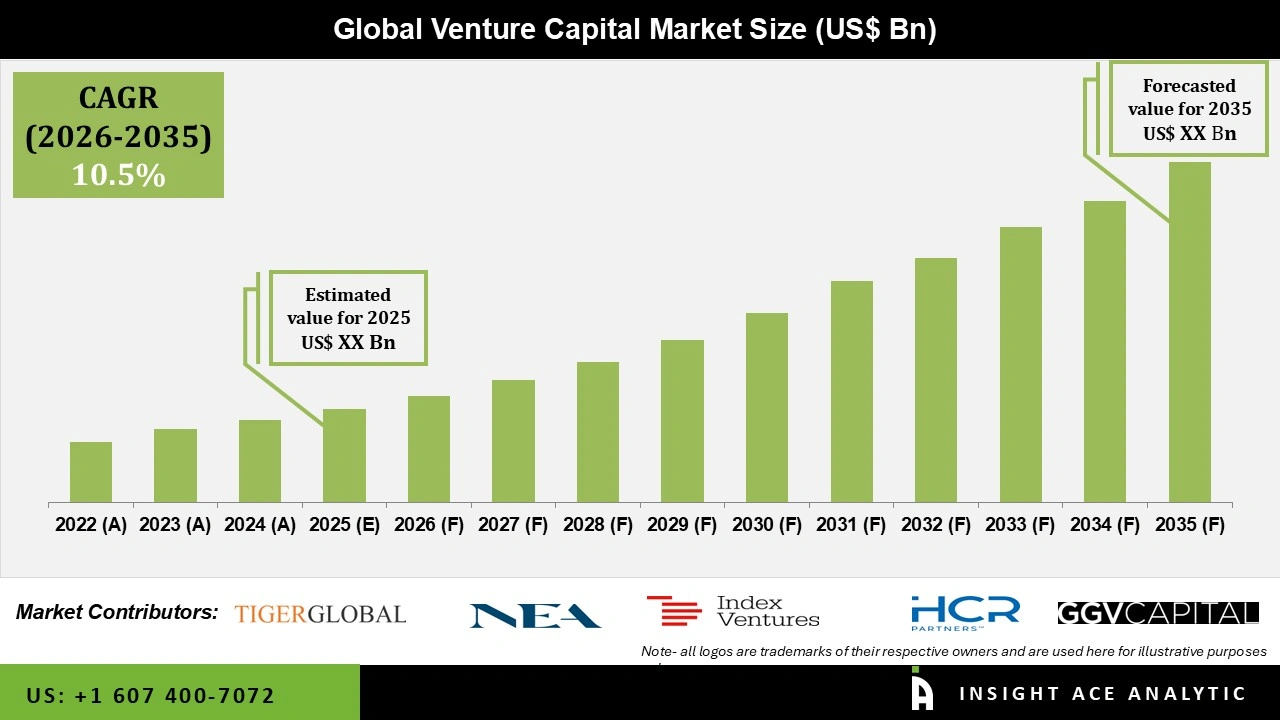
Venture capital (VC) firms are private equity financers where investors provide capital to early-stage, high-potential startup companies in exchange for equity ownership. VC investors typically seek innovative companies with strong growth prospects, often in technology or healthcare sectors, and provide not only funding but also strategic guidance and industry connections to help these startups scale. One of the primary drivers of the venture capital market is the expansion of the technology industry.At the moment, the two technologies attracting the greatest corporate venture capital investment are artificial intelligence (AI) and cloud computing. Together, they have more than twice the pace of venture investments in all other sectors over the past 10 years, and they currently make up more than one-third of the overall value of venture investments in the technology industry. Additionally, the expansion of the venture capital market is significantly influenced by technological developments. Startups thrive in the rapidly evolving fields of biotech, fintech, cleantech, and artificial intelligence. Technologies that upend established markets or offer innovative answers to urgent issues draw in investors.
However, one of the main factors impeding the market's expansion is the need for a thorough due diligence procedure. Conversely, technology developments in the venture capital investment space are anticipated to offer significant and profitable prospects for the market's expansion in the years to come.
Competitive Landscape
Some Major Key Players In The Venture Capital Market:
- Accel Partners
- Andreessen Horowitz
- Battery Ventures
- Bessemer Venture Partners
- DST Global
- GGV Capital
- Greylock Partners
- Healthcare Royalty Partners
- IDG Capital
- Index Ventures
- Insight Venture Partners
- Kleiner Perkins Caufield Byers
- Lightspeed Venture Partners
- Matrix Partners
- Nanjing Zijin Investment
- NEA (New Enterprise Associates)
- New Enterprises Associates
- Redpoint Ventures
- Sequoia Capital
- SoftBank Vision Fund
- Tiger Global Management
- Union Square Ventures
- Other Market Players
Market Segmentation:
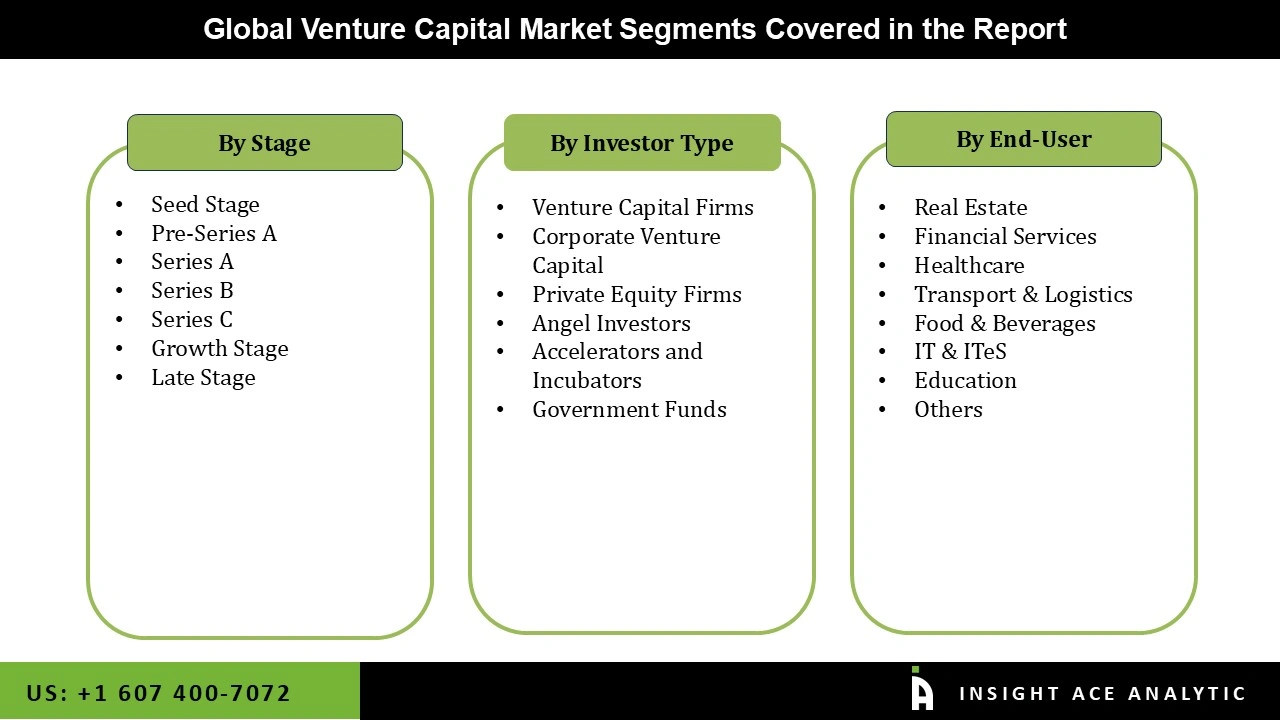
The Venture Capital market is segmented based on stage and end-user. Based on stage, the market is segmented into Seed Stage, Pre-Series A, Series A, Series B, Series C, Growth Stage, Late Stage. By Investor type, the market is segmented into venture capital firms, corporate venture capital, private equity firms, angel investors, accelerators and incubators, and government funds. By end-user, the market is segmented into Real Estate, Financial Services, Healthcare, Transport & Logistics, Food & Beverages, IT & ITeS, Education, and Others.
Based On The Type, The Local Investors Segment Is Accounted As A Major Contributor To The Venture Capital Market.
The Local Investors category is expected to report a major global market share in 2024, fueled by a growing desire for high-risk, high-reward investments in local markets, a mix of favourable government regulations, and an increase in entrepreneurial activity. Particularly in emerging regions where foreign venture capital participation may be restricted, local investors—such as high-net-worth individuals, family offices, and domestic venture capital firms—are becoming more and more important in financing early-stage enterprises. They have a strategic edge in spotting and fostering promising ventures because of their deep knowledge of local business environments, cultural dynamics, and regulatory frameworks.
Real Estate Segment To Witness Growth At A Rapid Rate
The growing use of technology in real estate development, management, and investment has led to a significant increase in the real estate segment of the venture capital market in recent years. Venture capital firms are increasingly attracted to PropTech startups that offer innovative solutions such as blockchain-enabled real estate transactions, digital marketplaces, AI-driven property analytics, and smart building systems. Furthermore, the growing need for energy-efficient and sustainable structures is attracting investment in new businesses that use eco-friendly materials and green building techniques.
In The Region, The North American Venture Capital Market Holds A Significant Revenue Share.
The North American Venture Capital market is expected to register the highest market share in revenue in the near future. This is explained by the fact that the industry is currently growing as a result of the overall growth of the market, startups, mutual fund venture capital firms, and financial institutions. Additionally, a rise in investment activity across other sector verticals, including media & entertainment, biotechnology, healthcare, and agriculture, is supporting the expansion of the venture capital industry.
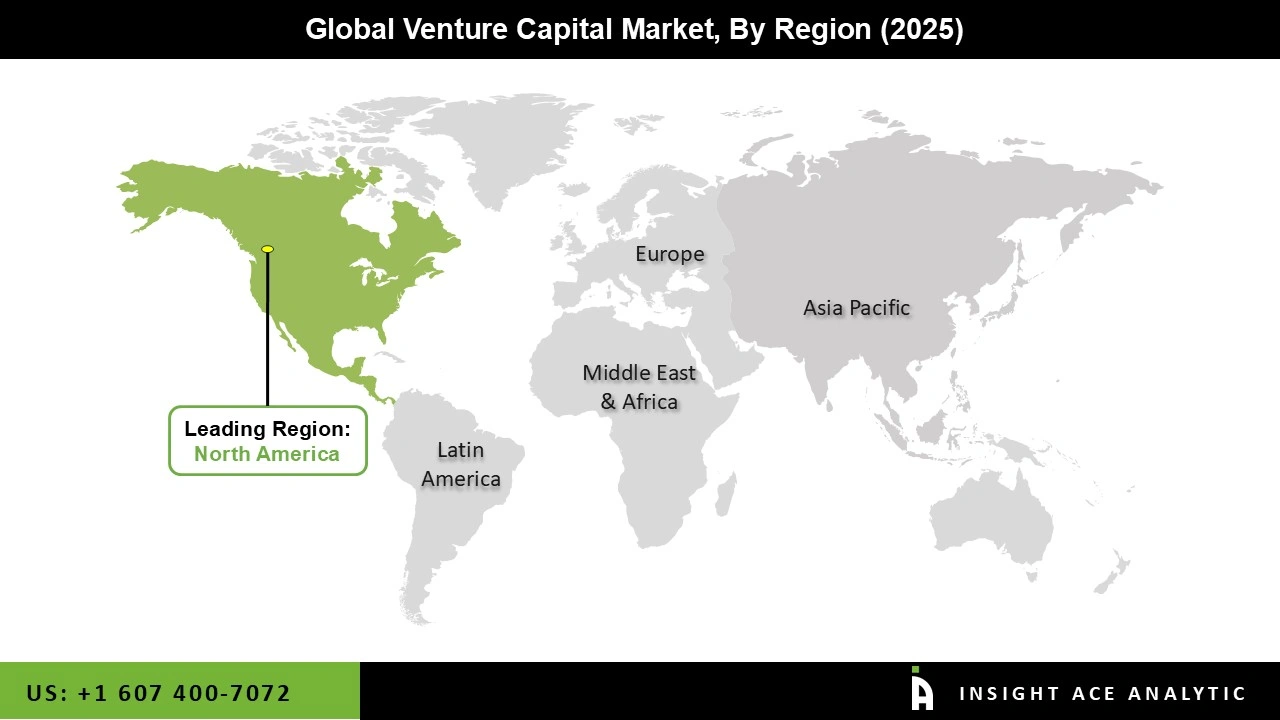
In addition, Asia Pacific is projected to grow rapidly in the global Venture Capital market, driven by a growing startup environment, strong economic expansion, and growing digital transformation in important industries. Particularly in industries like fintech, e-commerce, health tech, and artificial intelligence, countries like China, India, and Southeast Asia have become important hubs for venture capital investments. Due to the region's sizable and more technologically literate populace, as well as the encouragement of government programs and growing disposable incomes, innovation and entrepreneurship are flourishing.
Recent Development:
- July 2024: Index Ventures has declared $2.3 billion in new funds to establish connections with outstanding entrepreneurs developing disruptive, category-defining enterprises. In conjunction with Index's current $300 million Origin seed fund, Index is allocating $2.6 billion in financing to support creators from seed stage to IPO. This increases Index's cumulative capital raised since its inception to $15 billion.
Venture Capital Market Report Scope :
| Report Attribute | Specifications |
| Growth Rate CAGR | CAGR of 10.50% from 2026 to 2035 |
| Quantitative Units | Representation of revenue in US$ Million and CAGR from 2026 to 2035 |
| Historic Year | 2022 to 2025 |
| Forecast Year | 2026-2035 |
| Report Coverage | The forecast of revenue, the position of the company, the competitive market structure, growth prospects, and trends |
| Segments Covered | By Stage,Investor Type, End-User |
| Regional Scope | North America; Europe; Asia Pacific; Latin America; Middle East & Africa |
| Country Scope | U.S.; Canada; U.K.; Germany; China; India; Japan; Brazil; Mexico; France; Italy; Spain; South East Asia; South Korea |
| Competitive Landscape | Tiger Global Management, New Enterprises Associates, Index Ventures, Healthcare Royalty Partners, GGV Capital, Sequoia Capital, DST Global, IDG Capital, Nanjing Zijin Investment, and Greylock Partners. |
| Customization Scope | Free customization report with the procurement of the report and modifications to the regional and segment scope. Particular Geographic competitive landscape. |
| Pricing And Available Payment Methods | Explore pricing alternatives that are customized to your particular study requirements. |
Segmentation of Venture Capital Market :
Venture Capital Market, By Stage-
- Seed Stage
- Pre-Series A
- Series A
- Series B
- Series C
- Growth Stage
- Late Stage
Venture Capital Market, By Investor Type-
- Venture Capital Firms
- Corporate Venture Capital
- Private Equity Firms
- Angel Investors
- Accelerators and Incubators
- Government Funds
Venture Capital Market, By End-user-
- Real Estate
- Financial Services
- Healthcare
- Transport & Logistics
- Food & Beverages
- IT & ITeS
- Education
- Others
Venture Capital Market, By Region-
- North America-
- The US
- Canada
- Europe-
- Germany
- The UK
- France
- Italy
- Spain
- Rest of Europe
- Asia-Pacific-
- China
- Japan
- India
- South Korea
- South East Asia
- Rest of Asia Pacific
- Latin America-
- Brazil
- Argentina
- Mexico
- Rest of Latin America
- Middle East & Africa-
- GCC Countries
- South Africa
- Rest of Middle East and Africa
Research Design and Approach
This study employed a multi-step, mixed-method research approach that integrates:
- Secondary research
- Primary research
- Data triangulation
- Hybrid top-down and bottom-up modelling
- Forecasting and scenario analysis
This approach ensures a balanced and validated understanding of both macro- and micro-level market factors influencing the market.
Secondary Research
Secondary research for this study involved the collection, review, and analysis of publicly available and paid data sources to build the initial fact base, understand historical market behaviour, identify data gaps, and refine the hypotheses for primary research.
Sources Consulted
Secondary data for the market study was gathered from multiple credible sources, including:
- Government databases, regulatory bodies, and public institutions
- International organizations (WHO, OECD, IMF, World Bank, etc.)
- Commercial and paid databases
- Industry associations, trade publications, and technical journals
- Company annual reports, investor presentations, press releases, and SEC filings
- Academic research papers, patents, and scientific literature
- Previous market research publications and syndicated reports
These sources were used to compile historical data, market volumes/prices, industry trends, technological developments, and competitive insights.

Primary Research
Primary research was conducted to validate secondary data, understand real-time market dynamics, capture price points and adoption trends, and verify the assumptions used in the market modelling.
Stakeholders Interviewed
Primary interviews for this study involved:
- Manufacturers and suppliers in the market value chain
- Distributors, channel partners, and integrators
- End-users / customers (e.g., hospitals, labs, enterprises, consumers, etc., depending on the market)
- Industry experts, technology specialists, consultants, and regulatory professionals
- Senior executives (CEOs, CTOs, VPs, Directors) and product managers
Interview Process
Interviews were conducted via:
- Structured and semi-structured questionnaires
- Telephonic and video interactions
- Email correspondences
- Expert consultation sessions
Primary insights were incorporated into demand modelling, pricing analysis, technology evaluation, and market share estimation.
Data Processing, Normalization, and Validation
All collected data were processed and normalized to ensure consistency and comparability across regions and time frames.
The data validation process included:
- Standardization of units (currency conversions, volume units, inflation adjustments)
- Cross-verification of data points across multiple secondary sources
- Normalization of inconsistent datasets
- Identification and resolution of data gaps
- Outlier detection and removal through algorithmic and manual checks
- Plausibility and coherence checks across segments and geographies
This ensured that the dataset used for modelling was clean, robust, and reliable.
Market Size Estimation and Data Triangulation
Bottom-Up Approach
The bottom-up approach involved aggregating segment-level data, such as:
- Company revenues
- Product-level sales
- Installed base/usage volumes
- Adoption and penetration rates
- Pricing analysis
This method was primarily used when detailed micro-level market data were available.

Top-Down Approach
The top-down approach used macro-level indicators:
- Parent market benchmarks
- Global/regional industry trends
- Economic indicators (GDP, demographics, spending patterns)
- Penetration and usage ratios
This approach was used for segments where granular data were limited or inconsistent.
Hybrid Triangulation Approach
To ensure accuracy, a triangulated hybrid model was used. This included:
- Reconciling top-down and bottom-up estimates
- Cross-checking revenues, volumes, and pricing assumptions
- Incorporating expert insights to validate segment splits and adoption rates
This multi-angle validation yielded the final market size.
Forecasting Framework and Scenario Modelling
Market forecasts were developed using a combination of time-series modelling, adoption curve analysis, and driver-based forecasting tools.
Forecasting Methods
- Time-series modelling
- S-curve and diffusion models (for emerging technologies)
- Driver-based forecasting (GDP, disposable income, adoption rates, regulatory changes)
- Price elasticity models
- Market maturity and lifecycle-based projections
Scenario Analysis
Given inherent uncertainties, three scenarios were constructed:
- Base-Case Scenario: Expected trajectory under current conditions
- Optimistic Scenario: High adoption, favourable regulation, strong economic tailwinds
- Conservative Scenario: Slow adoption, regulatory delays, economic constraints
Sensitivity testing was conducted on key variables, including pricing, demand elasticity, and regional adoption.
Request Customization
Add countries, segments, company profiles, or extend forecast — free 10% customization with purchase.
Customize This Report →Enquire Before Buying
Speak with our analyst team about scope, methodology, pricing, or deliverable formats.
Enquire Now →Frequently Asked Questions
Global Venture Capital Market Size is predicted to develop at a 10.50% CAGR during the forecast period for 2026 to 2035.
Tiger Global Management, New Enterprises Associates, Index Ventures, Healthcare Royalty Partners, GGV Capital, Sequoia Capital, DST Global, IDG Capital, Nanjing Zijin Investment, and Greylock Partners.
Stage,Investor Type and End-User are the key segments of the Venture Capital Market.
North America region is leading the Venture Capital Market.