Artificial Intelligence Toolkit Market Size, Scope, Forecast Report 2026 to 2035
What is Artificial Intelligence (AI) Toolkit Market Size?
Artificial Intelligence (AI) Toolkit Market Size is valued at USD 36.65 Bn in 2025 and is predicted to reach USD 809.50 Bn by the year 2035 at a 36.4% CAGR during the forecast period for 2026 to 2035.
Artificial Intelligence Toolkit Market Size, Share & Trends Analysis Report By Offering (Software, Hardware (Processors, Accelerators, Services, Managed Services), By Technology (Natural Language Processing, Machine Learning, Computer Vision, Robotic Process Automation), By Vertical, By Region, And By Segment Forecasts, 2026 to 2035.
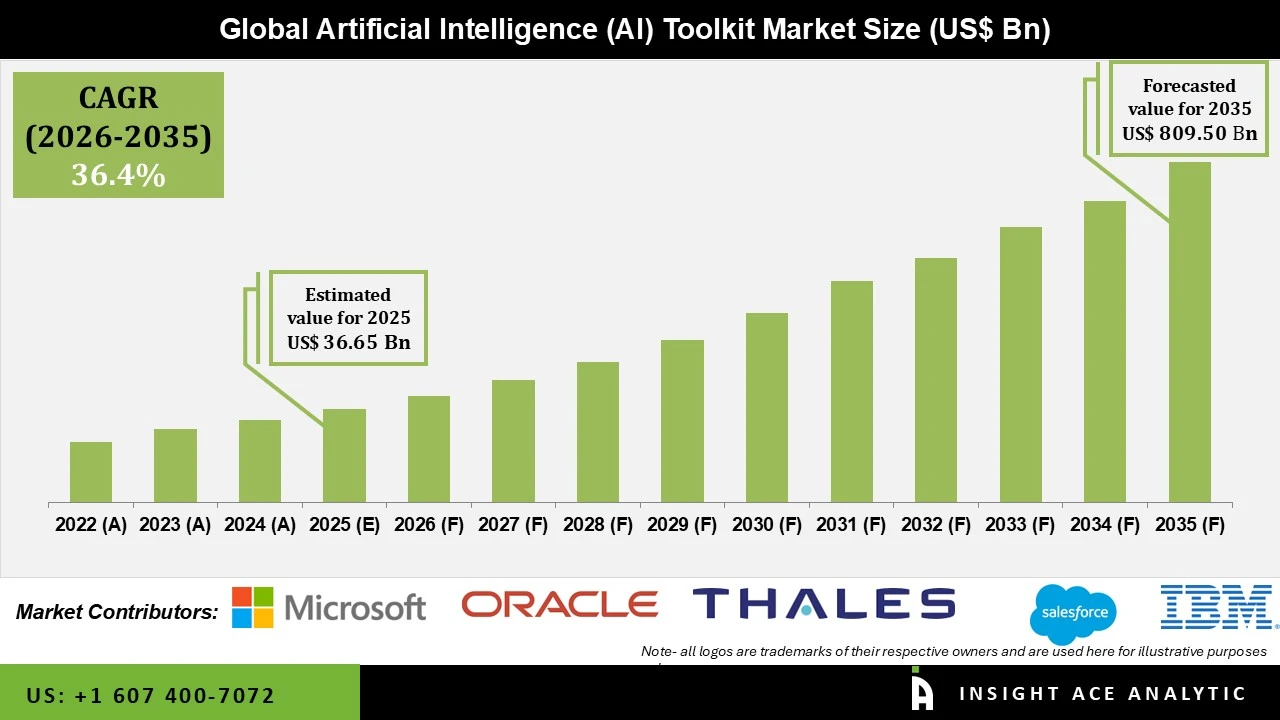
Artificial Intelligence (AI) Toolkit Market Key Takeaways:
|
The Artificial Intelligence (AI) toolkit market is experiencing robust growth and innovation. With key players like IBM, Google, Microsoft, and AWS, these toolkits are integral for AI application development. The market's evolution is driven by the expanding adoption of AI in various industry sectors, from healthcare to finance, underpinned by the Asia Pacific region's rapid growth. As governments support AI research and development and a skilled workforce emerges, the AI toolkit market is poised for continued expansion. Smaller startups and open-source projects further contribute to its dynamism, ensuring that AI technologies continue to advance and find new applications across a wide range of sectors.
However, the shortage of AI talent has created a thriving market for Artificial Intelligence (AI) toolkits. These toolkits provide pre-built solutions and libraries to empower businesses with AI capabilities without extensive expertise. As organizations seek to harness AI's potential, the toolkit market offers accessible and efficient solutions to bridge the talent gap and accelerate AI adoption.
Competitive Landscape
Some Major Key Players In The Artificial Intelligence (AI) Toolkit Market:
- Microsoft (US) Google (US)
- IBM (US)
- Oracle (US)
- Thales Group (France)
- Salesforce (US)
- Intel (US)
- Adobe (US)
- Meta Platforms (US)
- AWS (US)
- NVIDIA Corporation (US)
- ai (US)
- Alteryx (US)
- Altair (US)
- KNIME (Switzerland)
- DataRobot (US)
- Jasper (US)
- Rasa (US)
- SuperAnnotate (US)
- OpenAI (US)
- Obviously AI (US)
- Fiddler AI (US)
- Determined AI (US)
- Snorkel Al (US)
- Levity Al (Germany)
- Union AI (US)
- Attri AI (US)
- ai (US)
- Others
Market Segmentation:
The Artificial Intelligence (AI) toolkit market is segmented based on offering, technology and vertical. As per the offering, the market is segmented as software, hardware, processors, accelerators, and others (memory and networking equipment), and services include professional services and managed services. According to technology, the market is segmented as natural language processing(NLP), machine learning, computer vision, and robotic process automation. As per the vertical, the market is segmented as banking, financial services, & insurance (bfsi), retail & e-commerce, healthcare & life sciences, manufacturing, telecom, it & sites, media & entertainment, energy & utilities, government & defence, automotive, transportation, & logistics and other verticals (education, travel & hospitality, construction & real estate, and agriculture)
Based On Technology, The Natural Language Processing (NLP) Segment Is A Major Contributor To The Artificial Intelligence (AI) Toolkit Market.
Natural Language Processing (NLP) segment will hold the largest market size during the forecast period. NLP is a driving force behind popular voice assistants (Google Assistant, Amazon Alexa, etc.) contributing to the adoption of the Al toolkit market. These voice-activated services have become integral to homes and businesses, enhancing human-computer interaction and providing voice-activated solutions for various tasks. As these voice assistants gain widespread adoption, the demand for Al toolkits with robust NLP capabilities continues to surge. This trend not only expands the Al toolkit market but also promotes innovation in NLP technology, enabling more versatile and sophisticated voice-activated applications across various sectors, from smart homes to healthcare and customer service.
According To Vertical, The Healthcare And Life Sciences Segment Witnesses Growth At A Rapid Rate.
The Healthcare and Life Sciences segment is expected to lead with the maximum growth rate during the forecast period. "Al toolkits play a pivotal role in advancing healthcare Al research by enabling the analysis of large-scale healthcare datasets, and this function serves as a significant driver for the Al toolkit market. Healthcare institutions and researchers have recently been overwhelmed with an unprecedented volume of patient records, medical imaging, genomic data, and clinical notes due to the inclusion of big data.
Al toolkits empower healthcare Al research by efficiently processing and deciphering this vast pool of information. By leveraging machine learning (ML) algorithms and natural language processing, Al toolkits uncover hidden patterns, correlations, and insights that might elude human analysts. This not only expedites the pace of medical discoveries but also supports the development of more accurate diagnostics, treatment recommendations, and predictive healthcare models. As a result, the demand for Al toolkits in healthcare Al research continues to grow, fostering innovation and driving the expansion of the Al toolkit market.
In The Region, The North America Artificial Intelligence (AI) Toolkit Market Holds A Significant Revenue Share.
The North America Artificial Intelligence (AI) Toolkit market drives government support and funding. The commitment of governments in the region to Al research and development initiatives not only fosters innovation but also enhances competitiveness. Public investments in Al projects, research centres, and infrastructure create an ecosystem encouraging collaboration between academia, industry, and startups. This, in turn, fuels the development and adoption of Al toolkits, as they are the fundamental building blocks for Al innovation.
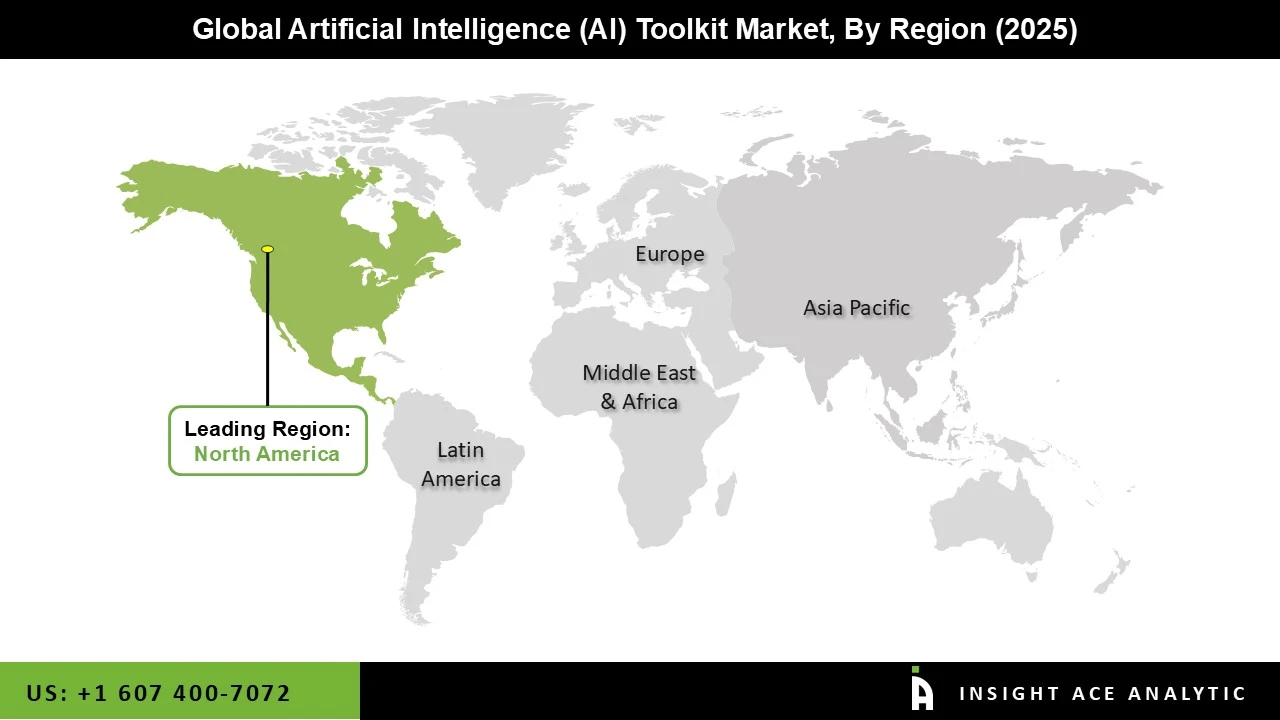
The availability of resources and funding facilitates the exploration of new Al applications and the expansion of Al capabilities, making North America a global leader in Al technology and driving the growth of the Al toolkit market in the region. In addition, Asia Pacific is witnessing substantial growth in the Artificial Intelligence (AI) Toolkit market. It is driven by the increased adoption of AI technology across various sectors, including healthcare, finance, and manufacturing.
Recent Developments:
- In Nov 2023, IBM declared its intention to release a data governance toolbox for artificial intelligence (AI) models that would be widely accessible. The purpose of this toolkit is to enhance openness in the recommendations produced by AI tools. IBM has announced that watsonx.governance will be accessible starting in early December 2023.
- In May 2023, Jasper declared an expanded collaboration with Google Cloud. The collaboration extended the accessibility of Jasper to a vast user base via the Google Cloud Marketplace, incorporated an additional foundational model into Jasper's AI Engine in conjunction with Google's Vertex AI, and unveiled fresh functionalities for Jasper Everywhere. By forming this partnership, Jasper successfully implemented its overarching goal of offering customized AI support to enterprises, accessible from any location they establish.
Artificial Intelligence (AI) Toolkit Market Report Scope
| Report Attribute | Specifications |
| Market Size Value In 2025 | USD 36.65 Bn |
| Revenue Forecast In 2035 | USD 809.50 Bn |
| Growth Rate CAGR | CAGR of 36.4% from 2026 to 2035 |
| Quantitative Units | Representation of revenue in US$ Bn and CAGR from 2026 to 2035 |
| Historic Year | 2022 to 2024 |
| Forecast Year | 2026-2034 |
| Report Coverage | The forecast of revenue, the position of the company, the competitive market structure, growth prospects, and trends |
| Segments Covered | By Offering, Technology, Vertical |
| Regional Scope | North America; Europe; Asia Pacific; Latin America; Middle East & Africa |
| Country Scope | U.S.; Canada; U.K.; Germany; China; India; Japan; Brazil; Mexico; France; Italy; Spain; South East Asia; South Korea |
| Competitive Landscape | Microsoft (US), Google (US), IBM (US), Oracle (US), Thales Group (France), Salesforce (US), Intel (US), Adobe (US), Meta Platforms (US), AWS (US), NVIDIA Corporation (US), H2O.ai (US), Alteryx (US), Altair (US), KNIME (Switzerland), DataRobot (US), Jasper (US), Rasa (US), SuperAnnotate (US), OpenAI (US), Obviously AI (US), Fiddler AI (US), Determined AI (US), Snorkel Al (US), Levity Al (Germany), Union AI (US), Attri AI (US), Regie.ai (US), and others |
| Customization Scope | Free customization report with the procurement of the report and modifications to the regional and segment scope. Particular Geographic competitive landscape. |
| Pricing And Available Payment Methods | Explore pricing alternatives that are customized to your particular study requirements. |
Segmentation of Artificial Intelligence (AI) Toolkit Market -
Artificial Intelligence (AI) Toolkit Market By Offering:
- Software
- Hardware
- Processors
- Accelerators
- Graphics processing units (GPUs)
- Tensor processing units
- Field programmable processing units
- Neuromorphic chips
- Others Hardware Types
- Services
- Professional Services
- Consulting
- Deployment & integration
- Support & maintenance
- Managed Services
- Professional Services
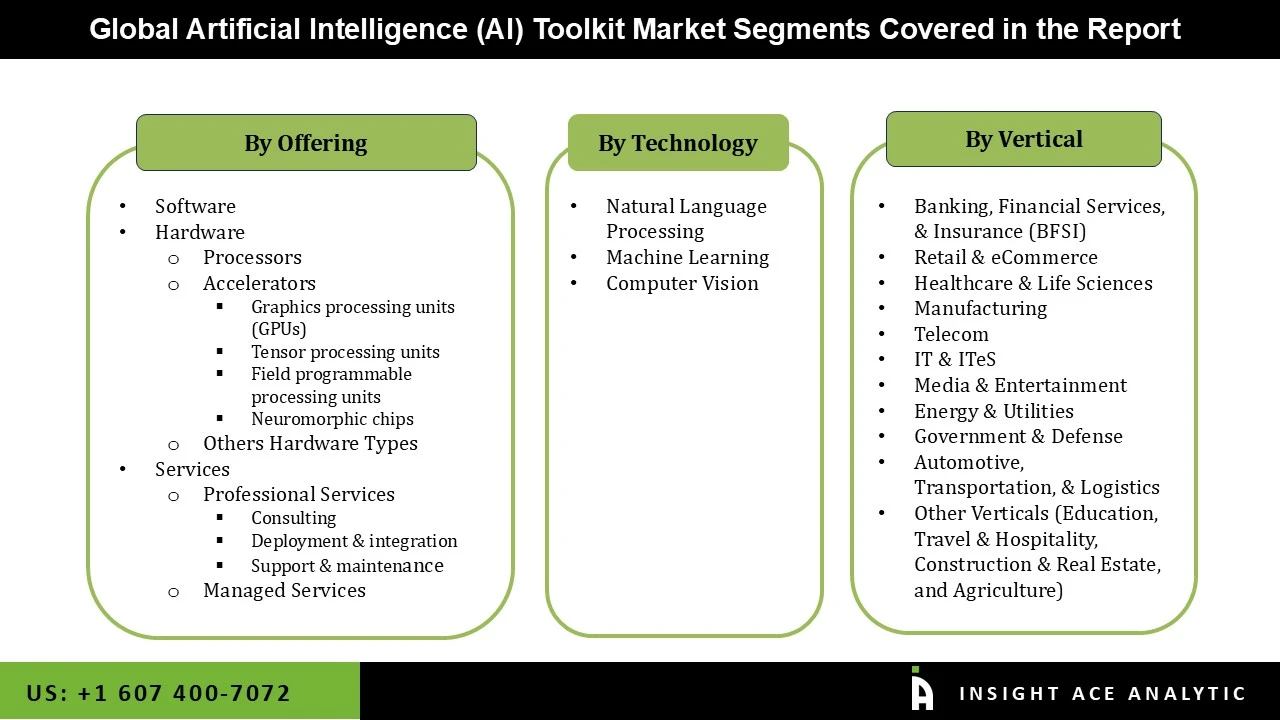
Artificial Intelligence (AI) Toolkit Market By Technology:
- Natural Language Processing
- Machine Learning
- Computer Vision
Artificial Intelligence (AI) Toolkit Market By Vertical:
- Banking, Financial Services, & Insurance (BFSI)
- Retail & eCommerce
- Healthcare & Life Sciences
- Manufacturing
- Telecom
- IT & ITeS
- Media & Entertainment
- Energy & Utilities
- Government & Defense
- Automotive, Transportation, & Logistics
- Other Verticals (Education, Travel & Hospitality, Construction & Real Estate, and Agriculture)
Artificial Intelligence (AI) Toolkit Market By Region-
North America-
- The US
- Canada
- Mexico
Europe-
- Germany
- The UK
- France
- Italy
- Spain
- Rest of Europe
Asia-Pacific-
- China
- Japan
- India
- South Korea
- South East Asia
- Rest of Asia Pacific
Latin America-
- Brazil
- Argentina
- Rest of Latin America
Middle East & Africa-
- GCC Countries
- South Africa
- Rest of Middle East and Africa
Research Design and Approach
This study employed a multi-step, mixed-method research approach that integrates:
- Secondary research
- Primary research
- Data triangulation
- Hybrid top-down and bottom-up modelling
- Forecasting and scenario analysis
This approach ensures a balanced and validated understanding of both macro- and micro-level market factors influencing the market.
Secondary Research
Secondary research for this study involved the collection, review, and analysis of publicly available and paid data sources to build the initial fact base, understand historical market behaviour, identify data gaps, and refine the hypotheses for primary research.
Sources Consulted
Secondary data for the market study was gathered from multiple credible sources, including:
- Government databases, regulatory bodies, and public institutions
- International organizations (WHO, OECD, IMF, World Bank, etc.)
- Commercial and paid databases
- Industry associations, trade publications, and technical journals
- Company annual reports, investor presentations, press releases, and SEC filings
- Academic research papers, patents, and scientific literature
- Previous market research publications and syndicated reports
These sources were used to compile historical data, market volumes/prices, industry trends, technological developments, and competitive insights.

Primary Research
Primary research was conducted to validate secondary data, understand real-time market dynamics, capture price points and adoption trends, and verify the assumptions used in the market modelling.
Stakeholders Interviewed
Primary interviews for this study involved:
- Manufacturers and suppliers in the market value chain
- Distributors, channel partners, and integrators
- End-users / customers (e.g., hospitals, labs, enterprises, consumers, etc., depending on the market)
- Industry experts, technology specialists, consultants, and regulatory professionals
- Senior executives (CEOs, CTOs, VPs, Directors) and product managers
Interview Process
Interviews were conducted via:
- Structured and semi-structured questionnaires
- Telephonic and video interactions
- Email correspondences
- Expert consultation sessions
Primary insights were incorporated into demand modelling, pricing analysis, technology evaluation, and market share estimation.
Data Processing, Normalization, and Validation
All collected data were processed and normalized to ensure consistency and comparability across regions and time frames.
The data validation process included:
- Standardization of units (currency conversions, volume units, inflation adjustments)
- Cross-verification of data points across multiple secondary sources
- Normalization of inconsistent datasets
- Identification and resolution of data gaps
- Outlier detection and removal through algorithmic and manual checks
- Plausibility and coherence checks across segments and geographies
This ensured that the dataset used for modelling was clean, robust, and reliable.
Market Size Estimation and Data Triangulation
Bottom-Up Approach
The bottom-up approach involved aggregating segment-level data, such as:
- Company revenues
- Product-level sales
- Installed base/usage volumes
- Adoption and penetration rates
- Pricing analysis
This method was primarily used when detailed micro-level market data were available.

Top-Down Approach
The top-down approach used macro-level indicators:
- Parent market benchmarks
- Global/regional industry trends
- Economic indicators (GDP, demographics, spending patterns)
- Penetration and usage ratios
This approach was used for segments where granular data were limited or inconsistent.
Hybrid Triangulation Approach
To ensure accuracy, a triangulated hybrid model was used. This included:
- Reconciling top-down and bottom-up estimates
- Cross-checking revenues, volumes, and pricing assumptions
- Incorporating expert insights to validate segment splits and adoption rates
This multi-angle validation yielded the final market size.
Forecasting Framework and Scenario Modelling
Market forecasts were developed using a combination of time-series modelling, adoption curve analysis, and driver-based forecasting tools.
Forecasting Methods
- Time-series modelling
- S-curve and diffusion models (for emerging technologies)
- Driver-based forecasting (GDP, disposable income, adoption rates, regulatory changes)
- Price elasticity models
- Market maturity and lifecycle-based projections
Scenario Analysis
Given inherent uncertainties, three scenarios were constructed:
- Base-Case Scenario: Expected trajectory under current conditions
- Optimistic Scenario: High adoption, favourable regulation, strong economic tailwinds
- Conservative Scenario: Slow adoption, regulatory delays, economic constraints
Sensitivity testing was conducted on key variables, including pricing, demand elasticity, and regional adoption.
Request Customization
Add countries, segments, company profiles, or extend forecast — free 10% customization with purchase.
Customize This Report →Enquire Before Buying
Speak with our analyst team about scope, methodology, pricing, or deliverable formats.
Enquire Now →Frequently Asked Questions
Artificial Intelligence Toolkit Market Size is valued at USD 36.65 Bn in 2025 and is predicted to reach USD 809.50 Bn by the year 2035
Artificial Intelligence (AI) Toolkit Market expected to grow at a 36.4% CAGR during the forecast period for 2026 to 2035.
Fiddler AI (US), Determined AI (US), Snorkel Al (US), Levity Al (Germany), Union AI (US), Attri AI (US), Regie.ai (US), and others