Underwater Camera Market Size, Scope, Revenue Report 2026 to 2035
What is Underwater Camera Market Size?
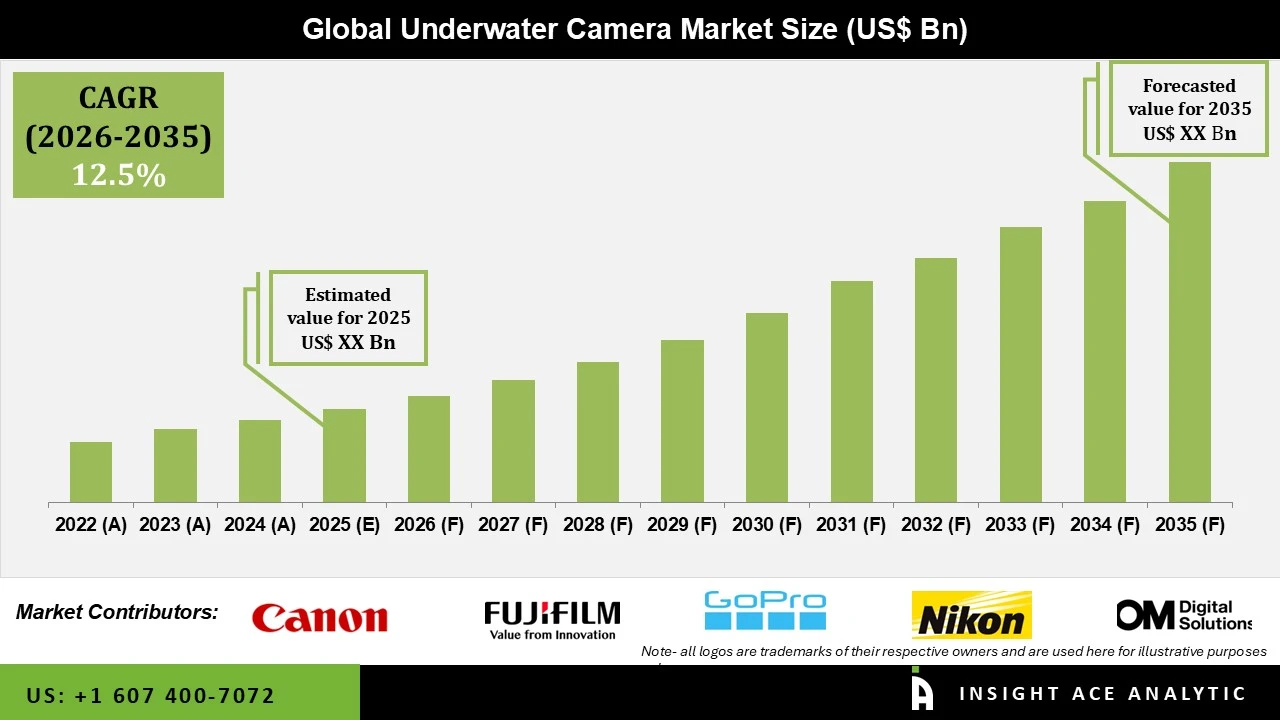
Underwater Camera Market will witness the growth at a 12.5% CAGR during the forecast period for 2026 to 2035.
Underwater Camera Market Size, Share & Trends Analysis Distribution by Type (Compact Cameras, Action Cameras, DSLR Cameras, Mirrorless Cameras, Others), By Application (Recreational & Tourism, Professional Photography & Filmmaking, Marine Research & Exploration, Aquaculture Monitoring, Industrial Inspection, Defense & Security, Environmental Monitoring), By End Use (Personal, Commercial, Industrial, Government & Defense), By Distribution Channel (Online, Offline) and Segment Forecasts, 2026 to 2035
Underwater cameras are purpose-built imaging devices that enable the capture of photographs and video in submerged environments. Designed specifically for use below the water’s surface, they incorporate waterproof construction, pressure resistance and optical systems adapted to the unique challenges of aquatic conditions, allowing reliable visual recording where conventional cameras cannot operate without specialised protection.
These systems are available in multiple formats, including compact and action cameras as well as DSLR and mirrorless models equipped with dedicated underwater housings. Typical features include enhanced low-light performance, image stabilisation, high-resolution sensors, wide-angle optics and varying depth ratings, supporting applications that range from recreational diving and marine exploration to professional filmmaking, scientific research and underwater inspection.
The market for underwater cameras covers the development, manufacture and commercial supply of imaging equipment intended for underwater photography, videography, monitoring and documentation. Demand arises from tourism and leisure, marine research, aquaculture, environmental monitoring, industrial inspection and defence-related activities. Continuous advances in image quality, low-light capability, stabilisation, connectivity and depth performance are expanding the practical value of these systems across both recreational and professional domains.
Competitive Landscape
Which are the Leading Players in the Underwater Camera Market?
• Canon Inc.
• FUJIFILM Holdings Corporation
• Arashi Vision, Inc.
• GoPro, Inc.
• Nikon Corporation
• OM Digital Solutions Corporation
• Panasonic Holdings Corporation
• Ricoh Company, Ltd.
• Sony Group Corporation
• SZ DJI Technology Co., Ltd.
Market Dynamics
Growing Popularity of Recreational Diving and Underwater Exploration
The growing popularity of recreational diving, snorkeling, and underwater tourism is a major driver of the underwater camera market, as travelers and enthusiasts increasingly seek to capture high-quality photographs and videos of marine life and underwater landscapes. The expansion of professional underwater photography, filmmaking, marine research, and ocean exploration further increases demand for specialized imaging equipment. Additionally, advancements in image resolution, low-light performance, image stabilization, and waterproofing capabilities are enhancing camera usability across recreational and professional applications, supporting broader market adoption.
Restrain/Challenge
High Cost of Specialized Underwater Imaging Equipment
The high price of specialized underwater imaging equipment presents a big problem for the underwater camera market, especially for amateur photographers and small businesses. If cameras are to function properly at various depths and in tough underwater conditions, they usually need waterproof cases, pressure-resistant parts, special lighting systems and compatible accessories. These extra costs raise the total ownership expense, and operating costs are also increased by the need for maintenance, regular checks of the seals, and repairs. As a result, financial limitations may prevent budget-minded consumers and smaller organizations from adopting the technology, especially in the case of advanced underwater photography and professional uses.
Action Cameras segment Segment is Expected to Drive the Underwater Camera Market
The action cameras segment is expected to drive the underwater camera market, supported by growing demand for compact, lightweight, and durable imaging devices for recreational diving, snorkeling, water sports, and adventure tourism. Their portability, ease of operation, wide-angle recording capabilities, and compatibility with waterproof housings make them suitable for capturing underwater photographs and videos in diverse aquatic environments. Continuous improvements in video resolution, image stabilization, battery performance, and waterproofing capabilities are further enhancing their appeal among consumers and content creators. These features position action cameras as a versatile option for recreational users seeking convenient and high-quality underwater imaging solutions.
Marine Research & Exploration Segment is Growing at the Highest Rate in the Underwater Camera Market
The marine research and exploration segment is expected to grow at the highest rate in the underwater camera market, driven by increasing demand for underwater imaging in oceanographic studies, marine biodiversity assessment, seabed mapping, and deep-sea exploration. Research institutes, government agencies, and environmental organizations are becoming more dependent on underwater cameras for documenting marine ecosystems, for observing aquatic species, and for evaluating changes in underwater habitats. Moreover, as remotely operated vehicles (ROVs) and autonomous underwater vehicles (AUVs) are being increasingly deployed, their imaging capabilities in deep and hard-to-reach marine environments are expanding, which in turn is raising the demand for more advanced underwater camera systems.
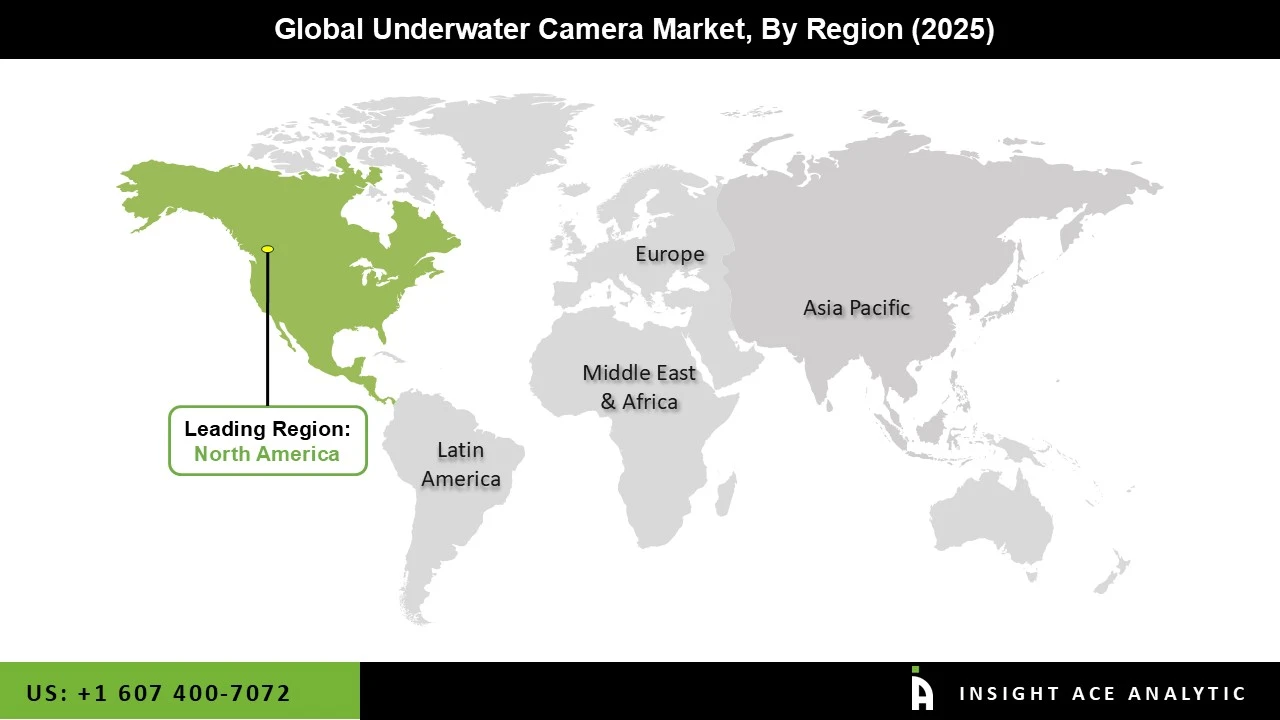
Why North America Led the Underwater Camera Market?
North America is leading the underwater camera market, supported by strong participation in recreational diving, snorkeling, water sports, and underwater tourism, particularly in the United States. The area enjoys high levels of consumer spending on sophisticated imaging equipment and the widespread use of action cameras for taking underwater photographs and videos. Moreover, marine research organisations, offshore energy projects, and the need to inspect underwater infrastructure all lead to demand for specialised imaging systems. The region's position in the market is further strengthened by the availability of leading camera manufacturers, well-developed distribution networks, and access to advanced imaging technologies.
Key Development
July 2026: FUJIFILM announced the launch of QuickSnap Active™, a waterproof single-use camera, and QuickSnap Black and White™, a black-and-white film camera, as part of its QuickSnap lineup's 40th anniversary celebrations. QuickSnap Active is designed for easy underwater photography, expanding the brand's offerings for water-based activities and outdoor use.
Underwater Camera Market Report Scope:
| Report Attribute | Specifications |
| Growth Rate CAGR | CAGR of 12.5% from 2026 to 2035 |
| Quantitative Units | Representation of revenue in US$ Bn and CAGR from 2026 to 2035 |
| Historic Year | 2022 to 2025 |
| Forecast Year | 2026-2035 |
| Report Coverage | The forecast of revenue, the position of the company, the competitive market structure, growth prospects, and trends |
| Segments Covered | Type, Application, End-Use, Distribution Channel and By Region |
| Regional Scope | North America; Europe; Asia Pacific; Latin America; Middle East & Africa |
| Country Scope | U.S.; Canada; U.K.; Germany; China; India; Japan; Brazil; Mexico; France; Italy; Spain; South Korea; Southeast Asia |
| Competitive Landscape | Canon Inc., FUJIFILM Holdings Corporation, Arashi Vision, Inc., GoPro, Inc., Nikon Corporation, OM Digital Solutions Corporation, Panasonic Holdings Corporation, Ricoh Company, Ltd., Sony Group Corporation, SZ DJI Technology Co., Ltd. |
| Customization Scope | Free customization report with the procurement of the report, Modifications to the regional and segment scope. Geographic competitive landscape. |
| Pricing and Available Payment Methods | Explore pricing alternatives that are customized to your particular study requirements. |
Market Segmentation:
Underwater Camera Market by Type -
• Compact Cameras
• Action Cameras
• DSLR Cameras
• Mirrorless Cameras
• Others
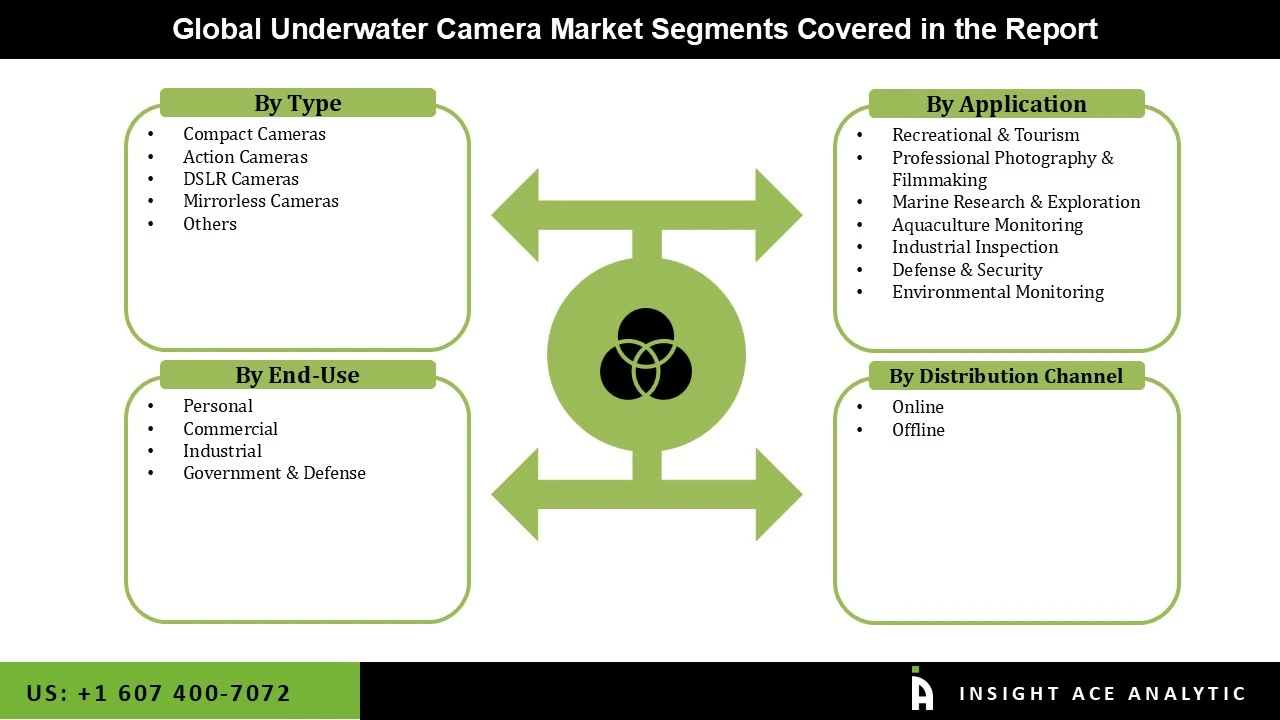
Underwater Camera Market by Application -
• Recreational & Tourism
• Professional Photography & Filmmaking
• Marine Research & Exploration
• Aquaculture Monitoring
• Industrial Inspection
• Defense & Security
• Environmental Monitoring
Underwater Camera Market by End Use -
• Personal
• Commercial
• Industrial
• Government & Defense
Underwater Camera Market by Distribution Channel -
• Online
• Offline
Underwater Camera Market by Region-
North America-
• The US
• Canada
• Mexico
Europe-
• Germany
• The UK
• France
• Italy
• Spain
• Rest of Europe
Asia-Pacific-
• China
• Japan
• India
• South Korea
• South East Asia
• Rest of Asia Pacific
Latin America-
• Brazil
• Argentina
• Rest of Latin America
Middle East & Africa-
• GCC Countries
• South Africa
• Rest of Middle East and Africa
Research Design and Approach
This study employed a multi-step, mixed-method research approach that integrates:
- Secondary research
- Primary research
- Data triangulation
- Hybrid top-down and bottom-up modelling
- Forecasting and scenario analysis
This approach ensures a balanced and validated understanding of both macro- and micro-level market factors influencing the market.
Secondary Research
Secondary research for this study involved the collection, review, and analysis of publicly available and paid data sources to build the initial fact base, understand historical market behaviour, identify data gaps, and refine the hypotheses for primary research.
Sources Consulted
Secondary data for the market study was gathered from multiple credible sources, including:
- Government databases, regulatory bodies, and public institutions
- International organizations (WHO, OECD, IMF, World Bank, etc.)
- Commercial and paid databases
- Industry associations, trade publications, and technical journals
- Company annual reports, investor presentations, press releases, and SEC filings
- Academic research papers, patents, and scientific literature
- Previous market research publications and syndicated reports
These sources were used to compile historical data, market volumes/prices, industry trends, technological developments, and competitive insights.
Primary Research
Primary research was conducted to validate secondary data, understand real-time market dynamics, capture price points and adoption trends, and verify the assumptions used in the market modelling.
Stakeholders Interviewed
Primary interviews for this study involved:
- Manufacturers and suppliers in the market value chain
- Distributors, channel partners, and integrators
- End-users / customers (e.g., hospitals, labs, enterprises, consumers, etc., depending on the market)
- Industry experts, technology specialists, consultants, and regulatory professionals
- Senior executives (CEOs, CTOs, VPs, Directors) and product managers
Interview Process
Interviews were conducted via:
- Structured and semi-structured questionnaires
- Telephonic and video interactions
- Email correspondences
- Expert consultation sessions
Primary insights were incorporated into demand modelling, pricing analysis, technology evaluation, and market share estimation.
Data Processing, Normalization, and Validation
All collected data were processed and normalized to ensure consistency and comparability across regions and time frames.
The data validation process included:
- Standardization of units (currency conversions, volume units, inflation adjustments)
- Cross-verification of data points across multiple secondary sources
- Normalization of inconsistent datasets
- Identification and resolution of data gaps
- Outlier detection and removal through algorithmic and manual checks
- Plausibility and coherence checks across segments and geographies
This ensured that the dataset used for modelling was clean, robust, and reliable.
Market Size Estimation and Data Triangulation
Bottom-Up Approach
The bottom-up approach involved aggregating segment-level data, such as:
- Company revenues
- Product-level sales
- Installed base/usage volumes
- Adoption and penetration rates
- Pricing analysis
This method was primarily used when detailed micro-level market data were available.
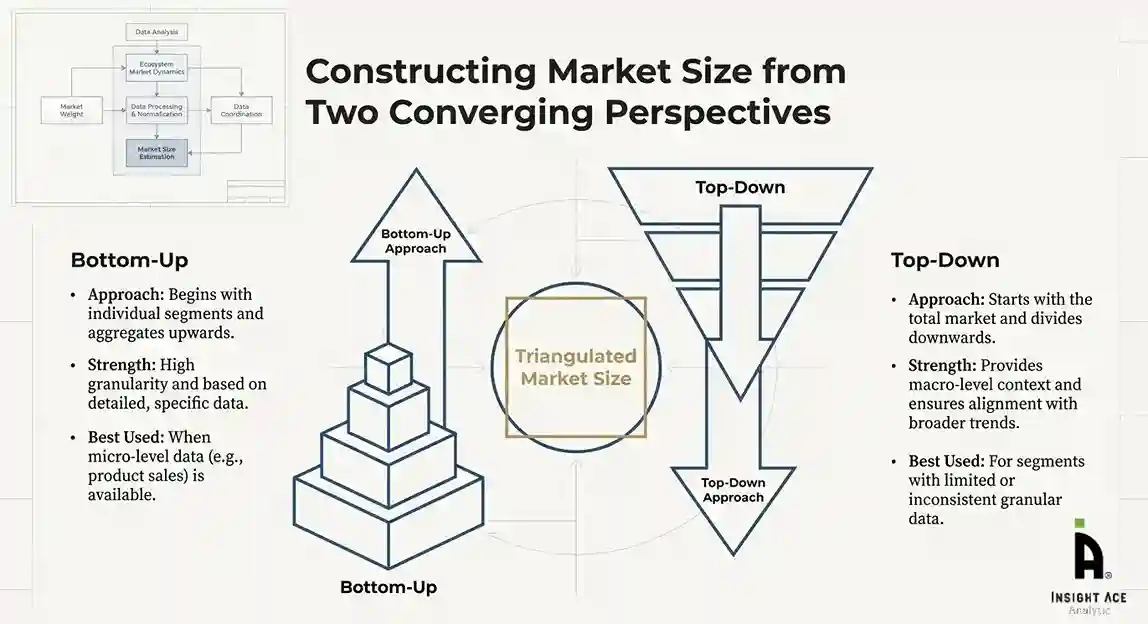
Top-Down Approach
The top-down approach used macro-level indicators:
- Parent market benchmarks
- Global/regional industry trends
- Economic indicators (GDP, demographics, spending patterns)
- Penetration and usage ratios
This approach was used for segments where granular data were limited or inconsistent.
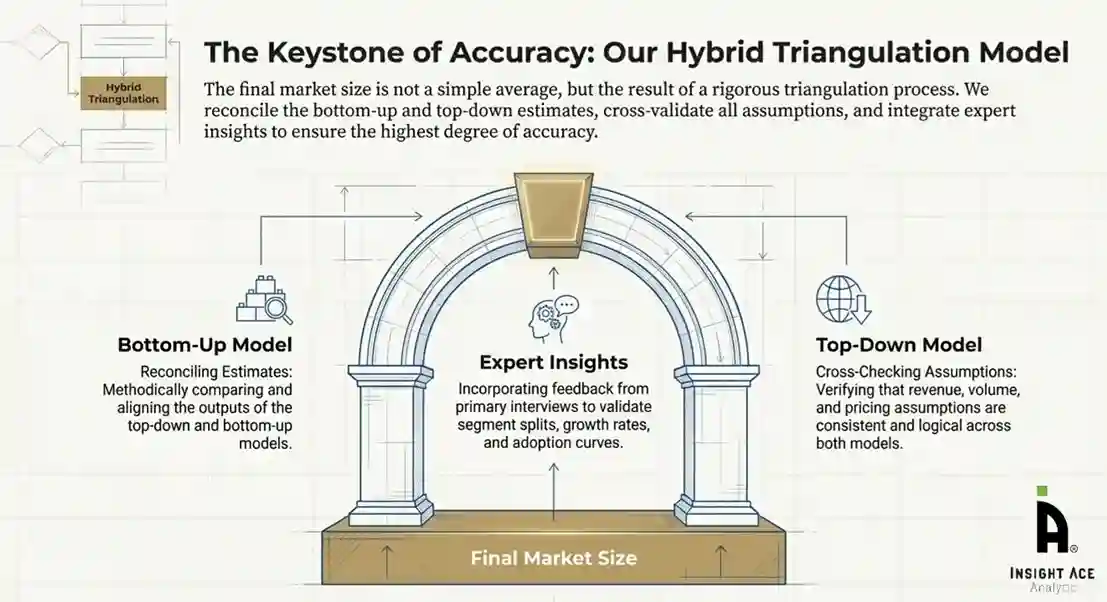
Hybrid Triangulation Approach
To ensure accuracy, a triangulated hybrid model was used. This included:
- Reconciling top-down and bottom-up estimates
- Cross-checking revenues, volumes, and pricing assumptions
- Incorporating expert insights to validate segment splits and adoption rates
This multi-angle validation yielded the final market size.
Forecasting Framework and Scenario Modelling
Market forecasts were developed using a combination of time-series modelling, adoption curve analysis, and driver-based forecasting tools.
Forecasting Methods
- Time-series modelling
- S-curve and diffusion models (for emerging technologies)
- Driver-based forecasting (GDP, disposable income, adoption rates, regulatory changes)
- Price elasticity models
- Market maturity and lifecycle-based projections
Scenario Analysis
Given inherent uncertainties, three scenarios were constructed:
- Base-Case Scenario: Expected trajectory under current conditions
- Optimistic Scenario: High adoption, favourable regulation, strong economic tailwinds
- Conservative Scenario: Slow adoption, regulatory delays, economic constraints
Sensitivity testing was conducted on key variables, including pricing, demand elasticity, and regional adoption.
Request Customization
Add countries, segments, company profiles, or extend forecast — free 10% customization with purchase.
Customize This Report →Enquire Before Buying
Speak with our analyst team about scope, methodology, pricing, or deliverable formats.
Enquire Now →Frequently Asked Questions
Underwater Camera Market will witness the growth at a 12.5% CAGR during the forecast period for 2026 to 2035.
Canon Inc., FUJIFILM Holdings Corporation, Arashi Vision, Inc., GoPro, Inc., Nikon Corporation, OM Digital Solutions Corporation, Panasonic Holdings Corporation, Ricoh Company, Ltd., Sony Group Corporation, SZ DJI Technology Co., Ltd.
Underwater Camera Market is expected to grow into Type, Application, End-Use, Distribution Channel and By Region
North America region is leading the Underwater Camera Market.