Skinimalism Market Size, Revenue, Trend Report 2026 to 2035
What is Skinimalism Market Size?
Global Skinimalism Market Size is predicted to grow at a 10.7% CAGR during the forecast period for 2026 to 2035.
Skinimalism Market Size, Share & Trends Analysis Distribution by Product Type (Multi-Benefit Moisturizers, Hybrid Sunscreen Products, Multi-Functional Serums, Gentle and Barrier-Friendly Cleansers, All-In-One Balms and Sticks, Hybrid Skincare-Makeup Products),by Functionality (Hydration and Barrier Repair, Sun Protection and Skin Treatment, Tone Correction and Skin Nourishment, Acne Care and Calming, Anti-Aging and Skin Firming, Redness and Sensitivity Management),Formulation Type (Minimal Ingredient Formulations, Dermatologist-Tested Formulations, Clean and Transparent Formulations, Fragrance-Free Formulations, Sensitive-Skin Focused Formulations), Distribution Channel (Offline Marketplaces, Online Marketplaces) and Segment Forecasts, 2026 to 2035.
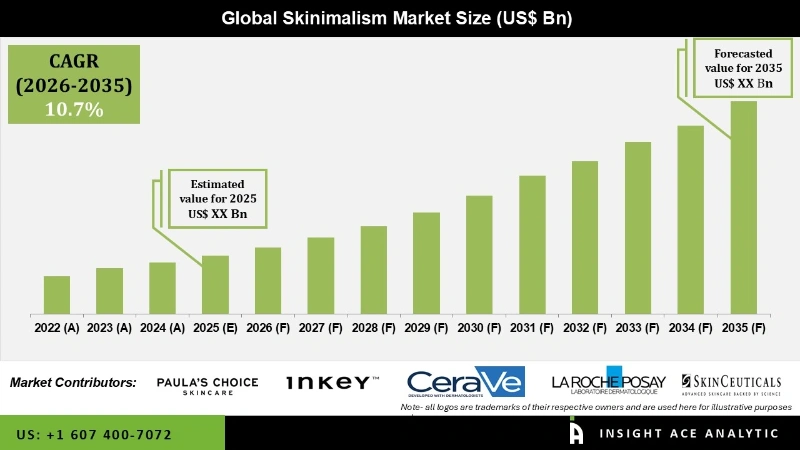
Skinimalism Market Key Takeaways:
|
Skinimalism is a skincare trend that encourages using fewer products with more benefits. Instead of following long routines, people are choosing simple steps with products that can do more than one purpose. The main idea is to make skincare easier, quicker, and more practical for daily life, not to avoid certain ingredients. As more people rethink their skincare habits, they are paying closer attention to time, cost, and skin health. Many now prefer gentle routines that help prevent irritation and avoid using too many products. Brands led by dermatologists are seeing the most success with skinimalism because they focus on science, safety, and healthy skin. These brands use clinically tested formulas, support skin barrier repair, and include gentle ingredients, which match what skinimalism is all about. As people look for expert-approved, multi-use products, dermatologist-recommended brands are becoming top choices.
More people are choosing skinimalism as they move away from long, complicated skincare routines and pick fewer, easier products. Many now want products that can hydrate, treat, and protect the skin all at once, replacing several steps. The main goal is to make routines simpler, not to follow strict ingredient rules. People are also more aware that using too many products can harm the skin barrier, so they look for gentle, minimal options. Skinimalism is especially helpful for working women because it saves time and fits into busy lives. Brands are responding by creating products that offer several benefits in one formula. Skinimalism also supports sustainability by reducing how many beauty products people use, which means less waste and a smaller impact on the environment.
Skinimalism makes skincare simpler and more efficient, but it also brings some challenges. Multi-use products might not meet the needs of people with specific or complex skin issues, and some are unsure if one product can really do it all. Still, skinimalism gives brands a chance to create better multi-purpose products that make routines easier, show real results, and earn trust, especially when they are supported by dermatology experts.
Competitive Landscape
Which are the Leading Players in the Skinimalism Market?
- The Ordinary
- Paula’s Choice
- The Inkey List
- CeraVe
- La Roche-Posay
- SkinCeuticals
- Drunk Elephant
- Glossier
- Summer Fridays
- Tatcha
- First Aid Beauty
- Versed
- Typology
- Dr. Dennis Gross Skincare
- Beauty of Joseon
- COSRX
- SKIN1004
- Anua
- Geek & Gorgeous
- Minimalist
- Facetheory
- Bioderma
- Avène
- HoliFrog
- Prequel Skin
Market Dynamics :
Driver
Consumer Fatigue with Complexity: Driving the Rise of Skinimalism
The main driver behind the Skinimalism trend is consumer fatigue with complexity. Many consumers are tired of long, multi-step skincare routines and want simpler, more efficient solutions that save time without compromising results. They prefer multi-functional products that can hydrate, protect, and treat the skin in a single step, replacing two or three separate products. Growing awareness of skin sensitivity and barrier health has also increased demand for gentle, minimal formulations. This shift in consumer behavior has prompted brands to reformulate products, combining multiple benefits into one formula. Dermatology-led brands benefit the most, as their science-backed, clinically tested, and trustworthy products align perfectly with the needs of modern, time-conscious consumers.
Restrain/Challenge
Compatibility Across Skin Types: Major Challenge for Skinimalism
A major challenge in the Skinimalism trend is ensuring that products work effectively for all skin types. Consumers have varied needs oily, dry, sensitive, or combination skin and a single product must deliver multiple benefits like hydration, protection, and treatment without causing irritation or reducing performance. Brands need to carefully balance ingredients and formulation techniques to create multifunctional products that are gentle, safe, and effective for diverse users. Achieving this not only enhances user satisfaction but also strengthens trust in the brand. Ensuring compatibility across skin types is crucial for Skinimalism to simplify skincare routines for everyone, making it truly accessible and reliable.
Market Segmentation
The Global Skinimalism market is segmented across four primary dimensions: product type, functionality, formulation type, and distribution channel. By product type, the market includes multi-benefit moisturizers, hybrid sunscreen products, multi-functional serums, gentle and barrier-friendly cleansers, all-in-one balms and sticks, and hybrid skincare-makeup products, catering to diverse consumer needs. Segmentation by functionality reflects the key skincare goals, such as hydration and barrier repair, sun protection and skin treatment, tone correction and skin nourishment, acne care and calming, anti-aging and skin firming, and redness and sensitivity management. The market is further classified by formulation type, including minimal ingredient formulations, dermatologist-tested formulations, clean and transparent formulations, fragrance-free formulations, and sensitive-skin focused formulations. Finally, by distribution channel, the market is served through offline and online marketplaces, highlighting the multiple avenues through which consumers access these skincare solutions.
Hydration and Barrier Repair Segment is Expected to Drive the Skinimalism market
The Hydration and Barrier Repair segment leads the Skinimalism market because it directly supports the core idea of using fewer products with better, long-term skin benefits. As consumers move away from complicated routines, they are prioritizing products that strengthen the skin barrier and maintain hydration are two essential needs for healthy skin. These functions reduce the need for multiple treatment steps, allowing one product to replace two or three others. Skinimalism adoption is accelerating due to changing consumer behavior. People are experiencing product fatigue, skin sensitivity, and time constraints, which has increased demand for gentle, multi-functional solutions. In response, brands are reformulating products to combine hydration, repair, and protection into single formulas. Dermatology-led brands benefit the most, as their clinically tested, barrier-focused products align perfectly with consumer trust and skinimalist values.
Dermatologist-Tested and Minimal Ingredient Formulations leads the Skinimalism Market
Dermatologist-tested and minimal ingredient formulations lead the skinimalism market because they strongly align with the trend’s focus on fewer products and simpler routines. As consumers move away from complex skincare steps, they prefer multi-functional products that are safe, gentle, and effective, often replacing two or three products with one. Skinimalism adoption is accelerating due to changing consumer behavior, including increased skin sensitivity, product fatigue, and a growing desire for expert-backed solutions. In response, brands are reformulating products to include fewer, well-chosen ingredients while maintaining multiple benefits in a single formula. Dermatology-led brands benefit the most, as their clinically tested, science-backed formulations build trust and naturally support the skinimalist goal of simplified, reliable skincare.
Why Asia Pacific is Fastest Growing Region in the Skinimalism Market ?
Asia Pacific is expected to grow significantly in the skinimalism market due to high skincare awareness and a strong preference for simple, effective routines. Consumers in the region are increasingly moving away from long, complex regimens and choosing multi-functional products that support hydration, barrier repair, and daily protection.
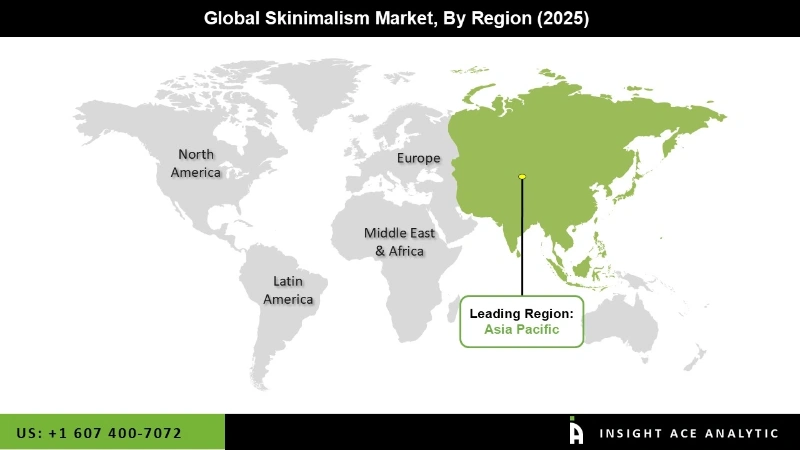
The strong influence of Korean Beauty (K-beauty) and Japanese Beauty (J-beauty) has promoted minimalist, skin-health-focused approaches. Rising concerns about skin sensitivity, overuse of products, and busy lifestyles have further accelerated this shift. In addition, widespread access to skincare through online marketplaces and strong innovation from regional brands continue to strengthen Asia Pacific’s leadership in the global Skinimalism market during the forecast period.
Key Development :
- September 2025: Laser by Aleya introduced a skinimalism-inspired service model to support clients who wanted simplified skincare. It emphasized intentional, result-oriented treatments that prioritized skin health and effectiveness. This approach aligned with the skinimalism movement, which promoted doing less but choosing better skincare solutions.
Skinimalism Market Report Scope :
| Report Attribute | Specifications |
| Growth Rate CAGR | CAGR of 10.7% from 2026 to 2035 |
| Quantitative Units | Representation of revenue in US$ Bn and CAGR from 2026 to 2035 |
| Historic Year | 2022 to 2024 |
| Forecast Year | 2026-2035 |
| Report Coverage | The forecast of revenue, the position of the company, the competitive market structure, growth prospects, and trends |
| Segments Covered | Product Type, Functionality, Formulation Type, Distribution Channel, By Region |
| Regional Scope | North America; Europe; Asia Pacific; Latin America; Middle East & Africa |
| Country Scope | U.S.; Canada; U.K.; Germany; China; India; Japan; Brazil; Mexico; The UK; France; Italy; Spain; China; Japan; India; South Korea; Southeast Asia; South Korea; Southeast Asia |
| Competitive Landscape | The Ordinary, Paula’s Choice, The Inkey List, CeraVe, La Roche-Posay, SkinCeuticals, Drunk Elephant, Glossier, Summer Fridays, Tatcha, First Aid Beauty, Versed, Typology, Dr. Dennis Gross Skincare, Beauty of Joseon, COSRX, SKIN1004, Anua, Geek & Gorgeous, Minimalist, Facetheory, Bioderma, Avène, HoliFrog, Prequel Skin. |
| Customization Scope | Free customization report with the procurement of the report, Modifications to the regional and segment scope. Geographic competitive landscape. |
| Pricing and Available Payment Methods | Explore pricing alternatives that are customized to your particular study requirements. |
Segmentation of Skinimalism Market :
Skinimalism Market by Product Type-
- Multi-Benefit Moisturizers
- Hybrid Sunscreen Products
- Multi-Functional Serums
- Gentle and Barrier-Friendly Cleansers
- All-In-One Balms and Sticks
- Hybrid Skincare-Makeup Products
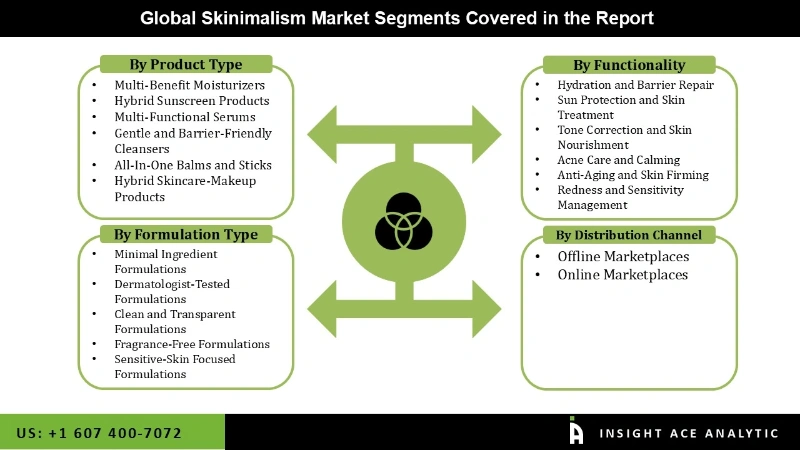
Skinimalism Market by Functionality-
- Hydration and Barrier Repair
- Sun Protection and Skin Treatment
- Tone Correction and Skin Nourishment
- Acne Care and Calming
- Anti-Aging and Skin Firming
- Redness and Sensitivity Management
Skinimalism Market by Formulation Type-
- Minimal Ingredient Formulations
- Dermatologist-Tested Formulations
- Clean and Transparent Formulations
- Fragrance-Free Formulations
- Sensitive-Skin Focused Formulations
Skinimalism Market by Distribution Channel-
- Offline Marketplaces
- Online Marketplaces
Skinimalism Market by Region-
- North America-
- The US
Canada
- The US
- Europe-
- Germany
- The UK
- France
- Italy
- Spain
- Rest of Europe
- Asia-Pacific-
- China
- Japan
- India
- South Korea
- South East Asia
- Rest of Asia Pacific
- Latin America-
- Brazil
- Argentina
- Mexico
- Rest of Latin America
- Middle East & Africa-
- GCC Countries
- South Africa
- Rest of Middle East and Africa
Research Design and Approach
This study employed a multi-step, mixed-method research approach that integrates:
- Secondary research
- Primary research
- Data triangulation
- Hybrid top-down and bottom-up modelling
- Forecasting and scenario analysis
This approach ensures a balanced and validated understanding of both macro- and micro-level market factors influencing the market.
Secondary Research
Secondary research for this study involved the collection, review, and analysis of publicly available and paid data sources to build the initial fact base, understand historical market behaviour, identify data gaps, and refine the hypotheses for primary research.
Sources Consulted
Secondary data for the market study was gathered from multiple credible sources, including:
- Government databases, regulatory bodies, and public institutions
- International organizations (WHO, OECD, IMF, World Bank, etc.)
- Commercial and paid databases
- Industry associations, trade publications, and technical journals
- Company annual reports, investor presentations, press releases, and SEC filings
- Academic research papers, patents, and scientific literature
- Previous market research publications and syndicated reports
These sources were used to compile historical data, market volumes/prices, industry trends, technological developments, and competitive insights.

Primary Research
Primary research was conducted to validate secondary data, understand real-time market dynamics, capture price points and adoption trends, and verify the assumptions used in the market modelling.
Stakeholders Interviewed
Primary interviews for this study involved:
- Manufacturers and suppliers in the market value chain
- Distributors, channel partners, and integrators
- End-users / customers (e.g., hospitals, labs, enterprises, consumers, etc., depending on the market)
- Industry experts, technology specialists, consultants, and regulatory professionals
- Senior executives (CEOs, CTOs, VPs, Directors) and product managers
Interview Process
Interviews were conducted via:
- Structured and semi-structured questionnaires
- Telephonic and video interactions
- Email correspondences
- Expert consultation sessions
Primary insights were incorporated into demand modelling, pricing analysis, technology evaluation, and market share estimation.
Data Processing, Normalization, and Validation
All collected data were processed and normalized to ensure consistency and comparability across regions and time frames.
The data validation process included:
- Standardization of units (currency conversions, volume units, inflation adjustments)
- Cross-verification of data points across multiple secondary sources
- Normalization of inconsistent datasets
- Identification and resolution of data gaps
- Outlier detection and removal through algorithmic and manual checks
- Plausibility and coherence checks across segments and geographies
This ensured that the dataset used for modelling was clean, robust, and reliable.
Market Size Estimation and Data Triangulation
Bottom-Up Approach
The bottom-up approach involved aggregating segment-level data, such as:
- Company revenues
- Product-level sales
- Installed base/usage volumes
- Adoption and penetration rates
- Pricing analysis
This method was primarily used when detailed micro-level market data were available.

Top-Down Approach
The top-down approach used macro-level indicators:
- Parent market benchmarks
- Global/regional industry trends
- Economic indicators (GDP, demographics, spending patterns)
- Penetration and usage ratios
This approach was used for segments where granular data were limited or inconsistent.
Hybrid Triangulation Approach
To ensure accuracy, a triangulated hybrid model was used. This included:
- Reconciling top-down and bottom-up estimates
- Cross-checking revenues, volumes, and pricing assumptions
- Incorporating expert insights to validate segment splits and adoption rates
This multi-angle validation yielded the final market size.
Forecasting Framework and Scenario Modelling
Market forecasts were developed using a combination of time-series modelling, adoption curve analysis, and driver-based forecasting tools.
Forecasting Methods
- Time-series modelling
- S-curve and diffusion models (for emerging technologies)
- Driver-based forecasting (GDP, disposable income, adoption rates, regulatory changes)
- Price elasticity models
- Market maturity and lifecycle-based projections
Scenario Analysis
Given inherent uncertainties, three scenarios were constructed:
- Base-Case Scenario: Expected trajectory under current conditions
- Optimistic Scenario: High adoption, favourable regulation, strong economic tailwinds
- Conservative Scenario: Slow adoption, regulatory delays, economic constraints
Sensitivity testing was conducted on key variables, including pricing, demand elasticity, and regional adoption.
Request Customization
Add countries, segments, company profiles, or extend forecast — free 10% customization with purchase.
Customize This Report →Enquire Before Buying
Speak with our analyst team about scope, methodology, pricing, or deliverable formats.
Enquire Now →Frequently Asked Questions
Skinimalism Market Size is predicted to grow at a 10.7% CAGR during the forecast period for 2026 to 2035.
The Ordinary, Paula’s Choice, The Inkey List, CeraVe, La Roche-Posay, SkinCeuticals, Drunk Elephant, Glossier, Summer Fridays, Tatcha, First Aid Beauty, Versed, Typology, Dr. Dennis Gross Skincare, Beauty of Joseon, COSRX, SKIN1004, Anua, Geek & Gorgeous, Minimalist, Facetheory, Bioderma, Avène, HoliFrog, Prequel Skin.
Skinimalism market is segmented across four primary dimensions: product type, functionality, formulation type, and distribution channel.
North America region is leading the Skinimalism Market.