Self Healing Polymers Market Research Report with Forecast 2026 to 2035
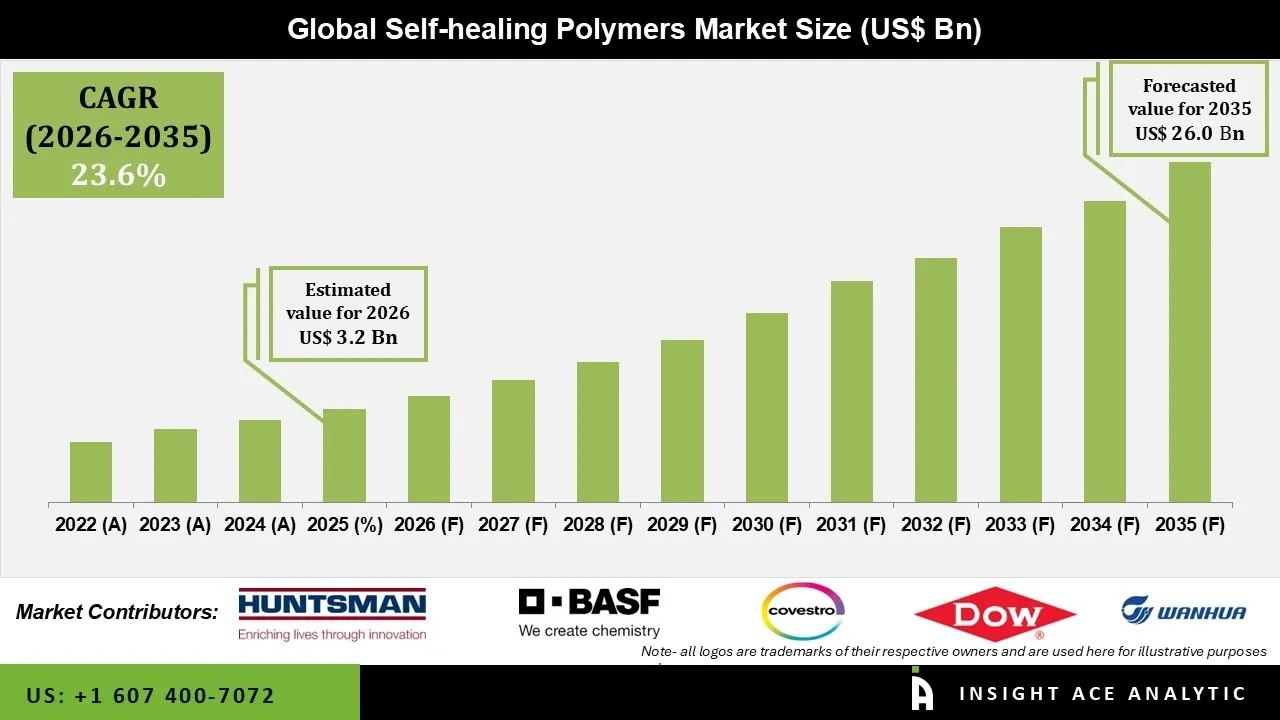
Self-healing Polymers Market Size is valued at USD 3.2 Bn in 2025 and is predicted to reach USD 26.0 Bn by the year 2035 at a 23.6% CAGR during the forecast period for 2026 to 2035.
Self-healing Polymers Market Size, Share & Trends Analysis Distribution by Material (Epoxy, Polyurethane (PU), Polylactide (PLA), and Others), Application (Automotive, Construction, Medical, Textile, Aerospace, and Others), and Segment Forecasts, 2026 to 2035
Self-healing polymers are advanced materials engineered to autonomously repair mechanical damage such as cracks, scratches, or fractures extending their service life and reducing maintenance needs. Inspired by biological healing, they restore structural integrity and functionality without external intervention.
The market distinguishes two main types: intrinsic self-healing, which relies on reversible chemical bonds (e.g., hydrogen bonds, ionic interactions, or dynamic covalent bonds like Diels-Alder or disulfide linkages) for repeated healing; and extrinsic self-healing, which embeds healing agents (monomers, catalysts) in microcapsules or vascular networks that release upon damage to polymerize and seal cracks. These materials are gaining traction in high-value applications where durability and reliability are critical.
The need for long-lasting and environmentally friendly products is driving rapid growth in the global self-healing polymer market. Furthermore, self-healing polymers are being used in an increasing number of industrial applications. These polymers improve medical implants and gadgets, improving patient outcomes and lowering healthcare expenses. The self-healing polymers market is expanding due to technological developments in material science and nanotechnology. Polymers with better mechanical characteristics and quicker healing times are the result of innovations. These developments include the creation of multifunctional self-healing polymers that react to mechanical stress, heat, and light, providing adaptable solutions that improve the longevity and performance of products.
Additionally, on the other hand, the self-healing polymers market has a number of obstacles that hinder its expansion. Large-scale production of these materials is challenging due in large part to the intricate manufacturing process. The availability of self-healing polymers may be restricted, and production prices may rise as a result of this complexity. There are also technical obstacles to overcome. However, the self-healing polymers innovation is fueled by ongoing developments in material science, chemistry, and engineering.
To improve healing potential, durability, and adaptability, researchers are creating novel methods and compositions. The development of self-healing polymers with enhanced functionality and performance is made possible by advances in microencapsulation, shape memory polymers, and nanotechnology, increasing their use in a variety of industries. Thus, it is anticipated to provide future expansion and prosperity in the self-healing polymers market.
Competitive Landscape
Which are the leading players in Self-healing Polymers Market?
• BASF SE
• Wanhua Chemical Group Co., Ltd.
• NEI Corporation
• Huntsman International Corporation
• CompPair Technologies SA
• Covestro AG
• Dow Inc.
• Autonomic Materials, Inc.
• Arkema S.A.
• The Lubrizol Corporation
• The Goodyear Tire & Rubber Company
• Sika AG
Market Dynamics
Driver
Increased Focus on Material Sustainability and Environmental Impact Reduction
The self-healing polymers have seen significant growth due to the increased focus on material sustainability and environmental impact reduction. Due to their short service life and low recyclability, conventional polymers frequently lead to waste accumulation. Self-healing polymers, on the other hand, prolong product lifecycles by decreasing early disposal and lowering the frequency of replacements. Because they reduce dependency on virgin raw materials, industries including consumer electronics and construction see these materials as enabling circular economy initiatives.
Reversible chemical systems are used in self-healing polymers to increase recyclability, which further promotes environmentally friendly material management. In line with larger international initiatives to lower carbon footprints and advance resource-efficient technologies, this sustainability component is boosting corporate and regulatory interest in the commercialization of these polymers.
Restrain/Challenge
Regulatory Obstacles Associated with the Use of Self-healing Polymers
Over the course of the projection period, the self-healing polymers market's growth will be constrained by the regulatory obstacles associated with the use of self-healing polymers in regulated industries. Strict regulations and a lack of standardized testing procedures make it difficult to integrate self-healing polymers in regulated industries like healthcare and aerospace. For broad commercial adoption, adherence to performance and safety standards is crucial. However, the validation process is made more difficult by the lack of well-recognized testing procedures. In order to overcome these obstacles and enable the integration of self-healing polymers into highly regulated industries, coordinated efforts are required to create uniform testing frameworks and clear regulatory channels.
Polyurethane (PU) Segment is Expected to Drive the Self-healing Polymers Market
The Polyurethane (PU) category held the largest share in the Self-healing Polymers market in 2025, driven by the construction and automotive industries' increasing need for high-performance materials. These sectors are looking more and more for ways to make products more resilient and long-lasting, especially in challenging environments. PU-based self-healing polymers are a great option for coatings, sealants, and adhesives because of their exceptional flexibility, mechanical strength, and resilience to weather. Their capacity to automatically fix surface flaws like scratches and cracks prolongs the life of materials and lessens the need for regular maintenance, which lowers costs and increases product effectiveness.
Automotive Segment is Growing at the Highest Rate in the Self-healing Polymers Market
In 2025, the automotive category dominated the Self-healing Polymers market, driven by OEM requirements for enhanced surface protection, reduced maintenance intervals, and longevity. This trend extends from paint films and protective coatings on the outside to interior components, lightweight structural parts, and electric vehicle housings, where the capacity for self-healing greatly improves overall lifespan performance.
Additionally, the automotive manufacturers are beginning to see self-healing polymers as a useful solution for improving reliability and lowering the total cost of ownership as the trend towards electrification, weight reduction, and advanced material integration picks up speed. As a result, the self-healing polymers market is the largest and fastest-growing in the world for end-use applications.
Why Asia Pacific Led the Self-healing Polymers Market?
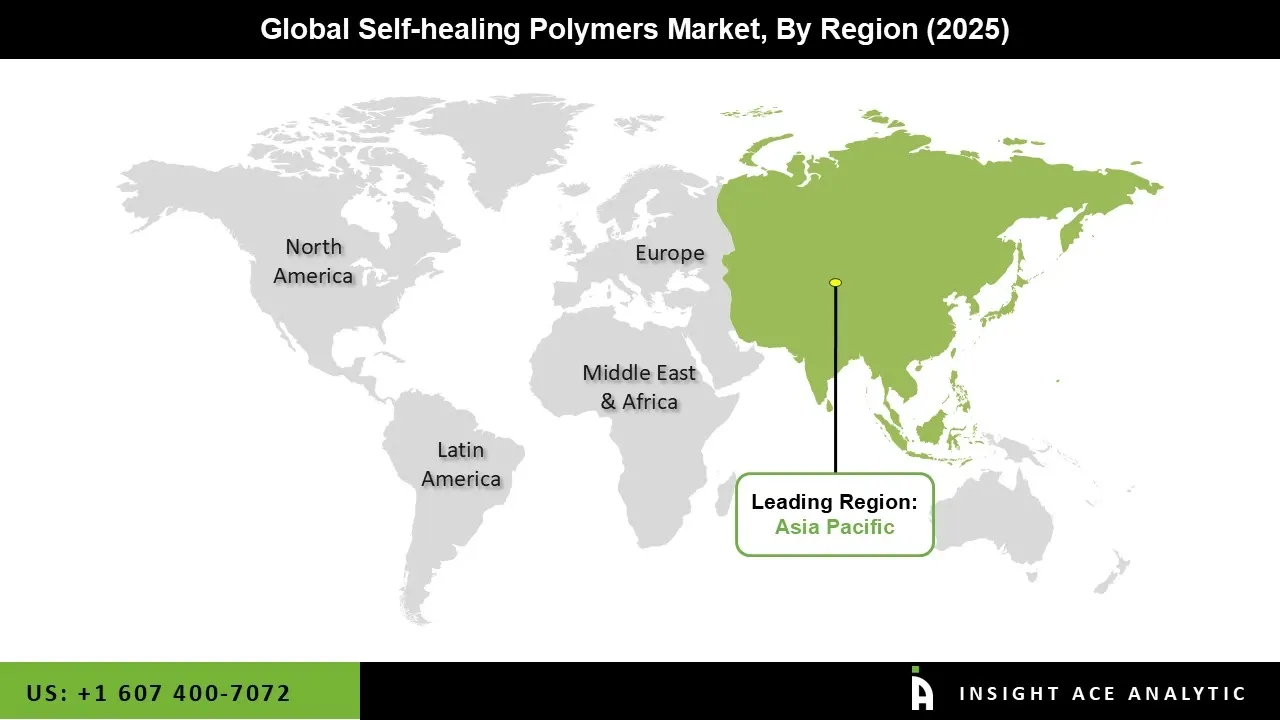
The Self-healing Polymers market was dominated by the North America region in 2025 due to the rapid industrialization and urbanization of South Korea, China, Japan, and India. Another factor anticipated to propel the growth of the self-healing polymers market in the Asia Pacific is the increasing use of these materials in electronics, vehicles, and architecture and construction to fix small fractures and damages.
The use of sophisticated materials is being encouraged by China's fast urbanization, growing construction industry, and government programs like Made in China 2025. Additionally, the nation's emphasis on sustainable materials and smart technology is driving the use of self-healing polymers in sectors like electronics, building, and healthcare, where creativity and economy are crucial.
Key Development
• In June 2024, NEI Corporation received a Phase II SBIR grant from the U.S. Department of defense to further develop its NANOMYTE SHP (Self-Healing Polymer) coatings for military aerospace applications. The project focuses on enhancing the coating's ability to heal impact damage and corrosion on aircraft surfaces in harsh environments, utilizing a combination of shape-memory polymers and corrosion-inhibiting agents released upon damage.
Self-healing Polymers Market Report Scope:
| Report Attribute | Specifications |
| Market size value in 2025 | USD 3.2 Bn |
| Revenue forecast in 2035 | USD 26.0 Bn |
| Growth Rate CAGR | CAGR of 23.6% from 2026 to 2035 |
| Quantitative Units | Representation of revenue in US$ Bn and CAGR from 2025 to 2035 |
| Historic Year | 2022 to 2025 |
| Forecast Year | 2026-2035 |
| Report Coverage | The forecast of revenue, the position of the company, the competitive market structure, growth prospects, and trends |
| Segments Covered | Material, Application, and By Region |
| Regional Scope | North America; Europe; Asia Pacific; Latin America; Middle East & Africa |
| Country Scope | U.S.; Canada; U.K.; Germany; China; India; Japan; Brazil; Mexico; The UK; France; Italy; Spain; China; Japan; India; South Korea; Southeast Asia; South Korea; Southeast Asia |
| Competitive Landscape | BASF SE, Wanhua Chemical Group Co., Ltd., NEI Corporation, Huntsman International Corporation, CompPair Technologies SA, Covestro AG, Dow Inc., Autonomic Materials, Inc., Arkema S.A., The Lubrizol Corporation, The Goodyear Tire & Rubber Company, Sika AG |
| Customization Scope | Free customization report with the procurement of the report, Modifications to the regional and segment scope. Geographic competitive landscape. |
| Pricing and Available Payment Methods | Explore pricing alternatives that are customized to your particular study requirements. |
Market Segmentation:
Self-healing Polymers Market by Material-
• Epoxy
• Polyurethane (PU)
• Polylactide (PLA)
• Others
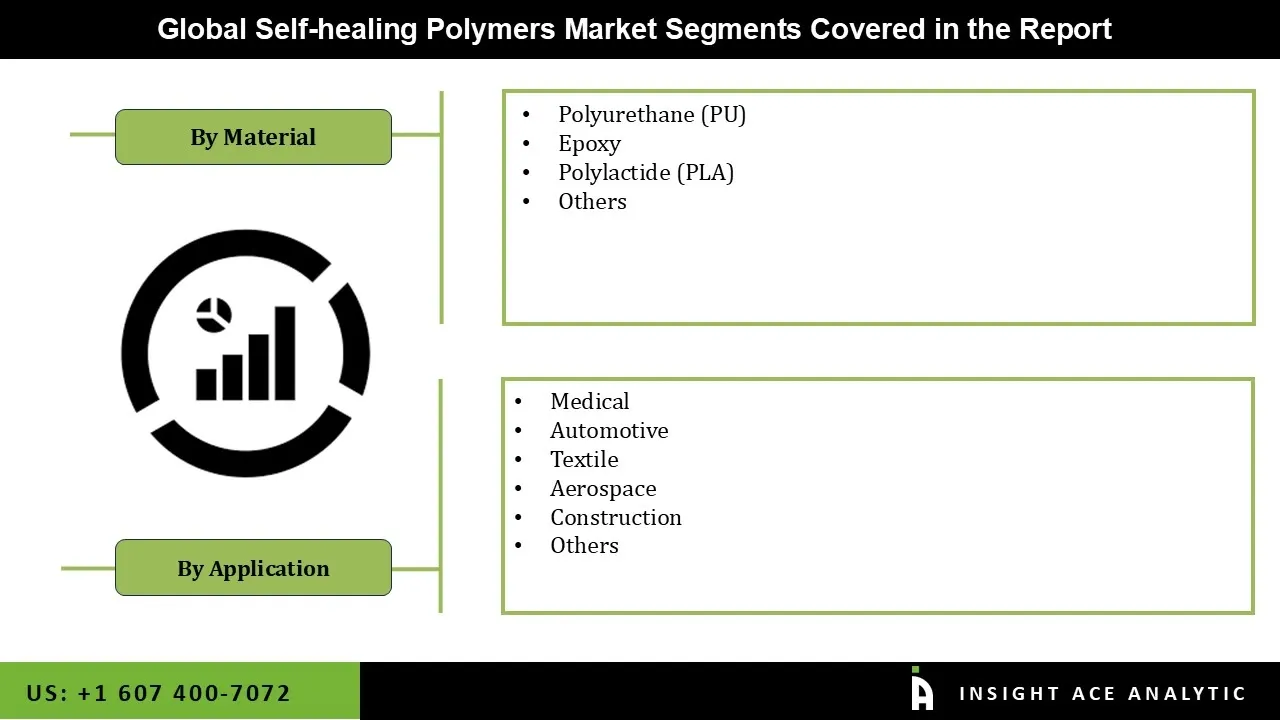
Self-healing Polymers Market by Application-
• Automotive
• Construction
• Medical
• Textile
• Aerospace
• Others
By Region-
North America-
• The US
• Canada
Europe-
• Germany
• The UK
• France
• Italy
• Spain
• Rest of Europe
Asia-Pacific-
• China
• Japan
• India
• South Korea
• South East Asia
• Rest of Asia Pacific
Latin America-
• Brazil
• Argentina
• Mexico
• Rest of Latin America
Middle East & Africa-
• GCC Countries
• South Africa
• Rest of Middle East and Africa
Research Design and Approach
This study employed a multi-step, mixed-method research approach that integrates:
- Secondary research
- Primary research
- Data triangulation
- Hybrid top-down and bottom-up modelling
- Forecasting and scenario analysis
This approach ensures a balanced and validated understanding of both macro- and micro-level market factors influencing the market.
Secondary Research
Secondary research for this study involved the collection, review, and analysis of publicly available and paid data sources to build the initial fact base, understand historical market behaviour, identify data gaps, and refine the hypotheses for primary research.
Sources Consulted
Secondary data for the market study was gathered from multiple credible sources, including:
- Government databases, regulatory bodies, and public institutions
- International organizations (WHO, OECD, IMF, World Bank, etc.)
- Commercial and paid databases
- Industry associations, trade publications, and technical journals
- Company annual reports, investor presentations, press releases, and SEC filings
- Academic research papers, patents, and scientific literature
- Previous market research publications and syndicated reports
These sources were used to compile historical data, market volumes/prices, industry trends, technological developments, and competitive insights.

Primary Research
Primary research was conducted to validate secondary data, understand real-time market dynamics, capture price points and adoption trends, and verify the assumptions used in the market modelling.
Stakeholders Interviewed
Primary interviews for this study involved:
- Manufacturers and suppliers in the market value chain
- Distributors, channel partners, and integrators
- End-users / customers (e.g., hospitals, labs, enterprises, consumers, etc., depending on the market)
- Industry experts, technology specialists, consultants, and regulatory professionals
- Senior executives (CEOs, CTOs, VPs, Directors) and product managers
Interview Process
Interviews were conducted via:
- Structured and semi-structured questionnaires
- Telephonic and video interactions
- Email correspondences
- Expert consultation sessions
Primary insights were incorporated into demand modelling, pricing analysis, technology evaluation, and market share estimation.
Data Processing, Normalization, and Validation
All collected data were processed and normalized to ensure consistency and comparability across regions and time frames.
The data validation process included:
- Standardization of units (currency conversions, volume units, inflation adjustments)
- Cross-verification of data points across multiple secondary sources
- Normalization of inconsistent datasets
- Identification and resolution of data gaps
- Outlier detection and removal through algorithmic and manual checks
- Plausibility and coherence checks across segments and geographies
This ensured that the dataset used for modelling was clean, robust, and reliable.
Market Size Estimation and Data Triangulation
Bottom-Up Approach
The bottom-up approach involved aggregating segment-level data, such as:
- Company revenues
- Product-level sales
- Installed base/usage volumes
- Adoption and penetration rates
- Pricing analysis
This method was primarily used when detailed micro-level market data were available.

Top-Down Approach
The top-down approach used macro-level indicators:
- Parent market benchmarks
- Global/regional industry trends
- Economic indicators (GDP, demographics, spending patterns)
- Penetration and usage ratios
This approach was used for segments where granular data were limited or inconsistent.
Hybrid Triangulation Approach
To ensure accuracy, a triangulated hybrid model was used. This included:
- Reconciling top-down and bottom-up estimates
- Cross-checking revenues, volumes, and pricing assumptions
- Incorporating expert insights to validate segment splits and adoption rates
This multi-angle validation yielded the final market size.
Forecasting Framework and Scenario Modelling
Market forecasts were developed using a combination of time-series modelling, adoption curve analysis, and driver-based forecasting tools.
Forecasting Methods
- Time-series modelling
- S-curve and diffusion models (for emerging technologies)
- Driver-based forecasting (GDP, disposable income, adoption rates, regulatory changes)
- Price elasticity models
- Market maturity and lifecycle-based projections
Scenario Analysis
Given inherent uncertainties, three scenarios were constructed:
- Base-Case Scenario: Expected trajectory under current conditions
- Optimistic Scenario: High adoption, favourable regulation, strong economic tailwinds
- Conservative Scenario: Slow adoption, regulatory delays, economic constraints
Sensitivity testing was conducted on key variables, including pricing, demand elasticity, and regional adoption.
Request Customization
Add countries, segments, company profiles, or extend forecast — free 10% customization with purchase.
Customize This Report →Enquire Before Buying
Speak with our analyst team about scope, methodology, pricing, or deliverable formats.
Enquire Now →Frequently Asked Questions
Self-healing Polymers Market Size is valued at USD 3.2 Bn in 2025 and is predicted to reach USD 26.0 Bn by the year 2035
Self-healing Polymers Market is expected to grow at a 23.6% CAGR during the forecast period for 2026 to 2035.
BASF SE, Wanhua Chemical Group Co., Ltd., NEI Corporation, Huntsman International Corporation, CompPair Technologies SA, Covestro AG, Dow Inc., Autonomic Materials, Inc., Arkema S.A., The Lubrizol Corporation, The Goodyear Tire & Rubber Company, Sika AG
Material, Application, and By Region are the key segments of the Self-healing Polymers Market.
Asia Pacific region is leading the Self-healing Polymers Market.