Acid Metal Complex Dyes Market Size, Share Detailed Report 2026 to 2035
Acid Metal Complex Dyes Market Size is valued at USD 296.28 Mn in 2025 and is predicted to reach USD 393.50 Mn by the year 2035 at a 3.0% CAGR during the forecast period for 2026 to 2035.
Acid Metal Complex Dyes Market Size, Share & Trends Analysis Distribution by Type (Metal Complex Type (Chrome Complex Dyes, Zinc Complex Dyes, Copper Complex Dyes) and Dye Form (Liquid/Solution, Powder, Paste)), Application (Automotive, Apparel and Fashion, Home Furnishing, and Others), End-user (Textile Industry, Paper Industry, Leather Industry, and Others), and Segment Forecasts, 2026 to 2035
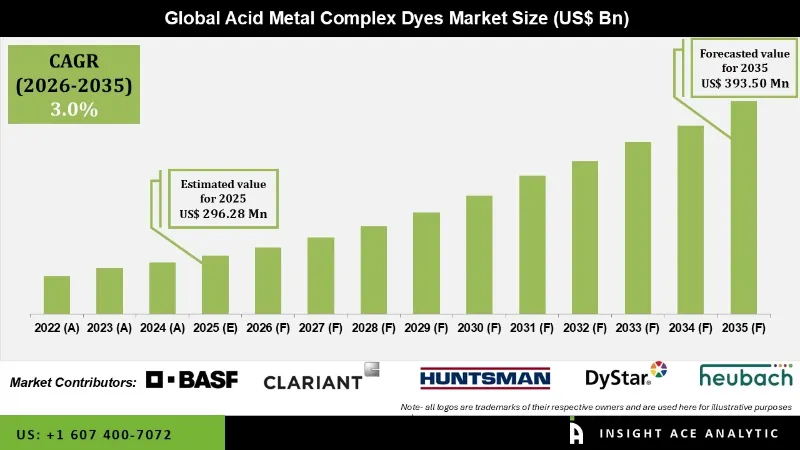
Acid metal complex dyes are a type of man-made colour that is made by mixing acid dyes with metal ions, usually copper, cobalt, or chromium, to make stable coordination complexes. Animal fibres like wool, silk, and leather, as well as polyamide fibres like nylon, are the main things that these dyes are used to colour. Adding metal ions to acid dyes makes them stick to fibers better than regular acid dyes. This makes the colors last longer, be more saturated, and be less affected by light, cleaning, and sweating. The main things that are driving the acid metal complex dyes market are rising demand in the textile industry, rising use in leather processing, and rising use in industrial applications.
The growing need for eco-friendly and sustainable dyeing solutions is another major factor propelling the acid metal complex dyes market. The manufacturers are shifting to dyes with better sustainability characteristics as consumers become more aware of environmental issues. Additionally, the textile industry is seeing a rise in personalization as companies look for distinctive hues and qualities in their goods. Manufacturers have the chance to innovate and create specialized metal complex dyes that meet particular consumer needs as a result of this desire for customized solutions. Moreover, the growth prospects are further enhanced by the growing popularity of specialist markets that demand high-performance dyes, like sportswear and activewear.
In addition, due to the global push for sustainability, technological advancements in dyeing techniques, and an increase in demand for specialized applications, the acid metal complex dye market is expanding rapidly. These trends, which emphasize performance and increased environmental responsibility, are altering market strategies, product formulas, and production practices. Additionally, the demand for acid metal complex dyes with exceptional lightfastness, wet fastness, and overall durability is driving market expansion. In order to maximize product life and consumer happiness, this trend supports industries that require long-lasting color, such as high-end leather accessories, automotive textiles, and outdoor apparel.
Competitive Landscape
Which are the Leading Players in the Acid Metal Complex Dyes Market?
• BASF SE
• Clariant AG
• Huntsman Corporation
• Dystar
• Heubach GmbH
• Archroma
• Sudarshan Chemical Industries Ltd.
• Jiangsu Baichuan Chemical Group Co., Ltd.
• Nippon Kayaku Co., Ltd.
• Taj Dyes and Chemicals Ltd.
• Sumitomo Chemical Co., Ltd.
• Yarntex Chemical Industries
• Zhejiang NHU Co., Ltd.
• Others
Market Dynamics
Driver
Growing Demand from the Textile and Leather Industry
The growing demand in the textile industry is one of the main drivers of the acid metal complex dyes market. The need for premium dyes with exceptional fastness qualities has increased as fashion trends change, and customer tastes move toward more robust and aesthetically pleasing textiles. Textile makers are increasingly choosing metal complex dyes because of their superior light and washing fastness. Furthermore, the industry's increasing focus on sustainable practices has resulted in the creation of environmentally friendly acid metal complex dyes, which are driving market expansion.
Moreover, the growth of the leather sector is another major factor driving the market for acid metal complex dyes, for leather goods like shoes, accessories, and car upholstery, dyes with rich, deep colours and fading resistance are necessary. In addition, it is anticipated that in the upcoming years, the use of acid metal complex dyes will increase due to the growing demand for luxury leather items, which is fueled by changes in lifestyle and increased disposable incomes.
Restrain/Challenge
Growing Environmental Contamination from Dyeing and Finishing Processes
The environmental contamination from dyeing and finishing processes is one of the biggest obstacles to the acid metal complex dyes market. Water pollution is caused by the dumping of acid, metal complex dyes and untreated wastewater from the textile and leather industries, which is why governments around the world have stringent laws.
Furthermore, significant investments in chemical waste disposal, environmental dyeing processes, and wastewater treatment are necessary to comply with environmental requirements. Additionally, companies find it more challenging to expand internationally due to regional differences in the regulatory environment. Thus, these factors are anticipated to limit the growth of the acid metal complex dyes market over the forecast period.
Metal Complex Type Segment is Expected to Drive the Acid Metal Complex Dyes Market
The Metal Complex Type category held the largest share in the Acid Metal Complex Dyes market in 2025 because of its increasing application base and strong performance qualities. These dyes are especially well-suited for high-end textile and leather applications because of their superior colour fastness, strong affinity for fibres, and increased resistance to light, washing, and sweat. The adoption of wool, silk, nylon, and speciality synthetic fibres is being driven by their capacity to generate rich, consistent hues with good levelling qualities. Additionally, market expansion is being supported by rising demand from the automobile and furniture upholstery industries, where long-lasting colour quality and durability are crucial.
Textile Industry Segment is Growing at the Highest Rate in the Acid Metal Complex Dyes Market
In 2025, the Textile Industry category dominated the Acid Metal Complex Dyes market, driven by the widespread usage of these dyes for clothing and textile colouring. These dyes' exceptional fastness qualities make them perfect for usage in the textile sector, where demand for premium, long-lasting, and visually beautiful fabrics is always growing. Additionally, the creation of acid metal complex dyes that adhere to strict environmental criteria has been prompted by the movement toward sustainable and eco-friendly fabrics.
Why North America Led the Acid Metal Complex Dyes Market?
The Acid Metal Complex Dyes market was dominated by the North America region in 2025, driven by growing consumer awareness of sustainable fashion, increased technological textile uses, and growing demand from North America's expanding textile markets. Significant expenditures are being made in R&D centred on bio-based dyes, formulations enhanced by nanotechnology, and integration with digital textile printing technologies as businesses expand to fulfil these market demands.
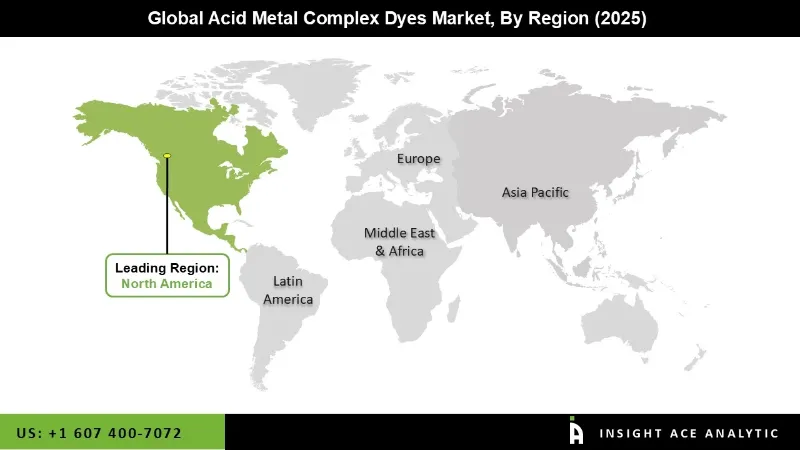
Furthermore, acid metal complex dyes will continue to be an essential part of high-performance, eco-friendly textile dyeing processes as the market develops, assisting the industry's global shift to smart and sustainable manufacturing ecosystems. The North American acid metal complex dyes market is anticipated to grow as a result.
Acid Metal Complex Dyes Market Report Scope:
| Report Attribute | Specifications |
| Market size value in 2025 | USD 296.28 Mn |
| Revenue forecast in 2035 | USD 393.50 Mn |
| Growth Rate CAGR | CAGR of 3.0% from 2026 to 2035 |
| Quantitative Units | Representation of revenue in US$ Bn and CAGR from 2026 to 2035 |
| Historic Year | 2022 to 2024 |
| Forecast Year | 2026-2035 |
| Report Coverage | The forecast of revenue, the position of the company, the competitive market structure, growth prospects, and trends |
| Segments Covered | Type, Application, End-user, and By Region |
| Regional Scope | North America; Europe; Asia Pacific; Latin America; Middle East & Africa |
| Country Scope | U.S.; Canada; U.K.; Germany; China; India; Japan; Brazil; Mexico; The UK; France; Italy; Spain; China; Japan; India; South Korea; Southeast Asia; South Korea; Southeast Asia |
| Competitive Landscape | BASF SE, Clariant AG, Huntsman Corporation, Dystar, Heubach GmbH, Archroma, Sudarshan Chemical Industries Ltd., Jiangsu Baichuan Chemical Group Co., Ltd., Nippon Kayaku Co., Ltd., Taj Dyes and Chemicals Ltd., Sumitomo Chemical Co., Ltd., Yarntex Chemical Industries, Zhejiang NHU Co., Ltd., Others |
| Customization Scope | Free customization report with the procurement of the report, Modifications to the regional and segment scope. Geographic competitive landscape. |
| Pricing and Available Payment Methods | Explore pricing alternatives that are customized to your particular study requirements. |
Market Segmentation:
Acid Metal Complex Dyes Market by Type-
- Metal Complex Type
-
- Chrome Complex Dyes
- Zinc Complex Dyes
- Copper Complex Dyes
- Dye Form
-
- Liquid/Solution
- Powder
- Paste
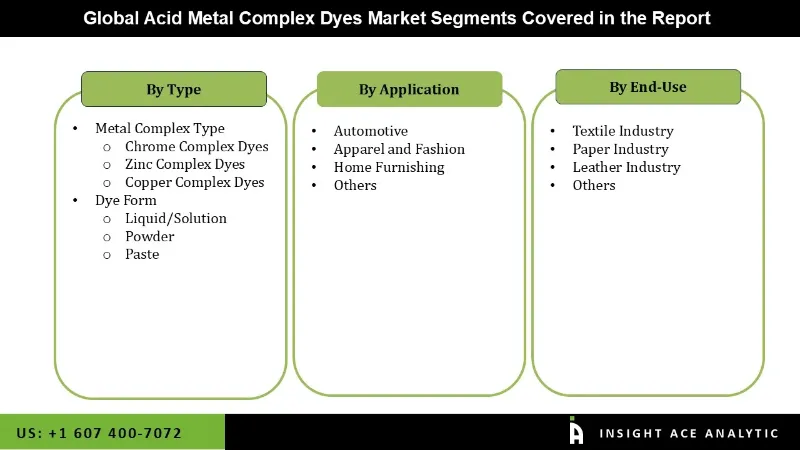
Acid Metal Complex Dyes Market by Application-
- Automotive
- Apparel and Fashion
- Home Furnishing
- Others
Acid Metal Complex Dyes Market by End-user-
- Textile Industry
- Paper Industry
- Leather Industry
- Others
Acid Metal Complex Dyes Market By Region-
North America-
- The US
- Canada
Europe-
- Germany
- The UK
- France
- Italy
- Spain
- Rest of Europe
Asia-Pacific-
- China
- Japan
- India
- South Korea
- South East Asia
- Rest of Asia Pacific
Latin America-
- Brazil
- Argentina
- Mexico
- Rest of Latin America
Middle East & Africa-
- GCC Countries
- South Africa
- Rest of Middle East and Africa
Research Design and Approach
This study employed a multi-step, mixed-method research approach that integrates:
- Secondary research
- Primary research
- Data triangulation
- Hybrid top-down and bottom-up modelling
- Forecasting and scenario analysis
This approach ensures a balanced and validated understanding of both macro- and micro-level market factors influencing the market.
Secondary Research
Secondary research for this study involved the collection, review, and analysis of publicly available and paid data sources to build the initial fact base, understand historical market behaviour, identify data gaps, and refine the hypotheses for primary research.
Sources Consulted
Secondary data for the market study was gathered from multiple credible sources, including:
- Government databases, regulatory bodies, and public institutions
- International organizations (WHO, OECD, IMF, World Bank, etc.)
- Commercial and paid databases
- Industry associations, trade publications, and technical journals
- Company annual reports, investor presentations, press releases, and SEC filings
- Academic research papers, patents, and scientific literature
- Previous market research publications and syndicated reports
These sources were used to compile historical data, market volumes/prices, industry trends, technological developments, and competitive insights.

Primary Research
Primary research was conducted to validate secondary data, understand real-time market dynamics, capture price points and adoption trends, and verify the assumptions used in the market modelling.
Stakeholders Interviewed
Primary interviews for this study involved:
- Manufacturers and suppliers in the market value chain
- Distributors, channel partners, and integrators
- End-users / customers (e.g., hospitals, labs, enterprises, consumers, etc., depending on the market)
- Industry experts, technology specialists, consultants, and regulatory professionals
- Senior executives (CEOs, CTOs, VPs, Directors) and product managers
Interview Process
Interviews were conducted via:
- Structured and semi-structured questionnaires
- Telephonic and video interactions
- Email correspondences
- Expert consultation sessions
Primary insights were incorporated into demand modelling, pricing analysis, technology evaluation, and market share estimation.
Data Processing, Normalization, and Validation
All collected data were processed and normalized to ensure consistency and comparability across regions and time frames.
The data validation process included:
- Standardization of units (currency conversions, volume units, inflation adjustments)
- Cross-verification of data points across multiple secondary sources
- Normalization of inconsistent datasets
- Identification and resolution of data gaps
- Outlier detection and removal through algorithmic and manual checks
- Plausibility and coherence checks across segments and geographies
This ensured that the dataset used for modelling was clean, robust, and reliable.
Market Size Estimation and Data Triangulation
Bottom-Up Approach
The bottom-up approach involved aggregating segment-level data, such as:
- Company revenues
- Product-level sales
- Installed base/usage volumes
- Adoption and penetration rates
- Pricing analysis
This method was primarily used when detailed micro-level market data were available.

Top-Down Approach
The top-down approach used macro-level indicators:
- Parent market benchmarks
- Global/regional industry trends
- Economic indicators (GDP, demographics, spending patterns)
- Penetration and usage ratios
This approach was used for segments where granular data were limited or inconsistent.
Hybrid Triangulation Approach
To ensure accuracy, a triangulated hybrid model was used. This included:
- Reconciling top-down and bottom-up estimates
- Cross-checking revenues, volumes, and pricing assumptions
- Incorporating expert insights to validate segment splits and adoption rates
This multi-angle validation yielded the final market size.
Forecasting Framework and Scenario Modelling
Market forecasts were developed using a combination of time-series modelling, adoption curve analysis, and driver-based forecasting tools.
Forecasting Methods
- Time-series modelling
- S-curve and diffusion models (for emerging technologies)
- Driver-based forecasting (GDP, disposable income, adoption rates, regulatory changes)
- Price elasticity models
- Market maturity and lifecycle-based projections
Scenario Analysis
Given inherent uncertainties, three scenarios were constructed:
- Base-Case Scenario: Expected trajectory under current conditions
- Optimistic Scenario: High adoption, favourable regulation, strong economic tailwinds
- Conservative Scenario: Slow adoption, regulatory delays, economic constraints
Sensitivity testing was conducted on key variables, including pricing, demand elasticity, and regional adoption.
Request Customization
Add countries, segments, company profiles, or extend forecast — free 10% customization with purchase.
Customize This Report →Enquire Before Buying
Speak with our analyst team about scope, methodology, pricing, or deliverable formats.
Enquire Now →Frequently Asked Questions
Acid Metal Complex Dyes Market Size is valued at USD 296.28 Mn in 2025 and is predicted to reach USD 393.50 Mn by the year 2035
Acid Metal Complex Dyes Market is expected to grow at a 3.0% CAGR during the forecast period for 2026 to 2035.
BASF SE, Clariant AG, Huntsman Corporation, Dystar, Heubach GmbH, Archroma, Sudarshan Chemical Industries Ltd., Jiangsu Baichuan Chemical Group Co., Ltd., Nippon Kayaku Co., Ltd., Taj Dyes and Chemicals Ltd., Sumitomo Chemical Co., Ltd., Yarntex Chemical Industries, Zhejiang NHU Co., Ltd., Others
Type, Application, End-user, and By Region are the key segments of the Acid Metal Complex Dyes Market.
North America region is leading the Acid Metal Complex Dyes Market.