Methylene Chloride Market Size and Revenue Impact Study 2026 to 2035
Global Methylene Chloride Market Size is valued at USD 890.8 Mn in 2025 and is predicted to reach USD 1,186.0 Mn by the year 2035 at a 3.1% CAGR during the forecast period for 2026 to 2035.
Methylene Chloride Market Size, Share & Trends Analysis Distribution by Application (Metal Cleaning, Paint Remover, Solvent, Foam Manufacturing, Pharmaceuticals, Chemical Processing, and Others), End-user (Pharmaceuticals Industry, Food & Beverage Industry, Transportation Industry, Building & Construction Industry, Others), Distribution Channel (Direct and In Direct), and Segment Forecasts, 2026 to 2035.
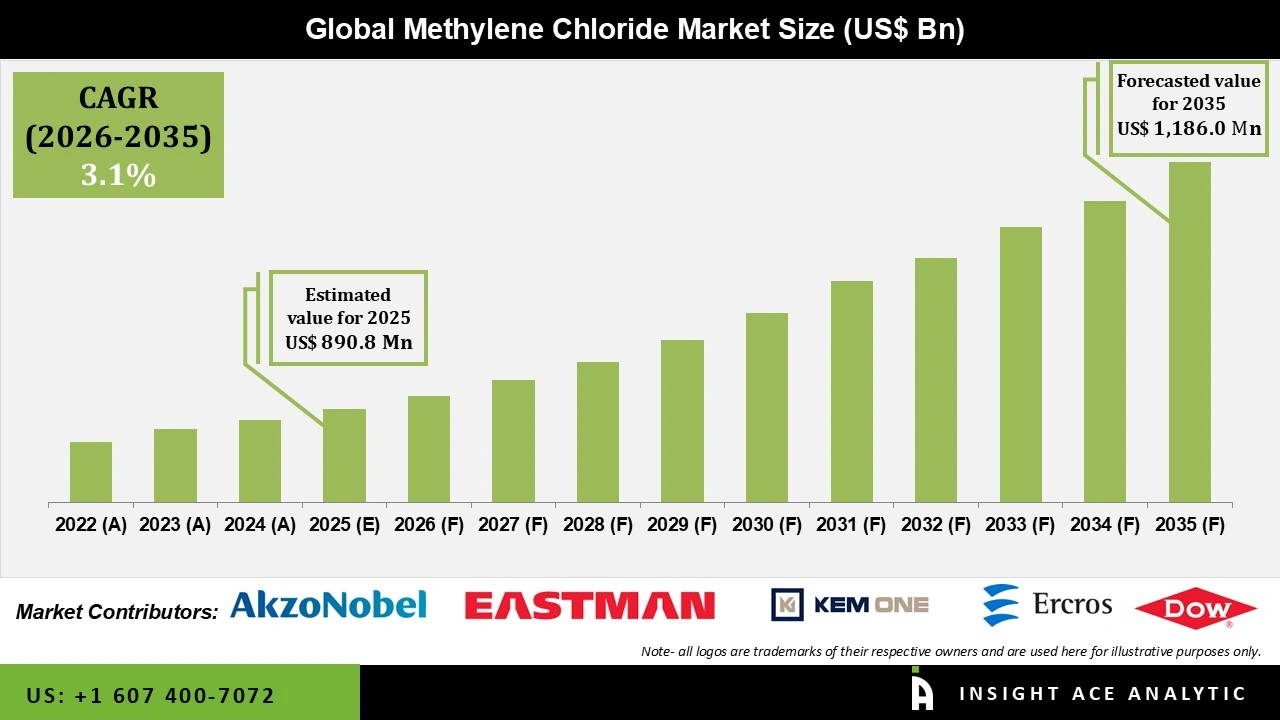
It is one of the most powerful and versatile organic solvents available, capable of dissolving a wide range of organic compounds quickly and effectively. Thanks to its low boiling point (~40 °C), high vapor pressure, and excellent solvency, it is widely used in many industries for tasks that require rapid cleaning, extraction, or dissolution without leaving residue. The pharmaceutical industry, which uses it as a crucial reaction and purification solvent in the production of antibiotics, steroids, and vitamins, is the main driver of the global market. The chemical processing industry also plays a major role in growth, using methylene chloride as a key raw material to produce hydrofluorocarbon (HFC) refrigerants like HFC-32, which are becoming more and more popular due to their lower potential for global warming than legacy alternatives. Additionally, the product's low flammability, rapid dissolving ability, and quick drying characteristic will guide its penetration in the various industries worldwide. Over the course of the projection period, an increase in construction activities, such as building and bridge construction, will fuel the methylene chloride market demand.
In addition, the main factors driving the methylene chloride market are rising demand for cleaning products and its usage as a crucial solvent in paint and adhesive compositions. It is utilized as a principal solvent in paint and adhesive formulations because of its high dissolving capacity, low flammability, and quick drying qualities. The construction and automobile sectors are the primary end users of paint and adhesives. The massive expansion of building projects, including bridges, residences, and manufacturing facilities, across the globe has led to a notable increase in the demand for paints and adhesives. However, because of the chemical's toxicity and carcinogenic nature, the market is severely hampered by strict environmental and safety restrictions.
Competitive Landscape
Which are the Leading Players in Methylene Chloride Market?
- AkzoNobel N.V.
- Solvay S.A.
- Eastman Chemical Company
- Gujarat Alkalies & Chemicals Ltd.
- Ineos Group
- Dow Chemical Company
- LOTTE Fine Chemical
- Occidental Petroleum Corporation
- Ercros S.A.
- MC Chemicals Ltd
- Olin Corporation
- PPG industries Inc.
- Shin-Etsu Chemical Co., Ltd.
- KEM ONE
- Tokuyama Corporation
- Others
Market Dynamics
Driver
Growing Need for Pharmaceutical Solvents
The growing need for pharmaceutical solvents due to the growing worldwide pharmaceutical sector is a major factor propelling the methylene chloride market. Methylene chloride is a favoured solvent for medication production and formulation because of its capacity to dissolve a wide variety of organic compounds and promote accurate chemical reactions. The need for effective and stable solvents like methylene chloride is increasing as pharmaceutical companies increase production to meet the growing demand for drugs, especially in emerging nations. Additionally, methylene chloride's function in pharmaceutical research and production processes is being strengthened by the rise in complicated drug compositions and the creation of novel medications. The market's responsiveness to changing pharmaceutical needs and the industry's continuous need for dependable solvents are both reflected in this development.
Restrain/Challenge
Growing Health and Environmental Hazards
The health and environmental hazards posed by methylene chloride are among the main factors limiting the market. As a volatile organic compound (VOC), methylene chloride, also known as dichloromethane, can be harmful to human health if inhaled or absorbed through the skin. Respiratory problems, impacts on the brain system, and even long-term health hazards might result from exposure. Because of these worries, regulatory bodies like the European Chemicals Agency (ECHA) and the US Environmental Protection Agency (EPA) have placed stringent limitations on the use of methylene chloride, especially in consumer products like paint removers. The market expansion for methylene chloride may be constrained by businesses' growing search for substitute solvents as environmental and safety concerns rise.
The Pharmaceutical Industry Segment is Expected to Drive the Methylene Chloride Market
The Pharmaceuticals Industry category held the largest share in the Methylene Chloride market in 2025, driven by the fact that it is an essential solvent in the production of several medications. In the production of pharmaceuticals, methylene chloride is very helpful due to its broad range of organic molecule dissolution. Active pharmaceutical ingredients (APIs) are extracted and purified using this process, which helps produce high-purity drugs. Pharmaceutical companies can save money by using this molecule because of its low boiling point and volatility, which enable quick recovery and recycling in production operations. Additionally, the manufacture of vitamins, steroids, and antibiotics all of which are in high demand worldwide requires the solvent properties of methylene chloride.
Direct Segment is Growing at the Highest Rate in the Methylene Chloride Market
In 2025, the direct category dominated the methylene chloride market because large-scale industrial buyers are increasingly choosing streamlined procurement. In order to cut out middlemen and guarantee supply chain dependability, major end users in the chemical processing and pharmaceutical industries are moving toward direct interaction with producers. This method enables purchasers to strictly monitor product quality while securing consistent, high-purity volumes that are necessary for sensitive activities. Moreover, direct sourcing helps businesses comply with strict safety regulations established by organisations like the US Environmental Protection Agency (EPA).
Why Asia Pacific Led the Methylene Chloride Market?
The methylene chloride market was dominated by Asia Pacific region in 2025 driven mainly by concentrated supply, strong demand, strategic trade positioning, and substantial regulatory factors. The region is a hub to the methylene chloride manufacturing base, supported by a well-developed chlor-alkali and chlorinated solvents infrastructure in China, India, and Southeast Asia.
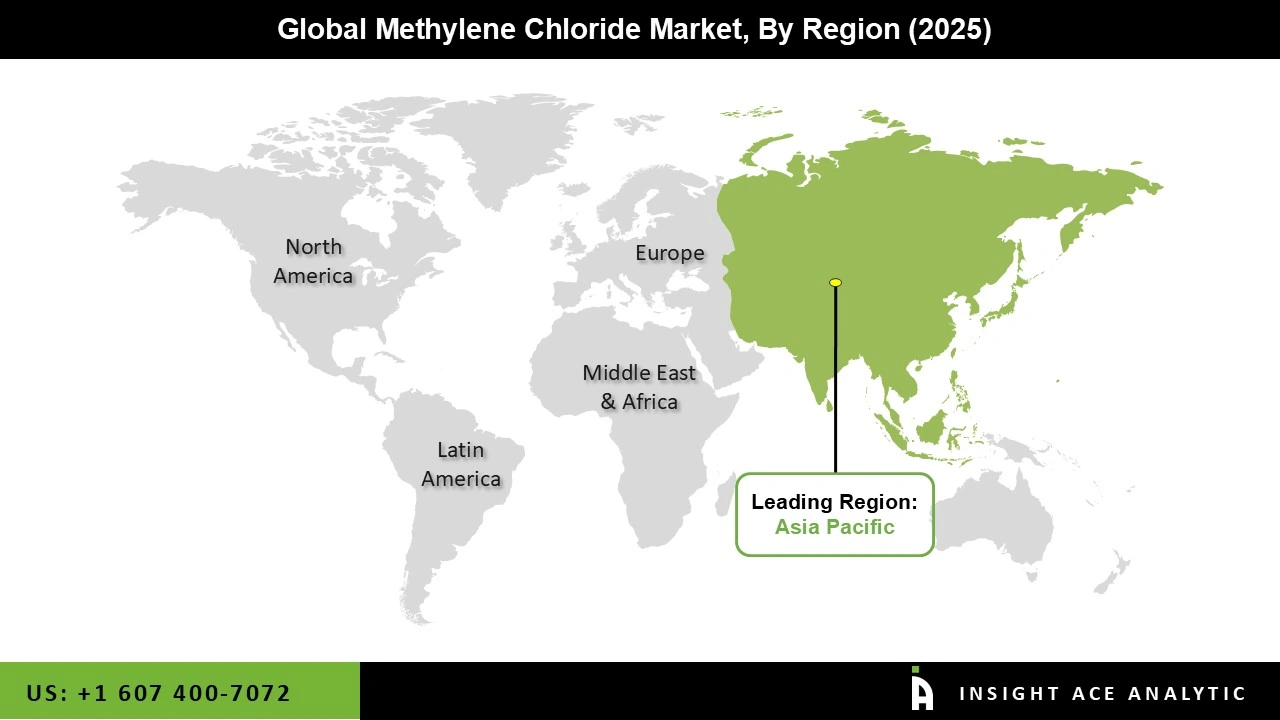
This efficient production base aligns with high downstream demand, as APAC is a hub for key industries such as pharmaceutical API and intermediate manufacturing, chemical processing, polyurethane foam production, and metal cleaning.
Methylene Chloride Market Report Scope :
| Report Attribute | Specifications |
| Market size value in 2025 | USD 890.8 Mn |
| Revenue forecast in 2035 | USD 1,186.0 Mn |
| Growth Rate CAGR | CAGR of 3.1% from 2026 to 2035 |
| Quantitative Units | Representation of revenue in US$ Mn, Volume (Kilotons) and CAGR from 2026 to 2035 |
| Historic Year | 2022 to 2025 |
| Forecast Year | 2026-2035 |
| Report Coverage | The forecast of revenue, the position of the company, the competitive market structure, growth prospects, and trends |
| Segments Covered | By Application, End-user, Distribution Channel, and By Region |
| Regional Scope | North America; Europe; Asia Pacific; Latin America; Middle East & Africa |
| Country Scope | U.S.; Canada; U.K.; Germany; China; India; Japan; Brazil; Mexico; The UK; France; Italy; Spain; China; Japan; India; South Korea; Southeast Asia; South Korea; Southeast Asia |
| Competitive Landscape | AkzoNobel N.V., Solvay S.A., Eastman Chemical Company, Gujarat Alkalies & Chemicals Ltd., Ineos Group, Dow Chemical Company, LOTTE Fine chemical, Occidental Petroleum Corporation, Ercros S.A., MC Chemicals Ltd, Olin Corporation, PPG industries Inc., Shin-Etsu Chemical Co. Ltd., KEM ONE, Tokuyama Corporation, and Others |
| Customization Scope | Free customization report with the procurement of the report, Modifications to the regional and segment scope. Geographic competitive landscape. |
| Pricing and Available Payment Methods | Explore pricing alternatives that are customized to your particular study requirements. |
Segmentation of Methylene Chloride Market :
Methylene Chloride Market, by Application-
- Metal Cleaning
- Paint Remover
- Solvent
- Foam Manufacturing
- Pharmaceuticals
- Chemical Processing
- Others
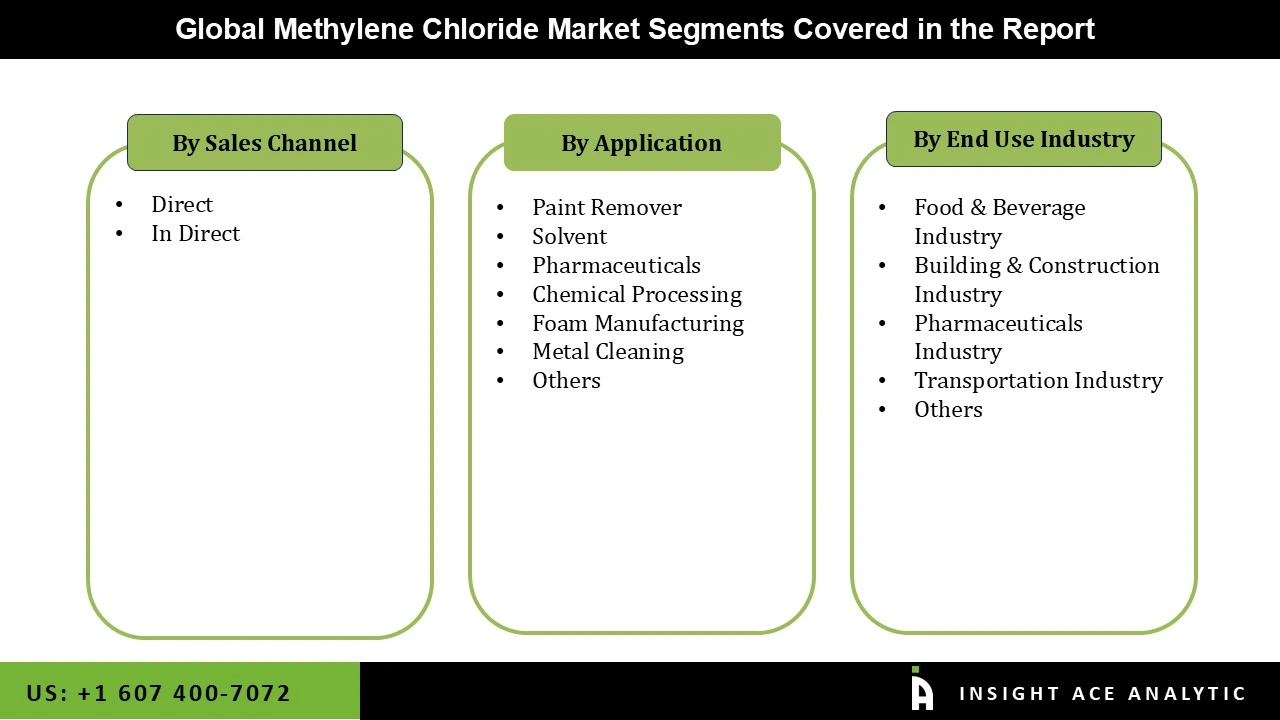
Methylene Chloride Market, by End-user-
- Pharmaceuticals Industry
- Food & Beverage Industry
- Transportation Industry
- Building & Construction Industry
- Others
Methylene Chloride Market, by Distribution Channel-
- Direct
- In Direct
Methylene Chloride Market, By Region-
- North America-
- The US
- Canada
- Europe-
- Germany
- The UK
- France
- Italy
- Spain
- Rest of Europe
- Asia-Pacific-
- China
- Japan
- India
- South Korea
- South East Asia
- Rest of Asia Pacific
- Latin America-
- Brazil
- Argentina
- Mexico
- Rest of Latin America
- Middle East & Africa-
- GCC Countries
- South Africa
- Rest of Middle East and Africa
Research Design and Approach
This study employed a multi-step, mixed-method research approach that integrates:
- Secondary research
- Primary research
- Data triangulation
- Hybrid top-down and bottom-up modelling
- Forecasting and scenario analysis
This approach ensures a balanced and validated understanding of both macro- and micro-level market factors influencing the market.
Secondary Research
Secondary research for this study involved the collection, review, and analysis of publicly available and paid data sources to build the initial fact base, understand historical market behaviour, identify data gaps, and refine the hypotheses for primary research.
Sources Consulted
Secondary data for the market study was gathered from multiple credible sources, including:
- Government databases, regulatory bodies, and public institutions
- International organizations (WHO, OECD, IMF, World Bank, etc.)
- Commercial and paid databases
- Industry associations, trade publications, and technical journals
- Company annual reports, investor presentations, press releases, and SEC filings
- Academic research papers, patents, and scientific literature
- Previous market research publications and syndicated reports
These sources were used to compile historical data, market volumes/prices, industry trends, technological developments, and competitive insights.

Primary Research
Primary research was conducted to validate secondary data, understand real-time market dynamics, capture price points and adoption trends, and verify the assumptions used in the market modelling.
Stakeholders Interviewed
Primary interviews for this study involved:
- Manufacturers and suppliers in the market value chain
- Distributors, channel partners, and integrators
- End-users / customers (e.g., hospitals, labs, enterprises, consumers, etc., depending on the market)
- Industry experts, technology specialists, consultants, and regulatory professionals
- Senior executives (CEOs, CTOs, VPs, Directors) and product managers
Interview Process
Interviews were conducted via:
- Structured and semi-structured questionnaires
- Telephonic and video interactions
- Email correspondences
- Expert consultation sessions
Primary insights were incorporated into demand modelling, pricing analysis, technology evaluation, and market share estimation.
Data Processing, Normalization, and Validation
All collected data were processed and normalized to ensure consistency and comparability across regions and time frames.
The data validation process included:
- Standardization of units (currency conversions, volume units, inflation adjustments)
- Cross-verification of data points across multiple secondary sources
- Normalization of inconsistent datasets
- Identification and resolution of data gaps
- Outlier detection and removal through algorithmic and manual checks
- Plausibility and coherence checks across segments and geographies
This ensured that the dataset used for modelling was clean, robust, and reliable.
Market Size Estimation and Data Triangulation
Bottom-Up Approach
The bottom-up approach involved aggregating segment-level data, such as:
- Company revenues
- Product-level sales
- Installed base/usage volumes
- Adoption and penetration rates
- Pricing analysis
This method was primarily used when detailed micro-level market data were available.

Top-Down Approach
The top-down approach used macro-level indicators:
- Parent market benchmarks
- Global/regional industry trends
- Economic indicators (GDP, demographics, spending patterns)
- Penetration and usage ratios
This approach was used for segments where granular data were limited or inconsistent.
Hybrid Triangulation Approach
To ensure accuracy, a triangulated hybrid model was used. This included:
- Reconciling top-down and bottom-up estimates
- Cross-checking revenues, volumes, and pricing assumptions
- Incorporating expert insights to validate segment splits and adoption rates
This multi-angle validation yielded the final market size.
Forecasting Framework and Scenario Modelling
Market forecasts were developed using a combination of time-series modelling, adoption curve analysis, and driver-based forecasting tools.
Forecasting Methods
- Time-series modelling
- S-curve and diffusion models (for emerging technologies)
- Driver-based forecasting (GDP, disposable income, adoption rates, regulatory changes)
- Price elasticity models
- Market maturity and lifecycle-based projections
Scenario Analysis
Given inherent uncertainties, three scenarios were constructed:
- Base-Case Scenario: Expected trajectory under current conditions
- Optimistic Scenario: High adoption, favourable regulation, strong economic tailwinds
- Conservative Scenario: Slow adoption, regulatory delays, economic constraints
Sensitivity testing was conducted on key variables, including pricing, demand elasticity, and regional adoption.
Request Customization
Add countries, segments, company profiles, or extend forecast — free 10% customization with purchase.
Customize This Report →Enquire Before Buying
Speak with our analyst team about scope, methodology, pricing, or deliverable formats.
Enquire Now →Frequently Asked Questions
Methylene Chloride Market Size is valued at USD 890.8 Mn in 2025 and is predicted to reach USD 1,186.0 Mn by the year 2035
The Methylene Chloride Market is expected to grow at a 3.1% CAGR during the forecast period for 2026 to 2035
AkzoNobel N.V., Solvay S.A., Eastman Chemical Company, Gujarat Alkalies & Chemicals Ltd., Ineos Group, Dow Chemical Company, LOTTE Fine chemical, Occidental Petroleum Corporation, Ercros S.A., MC Chemicals Ltd, Olin Corporation, PPG industries Inc., Shin-Etsu Chemical Co. Ltd., KEM ONE, Tokuyama Corporation, and Others
Methylene Chloride Market is segmented in Application (Metal Cleaning, Paint Remover, Solvent, Foam Manufacturing, Pharmaceuticals, Chemical Processing, and Others), End-user (Pharmaceuticals Industry, Food & Beverage Industry, Transportation Industry, Building & Construction Industry, Others), Distribution Channel (Direct and In Direct) and other.
North America region is leading the Methylene Chloride Market.