HVO for Data Center Backup Market Size, Share Detailed Report 2026 to 2035
Global HVO for Data Center Backup Market Size is valued at USD 14.3 Mn in 2025 and is predicted to reach USD 41.3 Bn by the year 2035 at a 11.6% CAGR during the forecast period for 2026 to 2035.
HVO for Data Center Backup Market Size, Share & Trends Analysis Distribution by Data Center Type (Hyperscale Data Center, Colocation and Retail, Others), By Feedstock Type (Edible Vegetable Oils, Used Cooking Oil, Tall Oil, Crude Palm Oil, Animal Fats, and Others), By Technology (Standalone Hydrotreating Technology and Co-Processing Technology), By Region and Segment Forecasts, 2026 to 2035
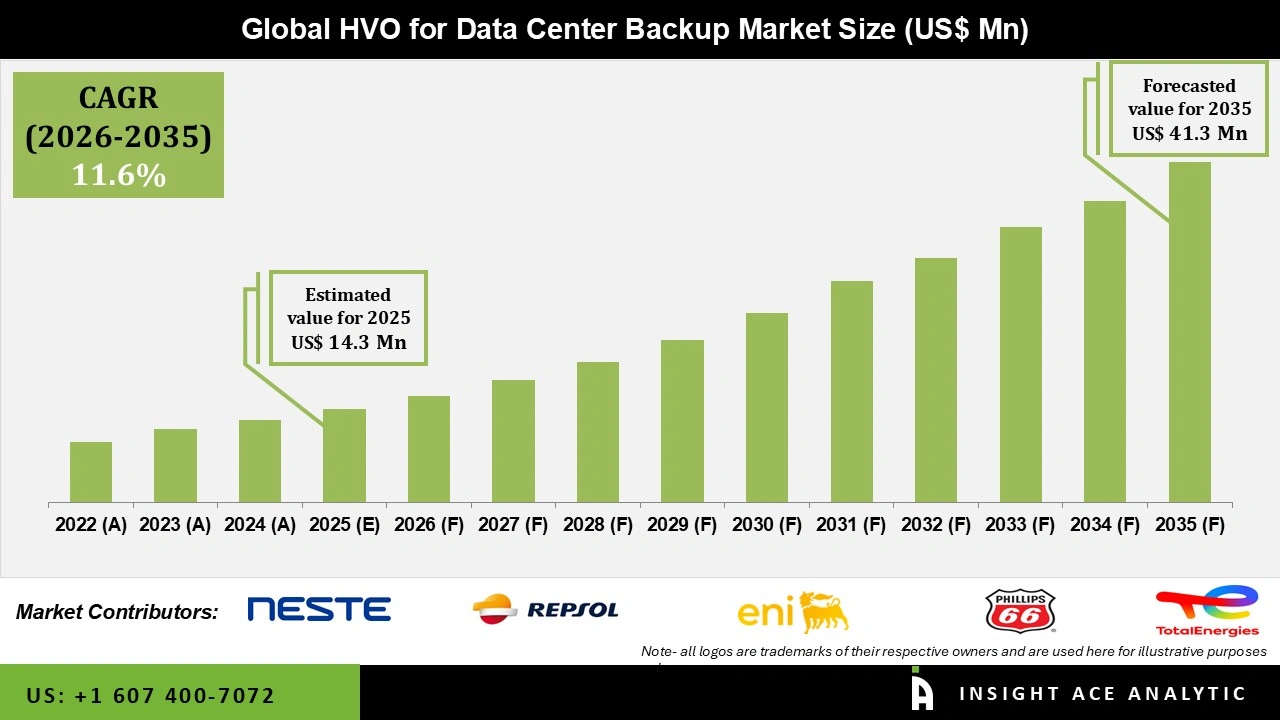
HVO (Hydrotreated Vegetable Oil) is a renewable diesel fuel made from waste oils, fats, and plant-based feedstocks. It works exactly like regular diesel and can be used directly in existing backup generators without any changes. In data centers, HVO powers emergency generators to keep everything running during power outages. It burns much cleaner than normal diesel, cutting carbon emissions by up to 90% over its full lifecycle and producing fewer harmful pollutants. The main reasons data centers are switching to HVO are stricter carbon reduction goals, the huge increase in data center power needs, and the desire for greener backup power without losing reliability.
The HVO for the data centre backup market is steadily increasing as the critical infrastructure sector begins to demonstrate a greater concern for the factors of sustainability, reduced carbon emissions, and guaranteed power availability. Data center facilities are increasingly reliant on HVO as a more sustainable alternative to classic diesel fuels to maintain constant operations in the event of a grid shutdown. Additionally, the power demand is rising substantially because of the higher usage of cloud computing, artificial intelligence, and hyperscale facilities. The rising interest from consumers to enhance the ESG profile and the increasing need to comply with the tightened regulations associated with the current higher concern against pollution are encouraging data center to adopt new fuels such as HVO.
Moreover, the fact that HVO can be integrated easily with the existing diesel generator base without the need for major modifications to the equipment adds to the market's growth. It finds particular applications as a data center backup power source owing to the high storage life, fuel stability, and reliability exhibited by the product when the power goes out. As a result of the support offered by the government in the form of sustainable regulations, the use of renewable fuels has started gaining momentum at a faster pace. However, there are some challenges that the market for HVO for data center backup power sources needs to face, including higher fuel prices compared to conventional diesel oil, along with limited accessibility.
Competitive Landscape
Which are the Leading Players in HVO for the data centre backup market?
- Neste
- Repsol
- TotalEnergies
- Phillips 66 Company
- Eni S.p.A.
- Crown Oil Ltd
- Foster Fuels Inc.
- Certas Energy
- LubiQ HVO Fuels
- Rehlko
- Rolls-Royce plc
- Caterpillar
- Cummins Inc.
- Moteurs Baudouin
Market Dynamics
Driver
Growing Pressure on Data Centers to Lower Their Carbon Impact and Improve Sustainability
The HVO for data center backup market is expanding dramatically due to growing pressure on data centers to lower their carbon impact and improve sustainability. In many areas and nations, the practice of obtaining renewable energy to power data centers is expanding. Data centers account for 1-3% of global energy use, making them among the biggest power consumers. Additionally, the operators of data centers, including Google, Microsoft, Meta (Facebook), and Amazon Web Services, have pledged to reach net-zero carbon emissions. Additionally, the need for cloud computing is driving the development of huge data centers across the globe. The HVO for data center backup market is expanding due to the rising need for enormous amounts of power.
Restrain/Challenge
High Capital Expenditure Needed for Data Center Backup Installation
One of the primary obstacles to the HVO for data center backup market's expansion is the substantial capital expenditure needed for data center backup installation and upkeep. To provide redundancy, large-scale data centers frequently require several high-capacity units, which greatly increases upfront expenses. The total cost of ownership is also increased by continuing maintenance, fuel costs, and compliance testing. These costs may be prohibitive for small and medium-sized businesses. Additionally, the requirement for qualified specialists and ongoing oversight raises operating expenses even more. Sustaining the HVO for data center backup market growth requires addressing these cost-related issues through service-based models, fuel-efficient technology, and modular designs.
Colocation and Retail Segment is Expected to Drive the HVO for Data Center Backup Market
The Colocation and Retail category held the largest share in the HVO for Data Center Backup market in 2025 since data centers need dependable and sustainable power solutions to run continuously. This rise is being driven by the increasing demand across industries for high-performance computing, cloud computing, and data storage. Furthermore, the efficiency and sustainability of backup power solutions are being improved by developments in HVO technologies, energy storage options, and power management systems, making them perfect for retail data centers and colocation.
The Edible Vegetable Oils Segment is Growing at the Highest Rate in the HVO for Data Center Backup Market
In 2025, the Edible Vegetable Oils category dominated the HVO for Data Center Backup market propelled by the growing emphasis on low-carbon and sustainable fuel substitutes for vital power applications. HVO made from edible vegetable oils like soybean, rapeseed, and palm oil offers a cleaner-burning alternative to traditional diesel, and data center operators are under increasing pressure to lower carbon emissions while maintaining a steady power supply. These oils make it possible to produce high-quality HVO with superior combustion qualities, a lower sulfur content, and fewer emissions of particulate matter and NOx, which makes them appropriate for data center backup generator systems.
Why North America Led the HVO for Data Center Backup Market?
The HVO for Data Center Backup market was dominated by North America region in 2025 due to the quick growth of colocation and hyperscale data centers, as well as the growing focus on carbon reduction and sustainability. Hydrotreated vegetable oil (HVO) is becoming more popular as a greener substitute for traditional diesel fuel in backup generators since data centers need highly dependable backup power solutions to guarantee continuous operations.
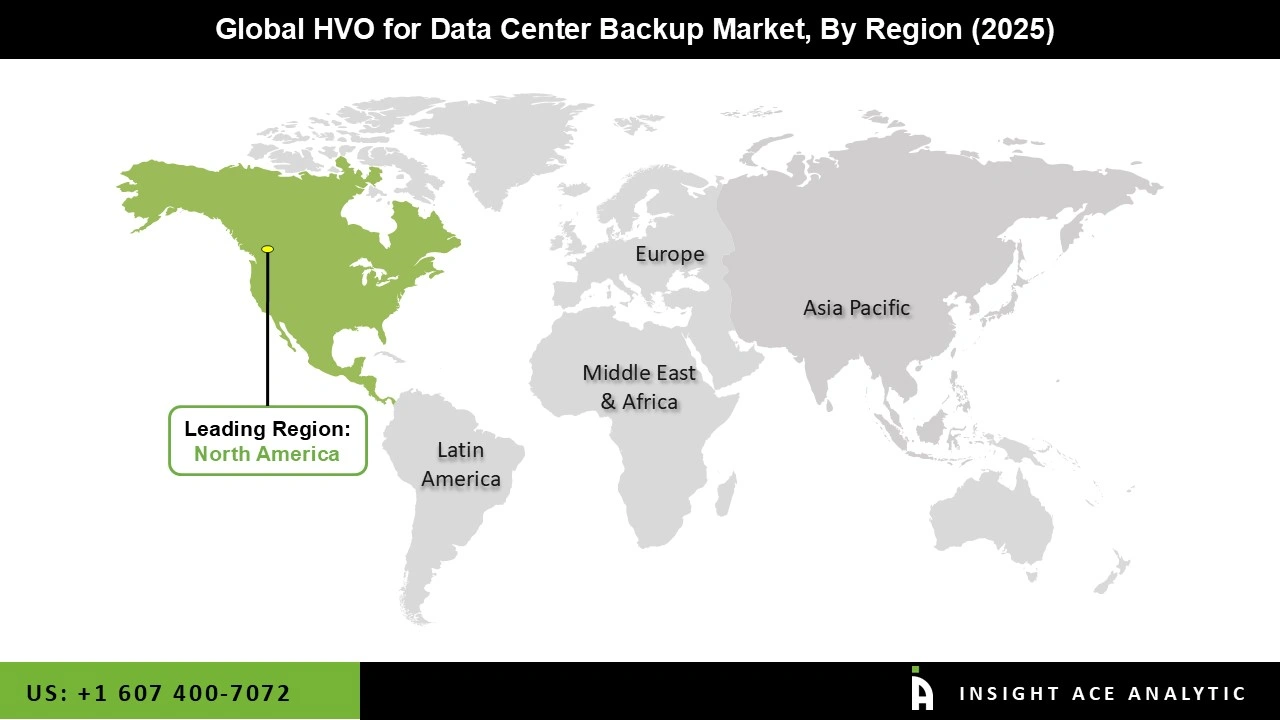
Additionally, data center operators are being encouraged to switch to HVO-based backup systems by strict environmental regulations, corporate net-zero promises, and growing pressure from investors and consumers to adopt low-emission energy solutions.
Key Development
- January 2025: Neste has established a partnership with the Italian gasoline distributor Firmin to introduce Neste MY Renewable Diesel (HVO100) in the Italian market, aiming to reduce greenhouse gas emissions in the transportation sector. This collaboration provides Italian enterprises with a sustainable alternative to fossil diesel and enhances Neste's market presence in Europe. Neste MY Renewable Diesel, composed completely of renewable resources, can reduce greenhouse gas emissions by up to 90% without necessitating new vehicle fleets or changes.
HVO for Data Center Backup Market Report Scope :
| Report Attribute | Specifications |
| Market size value in 2025 | USD 14.3 Mn |
| Revenue forecast in 2035 | USD 41.3 Mn |
| Growth Rate CAGR | CAGR of 11.6 % from 2026 to 2035 |
| Quantitative Units | Representation of revenue in US$ Bn and CAGR from 2026 to 2035 |
| Historic Year | 2022 to 2024 |
| Forecast Year | 2026-2035 |
| Report Coverage | The forecast of revenue, the position of the company, the competitive market structure, growth prospects, and trends |
| Segments Covered | Data Center Type, Feedstock Type, Technology, and By Region |
| Regional Scope | North America; Europe; Asia Pacific; Latin America; Middle East & Africa |
| Country Scope | U.S.; Canada; U.K.; Germany; China; India; Japan; Brazil; Mexico; The UK; France; Italy; Spain; China; Japan; India; South Korea; Southeast Asia; South Korea; Southeast Asia |
| Competitive Landscape | Neste, Repsol, TotalEnergies, Phillips 66 Company, Eni S.p.A., Crown Oil Ltd, Foster Fuels Inc., Certas Energy, LubiQ HVO Fuels, Rehlko, Rolls-Royce plc, Caterpillar, Cummins Inc., and Moteurs Baudouin |
| Customization Scope | Free customization report with the procurement of the report, Modifications to the regional and segment scope. Geographic competitive landscape. |
| Pricing and Available Payment Methods | Explore pricing alternatives that are customized to your particular study requirements. |
Segmentations of HVO for Data Center Backup Market:
HVO for Data Center Backup Market by Data Center Type-
- Hyperscale Data Center
- Colocation and Retail
- Others
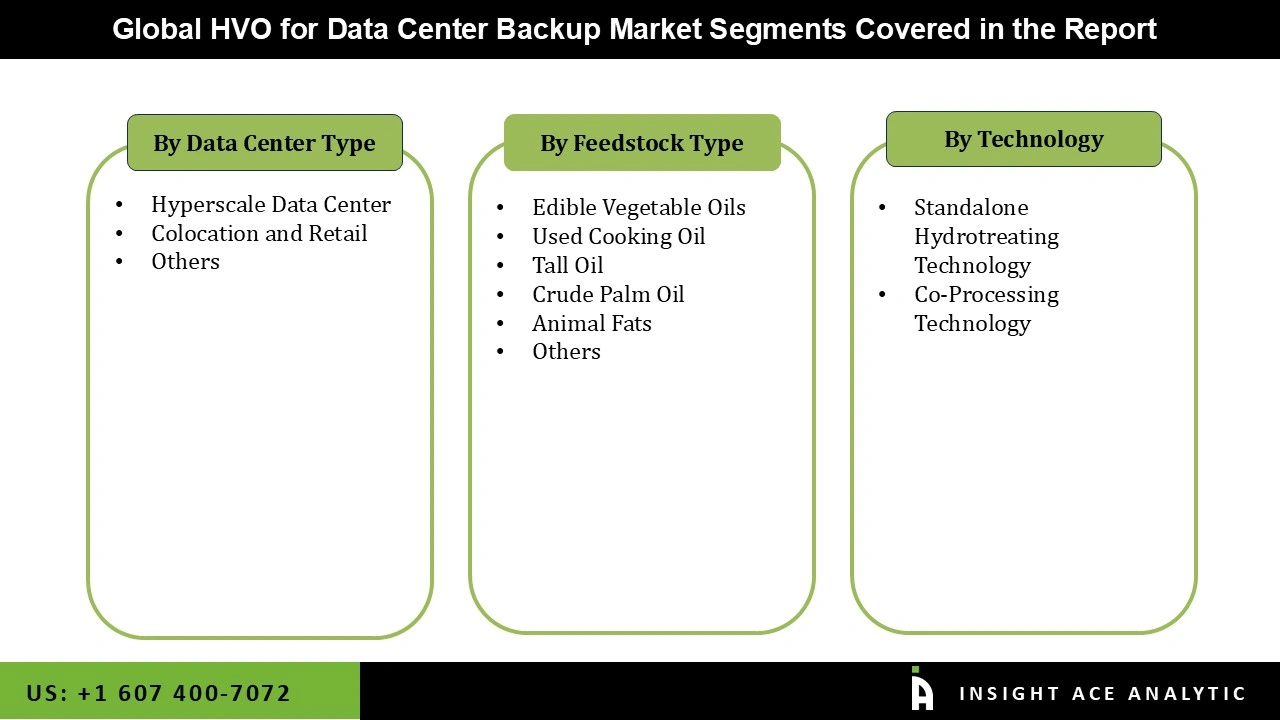
HVO for Data Center Backup Market by Feedstock Type-
- Edible Vegetable Oils
- Used Cooking Oil
- Tall Oil
- Crude Palm Oil
- Animal Fats
- Others
HVO for Data Center Backup Market by Technology-
- Standalone Hydrotreating Technology
- Co-Processing Technology
HVO for Data Center Backup Market by Region-
- North America-
- The US
- Canada
- Europe-
- Germany
- The UK
- France
- Italy
- Spain
- Rest of Europe
- Asia-Pacific-
- China
- Japan
- India
- South Korea
- South East Asia
- Rest of Asia Pacific
- Latin America-
- Brazil
- Argentina
- Mexico
- Rest of Latin America
- Middle East & Africa-
- GCC Countries
- South Africa
- Rest of Middle East and Africa
Research Design and Approach
This study employed a multi-step, mixed-method research approach that integrates:
- Secondary research
- Primary research
- Data triangulation
- Hybrid top-down and bottom-up modelling
- Forecasting and scenario analysis
This approach ensures a balanced and validated understanding of both macro- and micro-level market factors influencing the market.
Secondary Research
Secondary research for this study involved the collection, review, and analysis of publicly available and paid data sources to build the initial fact base, understand historical market behaviour, identify data gaps, and refine the hypotheses for primary research.
Sources Consulted
Secondary data for the market study was gathered from multiple credible sources, including:
- Government databases, regulatory bodies, and public institutions
- International organizations (WHO, OECD, IMF, World Bank, etc.)
- Commercial and paid databases
- Industry associations, trade publications, and technical journals
- Company annual reports, investor presentations, press releases, and SEC filings
- Academic research papers, patents, and scientific literature
- Previous market research publications and syndicated reports
These sources were used to compile historical data, market volumes/prices, industry trends, technological developments, and competitive insights.

Primary Research
Primary research was conducted to validate secondary data, understand real-time market dynamics, capture price points and adoption trends, and verify the assumptions used in the market modelling.
Stakeholders Interviewed
Primary interviews for this study involved:
- Manufacturers and suppliers in the market value chain
- Distributors, channel partners, and integrators
- End-users / customers (e.g., hospitals, labs, enterprises, consumers, etc., depending on the market)
- Industry experts, technology specialists, consultants, and regulatory professionals
- Senior executives (CEOs, CTOs, VPs, Directors) and product managers
Interview Process
Interviews were conducted via:
- Structured and semi-structured questionnaires
- Telephonic and video interactions
- Email correspondences
- Expert consultation sessions
Primary insights were incorporated into demand modelling, pricing analysis, technology evaluation, and market share estimation.
Data Processing, Normalization, and Validation
All collected data were processed and normalized to ensure consistency and comparability across regions and time frames.
The data validation process included:
- Standardization of units (currency conversions, volume units, inflation adjustments)
- Cross-verification of data points across multiple secondary sources
- Normalization of inconsistent datasets
- Identification and resolution of data gaps
- Outlier detection and removal through algorithmic and manual checks
- Plausibility and coherence checks across segments and geographies
This ensured that the dataset used for modelling was clean, robust, and reliable.
Market Size Estimation and Data Triangulation
Bottom-Up Approach
The bottom-up approach involved aggregating segment-level data, such as:
- Company revenues
- Product-level sales
- Installed base/usage volumes
- Adoption and penetration rates
- Pricing analysis
This method was primarily used when detailed micro-level market data were available.

Top-Down Approach
The top-down approach used macro-level indicators:
- Parent market benchmarks
- Global/regional industry trends
- Economic indicators (GDP, demographics, spending patterns)
- Penetration and usage ratios
This approach was used for segments where granular data were limited or inconsistent.
Hybrid Triangulation Approach
To ensure accuracy, a triangulated hybrid model was used. This included:
- Reconciling top-down and bottom-up estimates
- Cross-checking revenues, volumes, and pricing assumptions
- Incorporating expert insights to validate segment splits and adoption rates
This multi-angle validation yielded the final market size.
Forecasting Framework and Scenario Modelling
Market forecasts were developed using a combination of time-series modelling, adoption curve analysis, and driver-based forecasting tools.
Forecasting Methods
- Time-series modelling
- S-curve and diffusion models (for emerging technologies)
- Driver-based forecasting (GDP, disposable income, adoption rates, regulatory changes)
- Price elasticity models
- Market maturity and lifecycle-based projections
Scenario Analysis
Given inherent uncertainties, three scenarios were constructed:
- Base-Case Scenario: Expected trajectory under current conditions
- Optimistic Scenario: High adoption, favourable regulation, strong economic tailwinds
- Conservative Scenario: Slow adoption, regulatory delays, economic constraints
Sensitivity testing was conducted on key variables, including pricing, demand elasticity, and regional adoption.
Request Customization
Add countries, segments, company profiles, or extend forecast — free 10% customization with purchase.
Customize This Report →Enquire Before Buying
Speak with our analyst team about scope, methodology, pricing, or deliverable formats.
Enquire Now →Frequently Asked Questions
HVO for Data Center Backup Market Size is valued at USD 14.3 Mn in 2025 and is predicted to reach USD 41.3 Bn by the year 2035
HVO for Data Center Backup Market is expected to grow at a 11.6% CAGR during the forecast period for 2026 to 2035
Neste, Repsol, TotalEnergies, Phillips 66 Company, Eni S.p.A., Crown Oil Ltd, Foster Fuels Inc., Certas Energy, LubiQ HVO Fuels, Rehlko, Rolls-Royce plc, Caterpillar, Cummins Inc., Moteurs Baudouin and Others.
HVO for Data Center Backup Market is Segmented in By Data Center Type (Hyperscale Data Center, Colocation and Retail, Others), By Feedstock Type (Edible Vegetable Oils, Used Cooking Oil, Tall Oil, Crude Palm Oil, Animal Fats, and Others), By Technology (Standalone Hydrotreating Technology and Co-Processing Technology) and Other.
North America region is leading the HVO for Data Center Backup Market.