Pulsed Field Ablation Market Size, Share & Trends Analysis Report By Therapeutic Area (Cardiovascular Disorders, Oncological Disorders, Respiratory Disorders, Dermatological Disorders), By Product Components (Catheter, Generator, By Application Area, By Source of Ablation, By Region, And By Segment Forecasts, 2025-2034
Global Pulsed Field Ablation Market Size is valued at USD 185.6 Mn in 2024 and is predicted to reach USD 3980.4 Mn by the year 2034 at a 36.0% CAGR during the forecast period for 2025-2034.
Pulsed Field Ablation (PFA) is a minimally invasive cardiac procedure for treating irregular heart rhythms like atrial fibrillation. It involves delivering high-energy electrical pulses through catheters to create precise lesions or scar tissue on the heart, restoring a normal heart rhythm. PFA is known for its precision and shorter procedure time, offering a potentially safer and more effective alternative to traditional ablation methods.

The market's growth is driven by the need for effective, minimally invasive treatments for cardiac arrhythmias, particularly AF, as well as a commitment to improving patient outcomes and quality of life. The PFA market was anticipated to expand as the technology matured and garnered broader acceptance among both electrophysiologists and patients.
The pace of growth and the dynamics of the market may have evolved in the years after my last update. Additionally, continuous research and development endeavours have resulted in notable advancements in PFA systems. These include enhancements in catheter designs, more sophisticated energy delivery mechanisms, and improved mapping technologies, all of which have collectively rendered PFA procedures safer and more productive. Consequently, these advancements have attracted the interest of healthcare providers and patients alike.
Furthermore, medical professionals and healthcare organizations have been actively engaged in educational initiatives aimed at raising awareness about atrial fibrillation (AF) and its array of treatment options, including PFA. The size of the patient population afflicted with specific arrhythmias could have constrained the growth potential of the PFA market. Smaller patient populations may have limited the overall expansion of the market. However, as knowledge about PFA becomes more widespread among both patients and physicians, there is a likelihood of increased demand for this procedure.
Competitive Landscape
Some Major Key Players In The Pulsed Field Ablation Market:
- AccuPulse Medical
- Acutus Medical
- Adagio Medical
- AngioDynamics
- Arga Medtech
- AtriAN Medical
- Biosense Webster
- Boston Scientific
- CardioFocus
- CathRx
- CRC EP
- Galvanize Therapeutics
- Gradient Medical
- Hangzhou Dinova EP Technology
- Kardium
- Medtronic
- Abbott
- Mirai Medical
- Pulse Biosciences
- Tianjin Intelligent Health Medica
- ElectroPhysiology Frontiers
- EnChannel Medical
- Others
Market Segmentation:
The pulsed field ablation market is segmented on the basis of therapeutic area, product components and application area. Based on therapeutic area, the pulsed field ablation market is divided into cardiovascular disorders, oncological disorders, respiratory disorders, and dermatological disorders. By product components, the market is segmented into catheters and generators. The market is segmented by application area into ablation, ablation and mapping, source of ablation, pulsed-field energy, pulsed-field and radiofrequency energy and pulsed-field and cryoablation energy.
Based On Product, The Catheter Segment Is A Major Contributor In The Pulsed Field Ablation Market.
The catheter category is expected to hold a major share of the global Pulsed Field Ablation market in 2022. As catheter technology evolves, it becomes more accessible to a broader rise of healthcare providers and institutions. This can lead to increased adoption of PFA procedures in various healthcare settings. Catheter innovation allows for customization based on the patient's unique anatomy and the specific requirements of the ablation procedure. Tailored catheter solutions can improve outcomes and reduce the risk of complications. Advanced catheters can streamline PFA procedures, potentially reducing the time required for each ablation. This can improve procedural efficiency and patient throughput.
The Cardiovascular Diseases Segment Witnessed Growth At A Rapid Rate.
The cardiovascular diseases segment is projected to grow at a rapid rate in the global Pulsed Field Ablation market. Cardiovascular diseases can have serious health consequences, including an increased risk of heart stroke and heart failure. This has led to a growing demand for effective treatments that restore normal heart rhythms and improve patient outcomes.
The PFA market's growth and impact on cardiovascular disease management will depend on technological advancements, regulatory approvals, clinical evidence, and healthcare infrastructure development in different regions. Healthcare stakeholders, including device manufacturers, healthcare providers, and policymakers, play an integral role in addressing the evolving landscape of cardiovascular disease treatment.
In The Region, The North America Pulsed Field Ablation Market Holds A Significant Revenue Share.
The North American pulsed Field Ablation market is expected to register the highest market share population size, rapid urbanization, and changing demographics offered significant market potential for PFA devices and procedures, provided they could demonstrate safety and efficacy in terms of revenue in the near future. Pulsed Field Ablation Market. In addition, the Europe regional market is projected to develop steadily in the global Pulsed Field Ablation market.
Increasing awareness among patients about the availability of PFA as a treatment option was important. Educational efforts by healthcare providers and device manufacturers were essential in this regard, which accelerated the market growth. Europe's large and ageing population, along with the high prevalence of cardiac arrhythmias, offered substantial market potential for PFA devices and procedures.
Recent Developments
- In May 2023, Abbott declared that its TactiFlex Ablation Catheter, Sensor Enabled, has been approved by the FDA. This, according to the manufacturer, is the first ablation catheter in the world to feature a flexible tip and contact force technology. Additionally, the TactiFlex catheter was integrated with Abbott's EnSite X EP System, which enabled more precise visualization of cardiac anatomy by physicians.
- In March 2023, The Medtronic PulseSelect PFA System demonstrated exceptional results in the pioneering PULSED AF global IDE trial. The primary objective of PULSED AF was to assess the reliability and efficacy of the PulseSelect System in adult patients with a documented medical history of symptomatic paroxysmal or persistent AF that was resistant to medication treatment.
Pulsed Field Ablation Market Report Scope
| Report Attribute | Specifications |
| Market Size Value In 2024 | USD 185.6 Mn |
| Revenue Forecast In 2034 | USD 3980.4 Mn |
| Growth Rate CAGR | CAGR of 36.0% from 2025 to 2034 |
| Quantitative Units | Representation of revenue in US$ Mn,and CAGR from 2025 to 2034 |
| Historic Year | 2021 to 2024 |
| Forecast Year | 2025-2034 |
| Report Coverage | The forecast of revenue, the position of the company, the competitive market structure, growth prospects, and trends |
| Segments Covered | Therapeutic Area, Product Components, Application Areas, Source of Ablation |
| Regional Scope | North America; Europe; Asia Pacific; Latin America; Middle East & Africa |
| Country Scope | U.S.; Canada; U.K.; Germany; China; India; Japan; Brazil; Mexico ; France; Italy; Spain; South Korea; South East |
| Competitive Landscape | AccuPulse Medical, Acutus Medical Adagio Medical , AngioDynamics , Arga Medtech , AtriAN Medical , Biosense Webster , Boston Scientific , CardioFocus, CathRx, CRC EP , Galvanize Therapeutics , Gradient Medical , Hangzhou Dinova EP Technology , Kardium, Medtronic, Abbott, Mirai Medical, Pulse Biosciences and Tianjin Intelligent Health Medica, ElectroPhysiology Frontiers, EnChannel Medical. |
| Customization Scope | Free customization report with the procurement of the report and modifications to the regional and segment scope. Particular Geographic competitive landscape. |
| Pricing And Available Payment Methods | Explore pricing alternatives that are customized to your particular study requirements. |
Segmentation of Pulsed Field Ablation Market:
Pulsed Field Ablation Market By Therapeutic Area
- Cardiovascular Disorders
- Oncological Disorders
- Respiratory Disorders
- Dermatological Disorders
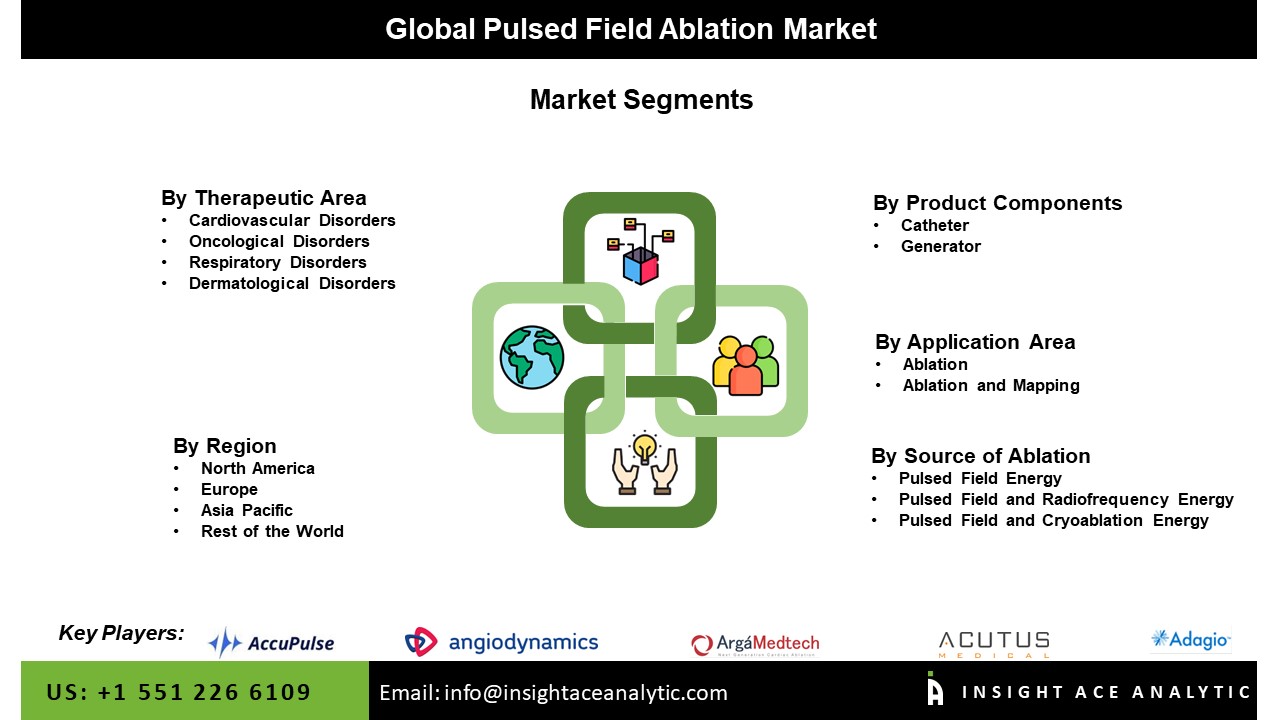
Pulsed Field Ablation Market By Product Components
- Catheter
- Generator
Pulsed Field Ablation Market By Application Area
- Ablation
- Ablation and Mapping
Pulsed Field Ablation Market By Source of Ablation
- Pulsed Field Energy
- Pulsed Field and Radiofrequency Energy
- Pulsed Field and Cryoablation Energy
Pulsed Field Ablation Market By Region-
North America-
- The US
- Canada
Europe-
- Germany
- The UK
- France
- Italy
- Spain
- Rest of Europe
Asia-Pacific-
- China
- Japan
- India
- South Korea
- South East Asia
- Rest of Asia Pacific
Latin America-
- Brazil
- Mexico
- Argentina
- Rest of Latin America
Middle East & Africa-
- GCC Countries
- South Africa
- Rest of Middle East and Africa
Research Design and Approach
This study employed a multi-step, mixed-method research approach that integrates:
- Secondary research
- Primary research
- Data triangulation
- Hybrid top-down and bottom-up modelling
- Forecasting and scenario analysis
This approach ensures a balanced and validated understanding of both macro- and micro-level market factors influencing the market.
Secondary Research
Secondary research for this study involved the collection, review, and analysis of publicly available and paid data sources to build the initial fact base, understand historical market behaviour, identify data gaps, and refine the hypotheses for primary research.
Sources Consulted
Secondary data for the market study was gathered from multiple credible sources, including:
- Government databases, regulatory bodies, and public institutions
- International organizations (WHO, OECD, IMF, World Bank, etc.)
- Commercial and paid databases
- Industry associations, trade publications, and technical journals
- Company annual reports, investor presentations, press releases, and SEC filings
- Academic research papers, patents, and scientific literature
- Previous market research publications and syndicated reports
These sources were used to compile historical data, market volumes/prices, industry trends, technological developments, and competitive insights.

Primary Research
Primary research was conducted to validate secondary data, understand real-time market dynamics, capture price points and adoption trends, and verify the assumptions used in the market modelling.
Stakeholders Interviewed
Primary interviews for this study involved:
- Manufacturers and suppliers in the market value chain
- Distributors, channel partners, and integrators
- End-users / customers (e.g., hospitals, labs, enterprises, consumers, etc., depending on the market)
- Industry experts, technology specialists, consultants, and regulatory professionals
- Senior executives (CEOs, CTOs, VPs, Directors) and product managers
Interview Process
Interviews were conducted via:
- Structured and semi-structured questionnaires
- Telephonic and video interactions
- Email correspondences
- Expert consultation sessions
Primary insights were incorporated into demand modelling, pricing analysis, technology evaluation, and market share estimation.
Data Processing, Normalization, and Validation
All collected data were processed and normalized to ensure consistency and comparability across regions and time frames.
The data validation process included:
- Standardization of units (currency conversions, volume units, inflation adjustments)
- Cross-verification of data points across multiple secondary sources
- Normalization of inconsistent datasets
- Identification and resolution of data gaps
- Outlier detection and removal through algorithmic and manual checks
- Plausibility and coherence checks across segments and geographies
This ensured that the dataset used for modelling was clean, robust, and reliable.
Market Size Estimation and Data Triangulation
Bottom-Up Approach
The bottom-up approach involved aggregating segment-level data, such as:
- Company revenues
- Product-level sales
- Installed base/usage volumes
- Adoption and penetration rates
- Pricing analysis
This method was primarily used when detailed micro-level market data were available.

Top-Down Approach
The top-down approach used macro-level indicators:
- Parent market benchmarks
- Global/regional industry trends
- Economic indicators (GDP, demographics, spending patterns)
- Penetration and usage ratios
This approach was used for segments where granular data were limited or inconsistent.
Hybrid Triangulation Approach
To ensure accuracy, a triangulated hybrid model was used. This included:
- Reconciling top-down and bottom-up estimates
- Cross-checking revenues, volumes, and pricing assumptions
- Incorporating expert insights to validate segment splits and adoption rates
This multi-angle validation yielded the final market size.
Forecasting Framework and Scenario Modelling
Market forecasts were developed using a combination of time-series modelling, adoption curve analysis, and driver-based forecasting tools.
Forecasting Methods
- Time-series modelling
- S-curve and diffusion models (for emerging technologies)
- Driver-based forecasting (GDP, disposable income, adoption rates, regulatory changes)
- Price elasticity models
- Market maturity and lifecycle-based projections
Scenario Analysis
Given inherent uncertainties, three scenarios were constructed:
- Base-Case Scenario: Expected trajectory under current conditions
- Optimistic Scenario: High adoption, favourable regulation, strong economic tailwinds
- Conservative Scenario: Slow adoption, regulatory delays, economic constraints
Sensitivity testing was conducted on key variables, including pricing, demand elasticity, and regional adoption.
Request Customization
Add countries, segments, company profiles, or extend forecast — free 10% customization with purchase.
Customize This Report →Enquire Before Buying
Speak with our analyst team about scope, methodology, pricing, or deliverable formats.
Enquire Now →Frequently Asked Questions
Pulsed Field Ablation Market Size is valued at USD 185.6 Mn in 2024 and is predicted to reach USD 3980.4 Mn by the year 2034
Mirai Medical, Pulse Biosciences and Tianjin Intelligent Health Medica, ElectroPhysiology Frontiers, EnChannel Medical.
Global Pulsed Field Ablation Market is expected to grow at a 36.0% CAGR during the forecast period for 2025-2034.
North America region is leading the Pulsed Field Ablation Market.
Therapeutic Area, Product Components, Application Areas and Source of Ablation are the key segments of the Pulsed Field Ablation Market.