AI Video Analytics for Smart Cities Market Size, Share, Trend, Forecast Report 2026 to 2035
What is AI Video Analytics for Smart Cities Market Size?
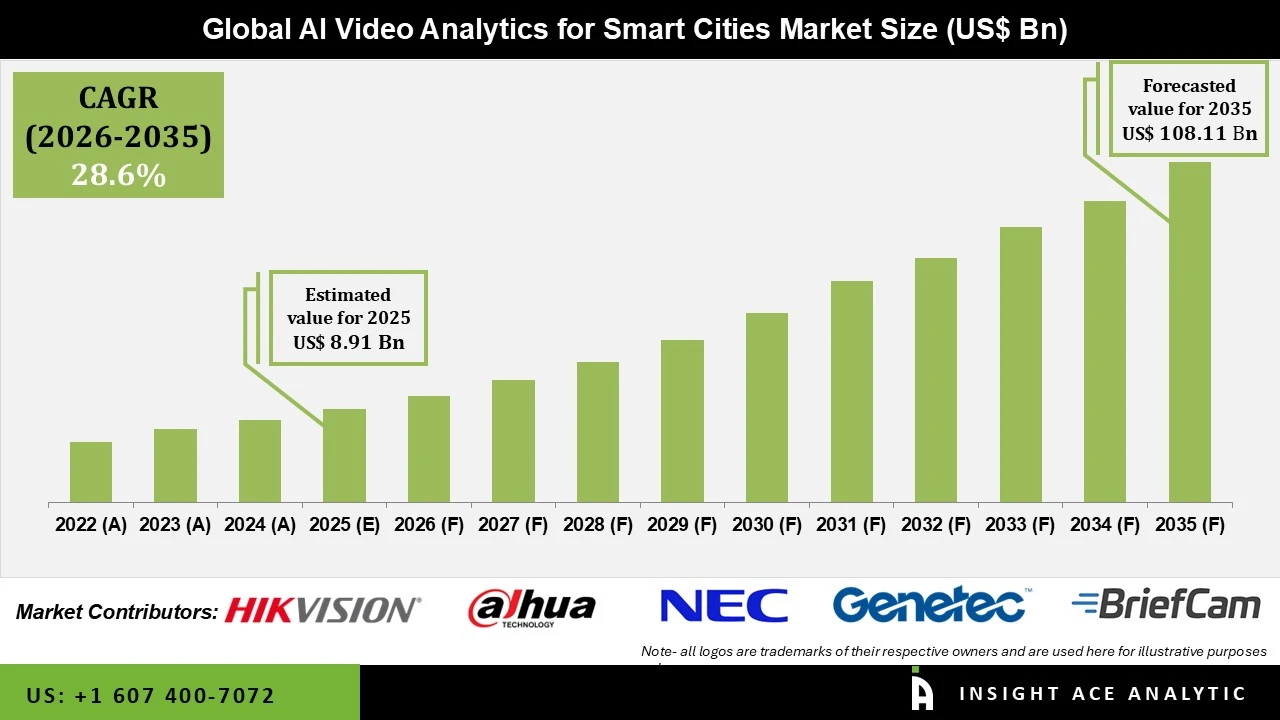
AI Video Analytics for Smart Cities Market Size is valued at USD 8.91 Bn in 2025 and is predicted to reach USD 108.11 Bn by the year 2035 at a 28.6% CAGR during the forecast period for 2026 to 2035.
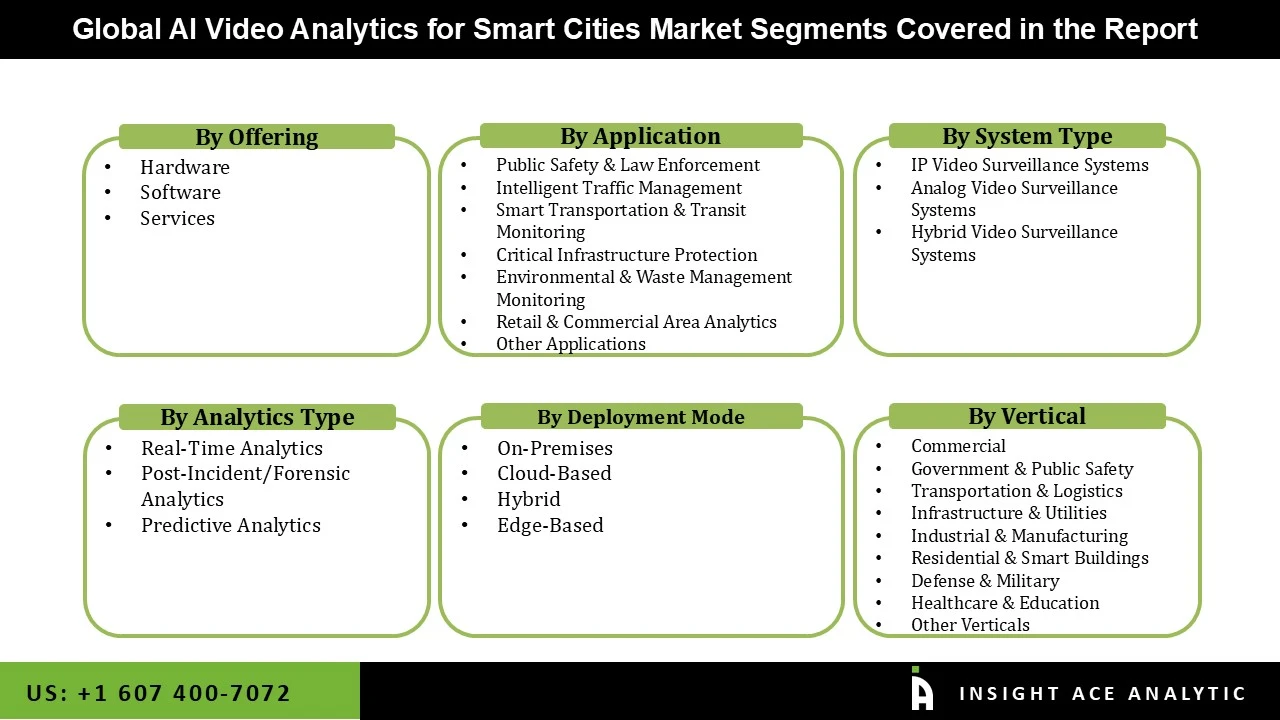
AI Video Analytics for Smart Cities Market Size, Share & Trends Analysis By Offering (Hardware, Software, and Services), Application (Public Safety & Law Enforcement, Intelligent Traffic Management, Smart Transportation & Transit Monitoring, Critical Infrastructure Protection, Environmental & Waste Management Monitoring, Retail & Commercial Area Analytics, and Other Applications), System Type (IP Video Surveillance Systems, Analog Video Surveillance Systems, and Hybrid Video Surveillance Systems), Analytics Type (Real-time Analytics, Post-Incident/Forensic Analytics, and Predictive Analytics), Deployment Mode (On-Premises, Cloud-Based, Hybrid, and Edge-Based), Vertical (Commercial, Governement & Public Safety, Transportation & Logistics, Infrastructure & Utilities, Industrial & Manufacturing, Residential & Smart Buildings, Defense & Military, Healthcare & Education, and Other Verticals), and Segment Forecasts, 2026 to 2035
AI video analytics for smart cities refers to using artificial intelligence methods to automatically analyze video feeds from surveillance cameras and connected devices. In this context, computer vision, deep learning, and machine learning algorithms help detect objects, track movements, identify anomalies, and perform facial recognition. This solution gives authorities the chance to improve public safety, optimize traffic flow, monitor public infrastructure, and respond to emergencies with minimal human help. The rapid growth of smart surveillance systems and connected urban infrastructure has increased the demand for AI-based video analytics in both developed and emerging countries.
Urbanization and the growing need for smart city management have significantly impacted the AI video analytics market for smart cities. Governments around the world are making substantial efforts to build their digital infrastructure, command centers, and smart transportation systems to enhance efficiency and services. AI video analytics has become crucial in these initiatives, enabling authorities to monitor multiple locations at once and lessen their reliance on manual surveillance. More surveillance cameras are being installed at transportation hubs, public places, airports, train stations, government buildings, and businesses.
The rising use of IoT-enabled devices and improved communication infrastructure is also boosting the market. Video analytics technology can integrate with various devices, such as sensors, traffic management systems, environmental monitoring systems, and emergency communication networks, to provide a unified platform for city management. 5G networks help improve video analytics systems by allowing better transmission of high-resolution video streams with low latency. This technology encourages cities to adopt AI-based surveillance and monitoring solutions.
Competitive Landscape
Which are the Leading Players in AI Video Analytics for Smart Cities Market?
• Motorola Solutions
• Cisco Systems
• Huawei Technologies
• Axis Communications
• Bosch Security Systems
• Hanwha Vision
• Hikvision
• Dahua Technology
• NVIDIA Corporation
• IBM Corporation
• NEC Corporation
• Genetec Inc.
• Avigilon Corporation
• BriefCam
• Milestone Systems
• Verint Systems
• IntelliVision Technologies
• VIVOTEK Inc.
• Qualcomm Technologies
• Honeywell International
• Teledyne FLIR
• Senstar Technologies
• Eagle Eye Networks
• Irisity AB
• AnyVision
• iOmniscient
• AxxonSoft
• Infinova
• Digital Barriers
• AllGoVision Technologies
Market Dynamics
Driver
Growing Investments in Smart City Infrastructure
Growing investments in smart city projects around the world are driving the rise of the AI video analytics market for these cities. Governments in various countries are spending a lot on developing intelligent transportation systems, public surveillance networks, digital governance frameworks, and connected public services. AI video analytics assists city managers in gathering real-time information and making decisions through monitoring and automation. Modern smart cities require constant surveillance of their roads, intersections, metro stations, airports, public parks, and government buildings. Traditional surveillance systems often need a lot of manual work, which can lead to inefficiency and slower response times during emergencies. AI video analytics provides a solution by detecting unusual activities in real time, recognizing objects, analyzing traffic, and sending out alerts.
Restrain/Challenge
High Implementation Costs and Data Privacy Concerns
Though the use of AI-based surveillance systems is growing, there are challenges in implementing them. Setting up a system that uses AI video analytics requires a significant investment. This includes purchasing high-resolution cameras, building data storage infrastructure, and acquiring hardware like network equipment, GPUs, cloud computing services, and AI software. Additionally, installing these systems in existing city infrastructure can be complex and costly. Another major challenge is data privacy and security. AI-based video analysis systems collect and process large amounts of video data, including images of faces and vehicles. As a result, government agencies are creating stricter laws regarding the collection, storage, and transfer of private data.
Public Safety & Surveillance Segment is Expected to Drive the AI Video Analytics for Smart Cities Market
The public safety and surveillance segment dominated the market share in 2025, with the deployment of intelligent surveillance technology systems in urban areas. With the installation of intelligent cameras with AI technology at airports, railway stations, government buildings, open spaces, schools and colleges and business districts, better security infrastructure is being ensured. AI Video Analytics helps to auto detect any security threat like abnormal behavior, unattended objects, access control, violent acts and any other security threat without any manual monitoring. Law enforcement agencies are increasingly conducting criminal investigation and emergency response with the use of AI technology. AI real-time alerts make the process easier and faster for authorities while keeping the situational awareness of the incident. The AI video analytics integrated with emergency response system makes the process simple; safety emerges as the most important application area in the market.
Computer Vision Segment is Growing at the Highest Rate in the AI Video Analytics for Smart Cities Market
The computer vision market is expected to grow at the highest rate during the forecast period. The AI systems can understand the visual inputs of surveillance cameras through computer vision technologies and convert it into useful data. Modern image recognition software can help identifying pedestrians, cars, traffic signs, infrastructures and crowd movements at any moment. Continuous improvements in deep learning algorithms have helped the object detection and event recognition systems to be much more accurate even under different environmental conditions. The computer vision can assist intelligent traffic management, optimize parking spaces, crowd tracking, infrastructure inspection and predictive maintenance. As autonomous monitoring and edge AI solutions are being adopted in urban areas, the demand for computer vision analytics will also increase.
Why North America Led the AI Video Analytics for Smart Cities Market?
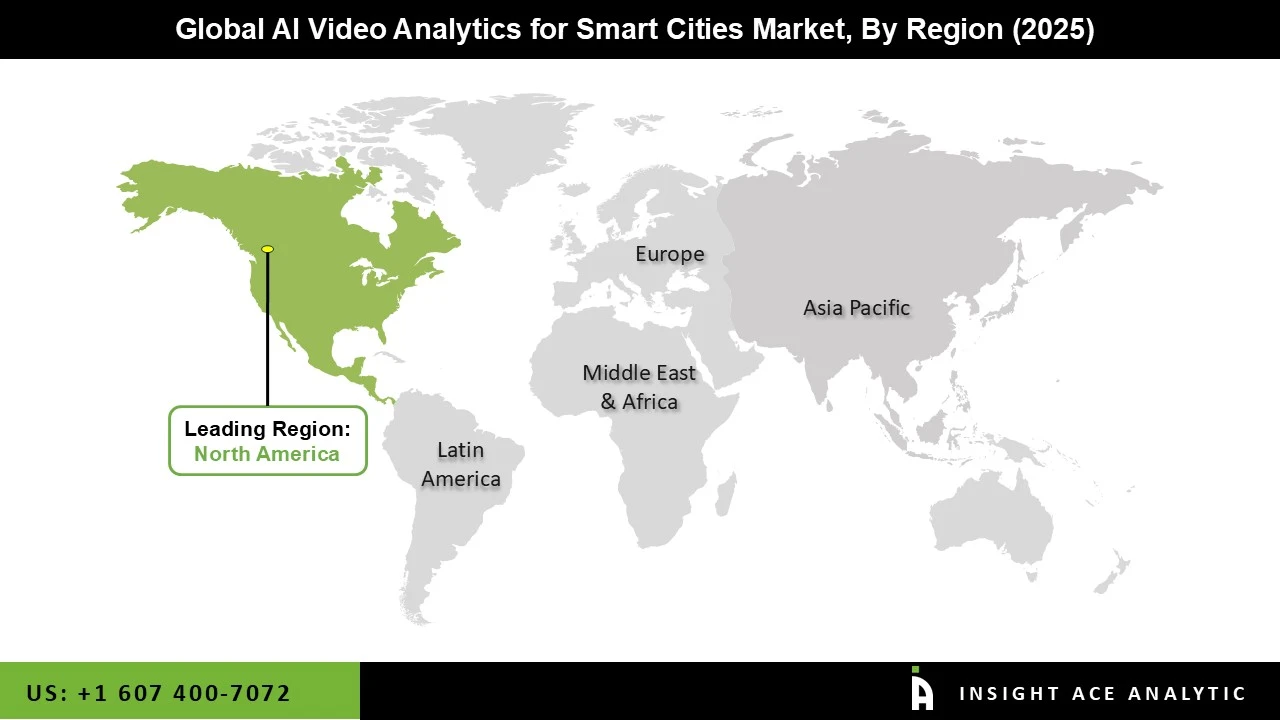
In 2025, North America led the market for AI video analytics in smart cities, thanks to its sophisticated digital infrastructure, widespread adoption of AI technologies, and strong government backing for smart city initiatives. AI-based surveillance and analytics platforms are being constantly updated for transportation system, public safety infrastructure and municipal services in the U.S. and Canada.
Leading IT vendors, AI software companies, cloud service providers and semiconductor firms in the region spur innovations. Organizations have extensively adopted edge computing solutions, intelligent surveillance cameras, cloud analytics, and command centers to enhance their efficiency.
Key Development
• In November 2025, Motorola Solutions acquired Blue Eye, a provider of AI-powered remote video monitoring services. The acquisition strengthens Motorola Solutions’ video security portfolio by adding real-time threat detection, verified alerts, live voice talk-down, and security operations center-supported monitoring capabilities.
AI Video Analytics for Smart Cities Market Report Scope:
| Report Attribute | Specifications |
| Market size value in 2025 | USD 8.91 Bn |
| Revenue forecast in 2035 | USD 28.6 Bn |
| Growth Rate CAGR | CAGR of 28.6% from 2026 to 2035 |
| Quantitative Units | Representation of revenue in US$ Bn and CAGR from 2026 to 2035 |
| Historic Year | 2022 to 2025 |
| Forecast Year | 2026-2035 |
| Report Coverage | The forecast of revenue, the position of the company, the competitive market structure, growth prospects, and trends |
| Segments Covered | Offering, Application, System Type, Analytics Type, Deployment Mode, Vertical, and By Region |
| Regional Scope | North America; Europe; Asia Pacific; Latin America; Middle East & Africa |
| Country Scope | U.S.; Canada; U.K.; Germany; China; India; Japan; Brazil; Mexico; The UK; France; Italy; Spain; China; Japan; India; South Korea; Southeast Asia; South Korea; Southeast Asia |
| Competitive Landscape | Motorola Solutions, Cisco Systems, Huawei Technologies, Axis Communications, Bosch Security Systems, Hanwha Vision, Hikvision, Dahua Technology, NVIDIA Corporation, IBM Corporation, NEC Corporation, Genetec Inc., Avigilon Corporation, BriefCam, Milestone Systems, Verint Systems, IntelliVision Technologies, VIVOTEK Inc., Qualcomm Technologies, Honeywell International, Teledyne FLIR, Senstar Technologies, Eagle Eye Networks, Irisity AB, AnyVision, iOmniscient, AxxonSoft, Infinova, Digital Barriers, and AllGoVision Technologies. |
| Customization Scope | Free customization report with the procurement of the report, Modifications to the regional and segment scope. Geographic competitive landscape. |
| Pricing and Available Payment Methods | Explore pricing alternatives that are customized to your particular study requirements. |
Market Segmentation:
AI Video Analytics for Smart Cities Market by Offering-
• Hardware
• Software
• Services
AI Video Analytics for Smart Cities Market by Application -
• Public Safety & Law Enforcement
• Intelligent Traffic Management
• Smart Transportation & Transit Monitoring
• Critical Infrastructure Protection
• Environmental & Waste Management Monitoring
• Retail & Commercial Area Analytics
• Other Applications
AI Video Analytics for Smart Cities Market by System Type-
• IP Video Surveillance Systems
• Analog Video Surveillance Systems
• Hybrid Video Surveillance Systems
AI Video Analytics for Smart Cities Market by Analytics Type-
• Real-time Analytics
• Post-Incident/Forensic Analytics
• Predictive Analytics
AI Video Analytics for Smart Cities Market by Deployment Mode-
• On-Premises
• Cloud-Based
• Hybrid
• Edge-Based
AI Video Analytics for Smart Cities Market by Verticals-
• Commercial, Governement & Public Safety
• Transportation & Logistics
• Infrastructure & Utilities
• Industrial & Manufacturing
• Residential & Smart Buildings
• Defense & Military
• Healthcare & Education
• Other Verticals
Research Design and Approach
This study employed a multi-step, mixed-method research approach that integrates:
- Secondary research
- Primary research
- Data triangulation
- Hybrid top-down and bottom-up modelling
- Forecasting and scenario analysis
This approach ensures a balanced and validated understanding of both macro- and micro-level market factors influencing the market.
Secondary Research
Secondary research for this study involved the collection, review, and analysis of publicly available and paid data sources to build the initial fact base, understand historical market behaviour, identify data gaps, and refine the hypotheses for primary research.
Sources Consulted
Secondary data for the market study was gathered from multiple credible sources, including:
- Government databases, regulatory bodies, and public institutions
- International organizations (WHO, OECD, IMF, World Bank, etc.)
- Commercial and paid databases
- Industry associations, trade publications, and technical journals
- Company annual reports, investor presentations, press releases, and SEC filings
- Academic research papers, patents, and scientific literature
- Previous market research publications and syndicated reports
These sources were used to compile historical data, market volumes/prices, industry trends, technological developments, and competitive insights.

Primary Research
Primary research was conducted to validate secondary data, understand real-time market dynamics, capture price points and adoption trends, and verify the assumptions used in the market modelling.
Stakeholders Interviewed
Primary interviews for this study involved:
- Manufacturers and suppliers in the market value chain
- Distributors, channel partners, and integrators
- End-users / customers (e.g., hospitals, labs, enterprises, consumers, etc., depending on the market)
- Industry experts, technology specialists, consultants, and regulatory professionals
- Senior executives (CEOs, CTOs, VPs, Directors) and product managers
Interview Process
Interviews were conducted via:
- Structured and semi-structured questionnaires
- Telephonic and video interactions
- Email correspondences
- Expert consultation sessions
Primary insights were incorporated into demand modelling, pricing analysis, technology evaluation, and market share estimation.
Data Processing, Normalization, and Validation
All collected data were processed and normalized to ensure consistency and comparability across regions and time frames.
The data validation process included:
- Standardization of units (currency conversions, volume units, inflation adjustments)
- Cross-verification of data points across multiple secondary sources
- Normalization of inconsistent datasets
- Identification and resolution of data gaps
- Outlier detection and removal through algorithmic and manual checks
- Plausibility and coherence checks across segments and geographies
This ensured that the dataset used for modelling was clean, robust, and reliable.
Market Size Estimation and Data Triangulation
Bottom-Up Approach
The bottom-up approach involved aggregating segment-level data, such as:
- Company revenues
- Product-level sales
- Installed base/usage volumes
- Adoption and penetration rates
- Pricing analysis
This method was primarily used when detailed micro-level market data were available.

Top-Down Approach
The top-down approach used macro-level indicators:
- Parent market benchmarks
- Global/regional industry trends
- Economic indicators (GDP, demographics, spending patterns)
- Penetration and usage ratios
This approach was used for segments where granular data were limited or inconsistent.
Hybrid Triangulation Approach
To ensure accuracy, a triangulated hybrid model was used. This included:
- Reconciling top-down and bottom-up estimates
- Cross-checking revenues, volumes, and pricing assumptions
- Incorporating expert insights to validate segment splits and adoption rates
This multi-angle validation yielded the final market size.
Forecasting Framework and Scenario Modelling
Market forecasts were developed using a combination of time-series modelling, adoption curve analysis, and driver-based forecasting tools.
Forecasting Methods
- Time-series modelling
- S-curve and diffusion models (for emerging technologies)
- Driver-based forecasting (GDP, disposable income, adoption rates, regulatory changes)
- Price elasticity models
- Market maturity and lifecycle-based projections
Scenario Analysis
Given inherent uncertainties, three scenarios were constructed:
- Base-Case Scenario: Expected trajectory under current conditions
- Optimistic Scenario: High adoption, favourable regulation, strong economic tailwinds
- Conservative Scenario: Slow adoption, regulatory delays, economic constraints
Sensitivity testing was conducted on key variables, including pricing, demand elasticity, and regional adoption.
Request Customization
Add countries, segments, company profiles, or extend forecast — free 10% customization with purchase.
Customize This Report →Enquire Before Buying
Speak with our analyst team about scope, methodology, pricing, or deliverable formats.
Enquire Now →Frequently Asked Questions
AI Video Analytics for Smart Cities Market Size is valued at USD 8.91 Bn in 2025 and is predicted to reach USD 108.11 Bn by the year 2035
AI Video Analytics for Smart Cities Market is expected to grow at a 28.6% CAGR during the forecast period for 2026 to 2035.
Motorola Solutions, Cisco Systems, Huawei Technologies, Axis Communications, Bosch Security Systems, Hanwha Vision, Hikvision, Dahua Technology, NVIDIA Corporation, IBM Corporation, NEC Corporation, Genetec Inc., Avigilon Corporation, BriefCam, Milestone Systems, Verint Systems, IntelliVision Technologies, VIVOTEK Inc., Qualcomm Technologies, Honeywell International, Teledyne FLIR, Senstar Technologies, Eagle Eye Networks, Irisity AB, AnyVision, iOmniscient, AxxonSoft, Infinova, Digital Barriers, and AllGoVision Technologies.
AI Video Analytics for Smart Cities Market is segmented into Offering, Application, System Type, Analytics Type, Deployment Mode, Vertical, and By Region
North America region is leading the AI Video Analytics for Smart Cities Market.