Pollution Free Construction Market Size, Share, Forecast Report 2026 to 2035
What is Pollution Free Construction Market Size?
Pollution Free Construction Market Size is valued at USD 383.65 Bn in 2025 and is predicted to reach USD 1,245.43 Bn by the year 2035 at a 13.0% CAGR during the forecast period for 2026 to 2035.
Pollution Free Construction Market Size, Share & Trends Analysis Distribution By Construction Type (Residential, Commercial, Industrial, Infrastructure); By Material Type (Low-carbon Cement & Concrete, Recycled Materials, Sustainable Wood & Bamboo, Green Insulation Materials, Low-VOC Paints & Coatings); By Technology (Prefabrication / Modular construction, 3D Printing Construction, Green Building Design, Smart Construction Technologies); By Energy & Resource Systems (Renewable Energy Systems, Water Management Systems, Energy-efficient Systems); By Certification (LEED, BREEAM, IGBC, Net-Zero Buildings, Passive House), and Segment Forecasts, 2026 to 2035
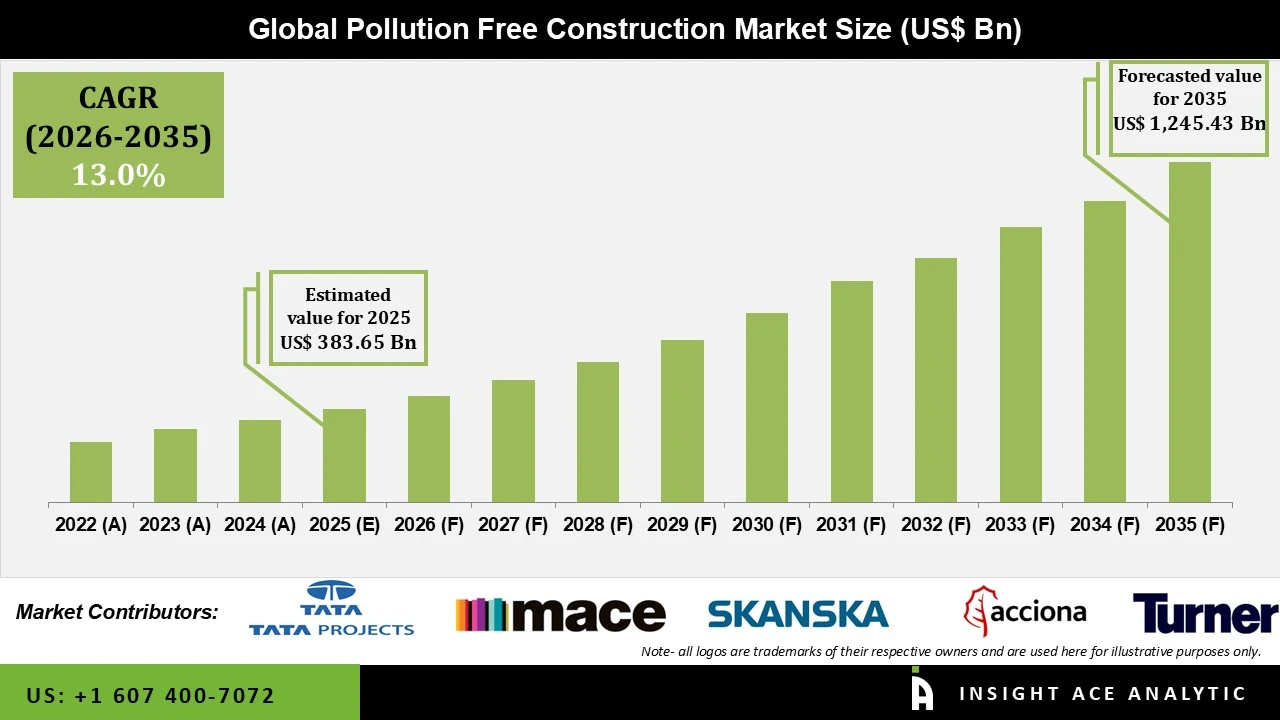
Pollution-free construction refers to building construction along with the associated technologies that reduces environmental impacts during construction. The term focuses on the importance of minimizing emissions of greenhouse gases, minimizing construction wastes, preserving natural resources, promoting energy efficiency, and preventing pollution from construction-related activities. Due to governments and industries are majorly prioritizing sustainable development, the pollution free construction has become an important factor of modern infrastructure.
The construction industry faces pressure to reduce its carbon footprint owing to rising urbanization and infrastructural development. Moreover, traditional construction processes lead to increased emissions of greenhouse gases, resource utilization, and creation of construction waste. Therefore, the construction industry is witnessing an increasing adoption of environmentally sound construction practices in line with sustainability principles.
Increasing investment in green infrastructure projects will contribute to the expansion of the global pollution-free construction market in the coming years. Increasing use of ESGs and energy-efficient buildings will further promote environmentally friendly construction processes. Stringent government policies and standards regarding pollution and green buildings will contribute to the growth of the market. Moreover, Innovation in sustainable building materials, digital construction techniques, and prefabrication processes is aiding the construction industry in becoming more efficient and environmentally friendly. In addition, the shift towards the development of net-zero buildings and the concept of circularity is opening up new possibilities within the construction sector.
Competitive Landscape
Which are the Leading Players in Pollution-Free Construction Market?
• Holcim Group
• Heidelberg Materials
• Saint-Gobain
• Cemex
• CRH plc
• Skanska AB
• VINCI Construction
• Bouygues Construction
• Lendlease Group
• Turner Construction
• Balfour Beatty
• Bechtel Corporation
• Fluor Corporation
• Arup Group
• Tata Projects
• Kingspan Group
• Obayashi Corporation
• Shimizu Corporation
• Kiewit Corporation
• Lafarge Canada
Market Dynamics
Driver
Growth in the investments in Sustainable Infrastructure Development
The increasing focus on sustainable urban development will help boost the pollution-free construction market throughout the forecast period. There has been a significant increase in investments by governments across the globe towards green infrastructure, climate-resilient cities, and efficient public utilities in meeting their environmental goals. With more companies and organizations getting certifications from green buildings like LEED and BREEAM, there has been an increase in sustainable construction practices in terms of material selection and use of low-emission methods during construction. More companies adopting ESG goals for sustainable development have been making it necessary for investors to focus on environmentally sustainable constructions.
Restrain/Challenge
High Initial Cost of Sustainable Construction Solutions
One of the greatest challenges of pollution-free construction is the higher investment that is needed when using environmentally friendly materials and green technology. For instance, the use of environmentally friendly materials, low carbon emission cement, energy systems that incorporate renewable energy sources, and advanced waste treatment technology will always need more money than the conventional methods. The high upfront cost involved will be a discouraging factor, especially for construction companies that are small and medium-sized and are financially constrained. Besides, scarcity of the environmentally friendly materials in some parts of the world, lack of professionals, and the absence of standard regulations will pose further challenges in implementing the environmentally friendly approach.
Commercial Construction Segment is Expected to Drive the Pollution-Free Construction Market
Commercial construction emerged as a major part of the pollution-free construction industry in 2025. The growing need for sustainable offices, shopping centers, hospitals, educational facilities, and mixed-use developments has contributed towards the growth of this segment. Institutions are focusing on building green structures that offer cost savings and enhance energy efficiency. This is because green buildings have become an essential requirement in the current environment where businesses are committed to sustainability.
Green Concrete Segment is Growing at the Highest Rate in the Pollution-Free Construction Market
Green concrete is expected to have a considerable share of the future market due to various reasons. The manufacture of green concrete employs recycled waste products, by-products of industries, and low-carbon processes that are environmentally friendly when compared to ordinary concrete. Awareness about carbon emissions produced by cement plants and stringent environmental regulations is contributing to the use of low-carbon options among builders. Apart from that, constant research in material science is enhancing the performance of green concrete as well.
Why North America Led the Pollution-Free Construction Market?
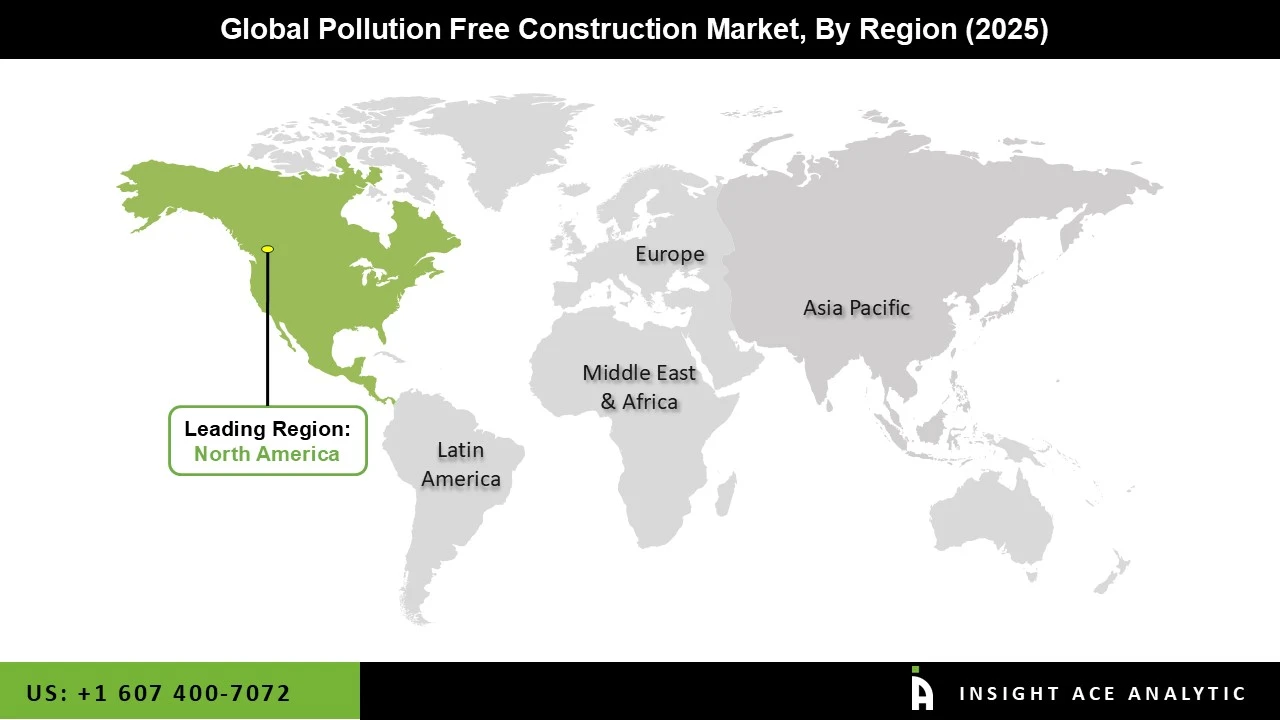
The North American region accounted for the largest share of the market for pollution-free construction in 2025 owing to strict environmental policies, sophisticated construction technology, and high prevalence of eco-friendly construction techniques. This can be attributed to the existence of government policies that favor energy-efficient construction, increased investments in sustainable construction infrastructure development, and also the presence of key players from construction companies to technology providers in the market.
Key Development
February 2026: The Pune Municipal Corporation (PMC) has launched a Clean Air Portal to monitor PM10 and PM2.5 levels at construction sites over 5,000 square meters using real-time sensors. This initiative aims to increase transparency and enforce pollution standards, with violators facing stop-work notices or fines.
December 2025: The Assam Pollution Control Board (APCB) and iFOREST launched the "Guwahati Clean Air Plan" to tackle the city's worsening air quality. This scientific, hotspot-based roadmap focuses on reducing PM10 emissions, particularly from road dust and construction, and implements a "three-strike" enforcement rule.
September 2024: ANGIRUS IND PVT LTD developed WRICKS, bricks made 100% from recycled waste (plastic and industrial/ C&D waste), with patented tech, field trials, and laboratory validations.
December 2023: Yi Design introduced an innovative solution to combat urban flooding by developing the Permeable YiBrick, a porous brick made from recycled ceramic waste.
Pollution-Free Construction Market Report Scope:
| Report Attribute | Specifications |
| Market size value in 2025 | USD 383.65 Bn |
| Revenue forecast in 2035 | USD 1,245.43 Bn |
| Growth Rate CAGR | CAGR of 13.0% from 2026 to 2035 |
| Quantitative Units | Representation of revenue in US$ Bn and CAGR from 2026 to 2035 |
| Historic Year | 2022 to 2025 |
| Forecast Year | 2026-2035 |
| Report Coverage | The forecast of revenue, the position of the company, the competitive market structure, growth prospects, and trends |
| Segments Covered | Construction Type, Material Type, Technology, Energy & Resource Systems, Certification, xand By Region |
| Regional Scope | North America; Europe; Asia Pacific; Latin America; Middle East & Africa |
| Country Scope | U.S.; Canada; U.K.; Germany; China; India; Japan; Brazil; Mexico; The UK; France; Italy; Spain; China; Japan; India; South Korea; Southeast Asia; South Korea; Southeast Asia |
| Competitive Landscape | Holcim Group, Heidelberg Materials, Saint-Gobain, Cemex, CRH plc, Skanska AB, VINCI Construction, Bouygues Construction, Lendlease Group, Turner Construction, Balfour Beatty, Bechtel Corporation, Fluor Corporation, Arup Group, Tata Projects, Kingspan Group, Obayashi Corporation, Shimizu Corporation, Kiewit Corporation, and Lafarge Canada. |
| Customization Scope | Free customization report with the procurement of the report, Modifications to the regional and segment scope. Geographic competitive landscape. |
| Pricing and Available Payment Methods | Explore pricing alternatives that are customized to your particular study requirements. |
Market Segmentation:
Pollution-Free Construction Market by Construction Type-
• Residential
• Commercial
• Industrial
• Infrastructure
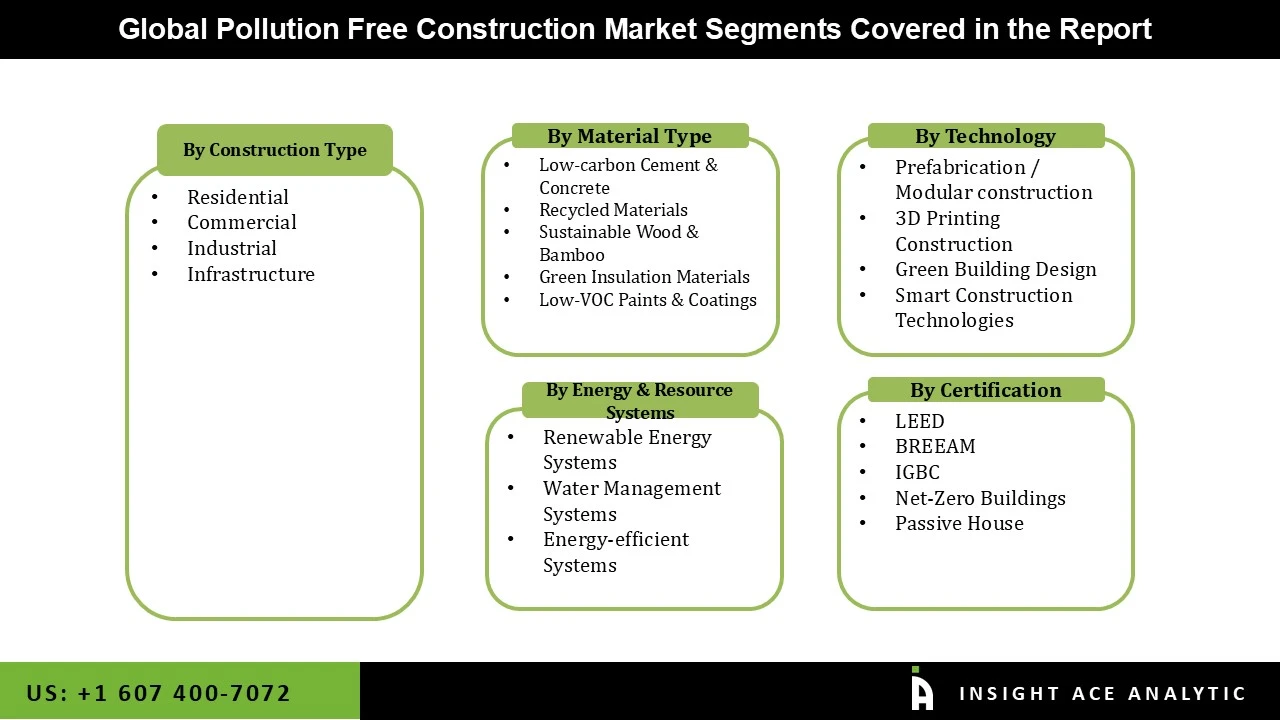
Pollution-Free Construction Market by Material Type-
• Low-carbon Cement & Concrete
• Recycled Materials
• Sustainable Wood & Bamboo
• Green Insulation Materials
• Low-VOC Paints & Coatings
Pollution-Free Construction Market by Technology-
• Prefabrication / Modular construction
• 3D Printing Construction
• Green Building Design
• Smart Construction Technologies
Pollution-Free Construction Market by Energy & Resource Systems-
• Renewable Energy Systems
• Water Management Systems
• Energy-efficient Systems
Pollution-Free Construction Market by Certification-
• LEED
• BREEAM
• IGBC
• Net-Zero Buildings
• Passive House
Research Design and Approach
This study employed a multi-step, mixed-method research approach that integrates:
- Secondary research
- Primary research
- Data triangulation
- Hybrid top-down and bottom-up modelling
- Forecasting and scenario analysis
This approach ensures a balanced and validated understanding of both macro- and micro-level market factors influencing the market.
Secondary Research
Secondary research for this study involved the collection, review, and analysis of publicly available and paid data sources to build the initial fact base, understand historical market behaviour, identify data gaps, and refine the hypotheses for primary research.
Sources Consulted
Secondary data for the market study was gathered from multiple credible sources, including:
- Government databases, regulatory bodies, and public institutions
- International organizations (WHO, OECD, IMF, World Bank, etc.)
- Commercial and paid databases
- Industry associations, trade publications, and technical journals
- Company annual reports, investor presentations, press releases, and SEC filings
- Academic research papers, patents, and scientific literature
- Previous market research publications and syndicated reports
These sources were used to compile historical data, market volumes/prices, industry trends, technological developments, and competitive insights.
Primary Research
Primary research was conducted to validate secondary data, understand real-time market dynamics, capture price points and adoption trends, and verify the assumptions used in the market modelling.
Stakeholders Interviewed
Primary interviews for this study involved:
- Manufacturers and suppliers in the market value chain
- Distributors, channel partners, and integrators
- End-users / customers (e.g., hospitals, labs, enterprises, consumers, etc., depending on the market)
- Industry experts, technology specialists, consultants, and regulatory professionals
- Senior executives (CEOs, CTOs, VPs, Directors) and product managers
Interview Process
Interviews were conducted via:
- Structured and semi-structured questionnaires
- Telephonic and video interactions
- Email correspondences
- Expert consultation sessions
Primary insights were incorporated into demand modelling, pricing analysis, technology evaluation, and market share estimation.
Data Processing, Normalization, and Validation
All collected data were processed and normalized to ensure consistency and comparability across regions and time frames.
The data validation process included:
- Standardization of units (currency conversions, volume units, inflation adjustments)
- Cross-verification of data points across multiple secondary sources
- Normalization of inconsistent datasets
- Identification and resolution of data gaps
- Outlier detection and removal through algorithmic and manual checks
- Plausibility and coherence checks across segments and geographies
This ensured that the dataset used for modelling was clean, robust, and reliable.
Market Size Estimation and Data Triangulation
Bottom-Up Approach
The bottom-up approach involved aggregating segment-level data, such as:
- Company revenues
- Product-level sales
- Installed base/usage volumes
- Adoption and penetration rates
- Pricing analysis
This method was primarily used when detailed micro-level market data were available.
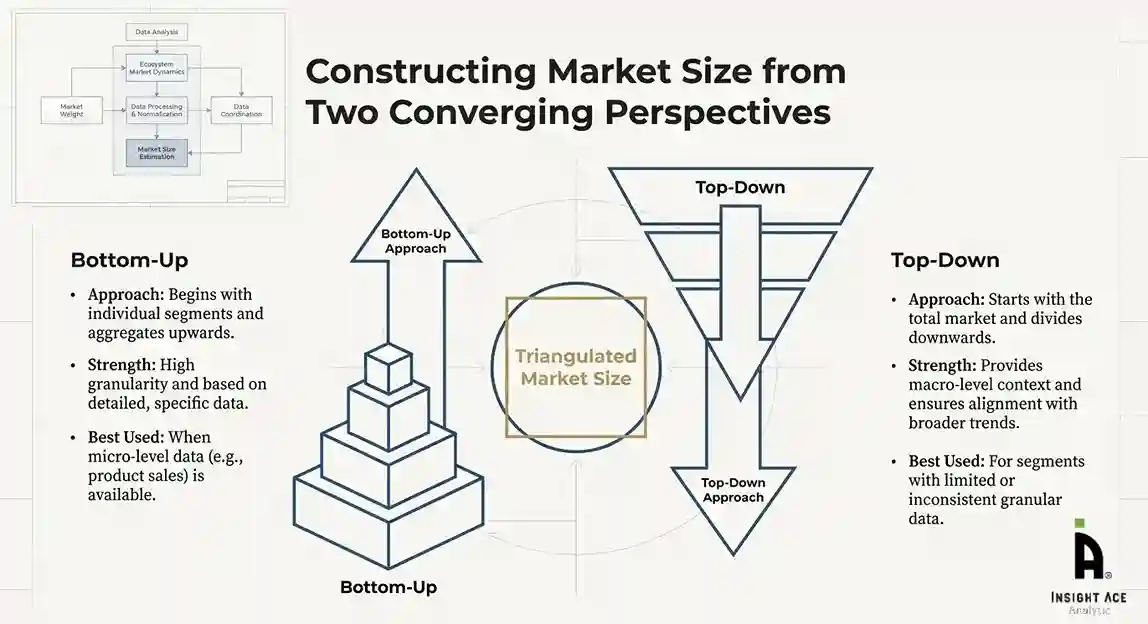
Top-Down Approach
The top-down approach used macro-level indicators:
- Parent market benchmarks
- Global/regional industry trends
- Economic indicators (GDP, demographics, spending patterns)
- Penetration and usage ratios
This approach was used for segments where granular data were limited or inconsistent.
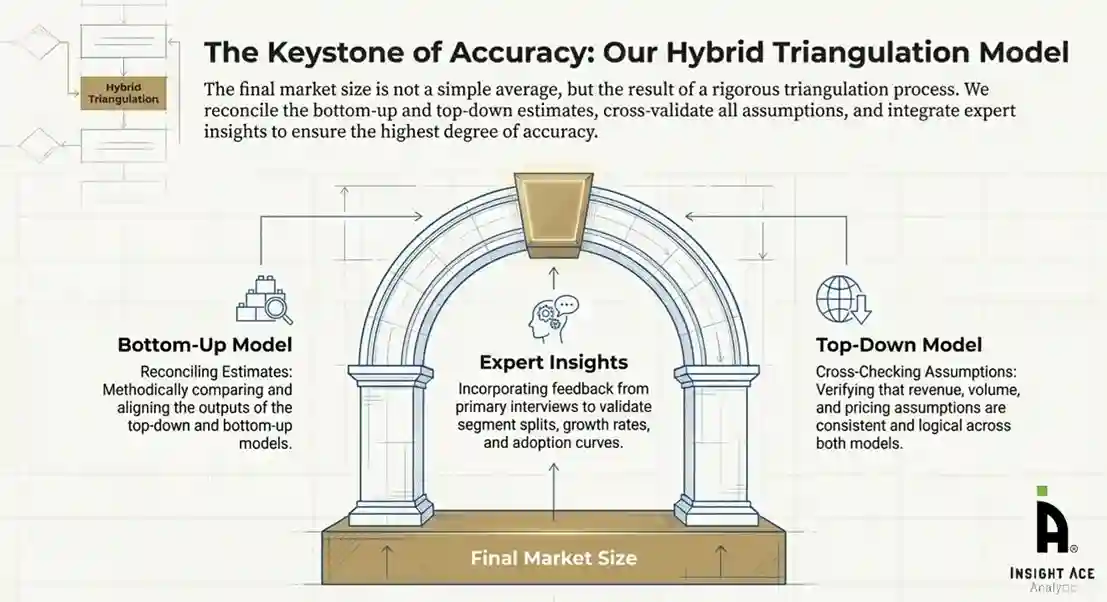
Hybrid Triangulation Approach
To ensure accuracy, a triangulated hybrid model was used. This included:
- Reconciling top-down and bottom-up estimates
- Cross-checking revenues, volumes, and pricing assumptions
- Incorporating expert insights to validate segment splits and adoption rates
This multi-angle validation yielded the final market size.
Forecasting Framework and Scenario Modelling
Market forecasts were developed using a combination of time-series modelling, adoption curve analysis, and driver-based forecasting tools.
Forecasting Methods
- Time-series modelling
- S-curve and diffusion models (for emerging technologies)
- Driver-based forecasting (GDP, disposable income, adoption rates, regulatory changes)
- Price elasticity models
- Market maturity and lifecycle-based projections
Scenario Analysis
Given inherent uncertainties, three scenarios were constructed:
- Base-Case Scenario: Expected trajectory under current conditions
- Optimistic Scenario: High adoption, favourable regulation, strong economic tailwinds
- Conservative Scenario: Slow adoption, regulatory delays, economic constraints
Sensitivity testing was conducted on key variables, including pricing, demand elasticity, and regional adoption.
Request Customization
Add countries, segments, company profiles, or extend forecast — free 10% customization with purchase.
Customize This Report →Enquire Before Buying
Speak with our analyst team about scope, methodology, pricing, or deliverable formats.
Enquire Now →Frequently Asked Questions
Pollution Free Construction Market Size is valued at USD 383.65 Bn in 2025 and is predicted to reach USD 1,245.43 Bn by the year 2035
Pollution Free Construction Market Size is predicted to grow at a 13.0% CAGR during the forecast period for 2026 to 2035.
Pollution Free Construction Market is segmented into Construction Type, Material Type, Technology, Energy & Resource Systems, Certification, and By Region
Holcim Group, Heidelberg Materials, Saint-Gobain, Cemex, CRH plc, Skanska AB, VINCI Construction, Bouygues Construction, Lendlease Group, Turner Construction, Balfour Beatty, Bechtel Corporation, Fluor Corporation, Arup Group, Tata Projects, Kingspan Group, Obayashi Corporation, Shimizu Corporation, Kiewit Corporation, and Lafarge Canada.
North America region is leading the Pollution Free Construction Market.