Fishing Boat Market Size, Revenue, Forecast Report 2026 to 2035
What is Fishing Boat Market Size?
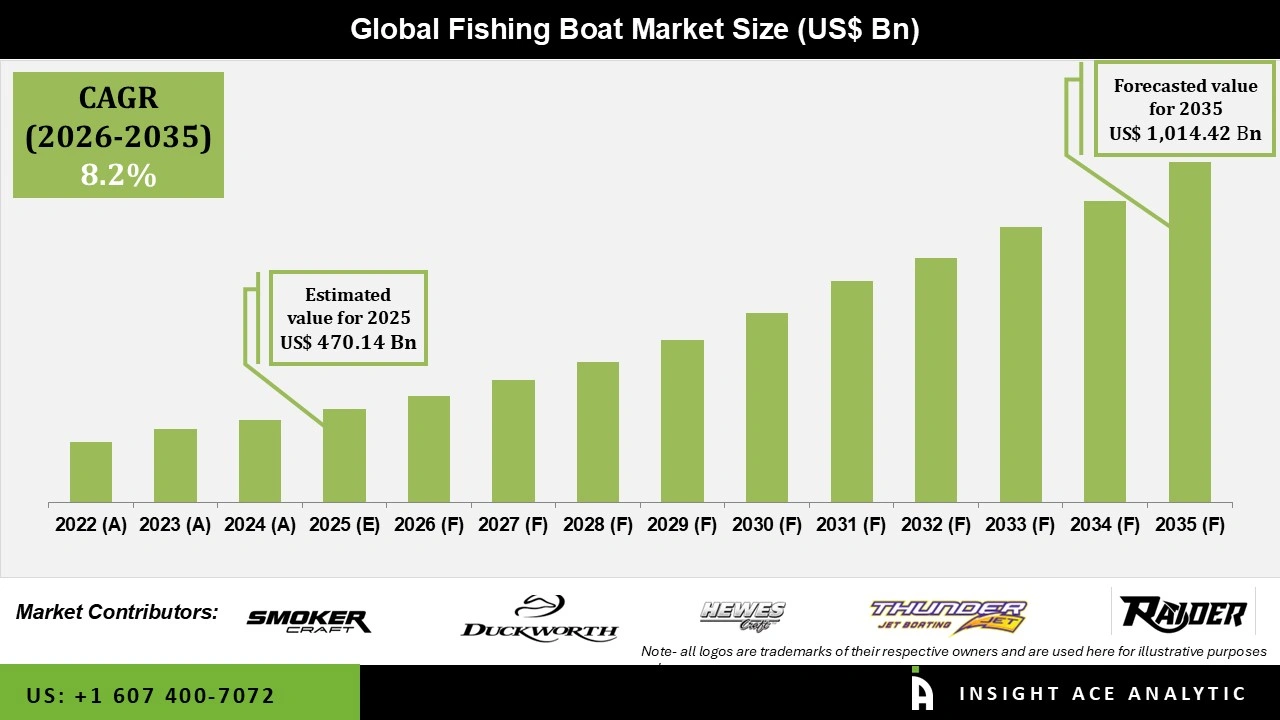
Global Fishing Boat Market Size is valued at USD 470.14 Bn in 2025 and is predicted to reach USD 1,014.42 Bn by the year 2035 at a 8.2% CAGR during the forecast period for 2026 to 2035.
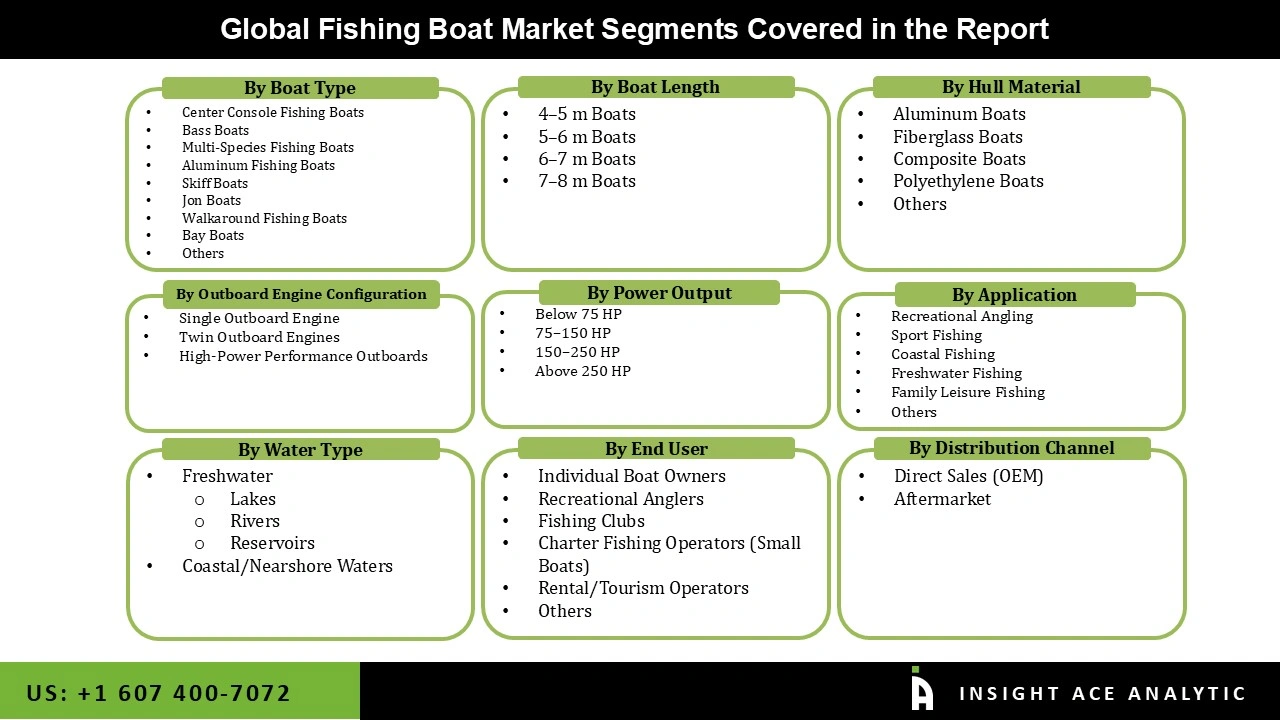
Fishing Boat Market Size, Share & Trends Analysis Distribution by Boat Type (Center Console Fishing Boats, Bass Boats, Multi-Species Fishing Boats, Aluminum Fishing Boats, Skiff Boats, Jon Boats, Walkaround Fishing Boats, Bay Boats, Flats Boats, Cuddy Cabin Boats, Ski-and-Fish Boats, Others), By Boat Length (4–5 m Boats, 5–6 m Boats, 6–7 m Boats, 7–8 m Boats), By Hull Material, By Outboard Engine Configuration, By Power Output, By Application, By Water Type, By End User, By Distribution Channel and Segment Forecasts, 2026 to 2035.
The recreational fishing boats market consists of boats made for leisure fishing in freshwater, coastal, and nearshore areas. These vessels are designed to provide a mix of fishing features, navigation performance, passenger comfort, and safety. The market includes various types of boats, such as center console boats, bass boats, bay boats, skiffs, jon boats, walkaround boats, flats boats, and aluminum fishing boats. Each type caters to different fishing methods, water conditions, and user choices. Modern recreational fishing boats use updated hull designs, lightweight materials, integrated electronics, GPS navigation, fish-finding tools, live wells, and efficient outboard engines to improve the boating and fishing experience.
The global recreational fishing boats market covers the making, distribution, and support system for fishing boats meant for personal use. This includes boat manufacturers, outboard engine suppliers, marine equipment providers, dealers, rental operators, and service providers. Market growth benefits from new product development, increasing premium and customized boat choices, more people participating in boating and fishing, and the use of smart marine technology. Additionally, rising investments in marine recreation facilities, growing demand for versatile boats, and more organized boating events continue to influence the competitive scene. Manufacturers are concentrating on performance, durability, fuel efficiency, and a better onboard user experience.
Competitive Landscape
Which are the Leading Players in the Fishing Boat Market?
- Smoker Craft Inc.
- Duckworth Boats
- Hewescraft Boats
- Thunder Jet Boats
- Wooldridge Boats
- Raider Boats
- KingFisher Boats
- Osprey Boats
- Silver Boats Ltd.
- Linder Aluminium Boats
- Bar Crusher Boats
- Makocraft
- Formosa Marine
- Seajay Boats
- Horizon Boats
- Stessco Boats
- Cruise Craft Boats
- Edencraft Boats
- Fish City Boats
- Platinum Plate Boats
Market Dynamics
Driver
Growing Participation in Recreational Fishing and Boating Activities
Recreational fishing has become one of the fastest-growing outdoor activities worldwide. This growth comes from a rising interest in nature-based recreation, wellness, and family experiences. Higher disposable incomes, more coastal and inland tourism, and easier access to lakes, rivers, and nearshore waters are prompting more people to buy dedicated fishing boats. Governments and fishing groups are also putting money into marinas, boat ramps, and recreational waterways, which makes boating more accessible. As more people take part in sport fishing tournaments and leisure angling, the demand for specialized fishing boats with better comfort, performance, advanced electronics, and flexible designs is rising. This makes participation in recreational fishing the main driver of market growth.
Restrain/Challenge
High Ownership and Maintenance Costs of Recreational Fishing Boats
The main challenge in the recreational fishing boats market is the high total cost of owning a boat. This cost goes well beyond the initial purchase price. Owners face ongoing expenses for fuel, insurance, registration, docking or storage, maintenance, repairs, engine servicing, and seasonal upkeep. Changes in raw material prices and marine equipment costs can add to these ownership expenses. These financial responsibilities can deter first-time buyers and restrict replacement purchases, especially for budget-conscious consumers. Consequently, even with rising interest in recreational fishing and boating, the high lifecycle cost of owning and maintaining a fishing boat continues to be a major obstacle to wider market acceptance.
Center Console Fishing Boats Segment is Expected to Drive the Fishing Boat Market
The center console fishing boats segment is the largest and main revenue source in the recreational fishing boats market due to its great versatility and wide consumer appeal. These boats are made for offshore, inshore, and nearshore fishing. Their 360-degree deck layout allows anglers to move freely. They work well with various outboard engine types, providing higher speed, better fuel efficiency, and improved maneuverability. Center console boats are not only popular among recreational anglers and sport fishing fans but are also widely used by charter operators and families for various recreational activities. Manufacturers keep adding features like GPS navigation, fish finders, live wells, rod holders, multifunction displays, and better seating, which helps maintain their market dominance.
5–6 m Boats Segment is Growing at the Highest Rate in the Fishing Boat Market
The 5 to 6 meter Boats segment is expected to see the highest growth rate due to its good balance of affordability, performance, and versatility. Boats in this size range can hold several passengers and necessary fishing gear while still being easy to tow, launch, and store compared to larger vessels. They are suitable for both freshwater and coastal fishing, which makes them popular with both new buyers and experienced anglers looking for versatile boats. Additionally, manufacturers are increasingly offering 5 to 6 meter models with new marine electronics, fuel-efficient outboard engines, improved seating, and customizable layouts. This broadens their appeal for recreational use, family leisure, and light charter purposes. Their lower operating and maintenance costs compared to larger boats also help drive quick adoption, making the 5 to 6 meter Boats segment the fastest-growing category in the market.
Why North America Led the Fishing Boat Market?
North America has the biggest share of the recreational fishing boats market because it has a strong boating culture, high participation in recreational fishing, and significant purchasing power. The area, especially the United States and Canada, features many lakes, rivers, reservoirs, and coastal waterways that allow for boating and fishing all year round.
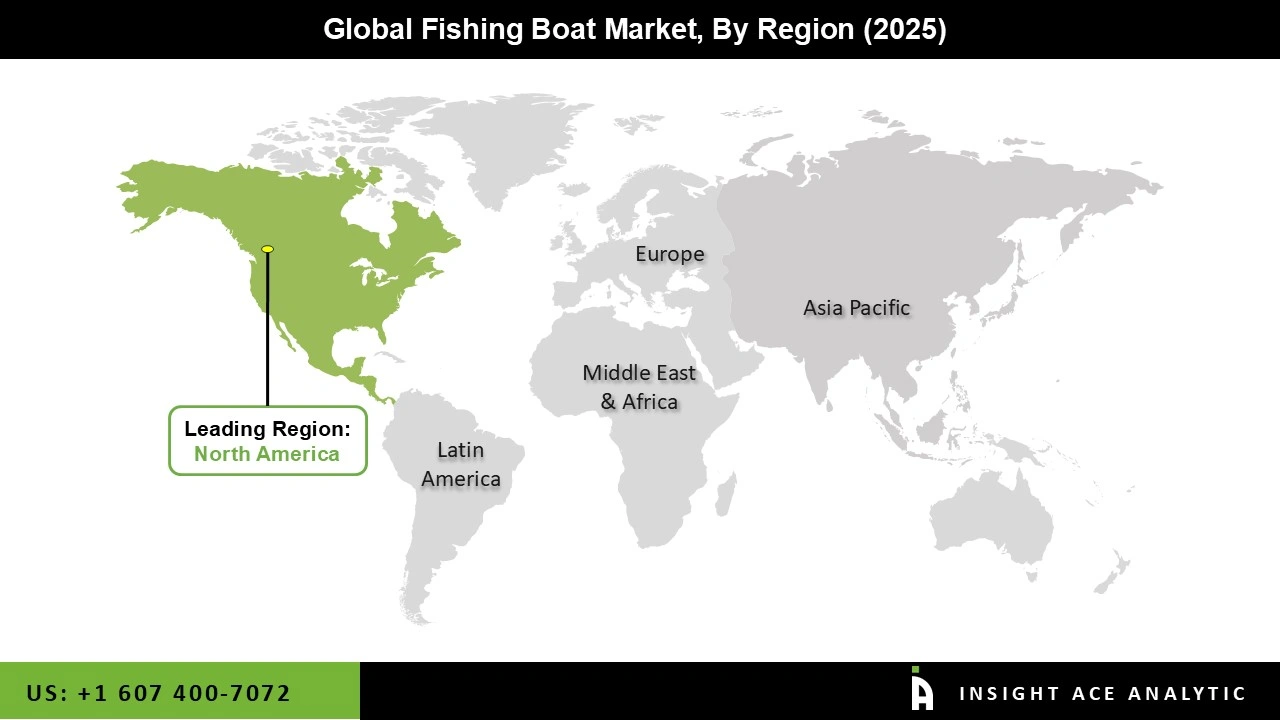
High boat ownership, well-developed marinas, and the availability of boat financing and maintenance services help the market grow. Additionally, leading boat makers, outboard engine suppliers, and marine equipment companies encourage ongoing product innovation and a wide range of products. The popularity of organized sport fishing tournaments, the rising demand for advanced fishing boats, and solid support for aftermarket services strengthen North America's position in the global recreational fishing boats market.
Key Development
In July 2024, KingFisher Boats launched the 3025 XRS and 2725 XRS Offshore Series, featuring an extended roof design, increased cabin headroom, KingDeck flooring, upgraded interiors, and integrated Garmin navigation and marine camera technology to enhance performance, comfort, and offshore capability.
Fishing Boat Market Report Scope :
| Report Attribute | Specifications |
| Market size value in 2025 | USD 470.14 Bn |
| Revenue forecast in 2035 | USD 1,014.42 Bn |
| Growth Rate CAGR | CAGR of 8.2% from 2026 to 2035 |
| Quantitative Units | Representation of revenue in US$ Bn and CAGR from 2026 to 2035 |
| Historic Year | 2022 to 2025 |
| Forecast Year | 2026-2035 |
| Report Coverage | The forecast of revenue, the position of the company, the competitive market structure, growth prospects, and trends |
| Segments Covered | Boat Type, Boat Length, Hull Material, Outboard Engine Configuration, Power Output, Application, Water Type, End User, Distribution Channel and By Region |
| Regional Scope | North America; Europe; Asia Pacific; Latin America; Middle East & Africa |
| Country Scope | U.S.; Canada; U.K.; Germany; China; India; Japan; Brazil; Mexico; The UK; France; Italy; Spain; China; Japan; India; South Korea; Southeast Asia; South Korea; Southeast Asia |
| Competitive Landscape | Smoker Craft Inc., Duckworth Boats, Hewescraft BoatsThunder Jet Boats, Wooldridge Boats, Raider Boats, KingFisher Boats, Osprey Boats, Silver Boats Ltd., Linder Aluminium Boats, Bar Crusher Boats, Makocraft, Formosa Marine |
| Customization Scope | Free customization report with the procurement of the report, Modifications to the regional and segment scope. Geographic competitive landscape. |
| Pricing and Available Payment Methods | Explore pricing alternatives that are customized to your particular study requirements. |
Segmentations of Fishing Boat Market:
Fishing Boat Market by Boat Type -
- Center Console Fishing Boats
- Bass Boats
- Multi-Species Fishing Boats
- Aluminum Fishing Boats
- Skiff Boats
- Jon Boats
- Walkaround Fishing Boats
- Bay Boats
- Flats Boats
- Cuddy Cabin Boats
- Ski-and-Fish Boats
- Others
Fishing Boat Market by Boat Length -
- 4–5 m Boats
- 5–6 m Boats
- 6–7 m Boats
- 7–8 m Boats
Fishing Boat Market by Hull Material -
- Aluminum Boats
- Fiberglass Boats
- Composite Boats
- Polyethylene Boats
- Others
Fishing Boat Market by Outboard Engine Configuration -
- Single Outboard Engine
- Below 50 HP
- 50–100 HP
- 100–150 HP
- Twin Outboard Engines
- 100–200 HP
- 200–300 HP
- High-Power Performance Outboards
- 300–450 HP
- Above 450 HP
Fishing Boat Market by Power Output (Outboard Boats) -
- Below 75 HP
- 75–150 HP
- 150–250 HP
- Above 250 HP
Fishing Boat Market by Application -
- Recreational Angling
- Sport Fishing
- Coastal Fishing
- Freshwater Fishing
- Family Leisure Fishing
- Others
Fishing Boat Market by Water Type -
- Freshwater
- Lakes
- Rivers
- Reservoirs
- Coastal/Nearshore Waters
Fishing Boat Market by End User-
- Individual Boat Owners
- Recreational Anglers
- Fishing Clubs
- Charter Fishing Operators (Small Boats)
- Rental/Tourism Operators
- Others
Fishing Boat Market by Distribution Channel -
- Direct Sales (OEM)
- Authorized Boat Dealers
- Marine Equipment Dealers
- Boat Show Sales
- Company-Owned Websites
- Others
- Aftermarket
- Independent Marine Dealers
- Boat Brokerage \& Resale Dealers
- Online Boat Marketplaces
- Marine Parts \& Accessories Retailers
- Service \& Repair Centers
Fishing Boat Market by Region-
- North America-
- The US
- Canada
- Europe-
- Germany
- The UK
- France
- Italy
- Spain
- Rest of Europe
- Asia-Pacific-
- China
- Japan
- India
- South Korea
- South East Asia
- Rest of Asia Pacific
- Latin America-
- Brazil
- Argentina
- Mexico
- Rest of Latin America
- Middle East and Africa-
- GCC Countries
- South Africa
- Rest of Middle East and Africa
Research Design and Approach
This study employed a multi-step, mixed-method research approach that integrates:
- Secondary research
- Primary research
- Data triangulation
- Hybrid top-down and bottom-up modelling
- Forecasting and scenario analysis
This approach ensures a balanced and validated understanding of both macro- and micro-level market factors influencing the market.
Secondary Research
Secondary research for this study involved the collection, review, and analysis of publicly available and paid data sources to build the initial fact base, understand historical market behaviour, identify data gaps, and refine the hypotheses for primary research.
Sources Consulted
Secondary data for the market study was gathered from multiple credible sources, including:
- Government databases, regulatory bodies, and public institutions
- International organizations (WHO, OECD, IMF, World Bank, etc.)
- Commercial and paid databases
- Industry associations, trade publications, and technical journals
- Company annual reports, investor presentations, press releases, and SEC filings
- Academic research papers, patents, and scientific literature
- Previous market research publications and syndicated reports
These sources were used to compile historical data, market volumes/prices, industry trends, technological developments, and competitive insights.

Primary Research
Primary research was conducted to validate secondary data, understand real-time market dynamics, capture price points and adoption trends, and verify the assumptions used in the market modelling.
Stakeholders Interviewed
Primary interviews for this study involved:
- Manufacturers and suppliers in the market value chain
- Distributors, channel partners, and integrators
- End-users / customers (e.g., hospitals, labs, enterprises, consumers, etc., depending on the market)
- Industry experts, technology specialists, consultants, and regulatory professionals
- Senior executives (CEOs, CTOs, VPs, Directors) and product managers
Interview Process
Interviews were conducted via:
- Structured and semi-structured questionnaires
- Telephonic and video interactions
- Email correspondences
- Expert consultation sessions
Primary insights were incorporated into demand modelling, pricing analysis, technology evaluation, and market share estimation.
Data Processing, Normalization, and Validation
All collected data were processed and normalized to ensure consistency and comparability across regions and time frames.
The data validation process included:
- Standardization of units (currency conversions, volume units, inflation adjustments)
- Cross-verification of data points across multiple secondary sources
- Normalization of inconsistent datasets
- Identification and resolution of data gaps
- Outlier detection and removal through algorithmic and manual checks
- Plausibility and coherence checks across segments and geographies
This ensured that the dataset used for modelling was clean, robust, and reliable.
Market Size Estimation and Data Triangulation
Bottom-Up Approach
The bottom-up approach involved aggregating segment-level data, such as:
- Company revenues
- Product-level sales
- Installed base/usage volumes
- Adoption and penetration rates
- Pricing analysis
This method was primarily used when detailed micro-level market data were available.

Top-Down Approach
The top-down approach used macro-level indicators:
- Parent market benchmarks
- Global/regional industry trends
- Economic indicators (GDP, demographics, spending patterns)
- Penetration and usage ratios
This approach was used for segments where granular data were limited or inconsistent.
Hybrid Triangulation Approach
To ensure accuracy, a triangulated hybrid model was used. This included:
- Reconciling top-down and bottom-up estimates
- Cross-checking revenues, volumes, and pricing assumptions
- Incorporating expert insights to validate segment splits and adoption rates
This multi-angle validation yielded the final market size.
Forecasting Framework and Scenario Modelling
Market forecasts were developed using a combination of time-series modelling, adoption curve analysis, and driver-based forecasting tools.
Forecasting Methods
- Time-series modelling
- S-curve and diffusion models (for emerging technologies)
- Driver-based forecasting (GDP, disposable income, adoption rates, regulatory changes)
- Price elasticity models
- Market maturity and lifecycle-based projections
Scenario Analysis
Given inherent uncertainties, three scenarios were constructed:
- Base-Case Scenario: Expected trajectory under current conditions
- Optimistic Scenario: High adoption, favourable regulation, strong economic tailwinds
- Conservative Scenario: Slow adoption, regulatory delays, economic constraints
Sensitivity testing was conducted on key variables, including pricing, demand elasticity, and regional adoption.
Request Customization
Add countries, segments, company profiles, or extend forecast — free 10% customization with purchase.
Customize This Report →Enquire Before Buying
Speak with our analyst team about scope, methodology, pricing, or deliverable formats.
Enquire Now →Frequently Asked Questions
Fishing Boat Market Size is valued at USD 470.14 Bn in 2025 and is predicted to reach USD 1,014.42 Bn by the year 2035
The Fishing Boat Market is expected to grow at a 8.2% CAGR during the forecast period for 2026 to 2035
Smoker Craft Inc., Duckworth Boats, Hewescraft BoatsThunder Jet Boats, Wooldridge Boats, Raider Boats, KingFisher Boats, Osprey Boats, Silver Boats Ltd., Linder Aluminium Boats, Bar Crusher Boats, Makocraft, Formosa Marine and Others.
Fishing Boat Market is segmented into Boat Type, Boat Length, Hull Material, Outboard Engine Configuration, Power Output, Application, Water Type, End User, Distribution Channel and Other.
North America region is leading the Fishing Boat Market.