Physical AI in Automotive Market Size, Scope, Revenue Report 2026 to 2035
What is Physical AI in Automotive Market Size?
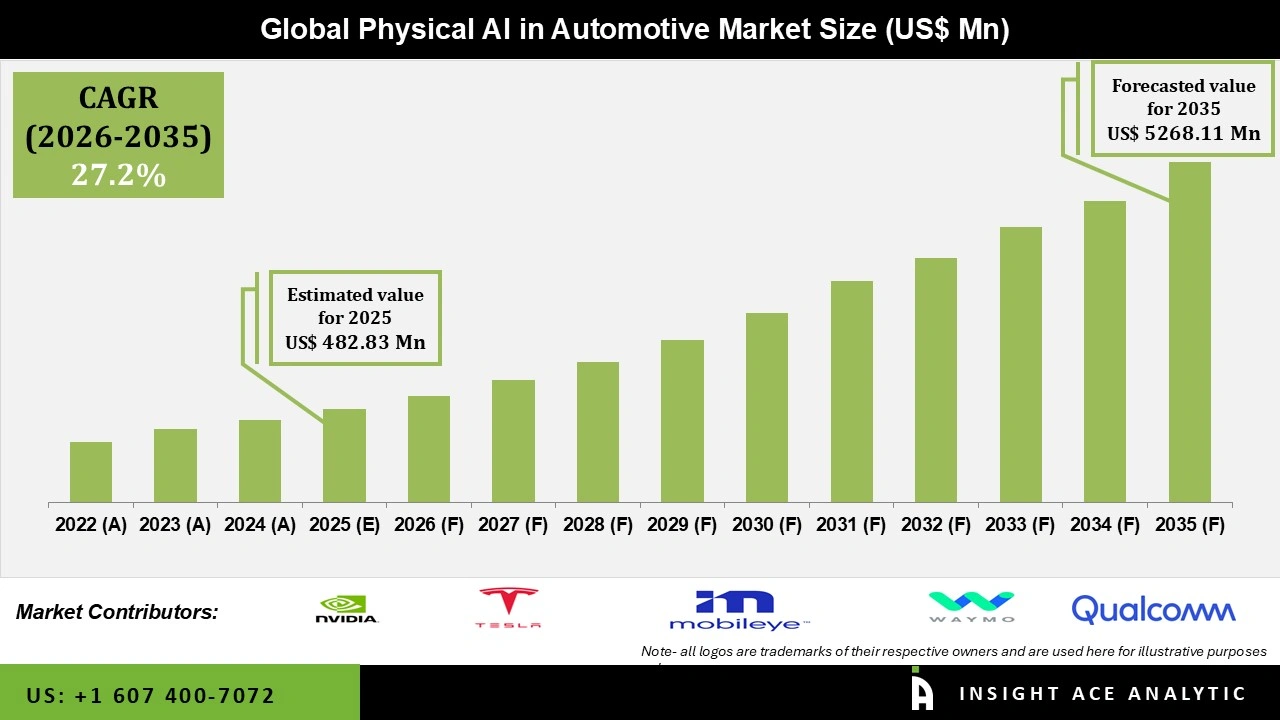
Global Physical AI in Automotive Market Size is valued at USD 482.83 Mn in 2025 and is predicted to reach USD 5,268.11 Mn by the year 2035 at a 27.2% CAGR during the forecast period for 2026 to 2035.
Physical AI in Automotive Market Size, Share & Trends Analysis By Component (Hardware, Software, Services) By Technology (Computer Vision, Speech / NLP, Gesture / Movement Recognition, Reinforcement Learning & Control Systems, Others (multi-modal AI, biomimetic robotics)) By Deployment (On-Vehicle (Edge AI), Cloud-Based, Hybrid) By End User (Automotive OEMs, Tier-1 Suppliers, Automotive Manufacturing Plants, Mobility-as-a-Service (MaaS) Providers, Others), and Segment Forecasts, 2026 to 2035.
Physical AI in Automotive refers to the implementation of Artificial Intelligence in vehicles and automotive production systems so that machines have the ability to perceive their environment, analyze the situation, make a decision, and perform physical actions. Such solutions combine AI algorithms with camera, LiDAR, radar, ultrasonic sensors, vehicle control, edge computing, robotics, and other hardware elements. Unlike conventional software AI, Physical AI is associated with the physical environment and needs to adapt to changes in the road, traffic, vehicle, and manufacturing conditions instantly. The market for Physical AI in automotive is growing, as carmakers are evolving from conventional driver assistance and rule-based automation solutions to more adaptive ones. Autonomous driving is the most obvious use case of Physical AI as it requires that cars continuously perceive roads, pedestrians, other vehicles, traffic signs, weather conditions, and any other unpredictable factors. Cognizant notes that Physical AI can become an essential part of ADAS and development of self-driving vehicles as cars need to make decisions instantly in critical situations.
The market of Physical AI in automotive is growing beyond the car itself. Car manufacturers are increasingly applying Physical AI not only in cars but also in the factories, using intelligent robots, automated inspections, adaptive assembly lines, and material handling solutions that require AI. Thus, the opportunities of the market grow as the same technologies of AI, simulation, sensors, and robotics can be applied both for intelligent cars and factories. Moreover, there is a tendency of convergence between automotive and robotics technologies.
Competitive Landscape
Which are the Leading Players in Physical AI in Automotive Market?
- NVIDIA Corporation
- Tesla, Inc.
- Hyundai Motor Group
- Toyota Motor Corporation
- Mercedes-Benz Group AG
- BMW Group
- Volkswagen Group
- General Motors
- Ford Motor Company
- Waymo
- Mobileye Global Inc.
- Qualcomm Technologies, Inc.
- Robert Bosch GmbH
- Continental AG
- ZF Friedrichshafen AG
- Aptiv PLC
- BYD Company Limited
- XPeng Inc.
- Horizon Robotics
- Arm Holdings plc
Market Dynamics
Driver
Growing Adoption of Autonomous Driving and Advanced Driver Assistance Systems
Growing ADAS and autonomous driving applications are expected to be among the most significant drivers for the Physical AI in automotive market. Modern vehicles require the ability to analyze vast amounts of data provided by sensors in extremely small time frames. Physical AI allows performing these operations via computer vision, machine learning, sensor fusion, edge computing, and vehicle control. The shift is from the initial assistance of a driver to the solution that is able to handle more and more complicated situations. The NVIDIA automotive platform, for instance, is being created based on the requirements of advanced autonomous driving and robotaxi applications. The company considers autonomous vehicles to be the first major area of using Physical AI and is creating the platform for Level 4 autonomy development. AI foundation model development is also having an effect on autonomous driving solutions. In July 2026, the China branch of the VW Group for automated driving CARIZON deepened cooperation with Horizon Robotics in order to use Horizon's AI foundation model for developing advanced self-driving vehicles in China.
Restrain/Challenge
High Development Costs and Safety Requirements
The key problem associated with the global Physical AI in automotive industry is the cost of creating reliable physical AI. For instance, an autonomous car requires sophisticated hardware, including several sensors, massive training datasets, simulation, high definition map or equivalent environment perception, validation. High requirements for safety raise the demands of automotive Physical AI comparing to conventional AI applications. The autonomous car should be capable of making predictable decisions based on the changes in road situation, restrictions of the sensors, unusual traffic conditions, and unpredictable actions of people.
Another challenge related to the physical implementation of AI is connected with edge computing. Physical AI models have certain limits concerning the power consumption, latency, and computing capabilities. According to the Arm corporation, Physical AI systems have the demand for the deterministic behavior, functional safety, security, and the long lifecycle of products. It makes the compute architecture especially relevant. Furthermore, high costs for the development and validation of autonomous systems are one more constraint of commercialization of the technology. The manufacturer has to make a compromise between the advantages of greater level of autonomy and the expenses for the sensors, processors, software, validation, and vehicle-level integration.
Autonomous Driving Segment is Expected to Drive the Physical AI in Automotive Market
It is predicted that autonomous driving will continue to be one of the most critical use cases for Physical AI since vehicles should constantly perceive, reason, plan and control their physical behavior based on real-time information coming from cameras, radars, LiDARs, GPS and other sensors. The growing adoption of level 3 and level 4 vehicles is driving this segment. In case of level 3 cars, automation is possible only under certain conditions and a driver should intervene when needed, whereas level 4 systems are fully automated without the need for a driver within defined operational design domains.
As part of its strategy until 2026 in the automotive industry, NVIDIA puts an emphasis on autonomous cars. Specifically, DRIVE Hyperion platform is created by the company for the development of such vehicles. Moreover, the enhanced cooperation between Volkswagen and Horizon Robotics in China follows the same trend since the companies collaborate to develop level 3 and level 4 vehicles.
Computer Vision and Sensor Fusion Segment is Growing at a Significant Rate in the Physical AI in Automotive Market
Computer vision and sensor fusion are key components due to the fact that Physical AI requires to have an accurate representation of the environment before proceeding to physical activities. Cameras will give the visual input, and radar and LiDAR can also give other inputs such as distance, speed, and location of objects. Sensor fusion will allow the car to integrate information from multiple sensors and not rely on one single source of information. This is especially helpful in challenging situations like rainy weather, nighttime, glare, roadwork, and dense urban areas.
Multimodal and foundation AI models are being developed to help cars better interpret challenging environments. There has been an introduction by NVIDIA of its Halos safety evaluation platform for automotive developers, which will include processes ranging from data collection and neural simulation to safety KPI analysis at different autonomy levels, including L2 active safety and L4 full autonomy.
Why North America Led the Physical AI in Automotive Market?
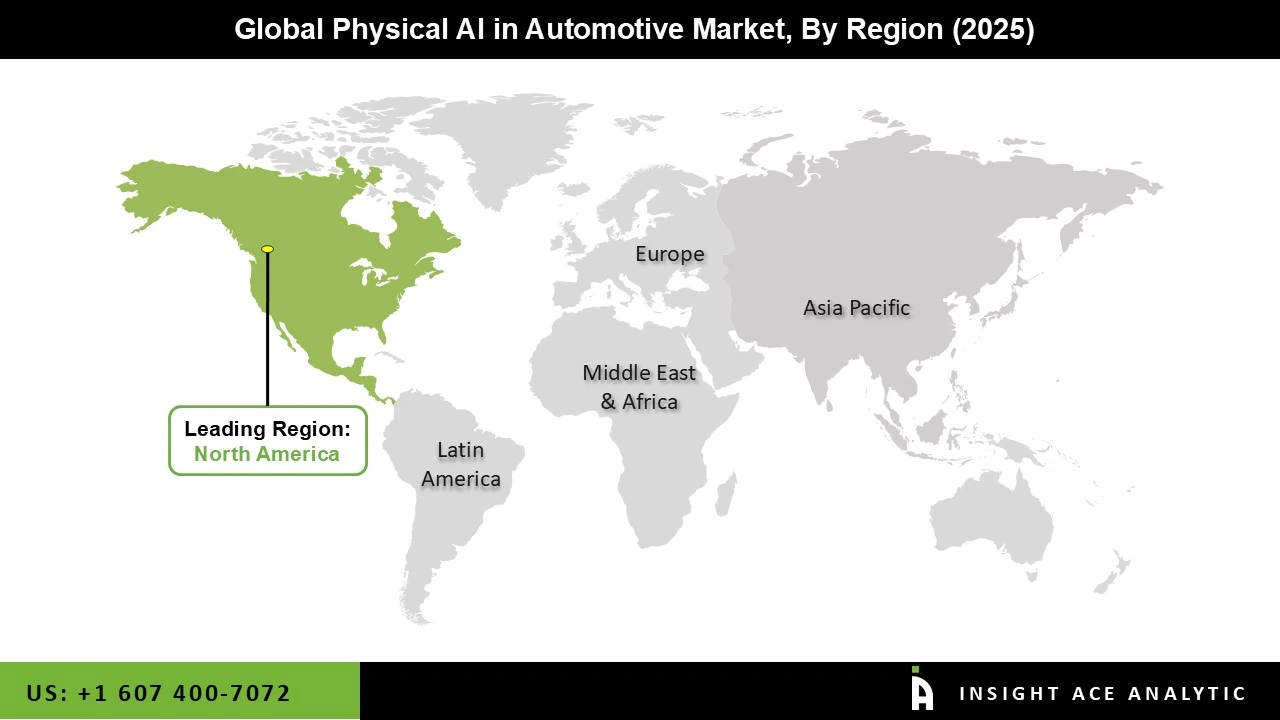
North America is set to remain a significant region in the Physical AI in automotive market owing to the robust ecosystem of AI, semiconductor industry, development of autonomous cars, technology and automotive manufacturers in the region. The region has become an important center for developing robotaxis and AI-based vehicle platforms. The United States will benefit due to the presence of NVIDIA, Tesla, Waymo, Qualcomm, Mobileye, General Motors, Ford, and a plethora of autonomous driving startups in the country. The combination of AI software, computing power, sensors, and automotive engineering is conducive for Physical AI in the country.
Waymo and other autonomous driving startups have been working to develop robotaxis from mere research to mobility platforms. On the other hand, NVIDIA is building a physical AI ecosystem for automobiles via autonomous driving platforms, simulation tools, safety technologies, and AI development tools.
Asia Pacific is anticipated to witness high growth rates during the forecast period. Countries like China, Japan, and South Korea are major players in automotive manufacturing and have strong investments in AI, robotics, semiconductors, and electric vehicles. While China is an important player in advanced driver assistance and autonomous driving, Japan and South Korea have made heavy investments in robotics and intelligent manufacturing.
Key Development
• July 2026: The Physical AI vision was announced by Hyundai Motor Group at the San Francisco AI Summit. The company mentioned that it has plans to shift from conventional automotive manufacturing towards autonomous driving, robotics, and AI-driven factories. Collaboration with NVIDIA for Robot Reference Platform with Physical AI features was also announced by the company.
Physical AI in Automotive Market Report Scope:
| Report Attribute | Specifications |
| Market size value in 2025 | USD 482.83 Mn |
| Revenue forecast in 2035 | USD 5,268.11 Mn |
| Growth Rate CAGR | CAGR of 27.2% from 2026 to 2035 |
| Quantitative Units | Representation of revenue in US$ Mn and CAGR from 2026 to 2035 |
| Historic Year | 2022 to 2025 |
| Forecast Year | 2026-2035 |
| Report Coverage | The forecast of revenue, the position of the company, the competitive market structure, growth prospects, and trends |
| Segments Covered | Component, Technology, Deployment, End User, and By Region |
| Regional Scope | North America; Europe; Asia Pacific; Latin America; Middle East & Africa |
| Country Scope | U.S.; Canada; U.K.; Germany; China; India; Japan; Brazil; Mexico; France; Italy; Spain; South Korea; Southeast Asia |
| Competitive Landscape | NVIDIA Corporation, Tesla, Hyundai Motor Group, Toyota Motor Corporation, Mercedes-Benz Group, BMW Group, Volkswagen Group, General Motors, Ford Motor Company, Waymo, Mobileye, Qualcomm Technologies, Bosch, Continental, ZF, Aptiv, BYD, XPeng, Horizon Robotics, and Arm Holdings. |
| Customization Scope | Free customization report with the procurement of the report, Modifications to the regional and segment scope. Geographic competitive landscape. |
| Pricing and Available Payment Methods | Explore pricing alternatives that are customized to your particular study requirements. |
Segmentations Physical AI in Automotive Market:
Physical AI in Automotive Market by Component -
- Hardware
- Software
- Services
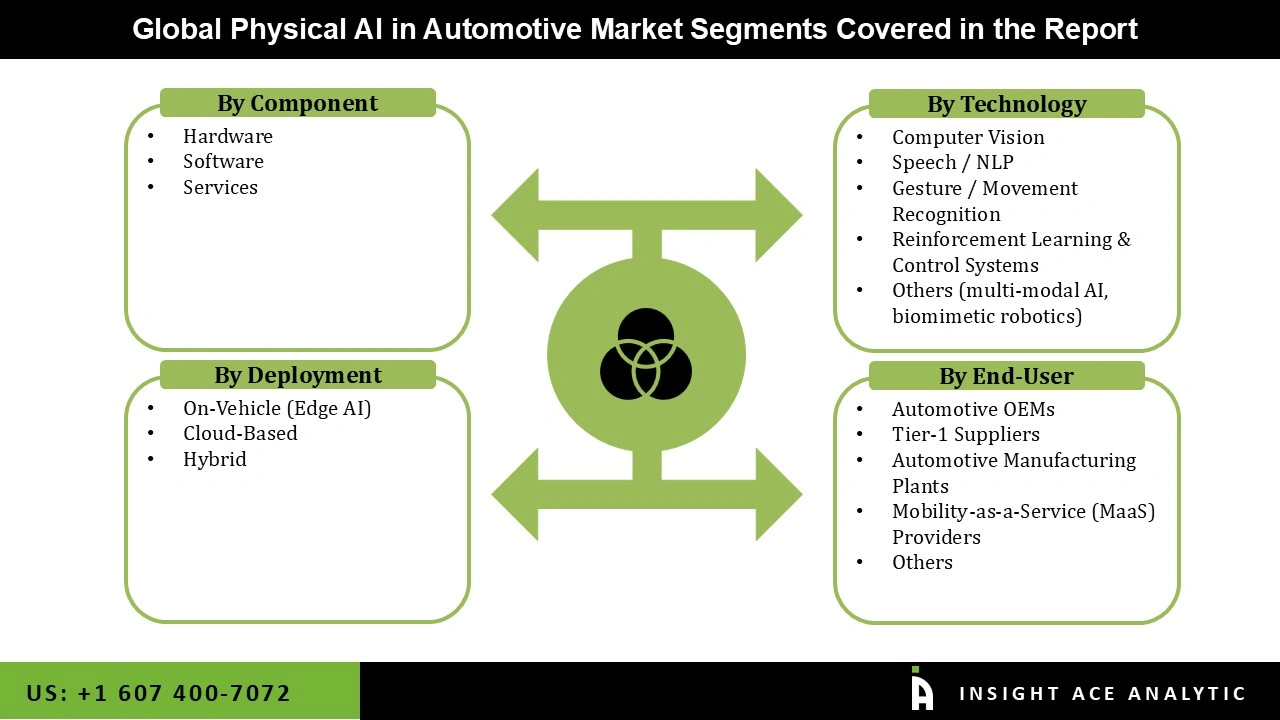
Physical AI in Automotive Market by Technology -
- Computer Vision
- Speech / NLP
- Gesture / Movement Recognition
- Reinforcement Learning & Control Systems
- Others (multi-modal AI, biomimetic robotics)
Physical AI in Automotive Market by Deployment -
- On-Vehicle (Edge AI)
- Cloud-Based
- Hybrid
Physical AI in Automotive Market by End User -
- Automotive OEMs
- Tier-1 Suppliers
- Automotive Manufacturing Plants
- Mobility-as-a-Service (MaaS) Providers
- Others
Physical AI in Automotive Market by Region-
- North America-
- The US
- Canada
- Europe-
- Germany
- The UK
- France
- Italy
- Spain
- Rest of Europe
- Asia-Pacific-
- China
- Japan
- India
- South Korea
- South East Asia
- Rest of Asia Pacific
- Latin America-
- Brazil
- Argentina
- Mexico
- Rest of Latin America
- Middle East and Africa-
- GCC Countries
- South Africa
- Rest of Middle East and Africa
Research Design and Approach
This study employed a multi-step, mixed-method research approach that integrates:
- Secondary research
- Primary research
- Data triangulation
- Hybrid top-down and bottom-up modelling
- Forecasting and scenario analysis
This approach ensures a balanced and validated understanding of both macro- and micro-level market factors influencing the market.
Secondary Research
Secondary research for this study involved the collection, review, and analysis of publicly available and paid data sources to build the initial fact base, understand historical market behaviour, identify data gaps, and refine the hypotheses for primary research.
Sources Consulted
Secondary data for the market study was gathered from multiple credible sources, including:
- Government databases, regulatory bodies, and public institutions
- International organizations (WHO, OECD, IMF, World Bank, etc.)
- Commercial and paid databases
- Industry associations, trade publications, and technical journals
- Company annual reports, investor presentations, press releases, and SEC filings
- Academic research papers, patents, and scientific literature
- Previous market research publications and syndicated reports
These sources were used to compile historical data, market volumes/prices, industry trends, technological developments, and competitive insights.

Primary Research
Primary research was conducted to validate secondary data, understand real-time market dynamics, capture price points and adoption trends, and verify the assumptions used in the market modelling.
Stakeholders Interviewed
Primary interviews for this study involved:
- Manufacturers and suppliers in the market value chain
- Distributors, channel partners, and integrators
- End-users / customers (e.g., hospitals, labs, enterprises, consumers, etc., depending on the market)
- Industry experts, technology specialists, consultants, and regulatory professionals
- Senior executives (CEOs, CTOs, VPs, Directors) and product managers
Interview Process
Interviews were conducted via:
- Structured and semi-structured questionnaires
- Telephonic and video interactions
- Email correspondences
- Expert consultation sessions
Primary insights were incorporated into demand modelling, pricing analysis, technology evaluation, and market share estimation.
Data Processing, Normalization, and Validation
All collected data were processed and normalized to ensure consistency and comparability across regions and time frames.
The data validation process included:
- Standardization of units (currency conversions, volume units, inflation adjustments)
- Cross-verification of data points across multiple secondary sources
- Normalization of inconsistent datasets
- Identification and resolution of data gaps
- Outlier detection and removal through algorithmic and manual checks
- Plausibility and coherence checks across segments and geographies
This ensured that the dataset used for modelling was clean, robust, and reliable.
Market Size Estimation and Data Triangulation
Bottom-Up Approach
The bottom-up approach involved aggregating segment-level data, such as:
- Company revenues
- Product-level sales
- Installed base/usage volumes
- Adoption and penetration rates
- Pricing analysis
This method was primarily used when detailed micro-level market data were available.

Top-Down Approach
The top-down approach used macro-level indicators:
- Parent market benchmarks
- Global/regional industry trends
- Economic indicators (GDP, demographics, spending patterns)
- Penetration and usage ratios
This approach was used for segments where granular data were limited or inconsistent.
Hybrid Triangulation Approach
To ensure accuracy, a triangulated hybrid model was used. This included:
- Reconciling top-down and bottom-up estimates
- Cross-checking revenues, volumes, and pricing assumptions
- Incorporating expert insights to validate segment splits and adoption rates
This multi-angle validation yielded the final market size.
Forecasting Framework and Scenario Modelling
Market forecasts were developed using a combination of time-series modelling, adoption curve analysis, and driver-based forecasting tools.
Forecasting Methods
- Time-series modelling
- S-curve and diffusion models (for emerging technologies)
- Driver-based forecasting (GDP, disposable income, adoption rates, regulatory changes)
- Price elasticity models
- Market maturity and lifecycle-based projections
Scenario Analysis
Given inherent uncertainties, three scenarios were constructed:
- Base-Case Scenario: Expected trajectory under current conditions
- Optimistic Scenario: High adoption, favourable regulation, strong economic tailwinds
- Conservative Scenario: Slow adoption, regulatory delays, economic constraints
Sensitivity testing was conducted on key variables, including pricing, demand elasticity, and regional adoption.
Request Customization
Add countries, segments, company profiles, or extend forecast — free 10% customization with purchase.
Customize This Report →Enquire Before Buying
Speak with our analyst team about scope, methodology, pricing, or deliverable formats.
Enquire Now →Frequently Asked Questions
Physical AI in Automotive Market Size is valued at USD 482.83 Mn in 2025 and is predicted to reach USD 5,268.11 Mn by the year 2035
The Physical AI in Automotive Market is expected to grow at a 27.2% CAGR during the forecast period for 2026 to 2035
NVIDIA Corporation, Tesla, Hyundai Motor Group, Toyota Motor Corporation, Mercedes-Benz Group, BMW Group, Volkswagen Group, General Motors, Ford Motor Company, Waymo, Mobileye, Qualcomm Technologies, Bosch, Continental, ZF, Aptiv, BYD, XPeng, Horizon Robotics, Arm Holdings and Others.
Physical AI in Automotive Market is segmented into Component, Technology, Deployment, End User and Other.
North America region is leading the Physical AI in Automotive Market.