Pet At-Home Diagnostic Tests Market Size, Share and Forecast 2025 to 2034
Global Pet At-Home Diagnostic Tests Market Size is valued at USD 85.3 Mn in 2025 and is predicted to reach USD 135.7 Mn by the year 2034 at a 5.3% CAGR during the forecast period for 2025-2034.
Pet At-Home Diagnostic Tests Market Size, Share & Trends Analysis Distribution by Animal Type (Dogs, Cats, and Others), Sample Type (Blood, Fecal, Urine, and Others), Application (Infectious Diseases, Parasitic Diseases, Fertility Testing, Genetic Conditions, and Allergies, Chronic and Metabolic Diseases, Others), Distribution Channel (Veterinary Hospitals / Clinics, Retail Pharmacies, and E-Commerce), and Segment Forecasts, 2025-2034

Pet at-home diagnostic tests are user-friendly kits that allow owners to monitor their pets' health conveniently from home, using simple samples like urine, feces, saliva, or hair. These kits detect common issues such as urinary tract infections, parasites (e.g., giardia, worms), kidney/liver function, diabetes (glucose monitoring), allergies, and genetic conditions. Results are either instant (dipstick-style) or obtained by mailing samples to a lab for professional analysis. Popular examples include urine test strips for UTIs/kidney problems, fecal tests for parasites, and DNA kits for breed/hereditary risks. The market is growing as owners prioritize preventive care over reactive vet visits.
The pet at-home diagnostic tests market is expanding as a result of the quick advancements in biotechnology, the usage of telehealth, and user-focused designs that have improved the reliability and convenience of home testing. Additionally, major competitors are making strategic mergers and acquisitions to assist the expansion of the at-home diagnostic test industry. Businesses can increase their market position, expand their product lines, and gain access to new technology solutions through this acquisition, which will ultimately accelerate growth in the pet at-home diagnostic tests industry. Furthermore, the pet at-home diagnostic tests market is growing at a significant rate due to the rising focus on pet humanization trends and the growth of e-commerce platforms that allow direct-to-consumer test kit delivery.
However, the widespread professional acceptability may be hampered by inconsistent test accuracy across product categories and a lack of veterinary control for result interpretation. This will limit the pet at-home diagnostic tests market growth. In addition, major trends in the pet at-home diagnostic tests market is the increasing smartphone connectivity in developed markets, particularly the USA and Europe, where consumers are willing to invest in connected diagnostic devices that provide automated result interpretation, cloud-based health tracking, and integrated telemedicine consultation capabilities.
Moreover, subscription-based testing services, which are moving toward recurring revenue models with automated test kit delivery and veterinary consultation packages, provide easy access to ongoing health monitoring that optimizes medication adherence and preventative care compliance. Thus, these factors are anticipated to boost the Pet At-Home Diagnostic Tests market growth over the forecast period.
Competitive Landscape
Which are the Leading Players in Pet At-Home Diagnostic Tests Market?
- Zoetis
- Affordable Pet Labs
- TouchBio Australia
- Vet Diagnostix
- Ring Biotechnology
- Targetvet
- Vitrosens Biotechnology
- Diagnostic Depot
- Forte Healthcare
- Vetic
Market Dynamics
Driver
Global Increase in Pet Ownership
The pet at-home diagnostic tests market has been greatly impacted by the global increase in pet ownership. As the number of individuals with pets has increased, care practices have changed as owners now give their pets the same amount of care that they do their family members. People's perspectives on pets have changed, which has improved knowledge of their general wellbeing and health requirements. Pet owners are now more accountable for keeping an eye on the health of their animals using easy testing methods that do not require trips to the vet. The testing techniques offered by home diagnostic kits benefit pet owners who require simple treatments to reduce anxiety during veterinary appointments, particularly for elderly or anxious animals. With the help of these at-home diagnostic tools, pet owners can detect health problems early on, resulting in quick treatment and better recovery results. Since pet owners prefer prevention and wellness through easily available at-home diagnostic options, the pet at-home diagnostic tests market keeps expanding.
Restrain/Challenge
Growing Concerns Regarding Accuracy and Sample Collection
Concerns about accuracy and proper sample collection/interpretation by pet owners are a major barrier to the pet at-home diagnostic test market, which can lower customer confidence and discourage repeat purchases. Owners must gather small, time-sensitive samples (urine, stool, saliva, swabs, or tiny blood droplets) for many at-home tests and adhere to exact handling procedures (right volume, avoiding contamination, correct storage temperature, prompt mailing). Results may be false-positive or false-negative if a sample is contaminated, diluted, or obtained at the incorrect time. This could cause owners to worry unnecessarily and see the veterinarian, or, more concerning, delay treatment when a real condition is present.
Dogs Segment is Expected to Drive the Pet At-Home Diagnostic Tests Market
The dogs category held the largest share in the Pet At-Home Diagnostic Tests market in 2024. Dogs are susceptible to a variety of illnesses, including obesity, diabetes, cancer, infectious diseases (including parvovirus and distemper), and chronic problems that need to be monitored frequently and diagnosed early. Compared to other pets, dogs frequently exhibit more obvious clinical symptoms of sickness, allowing for faster diagnostic intervention. For instance, dogs are more likely to exhibit symptoms like lethargy, vomiting, or limping, which can prompt early at-home testing prior to a clinic visit. Urinalysis strips, glucose monitors, and dog-specific fecal diagnostic kits are now in more demand.
Blood Segment is Growing at the Highest Rate in the Pet At-Home Diagnostic Tests Market
In 2025, the blood category dominated the Pet At-Home Diagnostic Tests market because of its excellent accuracy, diagnostic versatility, and capacity to identify a wide spectrum of serious health issues in both dogs and cats. Blood samples are crucial for identifying a wide range of illnesses that cannot be correctly identified using other sample types because they offer extensive diagnostic information. Capillary blood collection at home is becoming more practical due to recent developments. Small samples can now be collected by pet owners using lancets or other collection tools that come with at-home kits. These samples can be sent to a lab or examined by the reader at home. For instance, Basepaws' forthcoming blood-based biomarker tests emphasize the growing use of blood diagnostics by screening for early signs of kidney illness and cardiovascular problems.
Why North America Led the Pet At-Home Diagnostic Tests Market?
The Pet At-Home Diagnostic Tests market was dominated by the North America region in 2025 because of the sophisticated infrastructure for veterinary care and the strong culture of pet ownership. This region's pet owners actively take care of their animals by employing practical preventive care techniques, which are becoming more and more common.
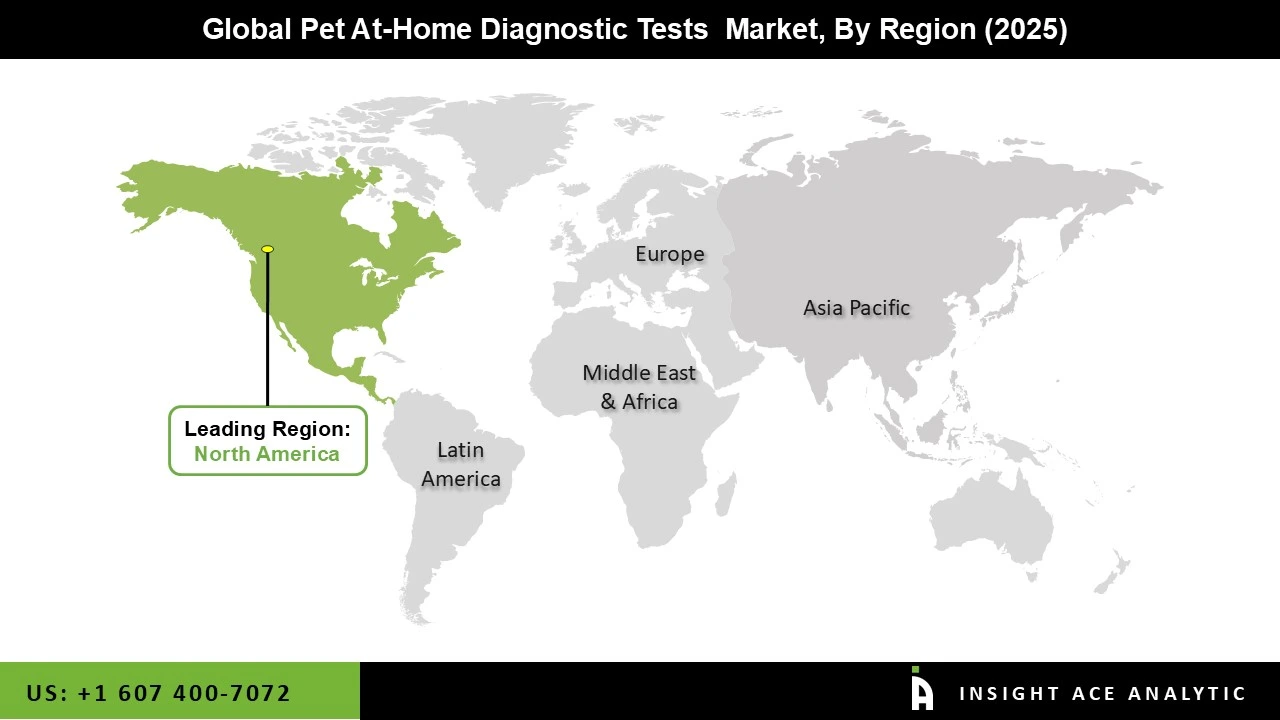
Additionally, a robust e-commerce system, a wide range of telemedicine options, and advanced technological diagnostic kits have all contributed to the pet at-home diagnostic tests market's rapid expansion. The use of at-home testing by veterinarians in North America is becoming more and more popular among pet owners as a means of monitoring pets and detecting illnesses early. Furthermore, the product innovation and availability are propelled throughout the region by the presence of key industry leaders and continuous financing for research.
Key Development :
- In May 2024: Zoetis Launched Vetscan Imagyst® with Fecal AI, a global platform expansion integrating at-home sample collection. The update allows pet owners to use a guided app to prepare and submit fecal samples via mail. An AI algorithm analyzes the imagery at a central lab, with digital results returned to both the owner and their veterinarian, bridging home testing with clinical oversight.
- August 2024: Affordable Pet Labs introduced cutting-edge at-home pet diagnostic services, such as simple DIY urine and fecal testing kits and professional in-home blood collection. In order to facilitate proactive health monitoring, these services are designed to lessen stress and increase accessibility for pet owners.
Pet At-Home Diagnostic Tests Market Report Scope :
| Report Attribute | Specifications |
| Market size value in 2025 | USD 85.3 Mn |
| Revenue forecast in 2034 | USD 135.7 Mn |
| Growth Rate CAGR | CAGR of 5.3% from 2025 to 2034 |
| Quantitative Units | Representation of revenue in US$ Bn and CAGR from 2025 to 2034 |
| Historic Year | 2021 to 2024 |
| Forecast Year | 2025-2034 |
| Report Coverage | The forecast of revenue, the position of the company, the competitive market structure, growth prospects, and trends |
| Segments Covered | Animal Type, Sample Type, Application, Distribution Channel, and By Region |
| Regional Scope | North America; Europe; Asia Pacific; Latin America; Middle East & Africa |
| Country Scope | U.S.; Canada; U.K.; Germany; China; India; Japan; Brazil; Mexico; The UK; France; Italy; Spain; China; Japan; India; South Korea; Southeast Asia; South Korea; Southeast Asia |
| Competitive Landscape | Zoetis, Affordable Pet Labs, TouchBio Australia, Vet Diagnostix, Ring Biotechnology, Targetvet, Vitrosens Biotechnology, Diagnostic Depot, Forte Healthcare, and Vetic |
| Customization Scope | Free customization report with the procurement of the report, Modifications to the regional and segment scope. Geographic competitive landscape. |
| Pricing and Available Payment Methods | Explore pricing alternatives that are customized to your particular study requirements. |
Segmentation of Pet At-Home Diagnostic Tests Market :
Pet At-Home Diagnostic Tests Market by Animal Type-
- Dogs
- Cats
- Others

Pet At-Home Diagnostic Tests Market by Sample Type-
- Blood
- Fecal
- Urine
- Others
Pet At-Home Diagnostic Tests Market by Application-
- Infectious Diseases
- Parasitic Diseases
- Fertility Testing
- Genetic Conditions, and Allergies
- Chronic and Metabolic Diseases
- Others
Pet At-Home Diagnostic Tests Market by Distribution Channel-
- Veterinary Hospitals / Clinics
- Retail Pharmacies
- E-Commerce
Pet At-Home Diagnostic Tests Market By Region-
- North America-
- The US
- Canada
- Europe-
- Germany
- The UK
- France
- Italy
- Spain
- Rest of Europe
- Asia-Pacific-
- China
- Japan
- India
- South Korea
- South East Asia
- Rest of Asia Pacific
- Latin America-
- Brazil
- Argentina
- Mexico
- Rest of Latin America
- Middle East & Africa-
- GCC Countries
- South Africa
- Rest of Middle East and Africa
Research Design and Approach
This study employed a multi-step, mixed-method research approach that integrates:
- Secondary research
- Primary research
- Data triangulation
- Hybrid top-down and bottom-up modelling
- Forecasting and scenario analysis
This approach ensures a balanced and validated understanding of both macro- and micro-level market factors influencing the market.
Secondary Research
Secondary research for this study involved the collection, review, and analysis of publicly available and paid data sources to build the initial fact base, understand historical market behaviour, identify data gaps, and refine the hypotheses for primary research.
Sources Consulted
Secondary data for the market study was gathered from multiple credible sources, including:
- Government databases, regulatory bodies, and public institutions
- International organizations (WHO, OECD, IMF, World Bank, etc.)
- Commercial and paid databases
- Industry associations, trade publications, and technical journals
- Company annual reports, investor presentations, press releases, and SEC filings
- Academic research papers, patents, and scientific literature
- Previous market research publications and syndicated reports
These sources were used to compile historical data, market volumes/prices, industry trends, technological developments, and competitive insights.

Primary Research
Primary research was conducted to validate secondary data, understand real-time market dynamics, capture price points and adoption trends, and verify the assumptions used in the market modelling.
Stakeholders Interviewed
Primary interviews for this study involved:
- Manufacturers and suppliers in the market value chain
- Distributors, channel partners, and integrators
- End-users / customers (e.g., hospitals, labs, enterprises, consumers, etc., depending on the market)
- Industry experts, technology specialists, consultants, and regulatory professionals
- Senior executives (CEOs, CTOs, VPs, Directors) and product managers
Interview Process
Interviews were conducted via:
- Structured and semi-structured questionnaires
- Telephonic and video interactions
- Email correspondences
- Expert consultation sessions
Primary insights were incorporated into demand modelling, pricing analysis, technology evaluation, and market share estimation.
Data Processing, Normalization, and Validation
All collected data were processed and normalized to ensure consistency and comparability across regions and time frames.
The data validation process included:
- Standardization of units (currency conversions, volume units, inflation adjustments)
- Cross-verification of data points across multiple secondary sources
- Normalization of inconsistent datasets
- Identification and resolution of data gaps
- Outlier detection and removal through algorithmic and manual checks
- Plausibility and coherence checks across segments and geographies
This ensured that the dataset used for modelling was clean, robust, and reliable.
Market Size Estimation and Data Triangulation
Bottom-Up Approach
The bottom-up approach involved aggregating segment-level data, such as:
- Company revenues
- Product-level sales
- Installed base/usage volumes
- Adoption and penetration rates
- Pricing analysis
This method was primarily used when detailed micro-level market data were available.

Top-Down Approach
The top-down approach used macro-level indicators:
- Parent market benchmarks
- Global/regional industry trends
- Economic indicators (GDP, demographics, spending patterns)
- Penetration and usage ratios
This approach was used for segments where granular data were limited or inconsistent.
Hybrid Triangulation Approach
To ensure accuracy, a triangulated hybrid model was used. This included:
- Reconciling top-down and bottom-up estimates
- Cross-checking revenues, volumes, and pricing assumptions
- Incorporating expert insights to validate segment splits and adoption rates
This multi-angle validation yielded the final market size.
Forecasting Framework and Scenario Modelling
Market forecasts were developed using a combination of time-series modelling, adoption curve analysis, and driver-based forecasting tools.
Forecasting Methods
- Time-series modelling
- S-curve and diffusion models (for emerging technologies)
- Driver-based forecasting (GDP, disposable income, adoption rates, regulatory changes)
- Price elasticity models
- Market maturity and lifecycle-based projections
Scenario Analysis
Given inherent uncertainties, three scenarios were constructed:
- Base-Case Scenario: Expected trajectory under current conditions
- Optimistic Scenario: High adoption, favourable regulation, strong economic tailwinds
- Conservative Scenario: Slow adoption, regulatory delays, economic constraints
Sensitivity testing was conducted on key variables, including pricing, demand elasticity, and regional adoption.
Request Customization
Add countries, segments, company profiles, or extend forecast — free 10% customization with purchase.
Customize This Report →Enquire Before Buying
Speak with our analyst team about scope, methodology, pricing, or deliverable formats.
Enquire Now →Frequently Asked Questions
Pet At-Home Diagnostic Tests Market Size is valued at USD 85.3 Mn in 2025 and is predicted to reach USD 135.7 Mn by the year 2034
Pet At-Home Diagnostic Tests Market is expected to grow at a 5.3% CAGR during the forecast period for 2025 to 2034.
Zoetis, Affordable Pet Labs, TouchBio Australia, Vet Diagnostix, Ring Biotechnology, Targetvet, Vitrosens Biotechnology, Diagnostic Depot, Forte Healthcare, and Vetic
Animal Type, Sample Type, Application, and Distribution Channel are the key segments of the Pet At-Home Diagnostic Tests Market.
North America region is leading the Pet At-Home Diagnostic Tests Market.